Best Applied Science Degree Programs
Compare 40+ accredited Applied Science programs at 30+ colleges, with net price after aid, graduation rates, earnings and debt from IPEDS and the U.S. College Scorecard.
A bachelor's degree in applied science builds on technical coursework instead of asking students to start over. The common credential is the Bachelor of Science in Applied Science, though the Bachelor of Applied Science (BAS) variant is built for transfer students holding an AAS, and several programs below accept up to 64 technical credits that a traditional B.S. would reject. Net price after aid across the schools ranked here runs from $1,807 to $28,699, and many can be completed fully online.
The tension is fit. BAS tracks assume a technical transcript and a working adult's schedule, while a B.S. in Applied Science at a research university often expects calculus-ready freshmen who have not yet settled on a specialization.
Key Points
- Applied science grads' median pay rose $12,700 to $17,700 by year five.
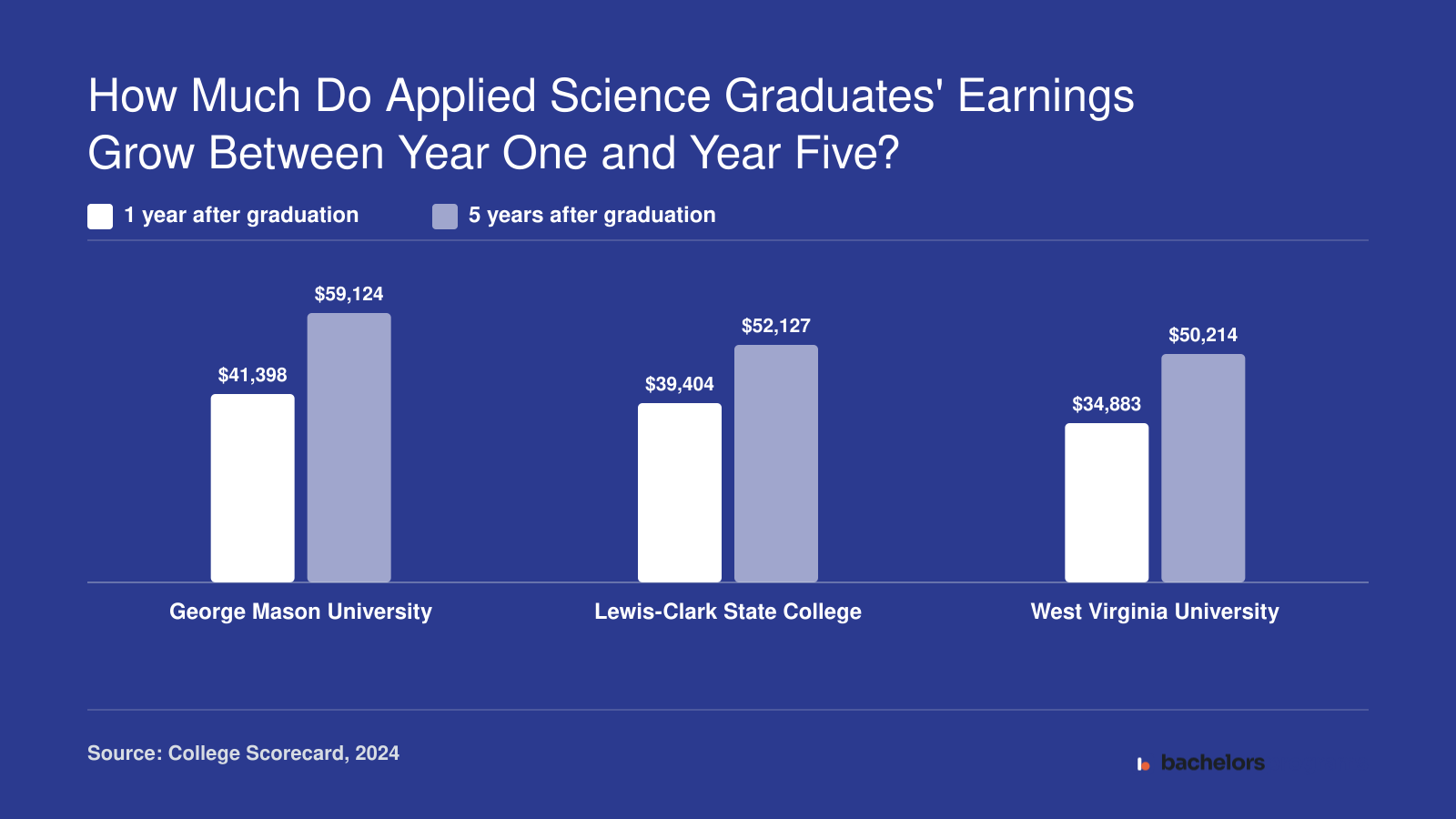
- George Mason graduates' earnings climbed about 43%, from $41,398 to $59,124.
- A BAS is built for students holding technical or workforce associate degrees.
Best Bachelor's Degree in Applied Science Schools Ranked
This list covers every format, so online, on-campus, and hybrid programs appear side by side and are judged on cost, outcomes, and flexibility. Each entry is a bachelor's degree in applied science or a closely related Bachelor of Science in Applied Science, with the average net price after aid, the school's graduation rate, and what the program is actually built for.
University of California-Los Angeles
#1Los Angeles, CA · $13,000/yr (est. net price)
Best for: Quantitative thinkers aiming at graduate math
UCLA's applied side runs through the mathematics department, where a Bachelor of Science in Mathematics/Applied Science pairs a full math core with work in another field. The school's graduation rate is 92.6%, and average net price after aid for in-state students is about $12,548. Expect a large research university and a rigorous quantitative path rather than a credit-for-experience completion degree.
- Bachelor of Science in Mathematics/Applied Science
- Listed in the 2026 General Catalog as a major
- Fall-quarter entry only, with a department application deadline in December
- Mathematics for Life Scientists course supports biology-focused students
University of California-San Diego
#2La Jolla, CA · $10,000 – $15,000/yr (est.)
Best for: Self-directed students designing an interdisciplinary track
UC San Diego's Mathematics-Applied Science BS asks students to build their own interdisciplinary component from upper-division courses outside math, approved by a department adviser. The school's graduation rate is 86.0%, and average net price after aid for in-state students is about $12,470. It suits students who already know which field they want to apply mathematics to, because the plan of study is theirs to design and defend.
- Bachelor of Science listed under the Mathematics department
- Seven upper-division courses form the applied-science component
- Applied courses come from one or two departments outside math
- Individualized study plan needs a mathematics adviser's approval
- Junior standing, 3.0 overall and 3.7 major GPA to enter the major
University of Pennsylvania
#3Philadelphia, PA · $29,000/yr (est. net price)
Best for: Pre-med students wanting a bioengineering base
Penn's Bachelor of Applied Science in Biomedical Science sits in the engineering school and is built for students heading toward medicine, business, or law rather than engineering practice. The school's graduation rate is 96.5%, and average net price after aid is about $28,699. Nine optional concentrations and a two-semester thesis give the degree real depth, and it is popular with dual-degree students.
- 37 course units across four years on the sample plan
- Nine optional concentrations, including neuroengineering and biomaterials
- Two-semester senior thesis in biomedical science required
- Writing seminar and one ethics course required
- Each concentration takes four course units, at least two in bioengineering
- Popular with dual degree students; prepares for medicine, business, law
George Mason University
#4Fairfax, VA · $15,000 – $20,000/yr (est.)
George Mason's Bachelor of Applied Science is a transfer-friendly completion degree with eight concentration options, including conflict analysis, cyber security, and cloud computing, offered on campus or fully online. The school's graduation rate is 67.8% and average net price after aid is about $17,915. Median earnings for graduates of the applied science program were $61,100 four years after finishing, which is strong for a degree built on an associate credential.
- Associate of Applied Science required for admission
- 120 to 126 total credits, including 45 upper-level credits
- 42 ACAR credits, 18 of them concentration coursework
- Run with the Jimmy and Rosalynn Carter School
- Mason students changing majors need a 2.50 GPA
- Second concentration allowed with 12 unique credits
- Fully online option available
- Run with the College of Engineering and Computing
- AAS in Cyber Security from a partner school required
- Capstone required
- Bachelor's-Accelerated Master's options available
- C or better in core and concentration courses
- Two tracks: Cloud Technology or Systems
- One of eight BAS concentrations
- Business and Engineering college collaboration
- Up to 12 advanced credits may substitute coursework
- Transfer a minimum of 30 AAS credits
North Carolina State University at Raleigh
#5Raleigh, NC · $9,000 – $33,000/yr (est.)
NC State's applied science option is a concentration inside the Nutrition Science major, aimed at students preparing for physician assistant, nursing, registered dietitian, public health, or occupational therapy programs. The school's graduation rate is 84.8%, with an average net price after aid of about $17,303. Median earnings were $65,594 four years after finishing, the highest figure on this list.
- Concentration inside the Nutrition Science major
- Enroll after acceptance into Nutrition Science
- Meets prerequisites for PA, nursing, RDN, MPH and OT programs
- Does not lead directly to a dietetic internship or RDN credential
- Credit available for internships, research or teaching
- Study abroad in Australia, Ireland, Italy and Taiwan
Indiana University-Kokomo
#6Kokomo, IN · ~$4,000/yr (est.)
Indiana University Kokomo built its Bachelor of Applied Science as a completion degree for Associate of Applied Science holders and accepts up to 64 technical credits toward the bachelor's. The school's graduation rate is 45.6%, and the average net price after aid is about $3,968, among the lowest on this list. Classes run online, on campus, or in combination, and an adviser helps shape the plan. Median earnings were $49,893 four years after finishing.
- Bachelor's completion degree for AAS holders
- Apply up to 64 A.A.S. technical credits
- Three tracks: Health Care Management, Sustainability Studies, Individualized
- Health Care Management track meets Health Facilities Administrator license requirements
- Classes online, on campus, or combined
- Advisor helps design the program and course plan
University of Northern Iowa
#7Cedar Falls, IA · $10,000 – $22,000/yr (est.)
The University of Northern Iowa delivers its Bachelor of Applied Science in Managing Business and Organizations entirely online, in 60 credits, for AAS graduates moving into supervisory roles. The school's graduation rate is 67.9%, and average net price after aid is about $15,901. Median earnings were $51,712 four years after finishing, and Iowa community college graduates may qualify for an award covering the tuition difference.
- 60 credits, fully online
- Builds on an AAS from an accredited institution
- 2.0 GPA minimum for admission
- Starts fall or spring; part-time is two courses per semester
- Delivered through Zoom videoconferencing and Blackboard
- UNI@IACC award may cover the tuition difference for Iowa community college graduates
West Virginia University at Parkersburg
#8Parkersburg, WV · $1,800/yr (est. net price)
WVU Parkersburg's Supervisory Management BAS is a 2+2 completion degree for workforce AAS graduates, taught fully online with coursework available at any hour. The school's graduation rate is 9.1%, the lowest here, so ask direct questions about completion and advising support before you enroll. Average net price after aid is about $1,807, and median earnings were $43,935 four years after finishing.
- 2+2 completion degree for AAS graduates in workforce fields
- Fully online; coursework can be done at any time of day
- Covers managerial accounting, quality, strategic management and marketing
- Estimated 2025-2026 tuition $192 to $267 per credit for WV and Ohio residents
- Non-resident tuition estimated at $376 to $401 per credit
- Prepares graduates for first-line supervision and branch management
Ohio University
#9Athens, OH · ~$22,000/yr (est.)
Ohio University's Customer Service Leadership major leads to a Bachelor of Applied Science, with every course online and no admission requirements beyond university admission. The school's graduation rate is 65.4%, and average net price after aid is about $21,637. Median earnings were $53,206 four years after finishing, and graduates move into billing, financial services, healthcare administration, hospitality, and retail roles.
- Every course delivered online
- 120 semester hours, with 30 at the 3000 or 4000 level
- 3-credit internship built into the core
- No admission requirements beyond university admission
- 2.0 GPA required in core courses
- Core covers leadership, customer service, human resources and career development
University of the Pacific
#10Stockton, CA · ~$25,000/yr (est.)
The University of the Pacific awards a Bachelor of Arts in Applied Science to students already enrolled in entry-level professional doctorate health programs, letting them add a baccalaureate along the way. The school's graduation rate is 69.0%, and average net price after aid is about $25,447. This is a narrow add-on credential rather than a stand-alone major for new undergraduates.
- For students in entry-level professional doctorate health programs
- Adds a baccalaureate alongside a clinical doctorate
- Apply through the Change of Program form
- Apply at least a year before doctorate graduation
- Not eligible for the Pacific Transfer Admission Agreement
- Offered by the Thomas J. Long School of Pharmacy
Cost & outcomes by school
Federal data for the highest-earning Applied Science programs, independent of the ranking above. Earnings are this field's bachelor's graduates four years after completing where the Scorecard reports them, else the school's undergraduate median.
| School | Net price / yr | Grad rate | Earnings | Debt | Grads/yr | Format |
|---|---|---|---|---|---|---|
| University of Pennsylvania PA | $28,699 | 97% | $111,371 | $15,715 | 49 | Campus |
| University of California-San Diego CA | $12,470 | 86% | $84,943 | $15,500 | 11 | Campus |
| University of California-Los Angeles CA | $12,548 | 93% | $82,511 | $14,000 | 5 | Campus |
| University of the Pacific CA | $25,447 | 69% | $78,445 | $19,500 | 2 | Campus |
| North Carolina State University at Raleigh NC | $17,303 | 85% | $65,594 | $19,028 | 30 | Campus |
| George Mason University VA | $17,915 | 68% | $61,100 | $19,500 | 383 | Online or campus |
| Saint Edward's University TX | $25,578 | 63% | $58,826 | $24,803 | 1 | Campus |
| Lewis-Clark State College ID | $15,635 | 40% | $58,327 | $21,500 | 23 | Online or campus |
| Trine University IN | $25,355 | 64% | $57,165 | $25,000 | 3 | Campus |
| Trine University-Regional/Non-Traditional Campuses IN | $15,788 | — | $57,165 | $25,000 | 5 | Campus |
| Wartburg College IA | $32,908 | 64% | $56,201 | $27,000 | 1 | Campus |
| West Virginia University WV | $15,634 | 65% | $56,132 | $20,180 | 161 | Online or campus |
Sources: U.S. Department of Education. Net price, graduation rate, earnings and debt: College Scorecard (earnings and debt for this field's bachelor's graduates where reported, else school-wide); graduates: IPEDS. A dash means no figure is reported.
Cost, debt & payoff
Median earnings of this field's bachelor's graduates (4 yrs after completing, else the school's undergraduate median) vs. their median federal loan debt · U.S. College Scorecard
Across these programs the median graduate earns about $53,298 and finishes with roughly $20,312 in debt — a ratio that clears a common rule of thumb (keep debt below first-year salary). Net price and debt vary widely school to school, so check the per-school figures in the table above before you shortlist.
How We Ranked These Applied Science Schools
This ranking compares bachelor's programs in applied science using public federal data on what students pay, whether they finish, and what graduates earn and owe. Every program here awards a bachelor's degree, and we weighed the same measures for each school.
What We Looked At
- Net price: the average cost after grants and scholarships, not the sticker tuition.
- Graduation and retention: how many students finish and how many return after the first year.
- Earnings and debt: program-level median earnings and median student debt, where the government publishes them.
- Flexibility: whether you can complete the degree online, on campus, or both.
The figures come from the U.S. Department of Education's College Scorecard and IPEDS. School-level data reflects the 2024 Scorecard snapshot. Program-level earnings and debt come from the 2022 snapshot, the most recent outcomes data available for these majors.
Limits Worth Knowing
Graduation and retention rates describe the whole institution, not the applied science major alone. Net price averages all students, so your own cost depends on your aid and, for public schools, your residency. Some programs have no published earnings, usually because too few graduates were counted. We left those figures out rather than estimate them.
Why Outcomes Outweigh Prestige
An applied science degree is built for work, often as a completion path for students with an associate degree. A famous name adds little if it means higher debt or a thin payoff. Affordability, finishing on time, and earnings relative to debt tell you more about whether the degree will pay off.
No school paid for placement on this list.
What Is a Bachelor's Degree in Applied Science? BAS vs. B.S.
A Bachelor of Applied Science and a B.S. in Applied Science can look nearly identical on a diploma, but they are often built for different transcripts. The BAS is designed for students who arrive with a technical or workforce associate degree, while the B.S. version generally carries a stronger disciplinary science core. The label alone tells you little. Verify the details and get the answers in writing before you commit.
Questions for a Registrar or Program Advisor
- Curriculum: Ask how much of the degree is applied, hands-on coursework and how much is theory.
- Math and science: Confirm the minimum math and lab-science requirements, since these vary widely by institution.
- Transfer credit: Ask how many technical or military credits count. Boise State, for example, accepts up to 80 such credits.2
- Prerequisite degree: Some programs expect an AAS from an accredited two-year school in an approved specialization, as George Mason does1; Purdue Fort Wayne also targets AAS holders.
- Accreditation and internships: Ask which accreditor reviews the program and whether an internship or capstone is required.
- Residency: Confirm how many upper-division credits must be taken at the awarding institution.
Where to Find the Answers
Start with the university registrar and the program's own catalog page for degree requirements. Community college BAS initiative pages explain transfer pathways from specific associate degrees. State higher education agency sites show whether a program is approved and how credits articulate. Professional association career pages add context on what employers expect.
Check Employer and Graduate-School Acceptance
For employer acceptance, search current job postings for degree language, then compare it with the Bureau of Labor Statistics Occupational Outlook Handbook and O*NET entries for the roles you want. Industry associations and hiring managers can confirm role-specific norms.
For graduate school, read master's admissions pages for prerequisite coursework and accreditation rules, then email the graduate coordinator to ask directly whether a BAS meets the criteria. Policies vary by program and institution. George Mason's accelerated BAS to MS pathway, for instance, requires at least 60 credits and a 3.30 GPA for consideration, plus 75 undergraduate credits; Thomas Edison State University allows undergraduates up to 12 graduate credits3; UCCS notes some graduate programs require the GRE, GMAT, MAT, LSAT, or MCAT.4
Applied Science Concentrations and the Careers They Lead To
The table below pairs common applied science concentrations with one representative job title each, using May 2025 median pay and 2025 to 2035 growth projections from the U.S. Bureau of Labor Statistics Occupational Outlook Handbook. Many of the programs ranked above are organized around tracks like these, so check each school's listed concentration against the career you want, and expect fields such as cybersecurity, IT and construction to reward industry certifications earned alongside the degree. Health care management shows the strongest projected growth here at 24 percent, while network and computer systems administrator jobs are projected to decline by 4 percent.
| Concentration | Example Job Title | BLS Median Annual Pay | Projected Job Growth |
|---|---|---|---|
| Cybersecurity | Information Security Analyst | $129,180 | N/A |
| Information Technology | Network and Computer Systems Administrator | $99,130 | -4% |
| Health Sciences / Healthcare Management | Medical and Health Services Manager | $123,860 | 24% |
| Construction or Project Management | Construction Manager | $114,990 | 9% |
| Operations / Industrial Technology | Industrial Production Manager | $126,060 | 3% |
Related Articles
What Tech-Track Applied Science Grads Can Earn
For students eyeing a technology concentration, federal wage data shows strong pay potential across the broader computer and IT field.
How Much Do Applied Science Graduates' Earnings Grow Between Year One and Year Five?
Federal program-level data shows applied science graduates gaining $12,700 to $17,700 in median earnings between their first and fifth years after graduation. George Mason University's graduates rose from $41,398 to $59,124 (about 43%), West Virginia University's from $34,883 to $50,214 (about 44%), and Lewis-Clark State College's from $39,404 to $52,127 (about 32%). Year-one pay is only a starting point, and these figures for applied science bachelor's programs suggest that much of the degree's value appears as graduates build experience. Potomac State College of West Virginia University reports the same figures as West Virginia University.
Questions to Ask Yourself
Which concentration matches the job title you want: cybersecurity, health management, or operations?
Will the program accept your full AAS, or only part of it?
Do you need fully online, asynchronous courses around a full-time job?
Is a lower net price worth it if the school publishes no program-level earnings?
How to Choose the Right Applied Science Program
Use this checklist to narrow your shortlist before you apply.
- Confirm institutional accreditationSearch the U.S. Department of Education's DAPIP database using the school's exact legal name and location. Small wording differences can change results. Confirm your campus is listed with a current status, not withdrawn or expired. Then check that CHEA's directory lists the accreditor as recognized and that the accreditor's own directory lists the school. The accreditor is the best source for recent changes.
- Check ABET where it mattersABET's Engineering Technology Accreditation Commission (ETAC) accredits individual programs, not whole schools. An applied science degree isn't automatically covered. If an employer, licensing board or graduate school requires ABET, use ABET's Find an Accredited Program search. Filter by institution, discipline and commission.
- Get the transfer policy in writingAsk for the maximum number of credits accepted. Also ask whether a completed AAS transfers as a block or is evaluated course by course.
- Match the concentration to your careerMake sure the coursework fits your target role and prepares you for any industry certifications employers expect.
- Fit the format to your scheduleCompare online, hybrid and on-campus delivery, along with term length.
- Compare the real costEstimate what you'll pay after transfer credits and financial aid. Compare schools on net price, not sticker price.
- Request informationContact the programs on your shortlist to confirm these details before you apply.
Applied Science programs by state
Applied Science Degree FAQs
These answers cover the questions prospective students ask most about a Bachelor of Applied Science. Requirements vary by school, so confirm details with each admissions office.
What is the best applied science degree program?
Can international students enroll in a Bachelor of Applied Science program, and do online programs qualify for a student visa?
Will a Bachelor of Applied Science get me into a master's program?
Can I earn a Bachelor of Applied Science without an associate degree?
Compare Applied Science programs on the data that matters
Explore more Natural & Applied Sciences majors or browse every field of study.
All Natural & Applied Sciences programs Browse every field of study