Best Agriculture Degree Programs
Compare 270+ accredited Agriculture programs at 170+ colleges, with net price after aid, graduation rates, earnings and debt from IPEDS and the U.S. College Scorecard.

Which schools offer a bachelor's degree in agriculture that pays back what it costs? Most schools award the Bachelor of Science (B.S.) in Agriculture, a four-year undergraduate degree. Every program ranked here is at that level, not graduate study.
Price is the first filter. Average net prices after aid at the schools ranked here run from $11,531 to $28,690 a year, and nearly all of them teach on campus rather than online.
Agriculture majors range from agribusiness and agronomy to agricultural education with a teaching license. Two schools awarding the same degree can send graduates into very different first jobs.
Key Points
- Berea College lists $51,658 in tuition but averages $6,106 after aid.
- College Scorecard reports earnings and debt for each school's agriculture graduates.
- BLS May 2025 median wages cover all workers, not entry-level pay.
Best Schools for a Bachelor's Degree in Agriculture: Our Top 10
Each card below shows the average net price after aid, the share of students at that school who graduate, and the specific agriculture programs you can enroll in, drawn from College Scorecard outcomes, net price data and institution-wide graduation rates. Every entry is a bachelor's degree in agriculture, delivered on campus, online or both.
California Polytechnic State University-San Luis Obispo
#1San Luis Obispo, CA · ~$17,000/yr (est.)
Best for: Hands-on agribusiness learners
Cal Poly's College of Agriculture, Food and Environmental Sciences is built on learn-by-doing, and its three bachelor's paths here cover agricultural business, agricultural communication and agricultural science with six emphasis areas. Students at this school graduate at 86%, and the average net price after aid is about $16,665 for California residents. Agricultural business graduates report a median $84,412 four years after finishing, the highest program-level figure in this top 10.
- 120 units, including 40 upper-division credits
- Core covers agribusiness accounting, food marketing and agricultural policy
- 12 units of 3000-4000 level agribusiness electives
- Senior project in applied agribusiness problems or consulting
- Up to 12 internship units count toward the degree
- Brock Center for Agricultural Communication supports student work
- 3-unit agricultural communications internship required
- Coursework in crisis communication and new media strategy
- Senior project, 3 units
- 40 units of upper-division coursework
- Six emphasis areas, including agricultural engineering technology
- 18 units in the chosen emphasis area
- Teaching credential candidacy available
- Minor in Agricultural Education available
- Maximum 12 internship units count
Cornell University
#2Ithaca, NY · $29,000/yr (est. net price)
Best for: Research-focused animal science students
Cornell's College of Agriculture and Life Sciences in Ithaca offers a Bachelor of Science in Agricultural Sciences with 48 core credits and four focus areas, including agribusiness and soil health management. Students at this school graduate at 95%, the highest rate on this list, and the average net price after aid is about $28,690. A required internship of at least six weeks and access to Cornell AgriTech's 900-acre Geneva campus give the degree a research footing. Agricultural sciences graduates report a median $67,954 four years after finishing.
- 120 credits, including 48 core course credits
- Four focus areas: animal science, agribusiness, cropping systems, soil health
- Agribusiness track offers business management or policy analysis
- Required agriculturally related internship of at least six weeks
- Access to Cornell AgriTech's 900-acre Geneva research campus
- Animal Science center houses more than 700 cattle
- First-year cohort course: Pathways to Success
University of Maryland-College Park
#3College Park, MD · $16,000/yr (est. net price)
Best for: Aspiring secondary ag teachers
The University of Maryland's Agricultural Science and Technology major sits in the Department of Plant Science and Landscape Architecture, with specializations in agronomy, environmental horticulture, and agricultural and extension education. Students at this school graduate at 89%, and average net price after aid runs about $15,678 for Maryland residents. The education track carries a teaching certificate option for readers aiming at secondary agriculture classrooms, and internships are built into the curriculum. Faculty advising happens at least twice a year.
- Three specializations: agronomy, environmental horticulture, agricultural education
- Specialization requirements total 54 to 75 credits
- Teaching certificate option for secondary agricultural education
- Internships built into the required curriculum
- Faculty advising at least twice a year
- Coursework in soil science, plant pathology and weed science
University of Georgia
#4Athens, GA · ~$14,000/yr (est.)
Georgia's Bachelor of Science in Agriculture comes in two forms here: an agribusiness major and an agricultural and applied economics major, both requiring 120 credit hours and an experiential learning component. Students at this school graduate at 90%, and average net price after aid is about $13,936 for Georgia residents. A Double Dawgs path lets strong students pair the bachelor's with a master's in under five years, and six department minors let students widen their footing.
- Bachelor of Science in Agriculture, at least 120 credit hours
- Courses in agricultural policy, finance and agribusiness management
- 18 hours of major electives and 12 hours of general electives
- Experiential learning required: internship, service or study abroad
- Choose agribusiness marketing or food and fiber marketing
- 24 hours of major required courses
- Coursework covers international trade
- Six department minors available
- Double Dawgs path to a master's in under five years
- 3+3 JD pathway completed in six years
North Carolina State University at Raleigh
#5Raleigh, NC · $9,000 – $33,000/yr (est.)
NC State's Department of Agricultural and Human Sciences awards a Bachelor of Science in Agricultural Science with ten specialization options, and pairs it with an agricultural education degree that leads to grades 6-12 licensure and FFA advising. Students at this school graduate at 85%, and average net price after aid is about $17,303 for North Carolina residents. A fully online version of the agricultural science degree serves distance learners. Agricultural science graduates report a median $53,969 four years after finishing.
- 120 credit hours, two specializations from ten options
- Each specialization carries 12 credit hours, 6 at 300 level or above
- Options include agribusiness, agroecology, poultry science, feed mill management
- 15 hours of advised electives
- Minimum grade of C- in designated courses
- Fully online option with synchronous and asynchronous classes
- Same two-specialization structure as the campus degree
- Designed for distance learners outside Raleigh
- Coursework includes agricultural extension education and leadership
- Teacher licensure for grades 6-12
- Prepares students to serve as FFA advisors
- Careers in county extension offices and community colleges
- Specialty area chosen within agriculture
Purdue University
#6West Lafayette, IN · ~$15,000/yr (est.)
Purdue's College of Agriculture, home to more than 25 majors, offers an Agricultural Education bachelor's that leads to the Indiana teaching license for grades 5-12 and carries interstate reciprocity. Students at this school graduate at 83%, and average net price after aid is about $14,600 for Indiana residents. Early classroom experience and student teaching are built in, and the program reports 100% placement after graduation. The Pathway to Purdue Agriculture partnership with Ivy Tech Community College-Lafayette gives transfer students a defined route in.
- Prepares for the Indiana teaching license in grades 5-12
- Interstate reciprocity extends licensure to other states
- Early classroom experience plus student teaching
- Program reports 100% placement after graduation
- Transfer applicants need a minimum 2.5 GPA
- College of Agriculture offers 25+ majors
University of Illinois Urbana-Champaign
#7Champaign, IL · ~$14,000/yr (est.)
Illinois runs agronomy as a Bachelor of Science inside the College of Agricultural, Consumer and Environmental Sciences, with 126 credit hours and a strong sciences core in plant genetics, soils and crop management. Students at this school graduate at 85%, and average net price after aid is about $14,355 for Illinois residents. An internship or undergraduate research thesis option lets students build field or lab experience before graduating. Graduates move into crop consulting, soil and crop management, and science policy.
- 126 credit hours, at least 40 upper division
- Core includes crop sciences, plant biology and introductory soils
- Required courses in plant genetics and crop growth management
- 15 hours of 300- or 400-level electives in crop, horticulture or plant pathology
- Internship or undergraduate research thesis option
- Path to crop consulting, soil management or science policy
Texas A&M University-College Station
#8College Station, TX · ~$21,000/yr (est.)
Texas A&M's agricultural education degree readies students for Texas Education Agency certification as a grades 6-12 Agriculture, Food and Natural Resources teacher, with upper-division work at the RELLIS campus in Bryan. Students at this school graduate at 84%, and average net price after aid is about $21,315 for Texas residents. The final semester is a clinical student teaching placement, and labs in floral design and agricultural mechanics give students shop-floor practice. Graduates report a median $59,213 four years after finishing.
- 120 credits leading to Texas Education Agency certification, grades 6-12
- Semester-long clinical student teaching in the final semester
- Upper division coursework at the RELLIS campus in Bryan
- Labs in floral design and agricultural mechanics
- Extra certificates in CPR, pesticide application and shooting sports
- Many graduates hold job offers before graduation
California State Polytechnic University-Pomona
#9Pomona, CA · $10,000 – $15,000/yr (est.)
Cal Poly Pomona's Huntley College of Agriculture teaches agricultural science on campus in labs, fields and greenhouses, with coursework spanning sustainable agriculture, animal production and agribusiness accounting. Average net price after aid is about $11,531 for California residents, the lowest among the ranked schools here, and students at this school graduate at 68%. An advisor-guided elective structure lets students tilt the degree toward agribusiness, livestock management or research. Huntley College scholarships are available based on academic interest.
- Interdisciplinary coursework in biology, chemistry and sustainable agriculture
- Includes animal production and agribusiness accounting
- Hands-on labs, fields and greenhouses
- Huntley College scholarships based on academic interest
- Related Agricultural Specialist Credential offered
- Careers in agribusiness, livestock management and research
Virginia Polytechnic Institute and State University
#10Blacksburg, VA · $25,000/yr (est. net price)
Virginia Tech's agricultural sciences degree centers on a major in agricultural and extension education, combining teacher licensure requirements with animal science, plant science and agricultural mechanics. Students at this school graduate at 86%, and average net price after aid is about $24,953 for Virginia residents. Internships, field studies and undergraduate research round out the experiential side, and graduates move into middle and high school agriculture teaching, 4-H extension work and agricultural consulting. Agricultural sciences graduates report a median $53,568 four years after finishing.
- Major in Agricultural and Extension Education
- Combines teacher licensure requirements with animal and plant science
- Coursework in agricultural mechanics and welding
- Internships, field studies and undergraduate research
- Leads to roles as agriculture teachers and 4-H extension agents
- Builds a foundation for graduate study
Cost & outcomes by school
Federal data for the highest-earning Agriculture programs, independent of the ranking above. Earnings are this field's bachelor's graduates four years after completing where the Scorecard reports them, else the school's undergraduate median.
| School | Net price / yr | Grad rate | Earnings | Debt | Grads/yr | Format |
|---|---|---|---|---|---|---|
| California Polytechnic State University-San Luis Obispo CA | $16,665 | 86% | $84,412 | $21,903 | 44 | Campus |
| University of Maryland-College Park MD | $15,678 | 89% | $82,860 | $19,000 | 17 | Campus |
| University of Illinois Urbana-Champaign IL | $14,355 | 85% | $81,054 | $19,500 | 3 | Campus |
| University of California-Davis CA | $14,741 | 86% | $80,838 | $13,000 | — | Campus |
| Brigham Young University UT | $15,564 | 81% | $75,790 | $11,069 | — | Campus |
| University of Connecticut CT | $25,097 | 83% | $73,997 | $21,500 | 7 | Campus |
| Purdue University IN | $14,600 | 83% | $72,424 | $19,500 | 17 | Campus |
| California State Polytechnic University-Pomona CA | $11,531 | 68% | $71,902 | $16,000 | — | Campus |
| University of Massachusetts-Amherst MA | $22,383 | 83% | $71,631 | $22,763 | — | Online or campus |
| University of Florida FL | $6,541 | 91% | $71,588 | $15,000 | — | Online or campus |
| Clemson University SC | $22,253 | 87% | $71,513 | $21,500 | — | Campus |
| Texas State University TX | $16,805 | 55% | $71,237 | $21,469 | 38 | Campus |
Sources: U.S. Department of Education. Net price, graduation rate, earnings and debt: College Scorecard (earnings and debt for this field's bachelor's graduates where reported, else school-wide); graduates: IPEDS. A dash means no figure is reported.
Cost, debt & payoff
Median earnings of this field's bachelor's graduates (4 yrs after completing, else the school's undergraduate median) vs. their median federal loan debt · U.S. College Scorecard
Across these programs the median graduate earns about $51,513 and finishes with roughly $20,500 in debt — a ratio that clears a common rule of thumb (keep debt below first-year salary). Net price and debt vary widely school to school, so check the per-school figures in the table above before you shortlist.
How We Ranked Bachelor's in Agriculture Programs
The U.S. Department of Education's College Scorecard reports median earnings and median federal loan debt separately for agriculture graduates at each institution, not just for the school as a whole. That program-level detail is the backbone of this ranking, paired with institution-level cost figures from IPEDS, the federal survey every college that takes Title IV aid must file. Both come from the most recent year available in the underlying data.
What We Measured
- Earnings after completion: median pay reported for the agriculture program's own graduates, where the figure is published.
- Median federal debt: what agriculture completers actually borrowed, which matters more than sticker price.
- Net price after aid: the average annual cost to families after grant and scholarship aid.
- Graduation and retention rates: evidence that students who start actually finish.
- Format availability: whether the bachelor's degree in agriculture can be completed on campus, online, or in a hybrid track.
We did not assign published weighting percentages: the available figures are too incomplete across schools to support that precision.
The Honest Caveats
Graduation and retention rates are school-wide numbers, so a strong agriculture college inside a struggling university can look worse than it is, and the reverse happens too. The net price figure averages first-time, full-time aid recipients, so your own bill may land above or below it. Some agriculture programs are small enough that federal privacy rules suppress their earnings data entirely, and a missing figure is not a bad one.
Why This Approach
Most agriculture college lists rank on reputation surveys and research dollars, which tell an undergraduate almost nothing about cost or payoff. The schools below earned their spots on affordability and measurable graduate outcomes instead.
Agriculture Degree Cost: The Lowest Net Prices Among Ranked Schools
Published tuition and what students actually pay are two different numbers. Berea College, a private school, lists $51,658 in tuition and fees, yet its average net price after grants and scholarships is $6,106, nearly the same as public California State University-Stanislaus at $6,067, according to 2024 IPEDS and College Scorecard data from the U.S. Department of Education. At both California State University campuses, out-of-state students pay $12,600 more in published tuition than California residents, so residency can matter as much as the public vs. private label. Lower cost also tends to mean less borrowing: the school-wide median federal debt at graduation is $3,591 at Berea, compared with $13,540 at Stanislaus and $14,505 at Fresno State. Net price is an average for aided students, not a guaranteed quote, so use each school's net price calculator to estimate your own cost.
| School | Sector | Net Price After Aid | In-State Tuition and Fees | Out-of-State Tuition and Fees | Graduation Rate | Median Federal Debt at Graduation (school-wide) | Format |
|---|---|---|---|---|---|---|---|
| California State University-Stanislaus (Turlock, CA) | Public | $6,067 | $8,246 | $20,846 | 53% | $13,540 | Campus |
| Berea College (Berea, KY) | Private nonprofit | $6,106 | $51,658 | $51,658 | 58% | $3,591 | Campus |
| California State University-Fresno (Fresno, CA) | Public | $7,000 | $7,350 | $19,950 | 57% | $14,505 | Campus |
Agriculture Degree Salary and Return on Investment
Graduate earnings and occupational wages answer different questions, and a sound return-on-investment judgment needs both.
What Graduates Earn Early On
College Scorecard figures track graduates of a specific program shortly after they finish. They show what a new graduate can expect, not what a mature career pays.
- Cornell University (Agricultural Sciences): Median earnings were $53,465 one year after graduation and $67,954 four years after. Median debt was $13,109, which works out to about $139 a month over 10 years.
- Cal Poly San Luis Obispo (Agricultural Business): Median earnings were $64,786 at one year and $84,412 at four years. Median debt was $21,903, or roughly $232 a month on a 10-year plan.
- California State University-Stanislaus (Agriculture): Median earnings were $43,101 at one year and $64,669 at four years. Debt figures are not reported for this program.
- Berea College (Agriculture and Natural Resources): Median earnings were $25,912 at one year. Its value comes from a net price of about $6,106, not from a high starting wage.
What Agriculture Occupations Pay Nationally
Bureau of Labor Statistics data describes the wider job market, using May 2025 median wages and 2025-2035 projections.
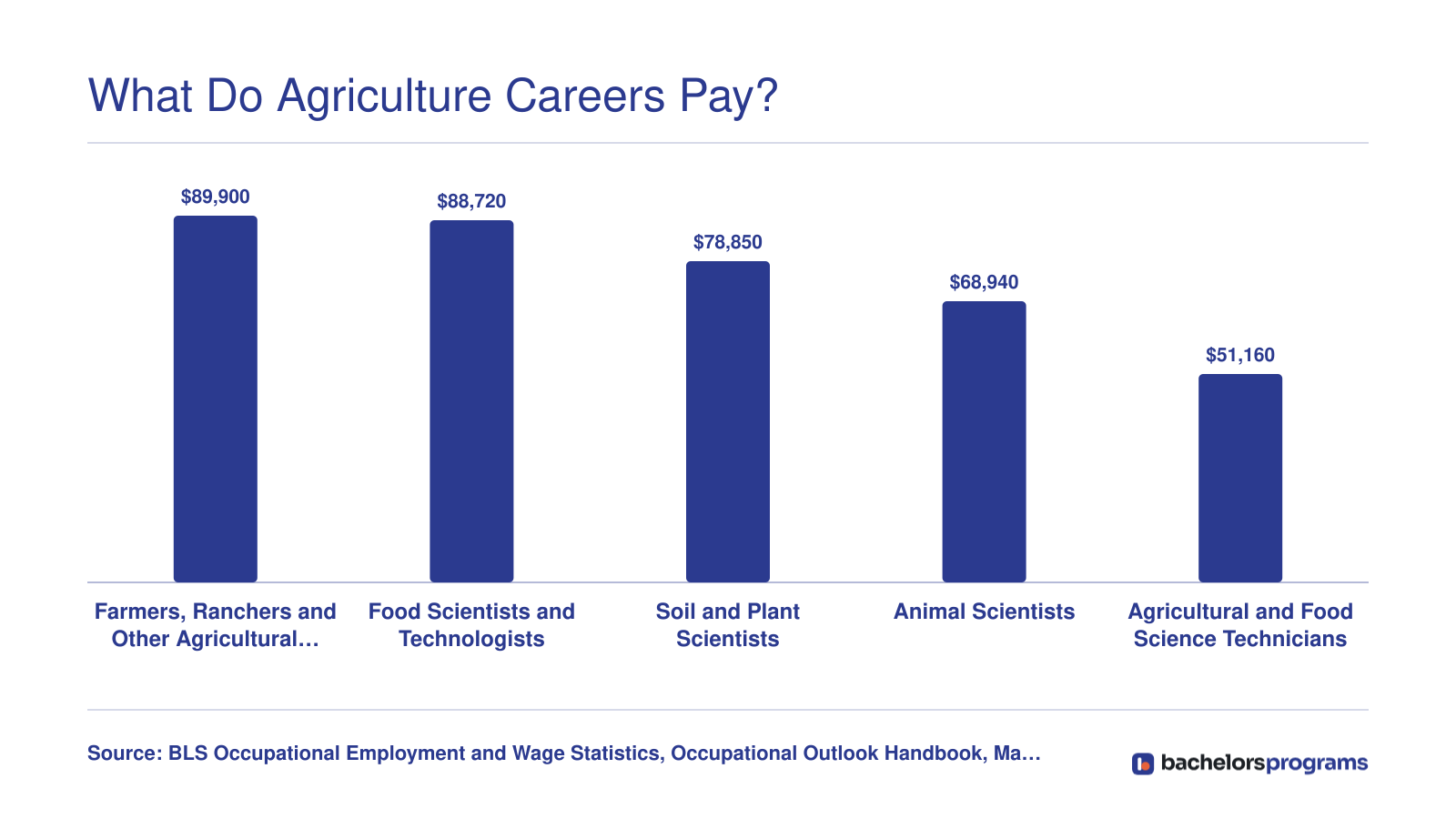
- Farmers, ranchers and other agricultural managers: The median is $89,900. Employment is projected to fall 3%, about 26,500 fewer jobs from a base of 788,700.
- Agricultural and food scientists: The median is $81,970, and employment is projected to grow 6%, or about 2,400 jobs. This group includes food scientists and technologists as well as soil and plant scientists.
- Agricultural and food science technicians: The combined median is $51,160, with 5% projected growth. Agricultural technicians have a median of $49,630, and food science technicians $52,130.
That gap matters when you choose a major. Technician roles pay close to what many programs here report at the one-year mark. Management and scientist roles pay well above it, and they are where a bachelor's degree tends to lead as a career matures. Scientist roles are also adding jobs while management positions shrink, so competition for management posts may be tighter.
The Practical Takeaway
The strongest return comes from pairing low debt with a higher-paying specialization. Cornell's modest monthly payment and Cal Poly's agribusiness earnings show how that plays out. Before you commit, compare a program's debt and net price against the wages in the occupation you actually want, such as food science, plant science or agricultural management.
What Do Agriculture Careers Pay?
These figures are Bureau of Labor Statistics median annual wages for May 2025, as reported in the 2026 Occupational Outlook Handbook. They cover everyone working in each occupation, from new hires to veterans, so they are not starting pay for new graduates. Management and scientist roles sit near the top of the range, while technician jobs pay less. Within the technician group, BLS reports a median of $49,630 for agricultural technicians and $52,130 for food science technicians.
Related Articles
Questions to Ask Yourself
Do you already work on a farm or in an ag business?
Does your specialization need labs and livestock?
Can you travel for summer intensives or a field practicum?
Does in-state tuition at a nearby land-grant school beat the online price?
Admissions, Transfer Credit and Agriculture Scholarships Checklist
Requirements differ by university and by major, so treat this as a starting list and confirm each item with the college of agriculture you plan to apply to.
- Diploma and transcriptsLand-grant universities generally require a high school diploma or GED plus official transcripts from every school attended.
- High school courseworkExpect preparation in math, laboratory science, English and social science; biology and chemistry help in most agriculture majors.
- GPA and test policyGPA expectations and score requirements vary by school, so check each university's current testing policy.
- Transfer creditCredit typically comes only from accredited institutions, often with a C or better, and is evaluated separately from admission.
- Articulation agreementsAsk whether your community college's agriculture associate degree has a transfer agreement with your target university.
- National FFA scholarshipsOne FFA application covers multiple awards totaling nearly $2.5 million; confirm current deadlines and eligibility.
- USDA 1890 National ScholarsCovers full tuition, fees, books, and room and board at 19 1890 universities; requires U.S. citizenship and a 3.0 GPA, plus one year of USDA service per year of aid.
- Departmental scholarshipsColleges of agriculture often award their own scholarships, so ask the department directly.
- FAFSAFile early; federal and institutional aid shape the net prices shown above.
Questions to Ask Yourself
Does this school offer the concentration your target career actually requires?
Can you get hands-on experience on the school's own farm, livestock units, or through extension partnerships?
Will the earnings from this program comfortably cover its typical monthly loan payment?
Is there an in-state land-grant option that costs less than your top pick?
Agriculture programs by state
Agriculture Degree FAQ
These are the questions prospective students ask most often about a bachelor's degree in agriculture. Each answer is short, so check the details with any school you are considering.
Are there accredited online agriculture degree programs?
What can you do with a bachelor's degree in agriculture?
Do you need a farming background to major in agriculture?
How long does a B.S. in Agriculture take, and can community college credits shorten it?
Compare Agriculture programs on the data that matters
Explore more Natural & Applied Sciences majors or browse every field of study.
All Natural & Applied Sciences programs Browse every field of study