Best Neuroscience Degree Programs
Compare 160+ accredited Neuroscience programs at 140+ colleges, with net price after aid, graduation rates, earnings and debt from IPEDS and the U.S. College Scorecard.
A bachelor's degree in neuroscience is a four-year science major built around how the nervous system produces thought and behavior, drawing on biology, psychology and statistics. The most common credential is the Bachelor of Science (B.S.) in Neuroscience, though Harvard and Pomona award a Bachelor of Arts.
Graduates go on to medical school, research labs and data-heavy tech roles. Average net price ranges from $6,128 at Princeton to $19,285 at Pomona College. Median pay one year after graduation ranges from $23,420 at UC San Diego to $47,050 at Princeton.
The low end rarely signals weak training. Many graduates spend early years in lab jobs or graduate school.
Key Points
- Columbia's Neuroscience & Behavior graduates post the highest early-career pay here.
- Public universities on this list carry the lowest average net prices.
- A B.S. adds more chemistry, physics, calculus and labs than a B.A.
Best Neuroscience Schools for a Bachelor's Degree: Our Top 10
The ten programs below share a common thread: each treats neuroscience as a serious undergraduate science major, not a survey course. What separates them is structure and price. The list mixes large public research universities with small private colleges, and net price after aid ranges from roughly $6,100 at the low end to more than $19,000 at the high end among the schools that report it.
Princeton University
#1Princeton, NJ · ~$6,000/yr (est.)
Best for: Future researchers wanting a senior thesis
Princeton is a small private research university in New Jersey where neuroscience sits within the natural sciences division rather than a professional school. Undergraduates work with EEG, fMRI and optogenetics, and the department expects comfort with linear algebra, statistics and Python. The senior thesis is a year-long, faculty-advised project, which makes this a strong fit for a student who wants research experience before applying to graduate school.
- Year-long senior thesis advised by a Princeton faculty member
- Laboratory course pairs single-neuron recording with a two-week independent project
- Students use EEG and fMRI for noninvasive cognitive measurement
- Optogenetics used to manipulate neuronal function in coursework
- Problem sets require programming in Python
- Coursework spans neuroeconomics, computational modeling and clinical neuropsychology
- Some seminars open to juniors and seniors only
University of California-Los Angeles
#2Los Angeles, CA · $13,000/yr (est. net price)
Best for: Students wanting classroom science outreach
UCLA is a large public research university in Los Angeles with one of the biggest neuroscience undergraduate cohorts in the country. Beyond the B.S. coursework, students can take Project Brainstorm, an upper-division course where they build neuroscience lessons and deliver hands-on demonstrations in Los Angeles-area K-12 classrooms. The campus also runs summer research pathways, including an eight-week program hosted by the Brain Research Institute and a UC-HBCU partnership that brings students into UCLA laboratories.
- Awards a B.S. in Neuroscience listed in the 2026 General Catalog
- Project Brainstorm places students in K-12 classrooms with hands-on demonstrations
- Brain Research Institute hosts an eight-week summer research experience
- UC-HBCU Neuroscience Pathways pairs HBCU students with UCLA labs
- Transfer applicants with 90 or more units must finish biology, chemistry and statistics first
University of California-Berkeley
#3Berkeley, CA · ~$13,000/yr (est.)
Best for: Interdisciplinary-minded students entering a new major
UC Berkeley is a large public research university whose neuroscience major welcomed its first students in fall 2024, replacing the older neurobiology emphasis in molecular and cell biology. The curriculum deliberately crosses disciplines, combining biology, psychology, behavior and computation, with attention to neurological disease and neurotechnologies. Research can happen in department labs or at affiliated centers such as Lawrence Berkeley National Laboratory and UCSF.
- New major launched in fall 2024
- No thesis or capstone required, with an optional senior capstone
- Combines biology, psychology, behavior and computation
- Covers molecular and cellular brain function and neural computation
- Examines neurological and neuropsychiatric disease
- Links brain science with engineering through neurotechnologies
- Prepares students for medicine, dentistry, optometry and pharmacy
- Research possible at Lawrence Berkeley National Laboratory and UCSF
Harvard University
#4Cambridge, MA · $15,000 – $20,000/yr (est.)
Harvard is a private research university in Cambridge, Massachusetts, and its neuroscience concentration leads to a Bachelor of Arts rather than a Bachelor of Science. Students choose among neurobiology, mind brain behavior, and computational neuroscience tracks. The department describes intense curiosity about the brain as the only prerequisite, and the coursework delivers broad scientific training in the biology of the nervous system.
- Concentration leads to a Bachelor of Arts (A.B.)
- Three tracks: neurobiology, mind brain behavior, computational neuroscience
- Studies the biological mechanisms that underlie behavior
- Broad scientific training in the biology of the nervous system
- Only stated prerequisite is curiosity about the brain
University of Chicago
#5Chicago, IL · ~$15,000/yr (est.)
The University of Chicago is a private research university on Chicago's South Side that offers unusually fine-grained choices: a BA, a BS, and a BS with Honors in neuroscience. The BS track requires an approved research project and a written thesis, while Honors adds a summer of full-time research and a public talk. Students also have access to a neuroscience minor and a computational neuroscience minor, plus paid undergraduate teaching assistant roles.
- Three options: BA, BS and BS with Honors
- BS requires 10 electives plus an approved research project
- BS includes one to three quarters of faculty-supervised research
- Written thesis and poster presentation required for the BS
- Honors adds a 3.5 major GPA, three quarters of research and summer research
- Honors includes a public talk
- Minors offered in neuroscience and computational neuroscience
- Paid undergraduate teaching assistant roles available
Georgia Institute of Technology
#6Atlanta, GA · ~$12,000/yr (est.)
Georgia Tech is a public technical university in Atlanta where the Bachelor of Science in Neuroscience sits alongside engineering and computing programs. The 120 credit-hour curriculum builds on chemistry, computer science, calculus, statistics and physics, and students pick either a general concentration or a business option. A Research Option leads to an undergraduate thesis, and the BSMS pathway lets eligible students double count up to six credits toward a master's degree.
- 120 credit-hour curriculum plus a required 2-credit health class
- Choose the General concentration or the Business Option
- Research Option requires ten units of supervised research over two or more terms
- Research Option includes six credit hours on one project and a thesis
- BSMS Option double counts up to 6 credits toward a graduate degree
- International Plan designation available
University of California-San Diego
#7La Jolla, CA · $10,000 – $15,000/yr (est.)
UC San Diego is a public research university in La Jolla where the neuroscience path runs through cognitive science. The B.S. in Cognitive Science with a specialization in Neuroscience is aimed at students heading into research or medicine. The upper division is heavy on core cognitive science plus electives that can include organic chemistry, biochemistry and physiology, giving students room to build a pre-health sequence alongside the major.
- B.S. in Cognitive Science with a specialization in Neuroscience
- Intended for students interested in neuroscience research or medicine
- Lower division: 11 courses (44 units) covering math, methods and programming
- Upper division: 12 courses (48 units) including six electives
- Four electives drawn from the neuroscience specialization list
- Electives can include organic chemistry, biochemistry and physiology
- Minimum grade of C- required in major courses
- Career paths include research scientist and occupational therapist
University of California-Irvine
#8Irvine, CA · $14,000/yr (est. net price)
UC Irvine is a public research university in Orange County that grants a B.S. in Neurobiology through its School of Biological Sciences. The major takes a biological approach, teaching how cellular, molecular, systems and behavioral analyses explain the nervous system. A year-long sequence covers the intellectual tools behind the field, and upper-division laboratories build the practical skills, with optional research through BIO SCI 199.
- Bachelor of Science in Neurobiology
- Year-long sequence on how knowledge about the nervous system is built
- Covers cellular, molecular, systems and behavioral analyses
- Upper-division laboratory coursework
- Optional undergraduate research through BIO SCI 199 with faculty mentoring
- Neurobiology satellite courses add advanced content
University of Michigan
#9Ann Arbor, MI · $18,000 – $61,000/yr (est.)
The University of Michigan is a large public research university in Ann Arbor whose neuroscience major is run jointly by the Department of Psychology and the Department of Molecular, Cellular, and Developmental Biology. That structure means students get both the cell and molecular side and the behavioral side in one major. Undergraduate research is available, and the program explicitly prepares students for graduate study, biotechnology and pharmaceutical work, health professions, or analytical fields such as law and business.
- Interdepartmental major managed by the Undergraduate Program in Neuroscience
- Collaboration between Psychology and Molecular, Cellular, and Developmental Biology
- Integrates cell and molecular with behavioral neuroscience
- Undergraduate research opportunities available
- Honors and non-honors thesis tracks
- Prepares students for graduate training, biotech and health professions
- Also framed as preparation for law or business careers
Pomona College
#10Claremont, CA · ~$19,000/yr (est.)
Pomona College is a small private liberal arts college in Claremont, California, and its neuroscience major leads to a Bachelor of Arts. The requirements are leaner than at a research university: basic science courses, two core neuroscience labs, and one additional elective. Every major completes a senior exercise, choosing between a library thesis, a project-based thesis, or a two-semester experimental thesis.
- Bachelor of Arts in Neuroscience
- Requires basic science courses plus two core neuroscience labs
- One additional neuroscience elective required
- Senior exercise: senior seminar plus one of three thesis options
- Two-semester experimental thesis available for lab-minded students
- All major courses must be taken for a letter grade
- Coursework at neighboring Claremont Colleges may count with chair approval
- AP Calculus AB or BC score of 4 or 5 meets the calculus requirement
Cost & outcomes by school
Federal data for the highest-earning Neuroscience programs, independent of the ranking above. Earnings are this field's bachelor's graduates four years after completing where the Scorecard reports them, else the school's undergraduate median.
| School | Net price / yr | Grad rate | Earnings | Debt | Grads/yr | Format |
|---|---|---|---|---|---|---|
| University of Pennsylvania PA | $28,699 | 97% | $111,371 | $18,300 | 81 | Campus |
| Cornell University NY | $28,690 | 95% | $104,043 | $14,000 | 77 | Campus |
| Boston College MA | $41,704 | 91% | $103,937 | $19,000 | — | Campus |
| Dartmouth College NH | $29,519 | 96% | $99,344 | $18,194 | 62 | Campus |
| Duke University NC | $29,612 | 97% | $97,800 | $12,125 | 144 | Campus |
| Washington and Lee University VA | $23,781 | 94% | $94,810 | $19,500 | 37 | Campus |
| Vanderbilt University TN | $15,846 | 94% | $91,565 | $14,000 | 34 | Campus |
| Lafayette College PA | $34,433 | 88% | $91,410 | $16,000 | 69 | Campus |
| Northwestern University IL | $29,167 | 95% | $89,363 | $15,000 | 51 | Campus |
| Williams College MA | $17,716 | 94% | $88,665 | $12,761 | 68 | Campus |
| Johns Hopkins University MD | $18,809 | 94% | $87,555 | $14,507 | 73 | Campus |
| Columbia University in the City of New York NY | $21,590 | 96% | $86,946 | $19,347 | 144 | Campus |
Sources: U.S. Department of Education. Net price, graduation rate, earnings and debt: College Scorecard (earnings and debt for this field's bachelor's graduates where reported, else school-wide); graduates: IPEDS. A dash means no figure is reported.
Cost, debt & payoff
Median earnings of this field's bachelor's graduates (4 yrs after completing, else the school's undergraduate median) vs. their median federal loan debt · U.S. College Scorecard
Across these programs the median graduate earns about $63,292 and finishes with roughly $20,651 in debt — a ratio that clears a common rule of thumb (keep debt below first-year salary). Net price and debt vary widely school to school, so check the per-school figures in the table above before you shortlist.
How We Ranked These Neuroscience Programs
A neuroscience program earns its spot by what it costs a student and what that student earns afterward, not by reputation alone.
What We Weighed
- Net price after aid: the average a first-year student actually pays once grants and scholarships apply, which matters more than sticker tuition for a major that often leads to graduate school.
- Graduation and retention rates: whether students stay and finish, a signal of advising and course availability in a lab-heavy major where one crowded prerequisite can derail a year.
- Median earnings for the major: reported pay a few years after graduation, a truer signal than the university's overall average.
- Median federal debt: what borrowers leave owing, read next to earnings rather than on its own.
- Admissions selectivity and completions: the number of students finishing the major shows whether neuroscience is an established department with its own faculty or a small offering borrowing courses from biology and psychology.
Where the Data Stops
Two limits apply. A school's graduation rate covers every student it enrolls, not the neuroscience major, so a healthy number can hide a department where introductory courses thin the ranks. Several programs report no earnings figure for the major at all. Blending cost, debt, completion and outcomes keeps any single missing figure from deciding a position. A program with softer earnings but low debt and a strong completion record can still finish ahead of one with a flashier salary and heavier borrowing.
Cost, Debt and Earnings Compared Across Top Neuroscience Schools
Most neuroscience majors treat the bachelor's degree as a stepping stone, and that shapes how its costs and early paychecks should be read.
Net Price: Public vs. Private
The public schools here post the lowest average net prices (what students pay after grant aid). Georgia Tech comes in at $12,116, UC San Diego at $12,470, UCLA at $12,548 and UC Santa Barbara at $16,109. The private schools run from $14,860 at the University of Chicago to $23,777 at Yale. These are school-wide figures, not program-specific ones.
Sticker price misleads here. Chicago lists tuition and fees above $70,000, yet its net price is lower than Harvard's and well under Yale's, because generous institutional aid cuts the bill sharply. Look at net price, not the published rate.
Earnings: Read the Window
Program-level median earnings vary widely by timing. One year after completion, they range from $23,420 at UC San Diego to $53,156 at Columbia. Five years out, Harvard's neuroscience graduates reach $102,305, while UC Santa Barbara's reach $66,321. Four years out, Columbia's sit at $86,946 and Georgia Tech's at $83,012.
Treat the early numbers cautiously. Many graduates go straight to medical school, a PhD or a research-assistant job, and those paths depress first-year pay.
Debt in Monthly Terms
Where programs report it, median federal debt for neuroscience graduates is modest. It runs from $10,800 at Amherst to $19,347 at Columbia. On a standard 10-year plan, that works out to roughly $114 a month at Amherst, $157 at UC San Diego, $176 at UCLA, $186 at Chicago and $205 at Columbia. Georgia Tech and Yale do not have program-level debt figures here, so compare them on net price instead.
The Takeaway
If medical school is your goal, minimize undergraduate debt first. A bachelor's degree with a payment near $114 or $157 a month leaves far more room for the loans that come later than a slightly higher early salary would.
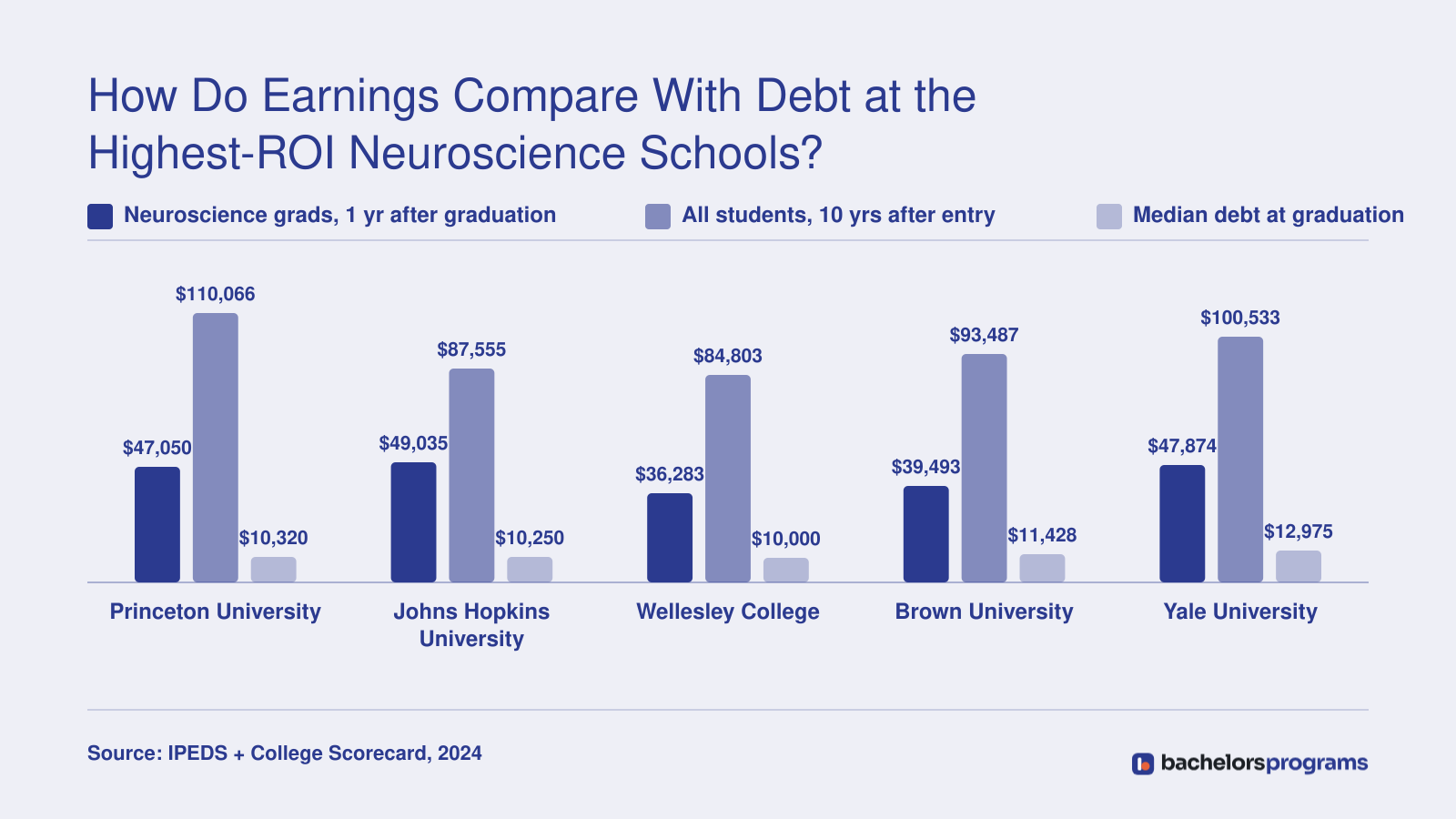
How Do Earnings Compare With Debt at the Highest-ROI Neuroscience Schools?
Each school shows three bars: median earnings for neuroscience graduates one year after finishing the bachelor's degree, school-wide median earnings 10 years after first enrolling, and school-wide median student loan debt at graduation. The ROI ratio that orders these schools divides the 10-year earnings figure by median debt. It is a rough proxy for payoff, not a guarantee of what any one graduate will earn. By that measure, Princeton leads at about 10.7 to 1, and Yale sits at about 7.7 to 1.
What a Bachelor's Degree in Neuroscience Covers: B.S. vs. B.A. and Specializations
B.S. vs. B.A.: What Actually Differs
There is no national standard, so check each catalog. Still, the pattern is consistent: a B.S. carries a heavier natural-science and quantitative load (chemistry, physics, calculus, more labs), while a B.A. leaves room for electives and for psychology or humanities coursework. The University of Hartford shows the gap clearly, listing 55 to 58 credits for its B.A. and 70 to 72 for its B.S. Boston University's B.A. runs 68 units across 17 courses1, and Tulane's B.S. requires three laboratory courses.4 Details vary, though. Boston University's B.A. allows specified chemistry or physics alternatives, and Oregon asks for a year of either chemistry or physics lab in its combined major (101 to 104 credits).2
Our verdict: choose the B.S. if you are aiming at medical school or a Ph.D. Hartford itself recommends its B.S. for pre-med. Choose the B.A. if you plan a double major, lean toward psychology, or want policy, education or biotech-adjacent work.
Common Specialization Tracks
Track names differ by school, but these four come up often:
- Molecular/cellular: Focuses on neurons, genes and proteins. It feeds lab research, biotech and medical school.
- Cognitive: Covers perception, memory and language. It suits graduate study in psychology or neuroscience and user-research roles.
- Computational: Blends coding, statistics and modeling. It leads toward data science, neurotechnology and Ph.D. programs.
- Behavioral: Links brain function to behavior. It supports clinical, counseling and health-related paths.
Research Expectations
Expect hands-on research at stronger programs, though the format varies. The University of Chicago's B.S. requires an approved project, one to three quarters of research, a written thesis and a poster. Clarkson requires directed lab research or a senior thesis.5 Boston University lets courses or an upper-level lab elective satisfy its requirement, and Tulane strongly encourages research or an honors thesis. Ask each department how early students join a lab.
Related Articles
Online, Hybrid and Accredited Neuroscience Degree Options
Neuroscience is a lab-heavy science, and that, not marketing language, limits how much of a bachelor's degree can be completed online.
Fully Online Programs Are the Exception
The programs ranked here are built around campus study. Online neuroscience bachelor's degrees exist, but they are rare, and the ones available tend to be interdisciplinary rather than a straight bench-science degree. Arizona State University's online B.S. in Neuroscience is interdisciplinary and includes foundational lab sciences. The University of Arizona's online B.S. in Neuroscience and Cognitive Science requires 120 credits, a neuroscience or cognitive science focus, and a 15-credit emphasis, with up to 6 emphasis credits allowed for research or independent study.1 Its electrophysiology lab is listed, though the catalog does not make clear whether that lab is fully online. Davis & Elkins College runs a hybrid B.S. Biology with a Neuroscience Concentration, including campus labs and instrumentation. Tarleton State University's 2026 listing names both Stephenville and online while labeling delivery on-campus, so confirm the format with admissions before you plan around it.2
How Online and Hybrid Labs Work
Lab delivery varies by course, not by the word "online." Arrangements include virtual simulations and instructor-provided datasets, mailed lab kits, scheduled campus lab sessions, supervised labs at an approved local site, and transfer credit for lab courses taken elsewhere. Ask about each required lab by course number: whether it is physical, virtual, proctored, synchronous, or requires a campus visit. For upper-level neuroscience labs, assume a campus component until the program confirms otherwise.
Accreditation Is Institutional, Not Programmatic
No programmatic accreditor exists for neuroscience bachelor's degrees, so there is no neuroscience-specific seal to look for.3 What matters is institutional accreditation recognized by the U.S. Department of Education or the Council for Higher Education Accreditation. CHEA's directories separate institutional and programmatic accreditors, and neuroscience does not appear in the programmatic category.4 Verify any accredited neuroscience degree program through the Department of Education's DAPIP database or CHEA before you apply. That status affects federal financial aid, transfer credit, and the coursework medical schools will accept.
Scholarships and Financial Aid for Neuroscience Majors
Aid for a neuroscience major is a mix of grants, scholarships and paid research work, and it brings a school's sticker price down to what your family actually pays. Start by checking access. The share of students receiving federal Pell Grants shows how many lower-income students a school enrolls. Public campuses such as UC Irvine and UC Santa Barbara have historically enrolled larger lower-income shares than highly selective private schools. A high Pell share signals access, not a promise of aid.
Core Aid Sources, in Order
- FAFSA and Pell: File the FAFSA first. It determines Pell Grant eligibility and is required for most other aid.
- Institutional need-based aid: Wealthy private schools often meet full demonstrated need. That is how Princeton's average net price lands at $6,128 against tuition of $62,688.
- Merit scholarships: Schools and outside groups award these for grades, leadership or talent.
- Paid research assistantships: Many neuroscience labs pay undergraduates hourly or through work-study.
- Summer research stipends: Paid programs fund lab work between academic years.
Research Awards Worth Targeting
The Barry Goldwater Scholarship supports sophomores and juniors planning research careers in the natural sciences, math or engineering. Applicants need at least a 3.00 GPA and U.S. citizenship, nationality or permanent residency.1 Each campus can typically nominate up to four students.1 The cycle opened the first Tuesday in September 2026, and national nominations are typically due the last Friday in January at 5 p.m. Central Time. Campus deadlines come earlier.
NSF Research Experiences for Undergraduates (REU) sites pay stipends for summer research, often with housing and travel help. Amounts vary by site, and most deadlines fall between January and March. One example is the Smithsonian-Mason School of Conservation REU, a conservation biology program rather than a neuroscience one. It pays $7,000 for 10 weeks in summer 2027, with applications due January 15, 2027. Look for REU sites in neuroscience or biology. Some neuroscience societies also sponsor undergraduate awards, so confirm current terms directly with each society.
Run Every Net Price Calculator
Published averages will not match your offer. Each school runs a net price calculator that estimates your real cost from your family's finances, so use it for every school you're considering.
Top Early-Career Earnings Among Ranked Neuroscience Programs
Among the neuroscience bachelor's programs ranked here, Columbia University's Neuroscience & Behavior graduates post the highest early-career pay.
Neuroscience programs by state
Compare Neuroscience programs on the data that matters
Explore more Natural & Applied Sciences majors or browse every field of study.
All Natural & Applied Sciences programs Browse every field of study