Best Oceanography Degree Programs
Compare 190+ accredited Oceanography programs at 160+ colleges, with net price after aid, graduation rates, earnings and debt from IPEDS and the U.S. College Scorecard.

Scripps Institution of Oceanography, the research arm behind UC San Diego's program, puts undergraduates on the water aboard the Robert Gordon Sproul. That kind of access separates a genuine bachelor's degree in oceanography from a marine science major with a few ocean-themed electives.
The credential is usually a Bachelor of Science (B.S.) in Oceanography, and it is built on calculus, physics, and chemistry before any biology. Ship time is expensive, so programs cluster on the coasts, and out-of-state tuition at a coastal flagship can run four times the in-state rate.
Key Points
- Top programs pair coastal campuses with research infrastructure that puts undergraduates on the water.
- Florida in-state tuition runs $3,876 to $6,565, versus up to $18,964 out-of-state.
- A B.S. in Oceanography leans on math and physics, not marine organisms.
Best Schools for a Bachelor's Degree in Oceanography
The strongest programs on this list share two things: a coastal state and research infrastructure large enough to put undergraduates on the water. Four are University of California campuses, two more sit in the Northeast, and each pairs its coursework with a marine lab, a research vessel, or a federal science partner.
Stanford University
#1Stanford, CA · $10,000 – $15,000/yr (est.)
Best for: Climate-focused students wanting interdisciplinary breadth
Stanford's Earth Systems B.S. carries a formal oceanography and climate concentration inside a broad environmental science major. Students build foundations in ecology, chemistry, geology, physics, economics and policy before specializing, then complete a 270-hour internship and a capstone. Field opportunities are optional, so the degree leaves room to design your own path.
- Oceanography and climate track among 8 concentration options
- 62 units in the program; 180 university units overall
- 1-unit internship equals 270 hours in the field
- Capstone required; an honors thesis can replace it
- Marine Biology and Conservation subcategory available
- Writing in the Major requirement
University of California-San Diego
#2La Jolla, CA · $10,000 – $15,000/yr (est.)
Best for: Hands-on marine biology researchers
UC San Diego teaches its Marine Biology B.S. through Scripps Institution of Oceanography, one of the country's largest ocean research centers. The upper-division core runs through ocean physics and chemistry as well as genetics and statistics, with lab work at intertidal zones and salt marshes and trips on the Robert Gordon Sproul. Qualified students can continue into a contiguous B.S./M.S. program.
- Taught through Scripps Institution of Oceanography
- 5 concentration options, including quantitative and computational
- Upper-division core: SIO 132, 134, 181, 136 and 139
- Field trips to intertidal zones and salt marshes
- Research vessel trips on the Robert Gordon Sproul
- C- or higher required in every major course
- Scripps Undergraduate Honors Program for researchers
- B.S./M.S. contiguous program available
Georgia Institute of Technology
#3Atlanta, GA · ~$12,000/yr (est.)
Best for: Students drawn to ocean physics and modeling
Georgia Tech's B.S. in Atmospheric and Oceanic Sciences is a physical-science degree rather than a biology track, built on thermodynamics of Earth systems, atmospheric dynamics and atmospheric chemistry. Students add technical electives in modeling or field methods plus a career development seminar, and can apply to the B.S./M.S. option at 90 credits.
- 122 total credit hours
- Physical and chemical oceanography coursework
- Atmospheric Dynamics practicum included
- Choose Environmental Field Methods, Geophysical Field Methods or Earth System Modeling
- 15 credit hours of AOS technical electives plus 21 free electives
- B.S./M.S. option shares 6 credit hours (3.0 GPA, 90 credits)
- Undergraduate research assistantship available
- International Plan adds language and international coursework
University of Florida
#4Gainesville, FL · ~$4,800/yr (est.)
The University of Florida's B.S. in Marine Sciences is run jointly by its agriculture and liberal arts colleges, with core work in oceanography, invertebrate biodiversity and the biology of fishes. Students build an advisor-approved curriculum plan before 70 credits and choose 18 credits of electives that can tilt toward physical oceanography, ecology or quantitative skills.
- 120 total credit hours
- 2.5 GPA required in critical-tracking courses
- 18 credits of approved marine sciences electives
- 30 upper-division credits must be completed at UF
- Electives span ecology, physical and chemical oceanography, quantitative skills
- Advisor-approved curriculum plan before 70 credits
- Practicum or internship option; study abroad may count
- Must pass subject test, analytical skills test and bioethics quiz
University of California-Davis
#5Davis, CA · $10,000 – $15,000/yr (est.)
UC Davis offers Marine and Coastal Science as a stand-alone major built around the terrestrial-marine interface and human impacts on the ocean. The Oceans and the Earth System track covers climate change, paleoceanography, conservation and marine policy, and every student finishes with a capstone research course. The Bodega Marine Laboratory gives undergraduates a coastal base.
- Capstone research course required
- Major only; no minor offered
- Foundation courses in math, chemistry, physics and biology
- Advanced work in wildlife, fish and conservation biology
- Covers climate change and marine policy
- Advanced atmospheric science coursework
- Coastal and Marine Sciences Institute resources
- Fieldwork and research opportunities built in
- Covers paleoceanography and ecological shifts
- Research and fieldwork skills emphasized
- Access to Bodega Marine Laboratory
- Prepares for research, teaching and policy careers
Bowdoin College
#6Brunswick, ME · ~$14,000/yr (est.)
Bowdoin awards its biology degree with an Ecology, Evolution, and Marine Biology concentration that keeps the full three-group biology core while emphasizing macro-scale systems. Students declare a concentration in the fourth semester and can switch, and all three tracks get equal registration priority. Faculty advising is built into course planning.
- Concentration within the biology major
- Keeps Group 1, 2 and 3 core courses
- Concentration chosen in the fourth semester
- Students may switch concentrations
- Equal registration priority across all three tracks
- Emphasizes biological systems at the macro scale
University of California-Berkeley
#7Berkeley, CA · ~$13,000/yr (est.)
Berkeley's B.A. in Earth and Planetary Science includes a Marine Science specialization covering the ocean's role in climate change, El Nino and La Nina cycles, marine sediments and corals, coastal pollution and coastal erosion. Declared majors can tap scholarships and undergraduate research, and the other five specializations let students pair ocean science with geology, geophysics or atmospheric science.
- Marine Science specialization among 6 options
- Covers El Nino and La Nina cycles
- Topics include marine sediments, corals and coastal erosion
- Declared majors can access scholarships and research
- Accepted into the major with a C average or better
- Bachelor of Arts degree delivered in person
University of Maryland-College Park
#8College Park, MD · $16,000/yr (est. net price)
Maryland's B.S. in Atmospheric and Oceanic Science is a 69-credit major that pairs math, chemistry, physics and computing with upper-division ocean and atmosphere courses and guided research. The department is strong in computer modeling, remote sensing and atmospheric chemistry, and students can work with NOAA's National Centers for Environmental Prediction and NASA Goddard Space Flight Center.
- 69 credit hours in the major
- 2.0 GPA and a C- or better in each major course
- No formal entry requirements; not a limited enrollment program
- Advisor meeting required each semester
- Research with NOAA and NASA Goddard
- Strengths in computer modeling and remote sensing
- Prepares for graduate school, industry and public service
University of California-Los Angeles
#9Los Angeles, CA · $13,000/yr (est. net price)
UCLA lists Marine Biology as its own B.S. major in the General Catalog, distinct from general biology, and the Registrar publishes the officially approved courses and requirements annually in both PDF and HTML. UCLA cautions that departmental websites may not reflect approved curricula, so students plan from the catalog of their year and confirm changes with an advisor.
- Marine Biology listed as its own major page
- Catalog published annually in PDF and HTML
- Registrar's Office maintains the official curriculum
- Department sites may not reflect approved curricula
- Courses and requirements subject to change without notice
Massachusetts Institute of Technology
#10Cambridge, MA · ~$20,000/yr (est.)
MIT's Bachelor of Science in Mechanical and Ocean Engineering (Course 2-OE) pairs a mechanical engineering core with ocean engineering: the engineering side of ocean science, exploration, and the use and protection of the oceans. Applicants apply to MIT without naming a major and choose in the spring of freshman year, with research available through UROP and maker spaces across campus.
- Course 2-OE sits inside Mechanical Engineering
- Combines a mechanical engineering base with ocean engineering
- Covers ocean exploration and protection of the oceans
- Major declared in the spring of freshman year
- Undergraduate research through UROP
- MISTI and study abroad options
- Maker Works, Beaver Works and the Hobby Shop
Cost & outcomes by school
Federal data for the highest-earning Oceanography programs, independent of the ranking above. Earnings are this field's bachelor's graduates four years after completing where the Scorecard reports them, else the school's undergraduate median.
| School | Net price / yr | Grad rate | Earnings | Debt | Grads/yr | Format |
|---|---|---|---|---|---|---|
| Massachusetts Institute of Technology MA | $20,111 | 96% | $143,372 | $14,768 | — | Campus |
| Stanford University CA | $13,807 | 92% | $124,080 | $12,000 | — | Campus |
| Cornell University NY | $28,690 | 95% | $104,043 | $14,000 | — | Campus |
| Georgia Institute of Technology GA | $12,116 | 94% | $102,772 | $21,672 | — | Campus |
| Duke University NC | $29,612 | 97% | $97,800 | $13,000 | 6 | Campus |
| Cal Poly Maritime Academy CA | $20,555 | 60% | $94,784 | $24,965 | — | Campus |
| Northeastern University MA | $30,915 | 91% | $92,538 | $24,250 | 34 | Campus |
| University of Southern California CA | $32,740 | 92% | $92,498 | $18,000 | 4 | Campus |
| University of California-Berkeley CA | $13,481 | 93% | $92,446 | $13,000 | — | Campus |
| California Polytechnic State University-San Luis Obispo CA | $16,665 | 86% | $90,768 | $18,500 | — | Campus |
| University of San Diego CA | $30,365 | 84% | $86,522 | $22,940 | — | Campus |
| Colgate University NY | $28,786 | 91% | $85,139 | $15,000 | — | Campus |
Sources: U.S. Department of Education. Net price, graduation rate, earnings and debt: College Scorecard (earnings and debt for this field's bachelor's graduates where reported, else school-wide); graduates: IPEDS. A dash means no figure is reported.
Cost, debt & payoff
Median earnings of this field's bachelor's graduates (4 yrs after completing, else the school's undergraduate median) vs. their median federal loan debt · U.S. College Scorecard
Across these programs the median graduate earns about $53,775 and finishes with roughly $22,000 in debt — a ratio that clears a common rule of thumb (keep debt below first-year salary). Net price and debt vary widely school to school, so check the per-school figures in the table above before you shortlist.
How We Ranked These Oceanography Schools
What actually makes one oceanography school better than another for an undergraduate? We answered that with public federal data rather than reputation alone. We used six measures covering cost, completion and early career outcomes.
The Six Factors We Considered
- Average net price: What students pay once grants and scholarships are counted, often far below the sticker price.
- Graduation rate: How many students finish their degree. This is a signal of advising, academic support and institutional stability.
- Program earnings: Median pay for people who completed that program, measured shortly after graduation. This reflects early-career outcomes, not lifetime earnings, which tend to grow with experience and further training.
- Median federal debt: How much students typically borrow, which shapes your monthly payments after graduation.
- Selectivity: The admission rate, which helps you gauge your odds and the academic peer group you'll join.
- Program completions: How many students earn the degree each year. A low count can mean small classes and closer faculty contact, but also fewer peers and possibly fewer course sections.
Where the Data Comes From
All figures come from the U.S. Department of Education's College Scorecard and the Integrated Postsecondary Education Data System (IPEDS). They reflect the latest available snapshot. Numbers change as new federal data is released, so check current costs with each school before applying.
Limits Worth Knowing
Graduation rates are institution-wide, not specific to oceanography majors. Many oceanography programs are small, and federal sources often withhold earnings for programs with few graduates to protect student privacy. A missing figure is not a penalty. Those schools are evaluated on the measures that are published. Many school lists never explain how they chose their picks. We'd rather show you the inputs so you can weigh them yourself.
What You'll Study in a B.S. in Oceanography (And How It Differs From Marine Biology)
The real tradeoff here is math and physics versus organisms and ecology. A B.S. in Oceanography treats the ocean as a physical and chemical system, and the coursework reflects that from the first semester.1
The Core Coursework
Expect a foundation in mathematics and statistics, physics, chemistry, biology, and oceanography.2 Texas A&M, for example, places Engineering Mathematics I and Fundamentals of Chemistry I early in its oceanography degree.3 Math and physics run heaviest for students heading toward physical or chemical oceanography, and chemistry can extend into marine chemistry or geochemistry. Geology, field methods, instrumentation, and GIS and data work recur across programs. Oregon State adds a research component through a thesis or internship.2 If you want strong programming skills, ask how much computing each department's data courses require.
The Four Classic Subfields
- Physical: how the ocean moves and how it interacts with climate.
- Chemical: the composition of seawater and the chemical cycles running through it.
- Biological: how marine life fits into and shapes ocean ecosystems.
- Geological: the seafloor, its sediments, and the processes that shape ocean basins.
Oceanography vs. Marine Biology vs. Marine Science
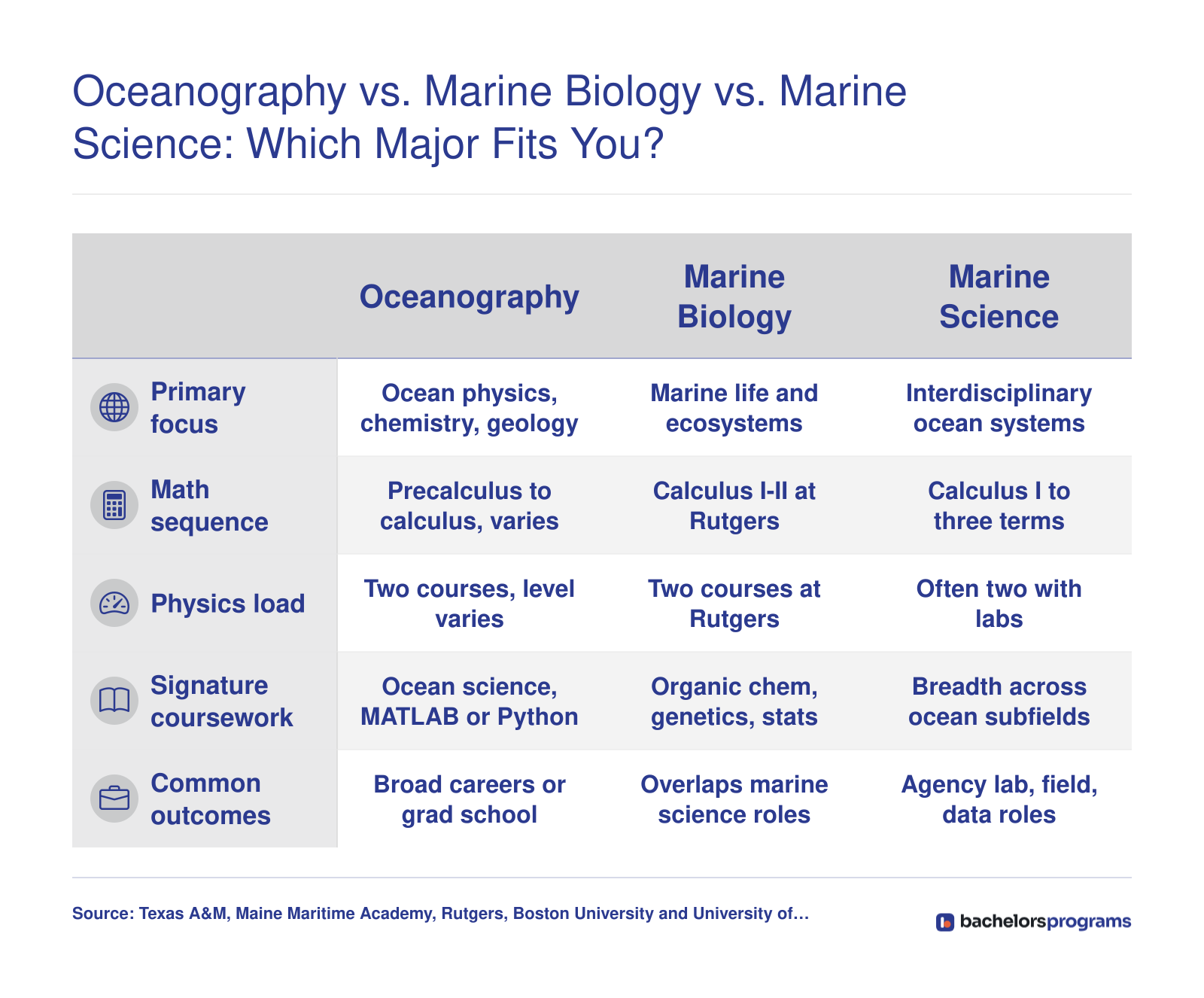
Oceanography studies the ocean itself. Marine biology studies the organisms in it, with core courses in general biology, cell and molecular biology, ecology, physiology, genetics, and evolution.4 Its chemistry often extends to biochemistry, while physics serves as a supporting science rather than the center of the degree. Marine science is the broadest label. Rutgers and Texas A&M both describe it as multidisciplinary6, and NC State lets majors concentrate in biological oceanography, chemistry, geology, meteorology, or physics5, so the same title can mean broad or focused training.
Career fit follows the same lines. Oceanography graduates go into marine technical support, energy, transportation, insurance, hazard mitigation, environmental consulting, and hydrology.3 Marine biology points toward biological research, fisheries, aquaculture, conservation, and consulting. Marine science graduates move into environmental management, applied marine science, teaching, and graduate study.1 Independent research and faculty roles generally require a graduate degree on any of these paths.
Which Fits You
If you enjoy calculus and physics problems, oceanography is likely your match. If animals, ecosystems, and living things draw you in, marine biology may suit you better. Interested in managing fish stocks and natural resources? Look at fisheries degrees too, which lean toward resource management.
Oceanography vs. Marine Biology vs. Marine Science: Which Major Fits You?
These three majors share a lot of coursework, but each frames the ocean differently. If climate, currents and ocean physics pull you in, a B.S. in Oceanography is usually the stronger fit. If you care most about marine life and ecosystems, look at marine biology, and choose marine science if you want a flexible, interdisciplinary mix.
Related Articles
Most Affordable Oceanography Bachelor's Degree Programs
The lowest average net prices among the schools ranked here all belong to Florida public universities, where in-state tuition runs $3,876 to $6,565 a year compared with $16,579 to $18,964 for out-of-state students. That gap makes residency at a coastal public university the biggest savings lever for most families, and private schools rarely offer a comparable in-state discount. Net price, drawn from 2024 IPEDS and College Scorecard data from the U.S. Department of Education, is the average cost after grants and scholarships and varies by family income. Pell shares of 66.7% to 81.3% show these campuses enroll many lower-income students, so run each school's net price calculator with your own numbers before ruling one out on sticker price.
| School | Location | Program | Avg. Net Price (After Aid) | In-State Tuition & Fees | Out-of-State Tuition & Fees | Pell Grant Share | Median Graduate Debt |
|---|---|---|---|---|---|---|---|
| University of Florida | Gainesville, FL | B.S. in Marine Sciences | $4,815 | $3,876 | $16,579 | 66.7% | $15,000 |
| Florida International University | Miami, FL | B.S. in Marine Biology | $9,288 | $6,565 | $18,964 | 81.3% | $16,500 |
| University of South Florida | Tampa, FL | B.S. in Marine Biology | $9,812 | $6,410 | $17,324 | 68.6% | $17,988 |
What Geoscientists, Including Oceanographers, Earn
The Bureau of Labor Statistics groups oceanographers with geoscientists, so that occupation's pay data is the best national benchmark for this career path.
Questions to Ask Yourself
Are you drawn to ocean physics and climate data, or to marine organisms?
Does the school guarantee time at sea, or require a cruise or field course to graduate?
Is there a coastal public university in your home state with an ocean-access program?
Are you prepared for a graduate degree if your goal is a research-scientist role?
How to Choose an Oceanography School and Prepare for Admission
Most universities admit future oceanography majors through their general undergraduate application, so strong math and science preparation matters most. Use this checklist to get ready and to compare the schools on your list.
- Take four years of mathGo through precalculus at minimum and reach calculus if your high school offers it, which matches the University of Washington's recommended fourth course in analysis or calculus.
- Build a lab science foundationComplete full-year lab chemistry, physics, and biology, and choose AP or IB versions when available to show you can handle college-level science.
- Check coastal or Great Lakes accessFavor campuses near an ocean coast or the Great Lakes so fieldwork is part of regular coursework rather than a rare trip.
- Ask about research vessels and field stationsConfirm whether undergraduates get time aboard a research vessel or at a marine field station before graduation.
- Weigh program size and selectivityCompare small departments with close faculty mentoring against large research universities, and check each school's overall admission rate.
- Plan your transfer path earlyCommunity college students should finish calculus, physics, and chemistry sequences and verify every course against the target school's articulation agreement, since minimum grades, GPAs, and unit counts vary by university.
- Show sustained ocean interestHighlight science fair projects, ocean-related volunteering, or National Ocean Sciences Bowl participation in your application.
Oceanography programs by state
Oceanography Degree FAQs
What is the best college for oceanography?
What can you do with a bachelor's degree in oceanography?
Do you need a master's degree to work as an oceanographer?
Can you major in something else and still become an oceanographer?
Compare Oceanography programs on the data that matters
Explore more Natural & Applied Sciences majors or browse every field of study.
All Natural & Applied Sciences programs Browse every field of study