Best Human Services Degree Programs in Tennessee
Compare 3 accredited Human Services programs in Tennessee, with net price after aid, graduation rates, earnings and debt from IPEDS and the U.S. College Scorecard.

A bachelor's degree in human services prepares graduates for community-facing helping roles such as case management, family support and youth services, but it does not carry a license on its own. The three ranked programs are at East Tennessee State University, Lee University and Carson-Newman University; ETSU awards a Bachelor of Science (B.S.) in Human Services.
Programs are ranked on cost, outcomes and format; online options, admissions, accreditation, careers and the alcohol and drug counselor pathway follow.
Entry-level pay in helping professions is modest, so what you borrow matters as much as where you enroll.
Key Points
- After aid, average net price runs $15,983 to $20,251 at these schools.
- Carson-Newman graduates earn a median $42,420 against $19,000 in debt.
- Social work licensure requires a CSWE-accredited BSW, not a human services degree.
Best Bachelor's in Human Services Programs in Tennessee: Our Ranked List
What separates the strongest Tennessee human services programs is what happens after you enroll: accreditation from the Council for Standards in Human Service Education, a required practicum or internship rather than an optional one, and completion rates that suggest students actually finish. Each card below also spells out where the degree leads, from child life certification to addiction counseling to ministry-adjacent social services.
East Tennessee State University
#1Johnson City, TN · ~$16,000/yr (est.)
Best for: Online learners pursuing child life certification
East Tennessee State University in Johnson City offers a CSHSE-accredited Bachelor of Science in Human Services with a Child Life concentration that can be completed fully online, plus a documented transfer route from Walters State Community College for students holding an early childhood associate degree. Students complete practicum and internship placements, and those pursuing child life certification go on to log 600 clinical hours under a Certified Child Life Specialist. The university reports a 53% graduation rate, and program graduates had median earnings of about $40,300 four years after finishing.
- CSHSE accredited program
- Child Life concentration available fully online
- Practicum and internship placements included
- Prepares for Child Life Specialist certification
- 600 post-graduation clinical hours under a Certified Child Life Specialist
- Articulation agreement with Walters State Community College
- A minor is required to complete the degree
Lee University
#2Cleveland, TN · ~$19,000/yr (est.)
Best for: Working adults returning to college online
Lee University in Cleveland delivers its Bachelor of Science in Human Services with an Addiction Emphasis online, built around crisis intervention, addiction treatment policy and the psychology of substance use. A dedicated course ties human services practice to Christian faith, and the 120-credit degree carries a 24-credit addiction concentration. Lee Online is designed for students with at least three years of experience beyond high school, with an appeal path for applicants who fall short of that mark. The university reports a 63% graduation rate.
- 120 credit hours, including a 24-credit Addiction Emphasis
- Christian faith integrated throughout the coursework
- Covers crisis intervention and addiction recovery policy
- Drugs and Behavior, Abnormal Psychology and Human Trafficking courses
- Online delivery with an on-campus transition option
- Built for students with at least three years beyond high school
Carson-Newman University
#3Jefferson City, TN · ~$20,000/yr (est.)
Best for: Campus students drawn to ministry and service
Carson-Newman University in Jefferson City frames its human services major around two destinations: social work and vocational ministry. Seniors complete a required internship with sites such as the Tennessee Department of Human Services, the Department of Children's Services, the Helen Ross McNabb Center and UT Medical Center, while service learning runs through Appalachian Outreach and its Samaritan House family shelter. The university reports a 53% graduation rate, and graduates of the program had median earnings of about $42,400 five years after finishing, though that cohort is small.
- Senior-year internship required for graduation
- Internships with Tennessee's Department of Human Services and Children's Services
- Service learning through Appalachian Outreach and the Samaritan House shelter
- Prepares students for social work or vocational ministry careers
- Campus ministries include counseling and Hispanic outreach
- Placements also include the Helen Ross McNabb Center and UT Medical Center
Cost & outcomes by school
Federal data for the highest-earning Human Services programs, independent of the ranking above. Earnings are this field's bachelor's graduates four years after completing where the Scorecard reports them, else the school's undergraduate median.
| School | Net price / yr | Grad rate | Earnings | Debt | Grads/yr | Format |
|---|---|---|---|---|---|---|
| Carson-Newman University TN | $20,251 | 53% | $48,382 | $19,000 | 5 | Campus |
| Lee University TN | $18,878 | 63% | $43,222 | $25,750 | 3 | Online |
| East Tennessee State University TN | $15,983 | 53% | $40,288 | $20,875 | 36 | Online |
Sources: U.S. Department of Education. Net price, graduation rate, earnings and debt: College Scorecard (earnings and debt for this field's bachelor's graduates where reported, else school-wide); graduates: IPEDS. A dash means no figure is reported.
Cost, debt & payoff
Median earnings of this field's bachelor's graduates (4 yrs after completing, else the school's undergraduate median) vs. their median federal loan debt · U.S. College Scorecard
Across these programs the median graduate earns about $43,222 and finishes with roughly $20,875 in debt — a ratio that clears a common rule of thumb (keep debt below first-year salary). Net price and debt vary widely school to school, so check the per-school figures in the table above before you shortlist.
How We Ranked Tennessee Bachelor's Degree in Human Services Programs
Two ways to compare human services programs: by brochure, or by outcomes. This list leans on outcomes.
What Moves a Program Up
A handful of measures carry the weight. Net price after aid comes first: what students actually pay once grants and scholarships are applied, not the published sticker price. Graduation rate follows, since a degree you never finish does not help anyone. Earnings and typical debt for graduates come next, hinting at whether the investment pays off. Finally, completions, a rough signal that a program has real momentum behind it. All of it comes from the federal College Scorecard, which publishes the same figures for every school.
Where the Numbers Stop
Two of those measures are broader than they look. Graduation rate and net price describe the whole institution, not the human services major, so a strong or weak result may reflect the campus more than the department. Earnings are also measured at a set point after completion, so a figure from one program is comparable to another only when the timing matches. A program with modest earnings and light debt can serve students better than one with headline pay and heavy borrowing. Read the numbers as a starting point for questions, not a verdict.
Online and Hybrid Bachelor's in Human Services Options at Tennessee Schools
An online or hybrid bachelor's in human services puts most coursework on the web while keeping the hands-on fieldwork the degree requires. How much time you spend on campus varies by program.
Delivery Format at Each School
- East Tennessee State University: Coursework for the B.S. in Human Services is 100% online. ETSU notes that some courses may occasionally run on-ground, but that is not guaranteed.
- Lee University: The human services program is offered online, with an option to transition to campus study. The catalog lists 120 total credit hours.
- Carson-Newman University: The program is campus-based in Jefferson City.
For working adults, ETSU and Lee are the realistic fits because neither requires regular trips to class. Carson-Newman suits students who want a residential experience.
Practicum and Internship Expectations
Online coursework does not mean online fieldwork. ETSU requires one practicum and one internship, completed in person at approved sites. Its online program page cites 350 field-work hours, mostly in senior year. The 2026-2027 catalog lists 290 hours (145 practicum plus 145 internship) for the Child Life concentration. ETSU does not explain the difference, so ask an advisor which total applies to you and whether a site near your home can be approved.
Carson-Newman requires a senior-year internship and highlights placements with Tennessee state agencies and a regional medical center, but it does not list required hours. Lee does not publish internship hours on the pages we reviewed.
Concentrations
- ETSU: Child Life, which prepares students for Child Life Specialist certification. The general B.S. also requires a minor.
- Lee: Addiction Emphasis, with coursework in crisis intervention, drugs and behavior, and addiction recovery policy.
- Carson-Newman: No concentrations appear on its program page.
Admission Requirements for Tennessee Bachelor's Programs in Human Services
Use this checklist when you review admissions at East Tennessee State University, Lee University and Carson-Newman University. Where we found no published policy for an item, we say so. Confirm every detail with the school's admissions office before you apply.
- Minimum GPAAsk each school whether it sets a GPA floor for freshman and transfer applicants and whether the human services major adds its own. In the sources we reviewed, none of these schools published a minimum GPA for the human services bachelor's.
- SAT/ACT test policyAsk whether scores are required, optional or used only for scholarships. In the sources we reviewed, none of these schools published a test policy for this major.
- Transfer credit policyRequest a course-by-course credit evaluation before you enroll. In the sources we reviewed, none of these schools published a transfer credit policy for human services.
- Application materialsPlan to submit an application, a high school transcript or equivalent, and transcripts from any college you attended. Check each school's portal for essays, fees or deadlines.
- Tennessee Transfer Pathway routeThe Tennessee Higher Education Commission's Transfer Pathway is a 60-credit AA, AS or AST curriculum: 41 general education core hours and 19 pre-major or elective hours. It is built for a smooth move into a four-year program. Our sources do not show how a pathway degree applies at these specific schools, though, especially Lee and Carson-Newman, which are private. Get written confirmation of how your credits will count.
- SelectivityETSU is a public university, and Lee and Carson-Newman are private. Our research found no selectivity data specific to the human services major, so ask each school for its current acceptance rate and typical admitted-student profile.
Cost of a Bachelor's Degree in Human Services in Tennessee
In-state tuition and fees run from $10,472 at East Tennessee State University to $34,700 at Carson-Newman University, but average net price after aid narrows that spread to $15,983 to $20,251. Net price is a school-wide average for aided undergraduates, not a figure specific to human services. Median debt for human services graduates is $20,875 at ETSU (about $221 a month on a 10-year plan) and $19,000 at Carson-Newman (about $201 a month); Lee University does not report a program debt figure. State aid can lower your cost: the HOPE Scholarship lists awards of up to $2,250 (actual amounts vary by enrollment status and school type) for Tennessee residents who file the FAFSA and earn a 3.0 high school GPA or an ACT 21 or SAT 1060, with no income limit. Tennessee Promise is last-dollar aid, mainly for community college; it covers up to about $5,003 (2024-25) at eligible four-year schools, requires 16 service hours a year starting in 2026-27, and lasts up to five semesters. The Dual Enrollment Grant, which averaged $1,176.85 in FY 2023-24, can help you earn credit before high school graduation. Tennessee Reconnect serves adults 23 and older pursuing associate or technical credentials, averaging $2,511.87 in FY 2023-24 for up to five years, so it can fund a first step toward a bachelor's degree.
| School | Program Format | In-State Tuition and Fees | Out-of-State Tuition and Fees | Average Net Price After Aid (School-Wide) | Median Program Debt | Est. Monthly Payment (10-Year Plan) |
|---|---|---|---|---|---|---|
| East Tennessee State University | Online | $10,472 | $14,522 | $15,983 | $20,875 | $221 |
| Lee University | Online | $23,790 | $23,790 | $18,878 | N/A | N/A |
| Carson-Newman University | Campus | $34,700 | $34,700 | $20,251 | $19,000 | $201 |
Are There Accredited Human Services Degree Programs in Tennessee? What CSHSE Means
Program accreditation and institutional accreditation answer two different questions. Institutional (regional) accreditation covers a whole university and matters for federal financial aid and credit transfer. Program accreditation from the Council for Standards in Human Service Education (CSHSE) looks only at the human services major itself.
Which Ranked Programs Hold CSHSE Accreditation
- East Tennessee State University: The BS in Human Services in Johnson City has held CSHSE accreditation since 2016, with an extension through 2026 granted in a 2021 decision letter.1 ETSU's own program page also states its CSHSE status.
- Lee University: Not listed in the CSHSE directory.
- Carson-Newman University: Not listed in the CSHSE directory.
If a program you like is not listed, ask the department directly about its status and whether it plans to seek review.
What the CSHSE Seal Signals
CSHSE accredits associate, bachelor's and master's programs against its National Standards, which address curriculum, supervised field experience and faculty.1 At ETSU, that shows up as 350 hours of field work spread across the curriculum, with most of it completed in the senior year.
Does It Matter for Your Career?
Most entry-level human services jobs do not require a degree from a CSHSE-accredited program. The seal can still help with employers and graduate admissions because it signals structured, supervised fieldwork. If you later apply for the Certified Human Service Professional credential, you will be advised to get written proof of your program's accreditation, such as an accreditation letter or certificate.
How to Check a Program's Status
Search the accredited programs directory on the CSHSE website, then confirm with the department, since the council says its lists are for information only.1 Because ETSU's current extension runs through 2026, ask about its next review date.
Related Articles
Human Services vs. Social Work Bachelor's Degrees in Tennessee
A bachelor's degree in human services and a Bachelor of Social Work (BSW) can lead to similar entry-level jobs, but they do not lead to the same license. The key difference is accreditation: social work programs are accredited by the Council on Social Work Education (CSWE), and each state's licensing board decides what a license requires. Check Tennessee's board requirements before choosing, since graduating from a CSWE-accredited program may help with licensure but does not guarantee it.
| Factor | Bachelor's in Human Services | BSW (Bachelor of Social Work) |
|---|---|---|
| Focus | Broad, interdisciplinary preparation for helping professions, including case support, community programs, and client services | Generalist social work practice grounded in the profession's standards and ethics |
| Programmatic accreditation | Often reviewed by CSHSE (Council for Standards in Human Service Education); confirm each school's status | CSWE accreditation, which applies to the social work program as a whole, not to individual courses |
| Field placement | Supervised field experience is common, but hours vary by school | CSWE standards require a minimum of 400 supervised field hours at the baccalaureate level |
| Tennessee licensure outcome | Generally does not lead to a social work license on its own | A degree from a CSWE-accredited program is required to sit for a licensing exam, and the Tennessee Board of Social Worker Licensure sets the specific requirements |
| Typical jobs | Case aide, community outreach worker, program assistant, youth or family services staff | Case management, advocacy, and community support roles, with BSW-level licensees generally practicing in a limited capacity |
| Graduate-school path | Opens doors to graduate study in human services, counseling, public administration, and related fields | Direct route into a Master of Social Work (MSW), which is the usual path to clinical practice |
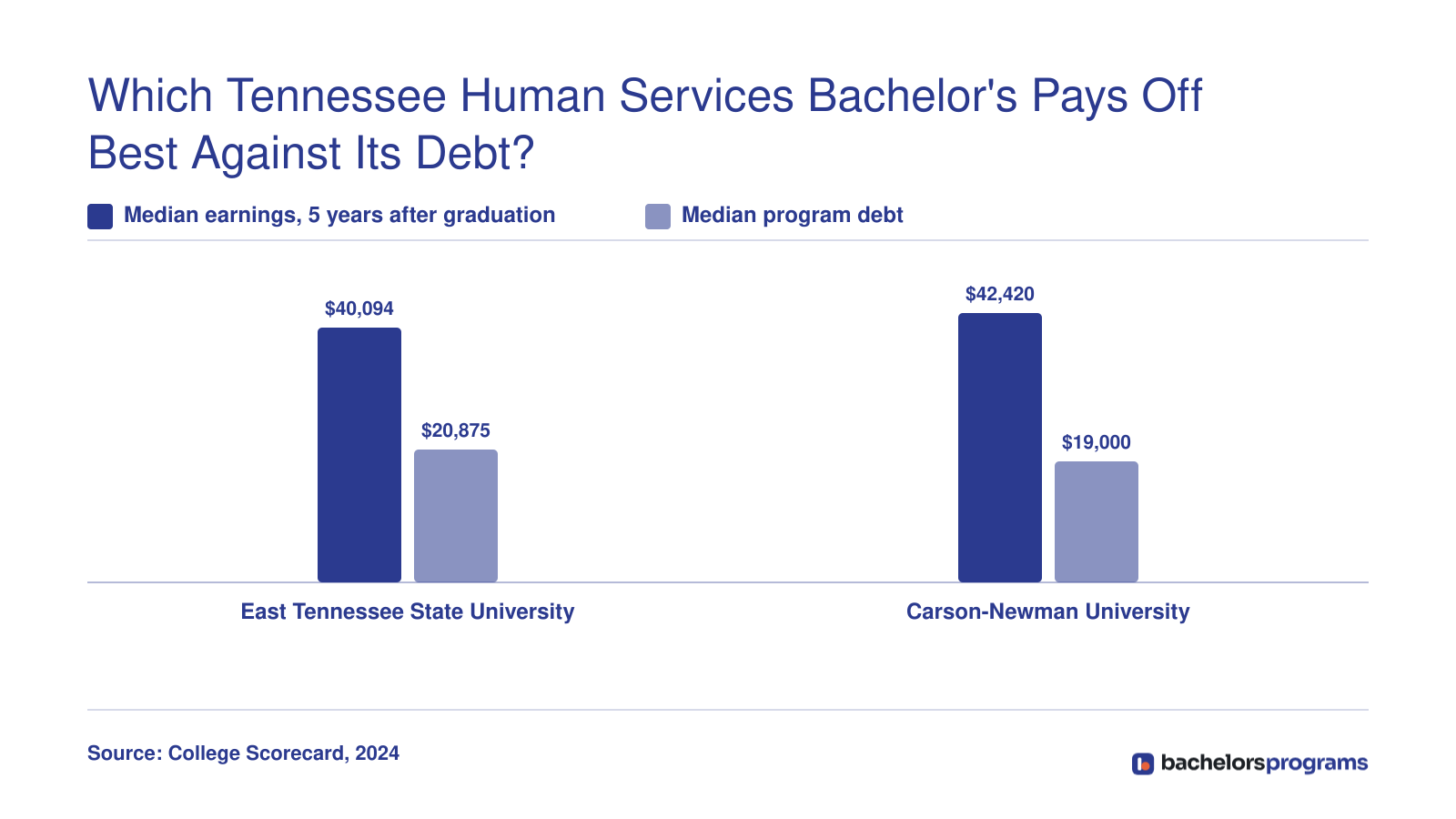
Which Tennessee Human Services Bachelor's Pays Off Best Against Its Debt?
This chart sets median earnings five years after graduation against median program debt for bachelor's degree in human services graduates at East Tennessee State University and Carson-Newman University. Carson-Newman shows the strongest balance: graduates earn a median $42,420 against $19,000 in debt, more than twice what they borrowed. ETSU graduates earn $40,094 against $20,875, nearly double their debt. Carson-Newman's figures come from a small graduating class, so they can shift more from year to year than ETSU's. Lee University does not report program-level earnings or debt, so it is not charted.
Questions to Ask Yourself
Do you need a fully online format, or can you attend a campus near a Tennessee internship site?
Do you want a social work license through a BSW, or is a human services bachelor's with an alcohol and drug counselor credential enough for your goal?
Does the program you are considering list CSHSE accreditation, if that matters to you or your employer?
Compare Human Services programs on the data that matters
Explore more Social Work & Social Sciences majors or browse every field of study.
All Social Work & Social Sciences programs Browse every field of study