Best Child Development Degree Programs
Compare 130+ accredited Child Development programs, with net price after aid, graduation rates, earnings and debt from IPEDS and the U.S. College Scorecard.

A bachelor's degree in child development typically requires 120 credits, most often earned as a Bachelor of Arts (B.A.) in Child Development. Graduates move into preschool leadership, family services and hospital child life work.
Programs diverge sharply on the details that shape those careers. The University of Florida says plainly that its early childhood studies major is not a teacher certification program, while Oregon State's child development option prepares students for dual pre-K and elementary licensure. Wisconsin requires 150 clinical hours. Net price after aid runs from $4,564 at Cal State San Bernardino to $39,998 at Tufts.
For most graduates, fieldwork hours and licensure alignment matter more than the title printed on the diploma.
Key Points
- Rankings use federal data, weighing net price after aid over sticker tuition.
- Online and campus programs share coursework but supervise fieldwork differently.
- Directing a preschool or childcare center is the top-paying role highlighted.
Best Child Development Schools Ranked for 2027
The ten programs below range from flagship public research universities to a small liberal arts work college in Kentucky, and each one awards a bachelor's degree in child development or a closely related field. Every entry below is a campus program, with program-level earnings and debt figures shown where the federal data reports them.
University of Florida
#1Gainesville, FL · ~$7,000/yr (est.)
Best for: Research-focused early childhood studies majors
The University of Florida pairs a large public research environment with the Anita Zucker Center for Excellence in Early Childhood Studies, a hub for early-childhood research, policy and practice that works with Florida's early-learning agencies, early intervention programs and school districts. Its child development offering is an education sciences degree rather than a teacher certification track, so graduates move into policy, nonprofit and education roles or continue to graduate study.
- 120 credits total; 30 in the major, split between a 15-credit core and a 15-credit specialization
- Specialization must be declared by semester 6; minimum grade of C in each major course
- Early Childhood Studies courses cover development, families, systems and child health
- Not a teacher certification program; graduates enter policy, nonprofit or graduate study
- Capstone includes a colloquium, senior seminar and experiential learning
- Median $51,497 four years after finishing
- Median federal debt among program borrowers: $17,296
University of Wisconsin-Madison
#2Madison, WI · ~$17,000/yr (est.)
Best for: Aspiring child life specialists
Wisconsin's School of Human Ecology runs a child development option inside the human development and family studies major, backed by a Child Development Lab that serves children from infancy through 4K and supports paid student internships and undergraduate research. Students can stack credentials in family life education, infant and early childhood mental health, or child life, and the school awards both merit and need-based scholarships.
- Child Development named option inside the Human Development and Family Studies BS
- 120 credits plus a capstone; semester-long professional internship of 150+ hours
- Child Development Lab serves infants through 4K and supports paid internships
- Add credentials in child life, family life education or infant mental health
- Current students can declare with a 2.750 GPA within their first 60 credits
- Median $59,044 four years after finishing
- Median federal debt among program borrowers: $21,250
Vanderbilt University
#3Nashville, TN · ~$16,000/yr (est.)
Best for: Psychology-minded students heading to graduate school
Vanderbilt's child development major sits in the Department of Psychology and Human Development at Peabody College, one of the most selective education schools in the country. Coursework follows children from infancy through adolescence across family, peer, school, community and cultural contexts, and the major is designed to prepare students for graduate work in psychology, medicine, nursing, social work, education or public policy.
- Major in the Department of Psychology and Human Development at Peabody College
- Follows children from infancy through adolescence
- Focus on biological, cognitive and social development
- Examines family, peer, school, community and cultural contexts
- Sibling majors include Child Studies, Cognitive Studies and Language Sciences
- Prepares students for graduate work in psychology, medicine, nursing or social work
- Separate minors include Child Psychology and Mental Health
Purdue University
#4West Lafayette, IN · ~$15,000/yr (est.)
Purdue's developmental and family science major lives in the College of Health and Human Sciences and lets students add a child development concentration or a family and community health focus. Every student finishes with a capstone built around a semester-long internship, a mentored research project or study abroad, and graduates move into child life, early intervention, casework and youth program roles or on to graduate study.
- Optional concentration in child development or family and community health
- Capstone choices: semester-long internship, mentored research or study abroad
- Offered by the College of Health and Human Sciences in West Lafayette
- Transfer applicants need a minimum 2.8 GPA
- Leads to child life, early intervention, caseworker and youth program roles
- Median $49,649 four years after finishing
- Median federal debt among program borrowers: $15,304
California State University-Long Beach
#5Long Beach, CA · $7,000 – $20,000/yr (est.)
Cal State Long Beach is a large, Hispanic-serving public campus with a child and family studies option housed in the College of Health and Human Services. The option was retitled Child Development effective Fall 2026, so applicants will see the new name in the catalog even though the curriculum itself carries forward for everyone already enrolled.
- Housed in the College of Health and Human Services
- Department of Family and Consumer Sciences; academic plan code CDFSBA01
- Option retitled Child Development effective Fall 2026
- Existing students in the older option move to the new title automatically
- Median $46,966 four years after finishing
- Median federal debt among program borrowers: $15,000
California State University-San Bernardino
#6San Bernardino, CA · $4,600/yr (est. net price)
Cal State San Bernardino delivers one child, adolescent and family studies major with two concentrations, both built to match the state's transfer model curriculum, which makes it a smooth landing spot for community college transfers. The department also runs an honors track for seniors who want research experience before graduate school.
- 120 units total; 61 in the major, 28 in the concentration
- Covers infant and toddler development, health, safety and nutrition, and play
- Includes early childhood special education and an advanced practicum
- Concentration code CDEC; aligned to the Transfer Model Curriculum
- Median $53,086 five years after finishing
- 120 units total; 61 in the major, 28 in the concentration
- Concentration code CDCA
- Shared core covers applied research methods, child assessment and developmental psychobiology
- Seniors can add the Child Development Honors Program courses CAFS 5674 and CAFS 5675
Berea College
#7Berea, KY · ~$6,000/yr (est.)
Berea College is a small liberal arts work college in Kentucky, and its child and family studies major is built around hands-on laboratory work rather than lecture-only coursework. Students spend time in an on-campus child development lab serving infants through preschoolers inside the college's Ecovillage, and in a home management house used for family resource management practicum work.
- Concentrations in child development, family studies, or nutrition and food studies
- Child Development Lab serves infants through preschoolers inside the Ecovillage
- Home Management House is a practicum base for family resource management
- Off-campus internships at legal services, social work agencies, camps and food banks
- Pair the major with a minor in economics and business, education studies or psychology
California State University-Fresno
#8Fresno, CA · ~$7,000/yr (est.)
Fresno State's child and family science degree takes a lifespan view, tracing individual and family development and the forces that shape personal and family relationships. The department points graduates toward social services, education, child and family health, family law, counseling and policy work, and also offers a minor for students majoring elsewhere.
- Coursework covers individual and family development across the life cycle
- Prepares students for the Certified Family Life Educator credential
- Career paths include parent educator, policy coordinator and bereavement counselor
- Department also offers a child and family science minor
Tufts University
#9Medford, MA · ~$40,000/yr (est.)
Tufts runs a small, discussion-driven child study major through the Eliot-Pearson Department of Child Study and Human Development, where students choose among four concentrations or design their own plan of study. Applied experience is built into the degree: internships and fieldwork require at least 110 hours, field placements abroad run every semester, and undergraduates can pick up research credit in department labs.
- 10 courses: two foundations, three in a concentration, an applied experience, three electives
- Four concentrations, including Child and Family Health/Well-Being and Children, Arts, and Media
- Applied experiences and internships require at least 110 hours
- Community Field Placement pairs an internship with a seminar
- Fieldwork abroad runs every semester, including summer
- Median $44,345 one year after finishing; $61,338 five years after
- Median federal debt among program borrowers: $16,170
Oregon State University
#10Corvallis, OR · $15,000 – $20,000/yr (est.)
Oregon State's child development option is part of the human development and family sciences major on the Corvallis campus, pairing coursework with a required 12-credit internship at the campus child development center. Students can also pursue a double degree with education that leads to dual pre-kindergarten and elementary teaching licensure.
- Child Development option at the Corvallis campus; option code 228
- Required 12-credit internship split across HDFS 430, 431 and 432
- Core includes HDFS 233 and HDFS 330, plus at least 12 elective credits
- Option course list totals 37 credits
- Double degree with education can lead to pre-K and elementary dual licensure
- Median $53,109 four years after finishing
- Median federal debt among program borrowers: $26,000
Cost & outcomes by school
Federal data for the highest-earning Child Development programs, independent of the ranking above. Earnings are this field's bachelor's graduates four years after completing where the Scorecard reports them, else the school's undergraduate median.
| School | Net price / yr | Grad rate | Earnings | Debt | Grads/yr | Format |
|---|---|---|---|---|---|---|
| Vanderbilt University TN | $15,846 | 94% | $91,565 | $14,000 | 22 | Campus |
| California Polytechnic State University-San Luis Obispo CA | $16,665 | 86% | $90,768 | $18,500 | — | Campus |
| Tufts University MA | $39,998 | 94% | $83,214 | $16,170 | 57 | Campus |
| San Francisco State University CA | $12,278 | 50% | $68,077 | $15,371 | — | Campus |
| Charter Oak State College CT | $15,815 | 67% | $64,209 | $18,683 | 54 | Online |
| University of Alabama in Huntsville AL | $18,796 | 64% | $61,767 | $20,705 | 4 | Online or campus |
| California Baptist University CA | $26,285 | 62% | $61,504 | $26,063 | — | Campus |
| California State University-Fresno CA | $7,000 | 57% | $61,244 | $14,505 | 102 | Campus |
| University of Mary ND | $17,770 | 67% | $60,909 | $24,000 | 6 | Campus |
| California State University-San Bernardino CA | $4,564 | 55% | $59,977 | $14,715 | 194 | Campus |
| University of Saint Joseph CT | $27,989 | 64% | $59,908 | $27,000 | 3 | Campus |
| University of Michigan-Dearborn MI | $9,492 | 58% | $59,649 | $22,500 | 8 | Online |
Sources: U.S. Department of Education. Net price, graduation rate, earnings and debt: College Scorecard (earnings and debt for this field's bachelor's graduates where reported, else school-wide); graduates: IPEDS. A dash means no figure is reported.
Cost, debt & payoff
Median earnings of this field's bachelor's graduates (4 yrs after completing, else the school's undergraduate median) vs. their median federal loan debt · U.S. College Scorecard
Across these programs the median graduate earns about $47,626 and finishes with roughly $22,500 in debt — a ratio that clears a common rule of thumb (keep debt below first-year salary). Net price and debt vary widely school to school, so check the per-school figures in the table above before you shortlist.
How We Ranked These Bachelor's Programs
This ranking compares bachelor's programs in child development using federal data rather than opinion. Four criteria drive it.
- Affordability: Net price, meaning what students pay after grants and scholarships, not the sticker tuition.
- Student outcomes: Graduation and retention rates, which show whether students finish and stay.
- Program-level earnings and debt: Figures for graduates of the child development major itself, not the whole school.
- Format flexibility: How accessible the program is for students who can't relocate or need a different schedule.
Where the Numbers Come From
Our figures come from the U.S. Department of Education's College Scorecard and the Integrated Postsecondary Education Data System (IPEDS). The program-level earnings and debt figures reflect the 2022 Scorecard snapshot.
What the Data Can't Tell You
Graduation rates are school-wide, so they describe the whole university rather than one major. Net price is an institutional average; your actual cost depends on family income and aid eligibility. Where a small program publishes no earnings figures, we omit the number rather than estimate one.
Why Outcomes Beat Reputation
Child development leads to specific jobs, such as preschool teaching, family services and child life work. A reputation survey mostly reflects name recognition. Completion rates, debt and earnings show what students actually experience, the right test for a career-focused degree.
What a Bachelor's Degree in Child Development Covers
A B.A. in child development and a B.S. cover much of the same ground, but they can tilt in different directions. Which one you get depends less on a national standard than on how each university builds its own degree.
Core Coursework
Expect a foundation in lifespan and child development theory, family systems, observation and assessment, guidance strategies, diversity and inclusion, and research methods. Montclair State's B.A. concentration, for example, requires a research methods course.4 At the University of Arkansas, the child life concentration requires 3 credits of statistics and 3 of research methods.1
B.A. vs. B.S.
A B.A. typically leans toward liberal arts, family studies, and social context. A B.S. more often makes statistics, applied assessment, and directed research explicit. The University of Texas at Dallas, for instance, requires PSY 2317 or STAT 1342 in its B.S.3 These are tendencies, not rules, and some schools offer only one version.
A B.S. with statistics and research experience can be stronger preparation for graduate study and for clinical-track roles such as child life. A B.A. tends to suit family services, community, and education pathways, and it can still lead to graduate study. Check each program's full degree plan rather than relying on the letters alone.
Credits and Fieldwork
About 120 semester credits is common. Texas Woman's University and Montclair State both list 120, while Jacksonville State lists 121.2 Fieldwork varies widely and is usually counted in credits, not clock hours:
- Texas Woman's University: 3 practicum credits, with a minimum grade of B in the child life emphasis.
- University of La Verne: a 4-credit early childhood observation practicum plus a 4-credit senior project.5
- Jacksonville State: 6 credits of directed field experience.2
- Eastern Kentucky University: 6 credits of child and family studies practicum, with a 9-credit early childhood practicum in that track.6
Common Concentrations
Child life is often a B.S. emphasis, and Texas Woman's University ties its version to eligibility for certification through the Association of Child Life Professionals. Other options include special education or early intervention, family services (Western Kentucky's Child and Family Services B.S. requires 63 or more major hours), and early childhood administration.7 Cal State San Bernardino's B.A. offers Child and Adolescent Development and Early Childhood Development tracks.8
Online Child Development Degrees vs. On-Campus Programs
Online and on-campus bachelor's programs in child development cover similar coursework, but they differ in how fieldwork is arranged and supervised. Several of the programs ranked here are offered online or in both formats, so check each school's listing for its delivery options. Online students usually complete fieldwork at an approved site near home, and some programs cannot place students in certain states, so confirm your state before you apply.
| Factor | Online Programs | On-Campus Programs |
|---|---|---|
| Schedule flexibility | Coursework is completed remotely, but in-person practicum hours still follow the placement site's operating schedule. | Practicum is built into the semester calendar. Trinity Washington University, for example, requires two semesters of practicum in the junior year at four hours per week. |
| How the practicum is arranged | Students typically complete fieldwork locally. Eastern Oregon University says its two in-person practica can be arranged in the student's home community, and IDEA's practicum includes 36 hours of field experience locally. | The university often handles placement. Trinity Washington University places student-teaching interns in public, charter, and private schools in the Washington metropolitan area. |
| Student-teaching and placement requirements | Requirements vary by program. Northwestern College requires supervised student teaching in two different approved settings, and Eastern Oregon University requires two in-person practica. | Requirements are often tiered. Kennesaw State University's B.S. includes a 60-hour infant/toddler practicum, a 60-hour preschool or Pre-K practicum, and a yearlong clinical experience for certification candidates. |
| Background checks and fingerprinting | Required before fieldwork. The University of North Florida requires a Level 2 background check with fingerprints before specified upper-level courses. Eastern Oregon University requires checks for practicum students. | Also required. Trinity Washington University calls for a TB test, fingerprinting, and a criminal background check the semester before pre-student-teaching practica and student teaching. |
| Lab schools and advising | Advising is generally by phone, video, or email. On-site lab schools are only practical if you live near one, so ask what support exists for off-campus students. | Advising is in person, and any campus-affiliated lab school or partner school may be easy to reach. Availability differs by school. |
| State authorization limits | Some programs cannot place students in certain states. Sites may also need to meet state rules, such as Oregon Office of Child Care regulations for Eastern Oregon University students. | Placements are usually within the school's home region, so authorization limits are less likely to affect students who live nearby. |
Related Articles
Child Life Specialist Eligibility Checklist
Many child development graduates aim for the Certified Child Life Specialist credential. Use this checklist, based on current Association of Child Life Professionals (ACLP) requirements, to confirm you can sit for the exam.
- Bachelor's degree, any fieldComplete and document your degree by the exam registration deadline. A master's is not required. ACLP rescinded the master's requirement it had announced for 2022 and has not set a new effective date, so a bachelor's degree finished now qualifies.
- One child life course taught by a CCLSThis course must be taught by a Certified Child Life Specialist. It counts toward the 10-course total.
- Nine more qualifying coursesYou need two child development courses covering birth to 18, plus one course each in family systems, play, loss and bereavement, and research. Add three related courses. An ACLP-Endorsed Academic Program can satisfy the coursework, but you still need a bachelor's degree.
- 600-hour clinical internshipComplete the internship under direct CCLS supervision and document it by the registration deadline. Part of it must take place in a hospital. Practicum, volunteer and paid work hours do not count.
- Check program alignmentAsk each school whether its child life concentration maps course by course to ACLP's requirements.
How Much Do Child Development Graduates Earn After Graduation?
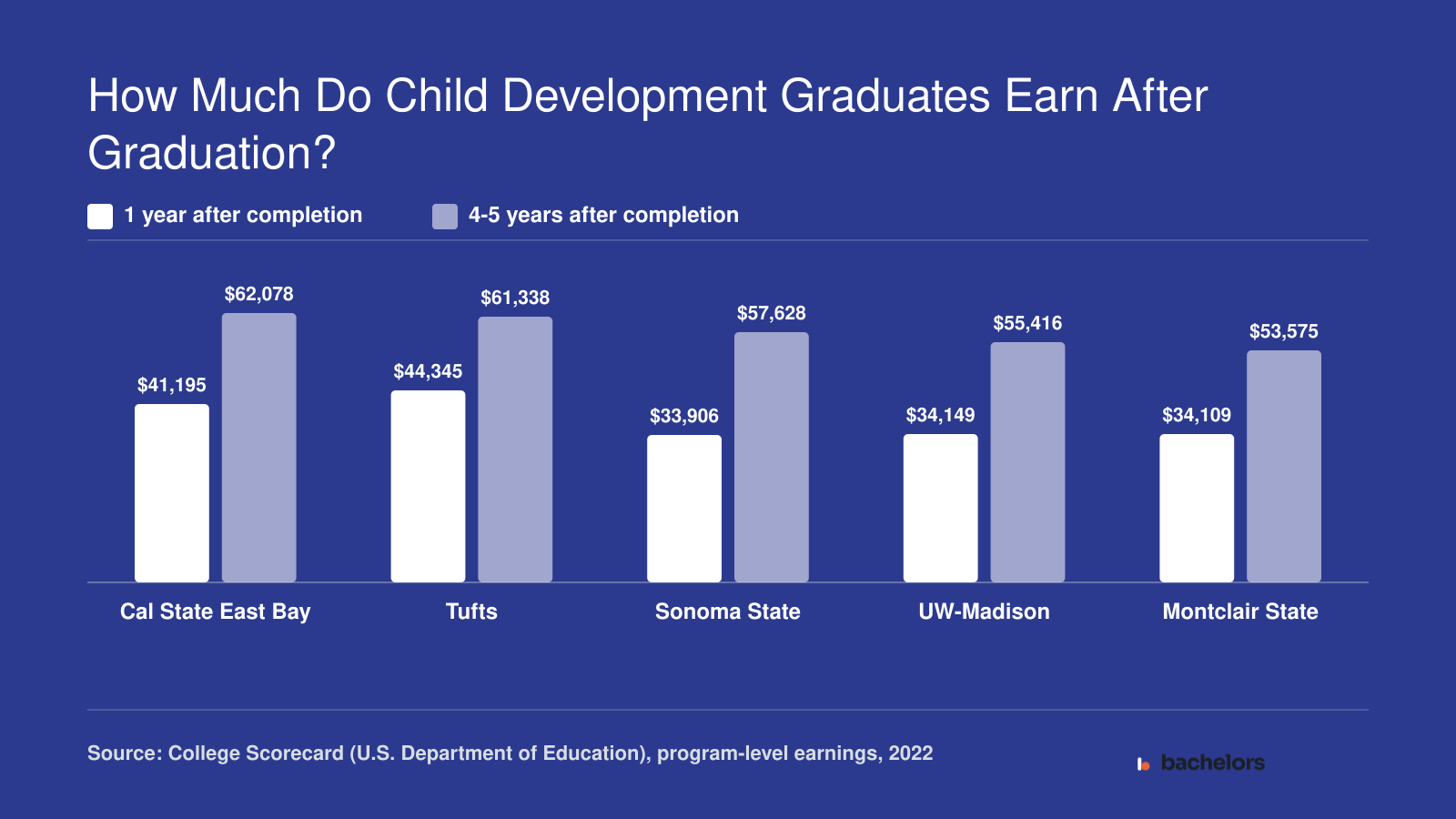
Program-level earnings show how pay changes as graduates of a bachelor's degree in child development settle into their careers. Each bar pair compares median earnings 1 year after completion with median earnings 4 or 5 years after completion, for this degree at each school, not the school as a whole. Montclair State uses its 4-year figure, and the other schools use 5-year figures. Schools without published program-level earnings for both points are left out. Pay rises by roughly $17,000-$24,000 over that window, a real gain, though most later figures still land in the mid-$50,000s to low-$60,000s.
Top-Paying Role for Child Development Graduates
Directing a preschool or childcare center is a common leadership goal for graduates with a bachelor's degree in child development.
Questions to Ask Yourself
Do you want a classroom teaching license, or a non-licensure path into family services, administration or child life?
If child life is your goal, does the coursework line up with ACLP requirements, and are you prepared for graduate study?
Can you complete the in-person practicum near home if you enroll online, and does the program place students in your state?
Will your associate degree or community college credits transfer as a block, or course by course?
Child Development programs by state
Choosing a Child Development Program: Common Questions
These are the questions prospective students ask most often when comparing bachelor's programs. The answers are short and meant to help you decide, not to repeat the rankings.
What is the best degree for child development?
How much do child development degree graduates earn?
Can I transfer an associate degree in early childhood education into a child development bachelor's program?
How long does a child development bachelor's take if I already have an associate degree?
Compare Child Development programs on the data that matters
Explore more Education & Teaching majors or browse every field of study.
All Education & Teaching programs Browse every field of study