Best Public Health Schools in Alabama
Compare 9 accredited Public Health programs in Alabama, with net price after aid, graduation rates, earnings and debt from IPEDS and the U.S. College Scorecard.

A bachelor's degree in public health trains students to prevent disease and improve health across whole populations, through epidemiology, health policy, environmental health and community program design. The usual credential is a Bachelor of Science (B.S.) in Public Health, though Alabama schools also label it Public and One Health, Public and Environmental Health, or Applied Health Science.
The real tension for Alabama students is between sticker price and program fit. Public universities charge sharply different rates to residents and non-residents, and accreditation status and online availability vary from school to school.
Every school and program here is Alabama-based and bachelor's-level, campus or online. Entry-level public health jobs in the state often prize practical experience as much as the diploma.
Key Points
- Auburn University tops the ranking for graduation rate and net price.
- UAB and The University of Alabama offer fully online public health routes.
- Residency matters: Auburn charges $12,890 in-state versus $34,922 out-of-state.
Best Public Health Schools in Alabama: Our Ranked List
Asked which is the best public health school in Alabama, we point to Auburn University, which leads this list on graduation rate, net price after aid, and the breadth of its One Health curriculum. The nine schools below cover campus and online formats across the state, from a fully online CEPH-accredited degree at UAB to small private and HBCU options. Net prices are sector-average estimates rather than a quote for any individual student.
Auburn University
#1Auburn, AL · $13,000 – $35,000/yr (est.)
Best for: Pre-health students drawn to One Health
Auburn University ties its public health degree to the One Health idea that human, animal, and environmental health are inseparable, and the program sits inside the College of Veterinary Medicine. Coursework runs from epidemiology and biostatistics to health policy and infectious disease, with internships, service-learning, and undergraduate research layered on. Auburn has worked with the Alabama Department of Public Health and UAB on the state's One Health Symposium. About 82% of its students graduate, and the estimated net price after aid is roughly $24,300.
- One Health framework linking human, animal, and environmental health
- Coursework in epidemiology, biostatistics, health policy, and environmental health
- Covers infectious disease, food safety, pandemic preparedness, and climate impacts
- Internships, service-learning, and undergraduate research
- Faculty drawn from across scientific disciplines
- Housed in the College of Veterinary Medicine
- Applicant for CEPH accreditation
- Prepares for public health roles or medicine, veterinary, and law study
The University of Alabama
#2Tuscaloosa, AL · ~$22,000/yr (est.)
Best for: Future community health educators
The University of Alabama offers a CEPH-accredited B.S. in Public Health with a concentration in Health Education and Promotion, one of the state's few accredited bachelor's options. The 120-credit curriculum covers health behavior theory, needs assessment, program planning and evaluation, and health disparities, and graduates can sit for the Certified Health Education Specialist exam. Strong students can finish a Master of Public Health in five years through an accelerated track. The graduation rate is about 73%, and the estimated net price after aid is roughly $22,400.
- CEPH-accredited B.S. in Public Health
- Concentration in Health Education and Promotion
- 120 credit hours and a 2.5 GPA minimum
- Eligibility for the Certified Health Education Specialist exam
- Accelerated path to a Master of Public Health in five years
- Coursework in health behavior theory, needs assessment, and health disparities
- Prepares for community health educator and worksite wellness roles
University of Alabama at Birmingham
#3Birmingham, AL · $19,000/yr (est. net price)
Best for: Working adults needing a fully online degree
UAB delivers its B.S. in Public Health online and is the only CEPH-accredited school of public health in Alabama, which makes it the most portable degree on this list. Online students take courses from the same faculty, earn the same diploma, and complete a required experiential learning placement, and the online design is Quality Matters certified. An accelerated pathway counts up to 12 graduate credits toward an MPH. About 64% of students graduate, and the estimated net price after aid is roughly $18,700.
- Online B.S. in Public Health
- Only CEPH-accredited school of public health in Alabama
- Quality Matters certified online courses
- Required experiential learning component
- Same faculty and diploma as on-campus students
- Accelerated bachelor's to MPH with up to 12 graduate credits
- Open to students nationwide
Samford University
#4Birmingham, AL · $30,000 – $35,000/yr (est.)
Samford University is a private campus in Birmingham with a B.S. in Public Health and Preventive Medicine aimed at health policy, community health, and healthcare management. Students study health disparities, access to care, epidemic response, and environmental hazards, and apply research and statistics to population health decisions. Motivated students can fast-track into graduate study and finish a master's in as little as five years, and Samford also runs online MPH and DrPH programs. About 77% of students graduate, and the estimated net price after aid is roughly $32,600.
- B.S. in Public Health and Preventive Medicine
- Focus on health policy, community health, and healthcare management
- Coursework on health disparities, epidemic response, and environmental hazards
- Fast-track to a graduate degree in as little as five years
- Online MPH and DrPH options at the same university
- Internships and community engagement built in
- Also prepares students for medicine, nursing, and PA study
University of North Alabama
#5Florence, AL · $12,000 – $22,000/yr (est.)
The University of North Alabama runs its B.S. in Applied Health Science with a Health Administration concentration entirely online in eight-week sessions, which suits working adults. Coursework covers health policy, ethics, budgeting and finance, health informatics, epidemiology, and grant writing, and a final-semester internship lets students work in their own community. The degree requires 120 credits, a 2.0 GPA, and a capstone. At roughly $12,200, it posts the lowest estimated net price on this list, and about 55% of its students graduate.
- Health Administration concentration delivered entirely online
- Eight-week course sessions
- 120 credit hours with a 2.0 GPA minimum
- Final-semester internship in the student's own community
- Coursework in health policy, ethics, budgeting, and health informatics
- Capstone project required
- Prepares for entry- to mid-level roles in hospitals, clinics, and government agencies
Athens State University
#6Athens, AL
Athens State University's B.S. in Public Health builds a foundation in epidemiology, biostatistics, health policy, and preventive medicine. Students learn to plan, manage, and evaluate public health services and develop skills in health economics, budgeting, and public communication. A new Dental Public Health Track opens in 2026 for students who want to focus on oral health at the population level. Graduates move into public agencies, the private sector, or graduate study.
- B.S. in Public Health with a preventive medicine focus
- Coursework in epidemiology, biostatistics, and health policy
- New Dental Public Health Track launching in 2026
- Training in health economics, budgeting, and public communication
- Prepares for leadership roles in public agencies and the private sector
- Pathway to graduate study in public health
South University-Montgomery
#7Montgomery, AL · ~$28,000/yr (est.)
South University in Montgomery offers a B.S. in Public Health on campus and through its online programs, built on a 182-quarter-credit curriculum with a required capstone. Core courses cover health communication, health disparities, legal and ethical issues, public health policy, epidemiology, environmental health, and management of public health systems. Admission is open to students with a high school diploma and a 1.5 CGPA, and transfers need 24 quarter credits, though online availability varies by state. The institution's graduation rate is about 9%, so applicants should ask detailed questions about advising and support before enrolling.
- 182 quarter credits including a 4-credit capstone
- Offered at the Montgomery campus and through online programs
- 1.5 CGPA minimum for admission
- Coursework in health communication, disparities, and public health policy
- GED, International Baccalaureate, and transfer credit options accepted
- Transfer students need 24 quarter credits
- Online availability varies by state
Jacksonville State University
#8Jacksonville, AL · $10,000 – $15,000/yr (est.)
Jacksonville State University's Bachelor of Public Health centers on prevention, education, and research, with coursework in epidemiology, health promotion, health policy, and community health. Students complete 120 credits, a 400-hour professional practicum, and hands-on program planning and health assessment work, all without a required minor. The program emphasizes health equity and wellness across populations and prepares graduates for health educator, preparedness, and community service roles. About 55% of students graduate, and the estimated net price after aid is roughly $14,300.
- 120 credit hours with a 2.5 GPA minimum to graduate
- 400-hour professional practicum
- No minor required
- Coursework in epidemiology, health promotion, and health policy
- Hands-on program planning and health assessment
- Emphasis on health equity and community wellness
- Prepares for health educator and emergency preparedness roles
Alabama A & M University
#9Normal, AL · ~$18,000/yr (est.)
Alabama A&M University, a historically Black land-grant institution in Normal, offers public and environmental health as a concentration inside its flexible Bachelor of Liberal Studies. Students complete general education requirements, at least 30 credits at the 300 and 400 level, and half of their concentration coursework at AAMU, choosing from roughly 20 concentration options. The program sits in the Department of Community and Regional Planning. About 24% of students graduate, and the estimated net price after aid is roughly $17,600.
- Bachelor of Liberal Studies with a Public and Environmental Health concentration
- One of about 20 concentration options
- At least 30 credit hours at the 300 and 400 level
- Half of concentration coursework must be earned at AAMU
- Housed in the Department of Community and Regional Planning
- Flexible structure for students building a custom degree
Cost & outcomes by school
Federal data for the highest-earning Public Health programs, independent of the ranking above. Earnings are this field's bachelor's graduates four years after completing where the Scorecard reports them, else the school's undergraduate median.
| School | Net price / yr | Grad rate | Earnings | Debt | Grads/yr | Format |
|---|---|---|---|---|---|---|
| Auburn University AL | $24,323 | 82% | $65,337 | $21,000 | 2 | Campus |
| Samford University AL | $32,622 | 77% | $58,469 | $19,500 | 2 | Campus |
| The University of Alabama AL | $22,420 | 73% | $51,588 | $25,000 | 174 | Campus |
| Athens State University AL | — | — | $50,273 | $18,051 | 8 | Campus |
| South University-Montgomery AL | $27,807 | 9% | $45,993 | $38,888 | 5 | Hybrid |
| University of North Alabama AL | $12,170 | 55% | $45,415 | $22,077 | 1 | Online |
| Jacksonville State University AL | $14,279 | 55% | $45,235 | $22,189 | — | Campus |
| University of Alabama at Birmingham AL | $18,749 | 64% | $44,398 | $25,000 | 83 | Online |
| Alabama A & M University AL | $17,621 | 24% | $40,628 | $31,000 | — | Campus |
Sources: U.S. Department of Education. Net price, graduation rate, earnings and debt: College Scorecard (earnings and debt for this field's bachelor's graduates where reported, else school-wide); graduates: IPEDS. A dash means no figure is reported.
Cost, debt & payoff
Median earnings of this field's bachelor's graduates (4 yrs after completing, else the school's undergraduate median) vs. their median federal loan debt · U.S. College Scorecard
Across these programs the median graduate earns about $45,993 and finishes with roughly $22,189 in debt — a ratio that clears a common rule of thumb (keep debt below first-year salary). Net price and debt vary widely school to school, so check the per-school figures in the table above before you shortlist.
Most Affordable Bachelor's in Public Health Schools in Alabama
The schools below are sorted by average annual net price, which is what students actually paid after grants and scholarships, using 2024 IPEDS and College Scorecard data from the U.S. Department of Education. The University of North Alabama has the lowest net price at $12,170 a year, and its applied health science degree is delivered fully online. The University of Alabama at Birmingham charges the lowest in-state tuition and fees ($9,098) but lands higher on net price, because net price also counts housing, books, and other costs of attendance.
| School | City | Program | Format | In-State Tuition and Fees | Average Annual Net Price | Median Debt at Graduation | Graduation Rate |
|---|---|---|---|---|---|---|---|
| University of North Alabama | Florence | Bachelor of Science in Applied Health Science | Online | $12,120 | $12,170 | $22,077 | 55% |
| Jacksonville State University | Jacksonville | Public Health | Campus | $12,894 | $14,279 | $22,189 | 55% |
| Alabama A & M University | Normal | Public and Environmental Health | Campus | $10,024 | $17,621 | $31,000 | 24% |
| University of Alabama at Birmingham | Birmingham | Public Health | Online | $9,098 | $18,749 | $22,300 | 64% |
| The University of Alabama | Tuscaloosa | Public Health | Campus | $12,180 | $22,420 | $22,750 | 73% |
CEPH Accreditation and the Bachelor's Degree in Public Health in Alabama
Accreditation is one of the clearest ways to tell Alabama's public health bachelor's programs apart, and the schools here sit at very different points. The Council on Education for Public Health (CEPH) is the independent accreditor for public health schools and programs.1 Its review covers curriculum, faculty and student outcomes. It can accredit an entire school of public health or a single standalone bachelor's program. Status can therefore differ by school and by degree level.
Why It Matters for Your Next Step
A CEPH-reviewed program tells graduate admissions committees and public health employers that your coursework meets a nationally recognized standard. If you expect to pursue further study or work in a health department, that recognition can make your training easier for others to evaluate.
Where the Ranked Schools Stand
This is what CEPH's accredited-program and applicant directories show as of 2026:
- The University of Alabama: CEPH accredits its Public Health Program from November 6, 2020, through July 1, 2028.1
- University of Alabama at Birmingham: CEPH accredits UAB's School of Public Health at the school level through December 31, 2030.1 That listing does not show a separate bachelor's-level accreditation, so ask UAB how its school accreditation applies to the undergraduate degree.
- Auburn University: The BS in Public and One Health is a CEPH applicant and is not yet accredited. CEPH accepted the application on February 24, 2025, scheduled a site visit for September 20, 2027, and expects a decision in 2028.2 CEPH notes that applicant status does not guarantee accreditation.2
- Samford, Jacksonville State and the other schools ranked here: We could not verify CEPH accreditation for their bachelor's programs in the directory results. A missing listing does not by itself confirm that a program is unaccredited, so check directly with each school.
How Much Weight to Give It
Treat CEPH status as a strong tiebreaker, especially if graduate school is in your plans. Weigh it alongside cost, format and fit rather than above them.
Related Articles
Online and Hybrid Public Health Bachelor's Options at Alabama Schools
Yes, you can earn a bachelor's degree in public health online in Alabama. The University of Alabama at Birmingham (UAB) and The University of Alabama both offer a route that can be completed entirely online, and the University of North Alabama and South University-Montgomery add online-delivered options.
How the Formats Compare
- Fully online: UAB's general Public Health concentration, The University of Alabama's B.S. in Public Health, and the University of North Alabama's Applied Health Science degree (Health Administration concentration, eight-week sessions). UAB's other concentrations, Environmental Health Sciences and Global Health Studies, are on-campus only.
- Hybrid: South University-Montgomery lists its B.S. in Public Health at the Montgomery campus and online. Online availability varies by state, so confirm yours before applying.
- Campus-only: Auburn University, Samford University, Athens State University, Jacksonville State University and Alabama A & M University.
In-Person Requirements to Expect
Online does not always mean zero hands-on work. UAB requires every School of Public Health undergraduate to complete at least one experiential learning course. Options include service-learning, education abroad, an internship or field placement, or directed research. UAB lists no campus requirement for the online concentration. The University of North Alabama requires a capstone and an internship you arrange in your own community. South University-Montgomery also requires a capstone. The University of Alabama's page does not spell out any on-site or internship requirement for online students1, so ask an advisor. Jacksonville State, by comparison, requires 400 clinical hours on the campus track.
Who Should Choose Which
Online suits working adults, parents and transfer students who need to hold a job and stay in one place. Campus programs fit students who want face-to-face faculty access, research labs and built-in internship networks.
Questions to Ask Yourself
Can you complete a public health internship or practicum in person, or do you need to arrange one near home?
Do you plan to stay in Alabama after graduating, or move elsewhere?
Will you start at a community college and transfer later?
Do you need a fixed class schedule or flexible online coursework?
Admissions Requirements for Alabama Public Health Bachelor's Programs
Getting into an Alabama public health program is usually easier than staying in the major, because the stricter GPA bars tend to sit at the program level rather than at the front door. Check both.
GPA Expectations
The University of Alabama sets the clearest program thresholds: a 2.50 GPA for the Health Education and Promotion concentration and a 3.00 for Health Professions, measured by 60 hours or at transfer after 60.1 Jacksonville State lists a 2.5 minimum, the University of North Alabama a 2.0, and South University-Montgomery a 1.5. We found no specific GPA minimum for Auburn, Samford, Athens State or Alabama A & M.
Test Policy
The University of Alabama's online undergraduate admissions are test-optional through 2026, except for Adult Freshmen,2 and its public health page says ACT or SAT scores are not required through Fall 2025.1 Transfer applicants with fewer than 24 credits face a shift: for 2027 entry they submit scores if their high school GPA is below 3.0, and for 2028 entry all of them do.3 For the University of Alabama at Birmingham, we found no specific freshman SAT or ACT policy or any public health-specific rule. The other schools here do not publish a test policy that we could confirm.
Transfer Credit
The University of Alabama requires official transcripts from every institution and a 2.0 cumulative GPA.2 It accepts credit from fully accredited schools but does not count technical, vocational, remedial, developmental or military coursework.4 UAB asks for a 2.0 and good standing from students with 24 or more transferable semester hours, and it excludes dual-enrollment credit from that count. South University-Montgomery lists 24 quarter credits for transfer students. For the remaining schools, we found no published transfer policy.
Selectivity in Context
Admission rates run from about 46% at Auburn to 88% at UAB, with Alabama A & M at 58% and Samford at 82%. Pell shares are high at Alabama A & M (about 85%), South University-Montgomery (78%) and Athens State (72%), which points to student bodies with many lower-income learners. Athens State and South University-Montgomery report no admission rate.
One Practical Tip
Before you apply, ask the department whether the public health major has its own entry requirements beyond general admission, such as a higher GPA or a progression checkpoint. Many do.
Cost of a Bachelor's Degree in Public Health in Alabama
Alabama's state aid tilts toward independent colleges and returning adult learners rather than traditional students at public universities, so sticker price tells only part of the story.
In-State vs. Out-of-State Pricing
The University of Alabama at Birmingham lists in-state tuition and fees of $9,198 and out-of-state of $22,446. Alabama A & M University is $10,024 in-state and $18,634 out-of-state. Auburn University and The University of Alabama sit near $12,000 to $13,000 for residents, but out-of-state costs climb to roughly $34,000 to $35,000. Samford University charges $40,150 regardless of residency.
Net price after aid is an average estimate across students, not a quote. It runs from about $12,170 at the University of North Alabama to $24,323 at Auburn and $32,622 at Samford. UAB's average is $18,749 despite the lowest sticker price, so compare both numbers.
State Grants and Scholarships
- Alabama Student Grant Program: For Alabama residents at participating independent nonprofit colleges (relevant to Samford, not the public universities). It is not need-based and awards are capped at $3,000 per year.1 Apply through the school's aid office; the 2026-2027 fall deadline was September 152, so confirm the next cycle's dates.
- Alabama Student Assistance Program: A need-based grant of $300 to $5,000 per year for residents pursuing a first undergraduate degree.3 It runs through the FAFSA, and the school decides awards.
- (Re)Engage Alabama: For residents 25 or older with at least 72 credits toward a bachelor's degree.4 The program must be on the state's high-demand list, so ask whether your major qualifies.
- Family scholarships: Tuition-based aid exists for dependents of eligible law enforcement officers, police and firefighters.5
Institutional scholarships at Auburn, The University of Alabama, UAB, and the other schools vary, so check each financial aid office for current amounts and deadlines.
The Cheapest Option
UAB has the lowest in-state sticker price at $9,198, while the University of North Alabama has the lowest average net price at $12,170; the affordability table above shows the full comparison.
Net price shifts with family income, and the FAFSA is the starting point for nearly every grant and scholarship above.
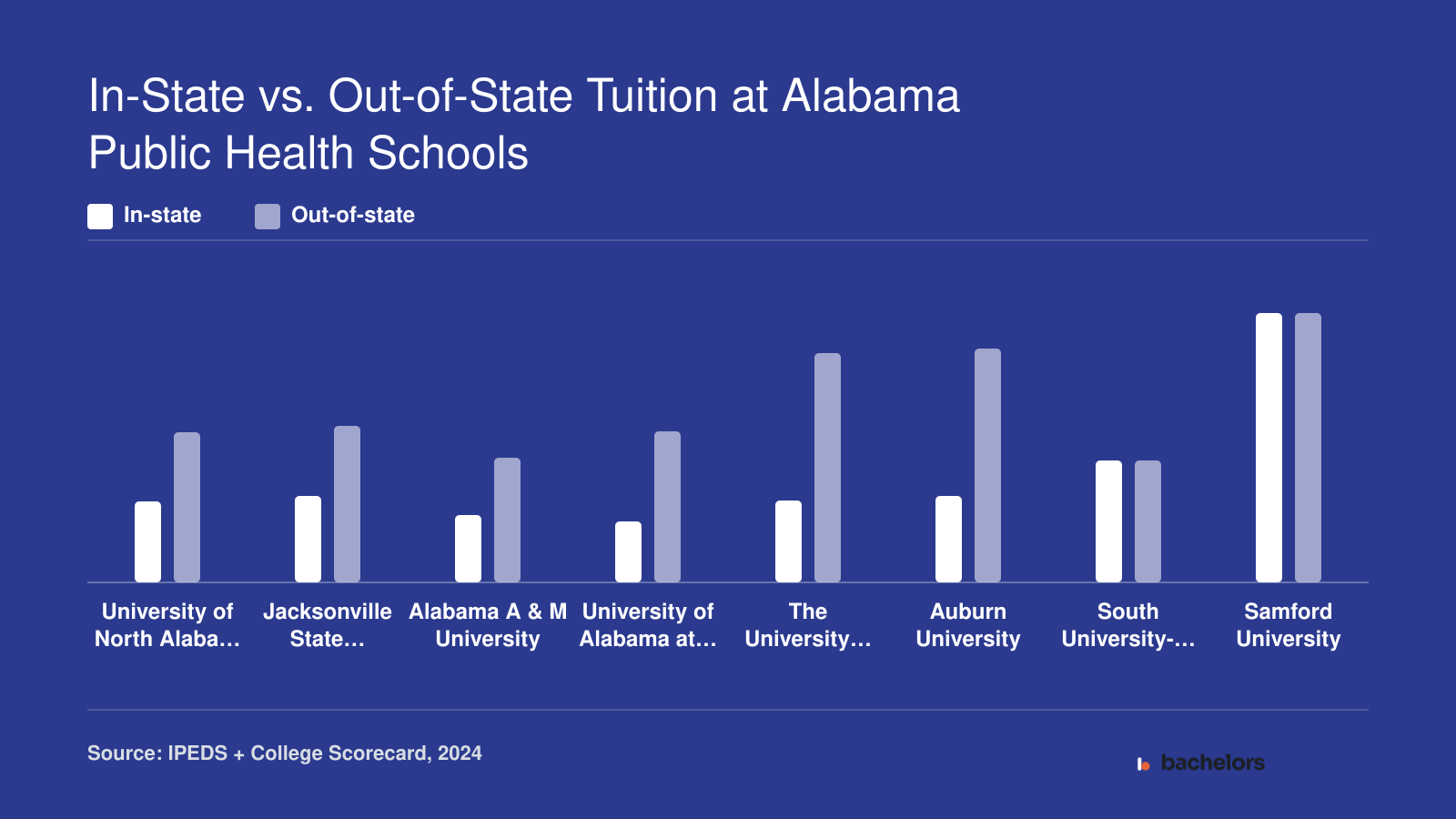
In-State vs. Out-of-State Tuition at Alabama Public Health Schools
Residency affects price most at Alabama's public universities. Auburn University shows the widest gap: in-state students pay $12,890 in tuition and fees, and out-of-state students pay $34,922, a difference of $22,032 a year. The University of Alabama is close behind at $21,992. University of Alabama at Birmingham has the lowest in-state rate at $9,098. Samford University ($40,150) and South University-Montgomery ($18,145) are private schools that charge every student one rate, so Alabama residency does not lower their price.
Public Health Careers and Jobs in Alabama With a Bachelor's Degree
A bachelor's degree in public health qualifies you for several entry-level roles in Alabama. Typical roles include:
- Health education specialist: designs and runs wellness programs for communities, clinics and schools.
- Community health worker: connects residents to care and social services.
- Program coordinator: manages grants, schedules and outcomes for a prevention program.
- Outreach or patient navigation specialist: helps patients use screening and follow-up services.
These jobs are found at state and county health departments, hospital systems and nonprofits.
What These Roles Pay
The Alabama Department of Labor's 2026 statewide estimates (built on May 2025 data) report entry, mean and experienced wages rather than medians. Health education specialists, about 540 jobs statewide, start around $43,797, average $67,468 and reach $79,303 at the experienced level. Community health workers, about 270 jobs, start around $35,269, average $46,663 and reach $52,361.1
For a national benchmark, the Bureau of Labor Statistics lists May 2025 median pay of $64,070 for health education specialists and $51,850 for community health workers.2 It projects 6% and 13% job growth respectively for 2025-2035.2 Treat the national medians as context, not as Alabama medians.
Licensure and the CHES Credential
Alabama has no single state license for public health work. The voluntary Certified Health Education Specialist (CHES) credential from NCHEC suits graduates aiming at health education roles. Eligibility rests on academic qualifications alone: a bachelor's degree plus either a major in a health education discipline or at least 25 semester credits covering the required areas of responsibility.3
Earnings Data and Next Steps
The program-level earnings in the table above describe what graduates of each school earn, which is a different measure from the occupational wages here. Use the table to compare schools and the wage figures to judge specific jobs.
Some graduates go on to an MPH, nursing or medical school, and the bachelor's degree can serve as a foundation for each.
Common Questions About Public Health Bachelor's Programs in Alabama
What is the cheapest public health degree in Alabama?
Can you get a bachelor's degree in public health online in Alabama?
Do you need a license to work in public health in Alabama?
Does CEPH accreditation matter for a bachelor's degree in public health?
Compare Public Health programs on the data that matters
Explore more Healthcare majors or browse every field of study.
All Healthcare programs Browse every field of study