Best Information Technology Schools in Alabama
Compare 9 accredited Information Technology programs in Alabama, with net price after aid, graduation rates, earnings and debt from IPEDS and the U.S. College Scorecard.

A bachelor's degree in information technology in Alabama trains you to run the systems a business depends on: networks, servers, cloud tenants, endpoints, and the security controls around them. It is usually awarded as a Bachelor of Science (B.S.) in Information Technology, offered on a Florence or Mobile campus or entirely online from an Alabama-based school.
Cost and outcomes diverge sharply. Median earnings five years after graduation and average net price after aid separate these programs more than the curriculum does.
The nine ranked Alabama schools all list the degree as information technology rather than computer information systems or information systems, though the courses behind the title still vary.
Key Points
- University of South Alabama IT grads earn $94,533 median after five years.
- Columbia Southern's $6,760 yearly tuition is lowest, but net price averages $14,580.
- Alabama Transfers maps community college credits; public universities expect a 2.0 GPA.
Best Bachelor's Degree in Information Technology Schools in Alabama, Ranked
Nine Alabama schools award a Bachelor of Science in Information Technology, from a Florence campus with ABET-accredited computing to fully online programs built for working adults. The list covers public, private, and online institutions, with concentrations that run from cybersecurity and digital forensics to UX and cloud computing. Each entry highlights what separates one program from the next.
University of North Alabama
#1Florence, AL · $12,000 – $22,000/yr (est.)
Best for: Shoals-area students targeting cybersecurity
The University of North Alabama is a public university in Florence whose B.S. in Information Technology sits in the Sanders College of Business and Technology, one of the few Alabama IT programs accredited by ABET's Computing Accreditation Commission. Students choose a concentration in software development, HCI/UX, or cybersecurity, and the university has paired the degree with a regional technology pipeline and transfer agreements with nearby community colleges. In-state tuition rates extend to students in Mississippi and Tennessee counties within 50 miles of campus.
- ABET Computing Accreditation Commission accredited
- Three concentrations: Software Development, HCI/UX, Cybersecurity
- Coursework in cloud computing, database management, networking
- On-campus tuition about $350 per credit hour plus fees
- In-state rates extend to nearby Mississippi and Tennessee counties
- Scholarship of Distinction in Computing open to computing majors
- Four-year completion for full-time students
- Sanders College of Business and Technology holds AACSB accreditation
University of South Alabama
#2Mobile, AL · $18,000/yr (est. net price)
Best for: Hands-on learners drawn to digital forensics
The University of South Alabama is a public research university in Mobile, and its IT degree runs through the School of Computing alongside computer science and information systems. The 120-credit program keeps general education broad, then places students in a 21-credit focus track: web publishing, networking, or digital forensics. A senior demo project and capstone close the degree, and no minor is required.
- 120 credit hours, including 53-56 in general education
- 21-credit focus track: Web Publishing, Networking or Digital Forensics
- Senior capstone and demo project required
- Minor not required
- Major courses require a grade of C or better
- IT core spans programming, networking, databases and systems architecture
Tuskegee University
#3Tuskegee, AL · $35,000/yr (est. net price)
Best for: HBCU students aiming at federal cyber service
Tuskegee University is a private, historically Black university that added its IT major in 2013 to train people to manage and secure systems for government and industry. The Department of Computer Science, part of the College of Business and Information Science, enrolls about 150 majors across four bachelor's programs. Its NSA and DHS designation as a National Center of Academic Excellence in Cyber Defense, plus an NSF-funded CyberCorps Scholarship for Service, make it a strong fit for students aiming at federal cyber roles.
- IT major added in 2013 to train systems and network managers
- Designated NSA/DHS National Center of Academic Excellence in Cyber Defense
- CyberCorps Scholarship for Service funded by NSF grants
- One of four B.S. majors in the Department of Computer Science
- IT electives must be 300- or 400-level CSIT or CSCI courses
- Minimum grade of C required in core English, economics, business and computing courses
- Department enrolls about 150 majors
Columbia Southern University
#4Orange Beach, AL · $15,000/yr (est. net price)
Columbia Southern University is a private institution based in Orange Beach that delivers its bachelor's programs fully online, with courses open around the clock. The IT degree is a 120-credit program that accepts up to 90 transfer credits and offers 11 start dates a year, which suits adults with prior college work or military training. Tuition is modest per credit hour, textbooks are included, and active-duty service members pay a reduced rate.
- 120 credit hours, fully online with 24/7 course access
- Transfer up to 90 credits
- 11 start dates each year
- Tuition $278 per credit hour; $250 for active-duty military
- Textbooks included in tuition
- SACSCOC institution with ACBSP-accredited business programs
Athens State University
#5Athens, AL
Athens State University is a public upper-division institution built almost entirely around transfer students and working adults, and a fully online option lets professionals keep working while they finish. Its IT bachelor's degree takes roughly two years for students who arrive with an associate degree. With Huntsville's defense, aerospace, cybersecurity, and government contracting employers nearby, the university also offers related certificates in cybersecurity operations and software systems.
- $270 per credit hour
- Fully online option available
- Average completion about two years, depending on transferred credits
- Designed for transfer students, working adults and IT professionals
- Coursework in networking, databases, programming and systems analysis
- Related certificates in cybersecurity operations and software systems
Oakwood University
#6Huntsville, AL · $25,000 – $30,000/yr (est.)
Oakwood University is a private, historically Black Seventh-day Adventist university in Huntsville that awards its IT bachelor's degree through LEAP, its adult degree completion program. Courses run asynchronously online in eight-week terms, and admission requires prior college credit, a 2.00 GPA, and either age 22 or an associate degree. Applicants with IT coursework or recent IT work experience can turn that background into a degree while staying employed.
- Offered through the LEAP adult degree completion program
- Asynchronous online courses in eight-week terms
- Requires 30 semester hours, a 2.00 GPA, and age 22 or an associate degree
- IT applicants need 10 hours of IT coursework or a year of IT work
- 120 credit hours, including 45 general education hours
- Credit for Prior Learning can cover up to 30 elective hours
- Tuition $378 per credit hour plus a $500 per-semester matriculation fee
Herzing University-Birmingham
#7Birmingham, AL · $15,000 – $20,000/yr (est.)
Herzing University's Birmingham campus serves working adults with career-focused programs, and its IT bachelor's degree is delivered entirely online. The 120-credit program takes an average of about 20 months, with coursework in networking, Linux administration, virtualization, ethical hacking, and cloud computing. Certification preparation for CCNA, CompTIA, and EC-Council exams is built into the plan, and students can swap up to 12 undergraduate credits for graduate coursework.
- 120 credits, average completion about 20 months
- Coursework in cloud computing, Linux, virtualization, ethical hacking and Python
- 3-credit capstone or internship closes the core
- Up to 12 undergraduate credits replaceable with graduate coursework
- Prepares students for CCNA, CompTIA and EC-Council exams
- Rolling admissions with no application deadlines
- Tuition $515 per credit hour; military rate $250 per credit hour
South University-Montgomery
#8Montgomery, AL · ~$28,000/yr (est.)
South University's Montgomery campus is part of a private system that emphasizes flexible scheduling for working students. The IT bachelor's degree runs 180 credits with three emphases: comprehensive, cybersecurity, and management. The cybersecurity track follows the NICE Cybersecurity Workforce Framework, and every cybersecurity course includes virtual lab work, which gives the program a more applied security focus than a general IT degree.
- 180 credit hours with three emphases: Comprehensive, Cybersecurity, Management
- 32-credit common core includes an IT capstone
- Cybersecurity emphasis follows the NICE Cybersecurity Workforce Framework
- All cybersecurity courses include virtual lab activities
- 48 general education credits plus 52 foundation credits
- Transfer entry with 24 or more quarter credit hours
- Admission requires a high school diploma with a 1.5 minimum CGPA
Strayer University-Alabama
#9Birmingham, AL · $10,000 – $15,000/yr (est.)
Strayer University's Alabama campus in Birmingham is part of a national system built around short, frequent terms and generous transfer credit. The IT bachelor's degree is 40 courses of 11 weeks each, with eight concentration options including artificial intelligence, cybersecurity, cloud computing, and data analytics. Students can take classes fully online or in person at select campuses, and up to 28 classes can transfer in.
- 40 courses of 11 weeks each
- Eight concentrations, including AI, cybersecurity and cloud computing
- AI and cloud computing concentrations available online only
- Tuition $1,555 per course plus a $65 technology fee each term
- Transfer up to 28 classes
- 100% online or in-person hybrid at select campuses
- 58.5 credits in major IT courses and 18 in a concentration
- MSCHE accredited
Cost & outcomes by school
Federal data for the highest-earning Information Technology programs, independent of the ranking above. Earnings are this field's bachelor's graduates four years after completing where the Scorecard reports them, else the school's undergraduate median.
| School | Net price / yr | Grad rate | Earnings | Debt | Grads/yr | Format |
|---|---|---|---|---|---|---|
| Athens State University AL | — | — | $102,639 | $22,750 | 17 | Online |
| Strayer University-Alabama AL | — | — | $82,304 | $37,500 | 15 | Online or campus |
| University of North Alabama AL | $12,170 | 55% | $80,423 | $27,000 | 76 | Campus |
| Columbia Southern University AL | $14,580 | 33% | $63,248 | $23,491 | 87 | Online |
| University of South Alabama AL | $17,648 | 53% | $59,602 | $26,328 | 23 | Campus |
| Tuskegee University AL | $35,013 | 55% | $49,641 | $27,000 | 4 | Campus |
| Oakwood University AL | $25,669 | 45% | $42,488 | $27,000 | — | Online |
| Herzing University-Birmingham AL | $19,651 | 13% | $36,909 | $21,500 | — | Online |
| South University-Montgomery AL | $27,807 | 9% | $34,421 | $26,123 | — | Online |
Sources: U.S. Department of Education. Net price, graduation rate, earnings and debt: College Scorecard (earnings and debt for this field's bachelor's graduates where reported, else school-wide); graduates: IPEDS. A dash means no figure is reported.
Cost, debt & payoff
Median earnings of this field's bachelor's graduates (4 yrs after completing, else the school's undergraduate median) vs. their median federal loan debt · U.S. College Scorecard
Across these programs the median graduate earns about $59,602 and finishes with roughly $26,328 in debt — a ratio that clears a common rule of thumb (keep debt below first-year salary). Net price and debt vary widely school to school, so check the per-school figures in the table above before you shortlist.
B.S. in Information Technology vs. CIS and Information Systems at Alabama Schools
At the bachelor's level, information technology is the hands-on side of computing: networks, servers, security, cloud systems and the people who use them. An Alabama IT bachelor's trains you to run and protect those systems, while CIS and information systems lean toward business process, data analysis and how software supports an organization. Computer science sits further toward theory, algorithms and software engineering.
What the program names show
All nine ranked schools list an information technology program, not a CIS or IS degree under a different name. The University of North Alabama, University of South Alabama, Columbia Southern University, Athens State University, Oakwood University, Herzing University-Birmingham, South University-Montgomery and Strayer University-Alabama all use "Information Technology" in the program name. Tuskegee University's information technology major sits alongside a Computer Science Information System option, so read the catalog carefully before you choose a track.
Why titles overlap
A CIS or IS program can include programming, databases and networking, and an IT program can include business courses. The difference is usually emphasis, not a wall between fields.
Check the concentration list first
- UNA: concentrations in software, UX and cybersecurity.
- South Alabama: three concentrations plus a 21-credit focus track.
- Strayer: eight concentrations, with 18 credits in the chosen area.
- South University-Montgomery: three concentrations and a 48-credit emphasis.
Then compare required courses. Herzing, for example, prepares students for CCNA and CompTIA exams, which signals a networking and support focus. The title tells you less than the course list does.
Online and Hybrid Bachelor's in IT Options at Alabama Schools
Several Alabama-based schools let you complete a Bachelor of Science in Information Technology fully online, and Strayer University-Alabama pairs online study with a Birmingham campus. The costs below are the per-credit or per-course rates each school publishes, so check how many credits you would still need before comparing totals. The University of North Alabama, the University of South Alabama and Tuskegee University list their IT bachelor's programs as campus-based.
| School | Location | Delivery format | Published cost | Program length | Notable features |
|---|---|---|---|---|---|
| Columbia Southern University | Orange Beach | Fully online | $278 per credit ($250 military rate) | 120 credit hours | 11 start dates per year, textbooks included in tuition, transfer up to 90 credits |
| Athens State University | Athens | Fully online | $270 per credit | 2-year program | Built for transfer students and working adults |
| Oakwood University | Huntsville | Fully online | $378 per credit | 120 credit hours | Asynchronous classes, eight-week terms, full-time and part-time options |
| Herzing University-Birmingham | Birmingham | Fully online | $515 per credit | 120 credit hours (20-month program) | Rolling admissions, prepares for CCNA and CompTIA exams, certification exam fees reimbursed |
| South University-Montgomery | Montgomery | Fully online | N/A | 180 credit hours (quarter system) | Cybersecurity emphasis follows the NICE framework, virtual labs in all cybersecurity courses |
| Strayer University-Alabama | Birmingham | Online or Birmingham campus | $1,555 per course plus $65 technology fee per term | 40 courses | 8 concentration options, transfer up to 28 classes, free course after every three passed |
Admission Requirements for Alabama IT Bachelor's Programs
At Alabama's public universities, a 2.0 cumulative college GPA is the standard transfer floor, and a second 2.0 often applies to each transferable course.1 Those two numbers decide more applications than any other admission rule, so start there.
GPA: the minimum is not the profile
A published minimum and an enrolling-class profile are different figures, and schools sometimes publish only one. A 2.0 keeps an application eligible; it does not describe who actually enrolls. When a school releases a middle-50% GPA range for its entering class, read that as a profile, not a cutoff. Many schools also recalculate your GPA on their own scale using only college-level academic coursework, so the number on your transcript and the number in your admission file can differ.
Where an IT program publishes no admission standard of its own, the university-wide freshman or transfer rule governs your application.3 When that happens, follow the general rule and confirm the details with an admissions counselor before you apply.
Test scores: conditional, not universal
Many Alabama universities stayed test-optional through the 2026 cycle, and what replaced blanket testing is a conditional rule.2 Applicants above a stated GPA threshold usually may apply without ACT or SAT scores; applicants below it usually must submit them. Transfer applicants with fewer than roughly 24 semester hours of college credit often fall under freshman rules, which can pull a test score back into the file.4 Ask which policy applies to you before you pay for a test date.
Transfer credit: read the exclusions
What counts is normally academic coursework from an accredited institution. Technical, vocational, remedial and military training typically fall outside the transferable total, and official evaluation usually happens after you are admitted, not before.1 That sequencing matters, because you may not learn how many credits survived until you have already committed.
The takeaway on selectivity
Selectivity varies across the schools ranked here, from relaxed to moderately competitive, and the IT major itself is rarely the bottleneck. What actually decides your file is the GPA floor, whether a test score is required for someone in your position, and how many earned credits clear the transfer audit. Confirm all three in writing before the deadline.
Transferring From an Alabama Community College Into an IT Bachelor's Program
How the Statewide System Works
Alabama Transfers (formerly STARS) is the state's transfer-planning system for moves from public two-year colleges to public universities. Its Computer Science & Information Technology pathway lists participating universities and the requirements specific to each school and major. Pick your intended major and university, and the system builds an Official Transfer Guide for your first two years. Once it's submitted, every Alabama public university offering that major must honor it for four years, provided you follow its instructions. Some universities add courses beyond the standard pathway. One participating school, for example, requires nine extra semester hours, including an advanced C++ programming course.
Four Practical Steps
- Choose your target early: Decide which bachelor's program you want before you register for associate-level courses.
- Match the associate track: Build your Transfer Guide around the IT or CIS pathway, not a general degree.
- Confirm which credits count: Ask the university in writing how each course applies to the major, not just to elective hours.
- Meet a transfer advisor: Do this at both schools before your final year.
Named Agreements and the Credit Risk
Graduates can move into UNA's Interdisciplinary Studies program for a B.S. or B.A., with up to 30 hours of block credit for technical coursework and up to 49 transferable hours overall. That is not direct entry into an IT major, and qualifying students may also get transfer scholarships or a 20% tuition discount. Another community college lists Athens State University among its articulation partners, but its source does not say which agreements cover IT.
Credits are lost when an associate degree doesn't line up with the bachelor's program, so confirm alignment before you enroll.
What a Bachelor's in IT Costs in Alabama: Tuition, Net Price and State Aid
Published tuition and what families actually pay can differ sharply. Columbia Southern University lists the lowest tuition and fees in this table at $6,760 a year, yet its average net price after aid ($14,580) runs above the University of North Alabama's $12,170. The public universities in Florence and Mobile charge Alabama residents far less than out-of-state students, while the private schools charge everyone the same rate. Treat each net price as a federal, institution-wide average for aided undergraduates rather than a quote for your household, then layer in state aid. The need-based Alabama Student Assistance Program pays $300 to $5,000 a year to Alabama residents enrolled at least half time (some schools publish a lower working cap of $2,500). The Alabama Student Grant Program serves residents enrolled full or half time. ANGEAP helps Alabama National Guard members in good standing who have completed basic training. You apply for these state awards through your school's financial aid office, and the fall 2026 state grant deadline was Sept. 15. File the FAFSA as early as possible each year, and ask each school directly about its own merit awards, such as UNA's Scholarship of Distinction in Computing.
| School | City | Sector | Program format | In-state tuition and fees (per year) | Out-of-state tuition and fees (per year) | Average net price after aid | Published per-credit rate |
|---|---|---|---|---|---|---|---|
| University of North Alabama | Florence | Public | Campus | $12,120 | $22,320 | $12,170 | $350 |
| Columbia Southern University | Orange Beach | Private for-profit | Online | $6,760 | $6,760 | $14,580 | $278 ($250 military rate) |
| University of South Alabama | Mobile | Public | Campus | $10,116 | $19,092 | $17,648 | N/A |
| Herzing University-Birmingham | Birmingham | Private nonprofit | Online | $13,450 | $13,450 | $19,651 | $515 |
| Oakwood University | Huntsville | Private nonprofit | Online | $22,512 | $22,512 | $25,669 | $378 |
Accreditation, Concentrations and Cybersecurity Pathways
Accreditation attaches to a named program, not to a university's reputation, and a hiring manager in Huntsville or a federal contracting officer can verify it in minutes.
What ABET covers, and what it does not
ABET reviews computing degrees through its Computing Accreditation Commission (CAC) and engineering technology degrees through the Engineering Technology Accreditation Commission (ETAC). A directory entry names the exact program title and the commission behind it, and that title does not always match the name used on the admissions page. Check the entry against the specific degree and the specific campus you plan to attend, because a school can hold ABET status for one program and not another.
Plenty of solid information technology programs are not ABET-accredited. Some sit inside a business college and carry AACSB accreditation instead; others rest on the university's regional accreditation. Absence of ABET status is not evidence of a weak program. It usually means the curriculum was built toward business process, project management and applied systems work rather than engineering-style outcomes. Ask what a program's accreditation actually covers before you read anything into it.
Cyber designations and concentrations
The National Security Agency's Centers of Academic Excellence in Cyber Defense (CAE-CD) designation is the other label worth knowing. The University of South Alabama's School of Computing holds CAE-CD status through academic year 2027 and added a cybersecurity research designation in 2024 that runs through 2029. Athens State University is an NSA-designated CAE in cyber defense education, with cybersecurity operations as its designated program of study.
Concentrations at Alabama IT programs cluster around networking, digital forensics, software development, human-computer interaction and UX, and applied AI. Which of those a school actually offers matters more to your first job than the wording on the diploma.
Why the letters matter
Federal job announcements and defense contracts sometimes specify an ABET-accredited degree, and some employer tuition assistance plans require programmatic or regional accreditation before they reimburse a credit. A CAE-CD program signals coursework mapped to federal cyber defense criteria. For most private-sector IT roles, the degree plus certifications and internship experience still carry more weight than either designation.
Related Articles
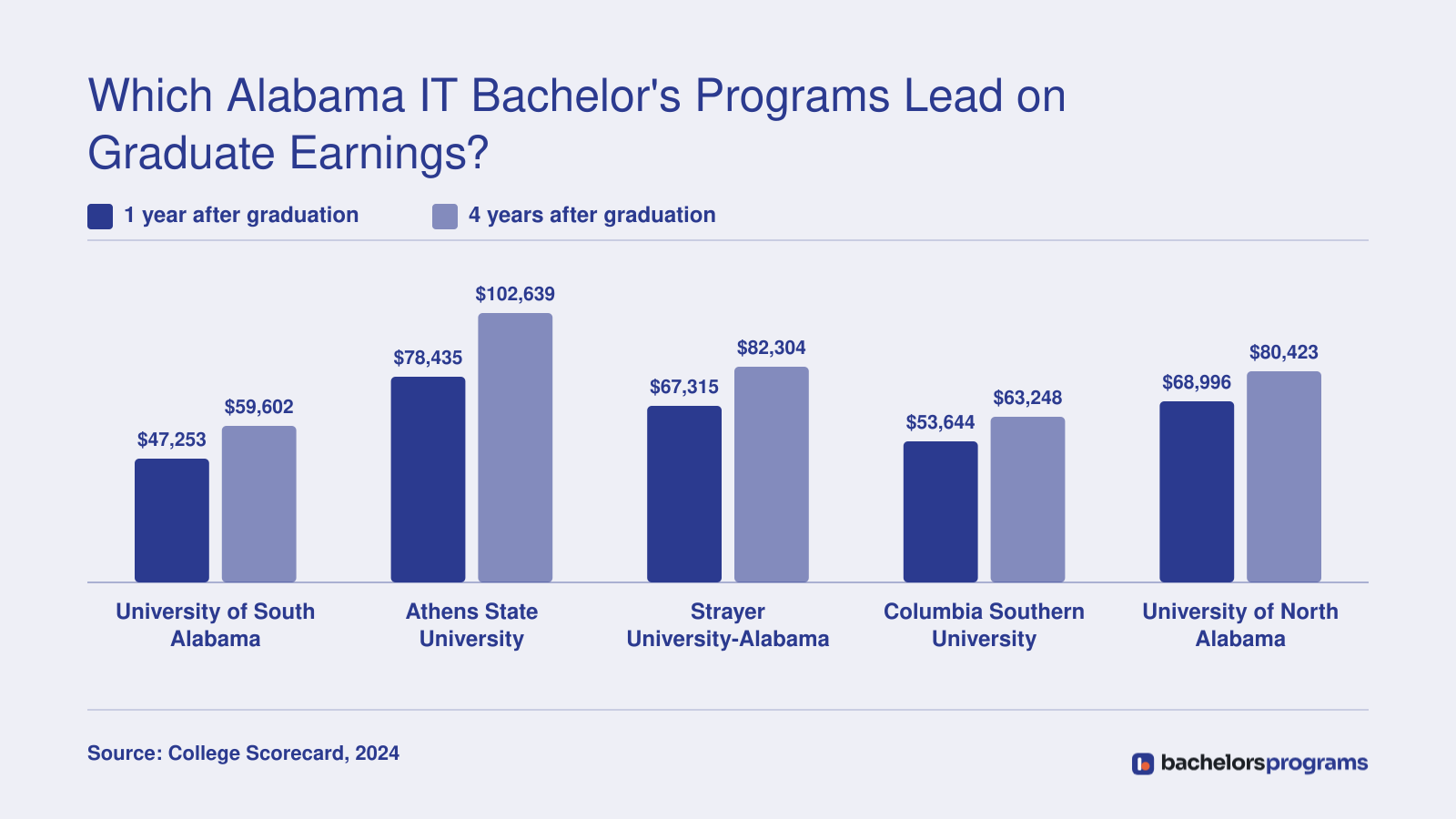
Which Alabama IT Bachelor's Programs Lead on Graduate Earnings?
These figures track graduates of each school's information technology bachelor's program, not the university as a whole. The University of South Alabama leads with median earnings of $94,533 five years after finishing, against a median debt of $26,328, or about $279 a month on a 10-year plan. The chart compares median pay one year and four years after graduation, the windows reported for every school shown.
IT Careers and Salaries in Alabama
Treat salary research as a short project, not a single figure to memorize. Start at BLS.gov and open the Occupational Employment and Wage Statistics (OEWS) data. Select Alabama, then the Huntsville and Birmingham-Hoover metro areas, and choose the occupation codes for network and computer systems administrators, information security analysts, and computer user support specialists. National May 2025 medians give you a benchmark: $99,130 for network and computer systems administrators, $129,180 for information security analysts, and $62,890 for computer support specialists, the broader BLS group that includes user support.1 BLS projects a 4% national decline for network and systems administrators from 2025 to 2035, a loss of about 13,200 jobs, so compare that national trend with local listings instead of assuming Alabama follows the same path.
Test Demand Against Live Postings
State and metro tables can lag or omit a detailed occupation. Cross-check what you find with the Alabama Department of Labor's WorksIQ data, the Huntsville/Madison County and Birmingham Business Alliance economic development sites, and the career pages of the IT and cyber employers that appear in your searches. Run LinkedIn and Indeed searches filtered by metro and job title, then note which skills and certifications repeat. For wage context, Huntsville's all-occupations mean wage was $34.18 per hour in May 2025, slightly above the $33.54 national mean, though that figure is not IT-specific.2
Compare Programs and Credentials
Visit program pages for the bachelor's degree in information technology options on your shortlist, plus community college transfer and bootcamp pages, and compare tuition, scheduling, and outcome disclosures. Check ISC2, ISACA, and CompTIA for certification paths and career resources, then confirm which credentials local postings actually request.
Quick Checklist
- BLS OEWS: Pull state and metro tables for each target occupation.
- Local postings: Search LinkedIn and Indeed by metro and title.
- Employer pages: Follow career pages for recurring IT and cyber roles.
- School pages: Compare tuition, format, and outcome disclosures.
- Associations: Review ISC2, ISACA, and CompTIA certification pages.
Salary and employment figures change annually. Use the most recent BLS release and current local postings, not a static summary.
How to Choose the Right Alabama IT School
Three checks separate a good fit from a costly mistake: ABET status, net price and the program's actual title. Run them before you compare anything else.
The Three Checks That Matter Most
- ABET status: Confirm whether the specific bachelor's program, not just the school, holds ABET accreditation. Some employers and graduate pathways care about it, and others do not.
- Net price: Compare what you would pay after grants and scholarships, not the sticker tuition.
- Program title: A B.S. in Information Technology is not the same as computer information systems or information systems. Read the course list to see whether it leans toward networking, systems administration and security or toward software and business analysis.
Picks by Student Type
- Working adult: Start with Columbia Southern University, whose B.S. in Information Technology is built around distance learners. Strayer University-Alabama and Herzing University-Birmingham are also worth a look if you want flexibility. Confirm each school's online or hybrid format before you apply.
- Transfer student: Prioritize schools with clear articulation for community college credits, such as Athens State University and the University of North Alabama. Ask for a written credit evaluation before you commit.
- Career changer: Match the concentrations and certification prep to the job you want, whether that is security, networking or support. Ask what industry certifications the coursework prepares you for.
- Cost-focused student: Look first at public options like the University of South Alabama, then price out state aid and institutional scholarships against private schools.
Next Step
Pick the two or three schools that fit your profile and request program information from each. Ask about ABET status, transfer credit policy and net price for your situation. The answers will narrow your list faster than any brochure.
Compare Information Technology programs on the data that matters
Explore more Computers & IT majors or browse every field of study.
All Computers & IT programs Browse every field of study