Best Forensic Science Schools in Alabama
Compare 5 accredited Forensic Science programs in Alabama at 4 colleges, with net price after aid, graduation rates, earnings and debt from IPEDS and the U.S. College Scorecard.

A bachelor's degree in forensic science, whether a Bachelor of Science (B.S.) or a Bachelor of Arts (B.A.), is harder to find in Alabama than the major's popularity suggests. The field here is small, and some listings are adjacent programs or minors rather than a major titled forensic science.
Each school below, campus or online, comes with detail on FEPAC status, admissions, cost and careers. Alabama State University stands out for its link to the Alabama Department of Forensic Sciences.
Because program titles vary from forensic chemistry to forensic investigation, the curriculum tells you more than the name on the diploma.
Key Points
- Alabama State University offers B.S. degrees in forensic chemistry and forensic biology.
- Alabama A & M charges $10,024 in-state; Talladega College charges $15,650.
- Alabama does not license forensic science technicians.
Best Bachelor's in Forensic Science Schools in Alabama
Four Alabama colleges appear here for students who want a bachelor's degree in forensic science or a very close forensic major. Every card names the credential exactly as the school awards it, along with the tracks or concentrations and the delivery format. The graduation rate printed on each card is institution-wide rather than program-specific, and the net price is an approximate average after aid, so treat both as context for comparing colleges rather than as a precise cost for one major. Where a listing is a chemistry or investigation major with a forensic track rather than a stand-alone forensic science bachelor's, the card says so.
Jacksonville State University
#1Jacksonville, AL · $10,000 – $15,000/yr (est.)
Best for: Students pairing a major with a forensics minor
Jacksonville State University, a public university in northeast Alabama, admits forensic students as Forensic Investigation Undecided and asks them to choose a track, Criminal Investigations or Forensic Laboratory/Technician, after a 15-credit lower-division core. Upper-division coursework requires a 2.5 overall GPA and a 2.5 GPA in forensic courses. The department also runs four forensic minors, including digital forensic investigation, which makes it a practical stop for students majoring in another field who want a forensic credential alongside it.
- Enter as Forensic Investigation Undecided, then choose a track
- Two tracks: Criminal Investigations or Forensic Laboratory/Technician
- Lower-division core: five courses, 15 semester hours
- 2.5 overall and 2.5 forensic GPA required for upper division
- Four minors: forensic, advanced forensic, digital forensic, analysis
- Separate plan of study published for each track
- Graduates' median earnings: $50,281 four years after completion
Alabama State University
#2Montgomery, AL · $20,000 – $25,000/yr (est.)
Best for: Students seeking a stand-alone forensic science major
Alabama State University awards a Bachelor of Science in Forensic Science and describes its undergraduate program as the only forensic science bachelor's at a public university in Alabama. Students work in the Robert C. Hatch Forensic Science Building, shared with the Alabama Department of Forensic Sciences, and finish with a capstone research project or an internship. A forensic science master's on the same campus gives graduates a local route to continue, and the program has a forensic science club and honor society.
- Chemistry track of the forensic science bachelor's degree
- Training in crime scene processing and toxicology
- Capstone or senior research project required to graduate
- Forensic Science Club and honor society on campus
- Direct path to ASU's Master of Science in Forensic Science
- Biology track of the forensic science bachelor's degree
- Forensic laboratories and a moot courtroom inside the building
- Building shared with the Alabama Department of Forensic Sciences
- Applications handled through the Physical Sciences office
- One of two forensic science bachelor's options at ASU
Talladega College
#3Talladega, AL · ~$16,000/yr (est.)
Best for: Chemistry majors who want a forensic focus
Talladega College is a small private college, and its forensic route is a concentration inside the chemistry major rather than a stand-alone forensic science bachelor's degree, so read this listing carefully if you want the words forensic science on your diploma. The major takes 50 semester hours and requires a C or better in every chemistry course. Coursework pairs Introduction to Forensics and an instrument-heavy Forensic Chemistry lab with criminal justice classes such as forensic psychology and criminal investigation. Admission is test optional with a 2.0 unweighted GPA minimum and a $25 application fee.
- Forensic concentration inside the chemistry major
- 50 semester hours in the major, 121 or 122 total hours
- C or better required in all chemistry courses for the major
- Introduction to Forensics covers DNA profiling and PCR
- Forensic Chemistry lab covers chromatography and spectroscopy
- Includes forensic psychology and criminal investigation courses
- Test optional, 2.0 GPA minimum, $25 application fee
Alabama A & M University
#4Normal, AL · ~$18,000/yr (est.)
Alabama A&M University lists a Bachelor of Chemistry with a concentration in Forensic Chemistry among its undergraduate degrees. The program sits in the Physics, Chemistry and Math department, one of three departments in the College of Engineering, Technology and Physical Sciences, which also offers chemistry tracks paired with a minor in mathematics or biology. The published department page is thin on credit totals and admission requirements for the forensic concentration, so plan to confirm details with the department before you apply.
- Forensic chemistry concentration within the chemistry bachelor's
- Housed in the Physics, Chemistry and Math department
- College of Engineering, Technology and Physical Sciences
- Chemistry tracks can pair with a math or biology minor
Cost & outcomes by school
Federal data for the highest-earning Forensic Science programs, independent of the ranking above. Earnings are this field's bachelor's graduates four years after completing where the Scorecard reports them, else the school's undergraduate median.
| School | Net price / yr | Grad rate | Earnings | Debt | Grads/yr | Format |
|---|---|---|---|---|---|---|
| Jacksonville State University AL | $14,279 | 55% | $50,281 | $23,250 | 68 | Campus |
| Alabama A & M University AL | $17,621 | 24% | $40,628 | $31,000 | — | Campus |
| Alabama State University AL | $20,435 | 30% | $34,502 | $31,000 | 13 | Campus |
| Talladega College AL | $15,560 | 31% | $32,229 | $28,500 | — | Campus |
Sources: U.S. Department of Education. Net price, graduation rate, earnings and debt: College Scorecard (earnings and debt for this field's bachelor's graduates where reported, else school-wide); graduates: IPEDS. A dash means no figure is reported.
Cost, debt & payoff
Median earnings of this field's bachelor's graduates (4 yrs after completing, else the school's undergraduate median) vs. their median federal loan debt · U.S. College Scorecard
Across these programs the median graduate earns about $34,502 and finishes with roughly $31,000 in debt — a ratio that clears a common rule of thumb (keep debt below first-year salary). Net price and debt vary widely school to school, so check the per-school figures in the table above before you shortlist.
How We Ranked Alabama's Forensic Science Schools
This ranking compares bachelor's-level programs in forensic science and closely related fields, such as forensic chemistry, forensic biology and forensic investigation, at schools based in Alabama. Programs offered on campus and online are both considered. Three points explain how the list was built and where it falls short.
- Who is included: Only Alabama-based schools with a qualifying bachelor's program appear. A school that offers no program in forensic science or a closely related field is not on the list, and some of the programs here are chemistry degrees with a forensic focus, so check each school's curriculum.
- Institution-wide figures: Graduation rate and net price describe the whole school, not the forensic science program alone. A program's own cost or completion rate may differ from what you see here.
- Not a guarantee of fit: The ranking does not replace a look at each school's program page. Course requirements, lab access and any accreditation status are worth confirming directly before you apply.
Use the list to narrow your options, then verify the details with the admissions office at each school that interests you.
What a Bachelor's Degree in Forensic Science Involves in Alabama
Two decisions shape a forensic science bachelor's degree before a student ever enters a lab: the credential (Bachelor of Science or Bachelor of Arts) and the track (forensic chemistry or forensic biology). In Alabama, the programs on this list award the B.S., the science-heavy version built on chemistry, biology and instrumental analysis; a B.A. would typically trade some laboratory depth for a broader liberal arts load. The track matters more for day-to-day coursework. Forensic chemistry leans on toxicology, drug analysis and instrumentation; forensic biology leans on DNA, serology and molecular biology.
Credits and Time to Finish
Most bachelor's degrees in forensic science require roughly 120 semester credit hours and take four years of full-time study, combining general education, core science sequences (general and organic chemistry, biology, calculus, statistics) and upper-division forensic coursework. Criminalistics, evidence handling and a criminal justice or law component usually appear as well. Students who attend part-time, repeat gatekeeper chemistry courses or add a minor should plan on longer. The honest answer to how long a forensic science degree takes in Alabama: four years is the standard, not a guarantee.
Lab, Internship and Capstone Work
Alabama State University's B.S. degrees in forensic chemistry and forensic biology are housed in the Robert C. Hatch Forensic Science Building, a roughly 50,000-square-foot facility shared with the Alabama Department of Forensic Sciences. That arrangement puts students close to working casework. Seniors may complete a research project or gain field experience through an internship; internships are encouraged rather than mandatory, while the capstone itself is a senior research project.
FEPAC Status and Accreditation
FEPAC, the Forensic Science Education Programs Accreditation Commission, accredits forensic science programs specifically; regional accreditors such as SACSCOC accredit the institution. Alabama State holds SACSCOC accreditation, and its program materials do not describe the bachelor's degrees as FEPAC-accredited, so confirm current status directly with the program and with FEPAC's list before applying. Jacksonville State University frames its offering as forensic investigation, while Talladega College and Alabama A&M University list chemistry degrees, so verify each program's curriculum and accreditation directly.
Online and Hybrid Bachelor's in Forensic Science Options at Alabama Schools
Can you earn a bachelor's degree in forensic science fully online in Alabama? Not from the schools covered here. Jacksonville State University, Alabama State University, Talladega College and Alabama A & M University all list their forensic programs as campus-based, and none of their current program pages advertise an online or hybrid track.
Why the Lab Work Stays In Person
Forensic science is a laboratory discipline, and the programs are built around it.
- Alabama State University: Students work in the 50,000-square-foot Robert C. Hatch Forensic Science Building, shared with the Alabama Department of Forensic Sciences. Coursework includes Forensic Microscopy and Lab and Forensic Toxicology.
- Talladega College: Most chemistry courses carry a required lab, with hands-on techniques such as chromatography and spectroscopy.
- Alabama A & M University: The forensic chemistry option sits inside a Bachelor of Chemistry in the College of Engineering, Technology and Physical Sciences, so instrument and lab time comes with the major.
Internships add another in-person layer. Alabama State lets seniors choose between a research project and an internship, and its page does not state hours or whether placements can be remote.
Adjacent Majors and Degree Completion
The closest thing to a flexible path is Jacksonville State's Forensic Investigation program, which sits within criminal justice rather than the lab sciences. It leans toward crime scene and investigative work, but its program page does not describe online delivery. None of the four schools' pages describe a degree-completion route for forensic science either.
If you need an online or hybrid format, ask each admissions office directly whether any courses are offered remotely, and expect any lab, practicum or internship component to happen on site.
Admissions for Alabama Bachelor's in Forensic Science Programs
A test-optional label sounds flexible, but the fine print can still ask for scores. That is the first thing to check at Alabama State University, which is the only school here with a detailed policy to report.
Alabama State University
- GPA: No single universal minimum. Regular admission uses a sliding scale of GPA bands (2.00 to 2.49, 2.50 to 2.99, and 3.00 to 3.49).
- Tests: The school calls itself test-optional, yet the scale pairs each band with scores. A 2.00 to 2.49 GPA pairs with an ACT of 18 or SAT of 940 to 970. A 2.50 to 2.99 GPA pairs with ACT 17 or SAT 900 to 930. A 3.00 to 3.49 GPA pairs with ACT 16 or SAT 860 to 890. Some tiers waive scores, including a 2.4 or higher GPA under Tier II and a 2.1 to 2.39 GPA under Tier III.
- Transfers: You need at least 15 attempted college-level credits and a cumulative 2.0 GPA. With 14 or fewer, you apply as a freshman transfer and submit all college transcripts, your high school transcript, and ACT or SAT scores. Credit comes only from regionally accredited institutions. Up to 30 credits from test scores, military training, corporate training, or similar sources may count.
- Science prerequisites: None specified for the forensic chemistry or forensic biology tracks, though the coursework builds on chemistry and biology.
Other Schools on This List
- Jacksonville State University: No published policy.
- Talladega College: No published policy.
- Alabama A & M University: No published policy.
Do not assume these schools follow Alabama State's rules. Confirm GPA, test requirements, transfer limits, and any high school chemistry, biology, or math expectations with each admissions office before you apply.
Related Articles
Cost of a Bachelor's in Forensic Science in Alabama
The cost of a bachelor's degree in forensic science in Alabama has two parts: the tuition and fees on the bill, and the net price, which is what families pay on average after grants and scholarships. The two figures answer different questions, so compare both.
Tuition and Net Price
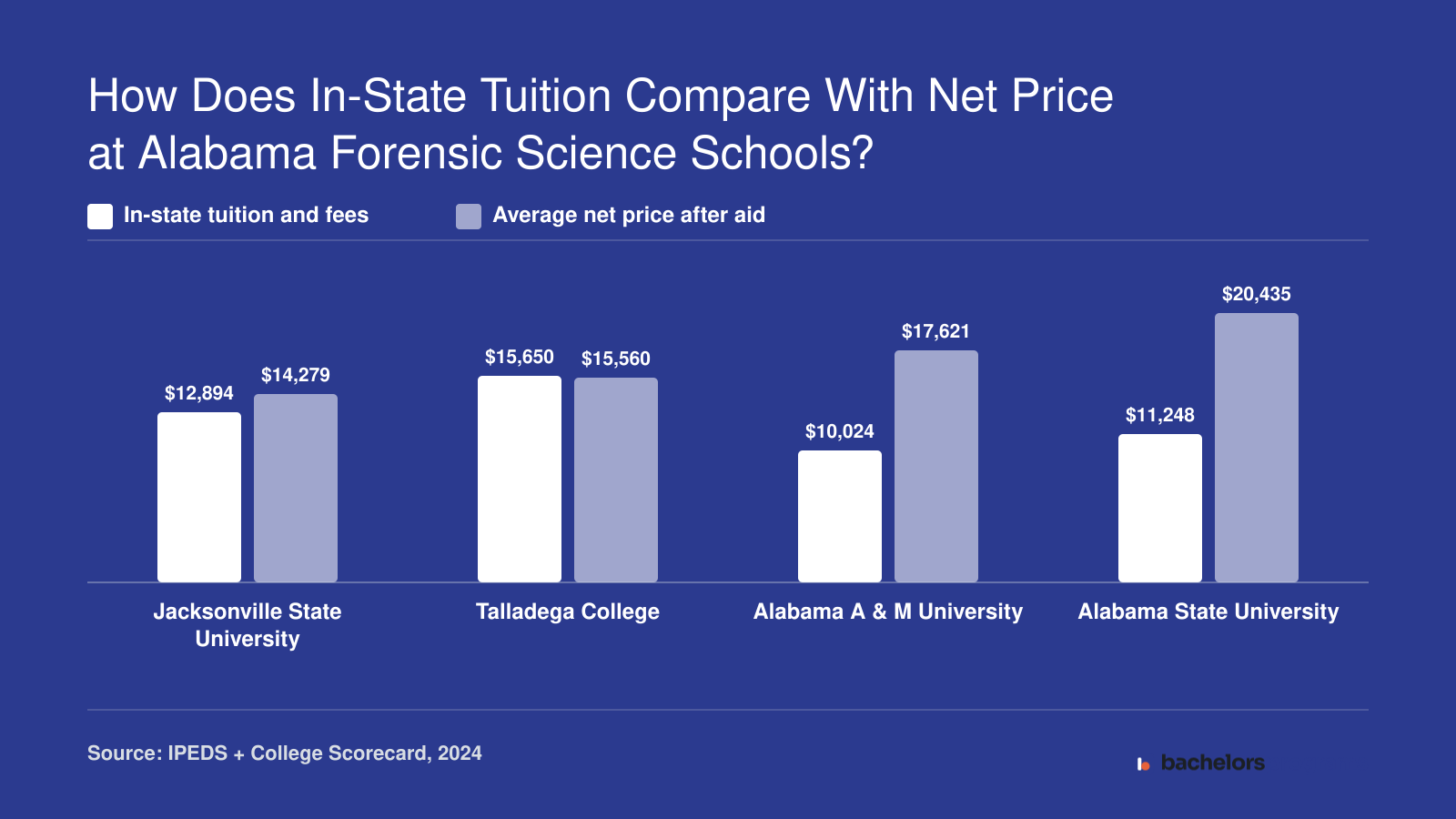
In-state tuition and fees run from about $10,024 at Alabama A & M University to $15,650 at Talladega College. Jacksonville State University is $12,894, and Alabama State University is $11,248.
Net price is an institution-wide average, not a forensic science figure, and it usually folds in housing and living costs. That is why it can exceed tuition:
- Jacksonville State University: $14,279
- Talladega College: $15,560
- Alabama A & M University: $17,621
- Alabama State University: $20,435
Use these as a rough guide to total yearly cost, and ask each school for a personal estimate.
Debt Among Completers
Program-level debt data is limited. For Jacksonville State, federal data for the program's field of study shows median debt of $23,250 among completers, based on the 2022 reporting year. The other schools here have no comparable program-level figure, so we do not estimate one.
State Aid and Scholarships
The Alabama Student Assistance Program gives Alabama-resident undergraduates between $300 and $2,500 per year. Income limits, deadlines and participating campuses can change, so confirm the current rules with each school's financial aid office. The Alabama National Guard Education Assistance Program is a separate option for eligible service members. It is described as covering tuition, fees, books and supplies, but check eligibility and any award cap directly.
Institutional aid varies by campus. Talladega College and Jacksonville State both note that scholarships or financial aid are available, and Alabama State University publishes a page on state grants. Most schools set their own scholarship applications and deadlines, so apply early.
A Practical Tip
File the FAFSA as soon as it opens, since it drives federal, state and most institutional aid. Then read each school's scholarship page for department awards, and ask whether forensic or chemistry majors qualify for anything extra.
How Does In-State Tuition Compare With Net Price at Alabama Forensic Science Schools?
In-state tuition and fees are lowest at Alabama A & M University ($10,024) and highest at Talladega College ($15,650), where in-state and out-of-state rates are the same. Net price is a different measure: it is the full yearly cost of attendance, including housing, food and books, minus the average grants and scholarships students receive. That is why net price runs above sticker tuition at the public schools, from $14,279 at Jacksonville State University to $20,435 at Alabama State University. Net price is an approximate institution-wide average for full-time students, not a figure for the forensic science major alone.
Forensic Science Credentials in Alabama at a Glance
Alabama Forensic Science Technician Median Wage
For Alabama graduates with a bachelor's degree in forensic science, the national wage is the clearest pay benchmark.
Forensic Science Schools in Alabama: Common Questions
These answers cover the questions students ask most about bachelor's degrees in forensic science in Alabama. Details such as accreditation, format and credit requirements can change, so confirm them with each school before you apply.
What is the best forensic science school in Alabama?
Does Alabama have FEPAC-accredited forensic science programs?
Can you get a bachelor's degree in forensic science online in Alabama?
How long does it take to get a bachelor's degree in forensic science in Alabama?
What jobs can you get with a forensic science degree in Alabama?
Compare Forensic Science programs on the data that matters
Explore more Criminal Justice & Law majors or browse every field of study.
All Criminal Justice & Law programs Browse every field of study