Best Computer Science Schools in Alabama
Compare 26 accredited Computer Science programs in Alabama at 16 colleges, with net price after aid, graduation rates, earnings and debt from IPEDS and the U.S. College Scorecard.

Auburn University charges Alabama residents $12,890 a year, and low in-state tuition is the strongest argument for earning a bachelor's degree in computer science here. Schools award a Bachelor of Science (B.S.) or, at Talladega College, a Bachelor of Arts (B.A.) in Computer Science.
Residency changes the math. Nonresidents at the state's public universities pay $8,976 to $14,276 more per year, so net price, ABET accreditation and online delivery deserve as much scrutiny as rank.
The jobs are in-state too. Huntsville's aerospace and defense contractors and Birmingham's health and finance employers hire graduates, though Alabama pay often trails national figures, which makes a low tuition bill count twice.
Key Points
- Auburn University ranks first, graduating 82 percent of its students.
- Net price at University of North Alabama averages just $12,170 a year.
- Out-of-state students pay $8,976 to $14,276 more yearly at Alabama publics.
Best Bachelor's Degree in Computer Science Programs in Alabama: Our Ranked List
Auburn University takes the top spot: it is the most selective public computer science program here at roughly 46 percent admitted, it graduates 82 percent of its students, and its in-state tuition of $12,890 undercuts most of the private colleges on the list. The nine schools that follow trade some of that scale for lower prices, smaller cohorts, or a sharper focus, from Huntsville's defense and aerospace corridor to cybersecurity-heavy online degrees. Tuition, net price, and graduation rates in each entry are institution-wide figures, not results for the computer science program alone.
Auburn University
#1Auburn, AL · $13,000 – $35,000/yr (est.)
Best for: Students wanting a large research campus
Auburn is the most selective public option on this list, and its Bachelor of Science in Computer Science is the flagship route into software, systems, and theory work. Coursework runs from algorithms and operating systems to networks and theoretical computer science, with electives in artificial intelligence, machine learning, and big data, plus hands-on time with the systems and tools employers use. The university admits about 46 percent of applicants and graduates 82 percent of its students; in-state tuition is $12,890 and the average net price after aid is $24,323.
- Covers algorithms, operating systems, networks, and theoretical computer science
- Electives in artificial intelligence, machine learning, and big data
- Hands-on exposure to computer systems, tools, and techniques
- Tracks: Artificial Intelligence, Machine Learning
- Preparation for software-related careers
University of Alabama in Huntsville
#2Huntsville, AL · $19,000/yr (est. net price)
Best for: Huntsville interns in defense and aerospace
UAH sits beside Cummings Research Park and Redstone Arsenal, which puts NASA's Marshall Space Flight Center, the Missile Defense Agency, and a dense cluster of aerospace, defense, and government employers within internship and co-op range. Its Bachelor of Science in Computer Science is ABET accredited and lets students add concentrations in cybersecurity, data science, entertainment computing, or web programming. The university admits about 69 percent of applicants and graduates 64 percent of its students; in-state tuition is $10,374 and the average net price is $18,796.
- ABET accredited computer science program
- Optional concentrations in cybersecurity, data science, and entertainment computing
- Web programming concentration with web development electives
- Core work in algorithms, data structures, computer architecture, and logic
- Electives in cloud computing, mobile app development, and computer graphics
University of South Alabama
#3Mobile, AL · $18,000/yr (est. net price)
Best for: Students curious about cybersecurity and graphics
South Alabama's School of Computing runs a campus-based Bachelor of Science in Computer Science built on programming, data structures, software engineering, networking, and computer architecture. Electives range across cybersecurity and information assurance, big data, graphics, game development, and robotics. Graduates of the program reported median earnings of about $80,300 four years after finishing. In-state tuition is $8,976 and the average net price is $17,648; the university admits about 71 percent of applicants and graduates 53 percent of its students.
- Core sequence in programming, data structures, software engineering, and networking
- Electives in cybersecurity, information assurance, big data, and robotics
- Computer graphics and video game development electives
- ABET accredited curriculum
- Tracks: Cybersecurity, Computer Graphics
University of Montevallo
#4Montevallo, AL · $14,000 – $27,000/yr (est.)
Montevallo awards a Bachelor of Arts in Computer Science rather than a B.S., which suits students who want room for a minor or second major and a world language alongside the technical core. The 36-credit major covers programming, algorithms, operating systems, databases, software engineering, and a senior seminar, with electives in artificial intelligence and data analytics. In-state tuition is $12,090 and the average net price is $17,683; the university admits about 54 percent of applicants and graduates 54 percent of its students.
- Bachelor of Arts with a 36-credit computer science major
- Core courses in programming, algorithms, operating systems, databases, and software engineering
- Electives include artificial intelligence and data analytics
- 120 total credits plus a minor or second major
- Second-year world language requirement for the B.A.
- 2.0 GPA required in major courses and upper-division math
Spring Hill College
#5Mobile, AL · $20,000/yr (est. net price)
Spring Hill delivers its Bachelor of Science in Computer Science entirely online with a cybersecurity concentration, built on a Jesuit liberal arts base and small classes averaging about 13 students. Admissions are test-optional with no entrance exam and a free application, which makes it the most flexible entry on this list for working adults. Tuition is $23,504 and the average net price after aid is $20,449; the college admits about 77 percent of applicants and graduates 52 percent of its students.
- Fully online Bachelor of Science in Computer Science
- Cybersecurity concentration with networking and security coursework
- Test-optional admission, no entrance exam, $0 application fee
- Average class size of about 13 students
- Coursework in agile development and real-world client projects
- Transfer credits accepted with transcript evaluation
- Tracks: Cybersecurity
Auburn University at Montgomery
#6Montgomery, AL · $10,000 – $15,000/yr (est.)
Auburn University at Montgomery pairs the lowest in-state tuition on this list with a Bachelor of Science in Computer Science that leans on high-performance computing. Students work with advanced research infrastructure, including National Science Foundation high-performance computing resources, and take courses in distributed computing, algorithms, and functional programming in C++. In-state tuition is $8,832 and the average net price is $13,224; the university admits about 92 percent of applicants and graduates 33 percent of its students.
- Campus-based Bachelor of Science in Computer Science
- Emphasis on high-performance computing and multi-core architectures
- Courses in distributed computing, algorithms, and functional programming in C++
- Access to NSF high-performance computing resources
- Double majors, a statistics minor, and the university honors program available
Tuskegee University
#7Tuskegee, AL · $35,000/yr (est. net price)
Tuskegee, a private HBCU, houses computer science in its Andrew F. Brimmer College of Business and Information Science and builds the degree around ABET-aligned student outcomes. Students work through analytical problem solving, software design, communication, teamwork, and ethics, and a second option blends computing with business coursework in accounting, finance, and information systems. Tuition is $21,064 and the average net price is $35,013; the university admits about 49 percent of applicants and graduates 55 percent of its students.
- ABET-aligned student outcomes across the curriculum
- Focus on analytical thinking and software design for real-world problems
- Communication, teamwork, and ethical considerations built into the program
- Campus-based study in the Brimmer College of Business and Information Science
- 47 computer science credit hours
- Blends computer science with accounting, finance, and management information systems
- SAT or ACT scores used for course placement
- Minimum grade of C required in program courses
- State-of-the-art labs and high-performance computing facilities
Faulkner University
#8Montgomery, AL · ~$22,000/yr (est.)
Faulkner is a private Montgomery campus that keeps its computer science degree deliberately practical, pairing a theoretical base in programming, hardware, and software with instructors who have industry experience. The B.S. carries substantial mathematics and physics coursework, and the department also offers tracks in computer and information science and informatics. Tuition is $21,930 and the average net price is $22,085; the university admits about 73 percent of applicants and graduates 37 percent of its students.
- Hands-on B.S. with a theoretical base in programming, hardware, and software
- Substantial mathematics and physics coursework required
- Taught by instructors with industry experience
- Tracks: Computer and Information Science, Informatics
- Prepares graduates for technology careers or graduate study
Oakwood University
#9Huntsville, AL · $25,000 – $30,000/yr (est.)
Oakwood is a private Huntsville campus whose Bachelor of Science in Computer Science runs 120 credits and puts C++ and object-oriented programming at the center of the sequence. Students work through algorithms, computer architecture, data structures, and networks, simulate CPU components, and take calculus, linear algebra, and probability alongside the major, with biblical principles woven into the curriculum. Tuition is $21,344 and the average net price is $25,669; the university admits about 45 percent of applicants and graduates 45 percent of its students.
- 120-credit Bachelor of Science in Computer Science
- C++ and object-oriented programming emphasis
- Students simulate CPU components and study computer architecture
- Math sequence includes calculus, linear algebra, and probability
- Curriculum integrates biblical principles
- Prepares graduates for software roles or graduate study
Talladega College
#10Talladega, AL · ~$16,000/yr (est.)
Talladega awards a Bachelor of Arts in Computer Science with a cybersecurity and networking bent, and it is the lowest-priced entry on this list before aid is applied. The curriculum covers programming, algorithms, data structures, network security, database management, and software engineering, and it includes a required internship. Tuition is $12,130 and the average net price is $15,560; the college admits about 85 percent of applicants and graduates 31 percent of its students.
- Bachelor of Arts in Computer Science
- Cybersecurity and networking focus
- Courses in network security, database systems, and web technology
- Required internship component
- Structured course sequence with a senior seminar
Cost & outcomes by school
Federal data for the highest-earning Computer Science programs, independent of the ranking above. Earnings are this field's bachelor's graduates four years after completing where the Scorecard reports them, else the school's undergraduate median.
| School | Net price / yr | Grad rate | Earnings | Debt | Grads/yr | Format |
|---|---|---|---|---|---|---|
| University of South Alabama AL | $17,648 | 53% | $80,317 | $25,750 | 58 | Campus |
| Auburn University AL | $24,323 | 82% | $65,337 | $21,000 | 57 | Campus |
| University of Alabama in Huntsville AL | $18,796 | 64% | $61,767 | $20,705 | 143 | Campus |
| University of Alabama at Birmingham AL | $18,749 | 64% | $54,501 | $22,300 | — | Campus |
| Spring Hill College AL | $20,449 | 52% | $51,500 | $27,000 | 1 | Online |
| Athens State University AL | — | — | $50,273 | $18,051 | — | Campus |
| Tuskegee University AL | $35,013 | 55% | $49,641 | $27,000 | 7 | Campus |
| University of North Alabama AL | $12,170 | 55% | $45,415 | $22,077 | — | Campus |
| Auburn University at Montgomery AL | $13,224 | 33% | $44,391 | $25,000 | 34 | Campus |
| Faulkner University AL | $22,085 | 37% | $43,457 | $23,000 | 4 | Campus |
| University of Montevallo AL | $17,683 | 54% | $42,957 | $24,000 | 11 | Campus |
| Oakwood University AL | $25,669 | 45% | $42,488 | $27,000 | 4 | Campus |
Sources: U.S. Department of Education. Net price, graduation rate, earnings and debt: College Scorecard (earnings and debt for this field's bachelor's graduates where reported, else school-wide); graduates: IPEDS. A dash means no figure is reported.
Cost, debt & payoff
Median earnings of this field's bachelor's graduates (4 yrs after completing, else the school's undergraduate median) vs. their median federal loan debt · U.S. College Scorecard
Across these programs the median graduate earns about $49,957 and finishes with roughly $24,500 in debt — a ratio that clears a common rule of thumb (keep debt below first-year salary). Net price and debt vary widely school to school, so check the per-school figures in the table above before you shortlist.
How We Ranked Alabama Bachelor's in Computer Science Programs
This ranking compares Alabama's bachelor's programs in computer science on the measures that shape what you pay and what you earn after graduation.
What the Ranking Looks At
The ranking draws on federal data. It considers four main factors:
- Net price: what students typically pay after grants and scholarships are subtracted.
- Graduation rate: the share of students who finish their degree.
- Earnings: what computer science bachelor's graduates from each program earn after leaving school, where that figure is published.
- Selectivity: how competitive admission is.
Limits to Keep in Mind
Graduation rates and net price are averages for the whole institution, not for the computer science department alone. A computer science major and a history major at the same school share one number. Only bachelor's programs are included. Master's and doctoral programs do not affect a school's position.
Why This List Is Undergraduate-Specific
Many national computer science rankings lean on peer assessment, where faculty and administrators rate other schools' reputations, often with research output and graduate programs in mind. That approach can reward a strong Ph.D. program even when the undergraduate experience is ordinary. This list focuses on what matters to someone earning a first degree: cost, completion and early-career pay for the bachelor's degree itself.
The 5 Cheapest Bachelor's in Computer Science Programs in Alabama
University of North Alabama in Florence has the lowest average net price after aid in our data, at $12,170 a year, and it appears in our directory rather than the ranked list. Among the schools ranked here, Auburn University at Montgomery is the most affordable at $13,224, followed by Talladega College and the University of South Alabama. Net prices come from IPEDS and College Scorecard (2024) and are approximate averages for aided students, not a quote for every student, so your cost will depend on family income, aid awarded and residency.
| School | City | Type | Average Net Price After Aid (per year) | In-State Tuition and Fees (per year) | Graduation Rate |
|---|---|---|---|---|---|
| University of North Alabama | Florence | Public | $12,170 | $12,120 | 54.9% |
| Auburn University at Montgomery | Montgomery | Public | $13,224 | $9,700 | 32.6% |
| Talladega College | Talladega | Private (HBCU) | $15,560 | $15,650 | 30.9% |
| Troy University | Troy | Public | $16,527 | $10,176 | 50.3% |
| University of South Alabama | Mobile | Public | $17,648 | $10,116 | 52.7% |
Related Articles
Online and Hybrid Bachelor's in Computer Science Options at Alabama Schools
Flexibility is the draw of an online computer science degree; certainty about accreditation and price is the catch. At Alabama schools, delivery format and program approval rarely line up neatly, so verify both before committing.
Fully Online and Hybrid Options
Auburn University is the clearest verified online route among the schools ranked here: it lists an online bachelor's in computer science, and Spring Hill College lists a B.S. in Computer Science with a cybersecurity concentration.
Faulkner University documents a fully online computer science bachelor's and lists a separate online course fee of $75 per semester hour. Its page does not show that online tuition matches the traditional rate, or that program accreditation matches the campus version.
UAH lists computer science among its fully online offerings, but the listing alone does not confirm the bachelor's-level program, the tuition rate, or accreditation parity.
When the Online Degree Is a Different Degree
South Alabama's fully online bachelor's is in computer information systems, not computer science. The university states the coursework matches its in-person version and that the program is ABET accredited, but the credential is not the CS degree.
UAB describes its B.S. in computer science as an on-campus program only.
Questions to Ask Before Enrolling
- Accreditation: does the online version fall under the same ABET Computing Accreditation Commission review as the campus program?
- Price: is the online rate identical to in-state tuition, or is there a separate per-credit charge?
- Course access: do upper-level electives and labs run online in the same terms?
If a school publishes no online or hybrid option, plan on the campus program.
Admission Requirements for Alabama Bachelor's in Computer Science Programs
First-year and transfer applicants are judged differently at Alabama computer science schools. A high school senior is evaluated on grades and test scores. A transfer student is evaluated mostly on college GPA and completed core courses. Auburn University publishes the most detailed rules among the schools here, so it shows clearly how the two paths differ.
First-Year Admission at Auburn
Auburn's 2026 admitted-student profile reports typical ranges, not minimum cutoffs:
- GPA: 3.87 to 4.33 for admitted students1
- ACT: 25 to 31 for Alabama residents, 28 to 32 for non-residents1
- SAT: 1250 to 1450 for residents, 1280 to 1370 for non-residents
- Test policy: Not test-optional. ACT or SAT scores are part of the freshman review.2
Falling below these ranges does not rule you out, but it places you in the lower part of the admitted pool.
Transfer Admission at Auburn
Auburn sorts transfer applicants by credit hours:
- 12 to 23 semester hours: 2.5 college GPA, at least one core course, current freshman requirements and a test score3
- 24 or more hours with at least two core courses: 2.5 cumulative college GPA, no test score required3
- 24 or more attempted hours: a 2.5 GPA in at least 20 semester hours (or 30 quarter hours) of standard Core Curriculum courses, in addition to the 2.5 overall4
Students who were not eligible for Auburn when they finished high school must complete at least 24 semester hours before applying. Auburn requires official transcripts from every college attended, including courses taken while in high school.2 Its admissions pages do not list a single maximum number of transferable credits. For the online Bachelor of Computer Science, Auburn sets 120 total hours: 60 prerequisite hours required to transfer and 60 computer science hours.
Other Schools on This List
GPA expectations, test policies and transfer rules for the University of Alabama in Huntsville, the University of Alabama at Birmingham, the University of South Alabama and Troy University could not be confirmed for this section. Contact each admissions office directly, and ask whether the computer science department adds requirements beyond the university's general standards.
Questions to Ask Yourself
Do you want to work in Huntsville's aerospace and defense sector after graduation?
Can you relocate to a campus town, or do you need to keep working while you study?
Will you qualify for in-state tuition and Alabama state aid?
What a Bachelor's in Computer Science Costs in Alabama
A published tuition rate and the average price a student actually pays are two different numbers, and the gap between them decides what an Alabama computer science degree really costs your family. Compare both before you apply, not after the award letter arrives.
Sticker Price vs. Net Price
Among the public universities in our data, in-state tuition runs from about $9,100 to $15,700 a year, while the average net price students actually pay after grants and scholarships falls between roughly $12,200 and $20,400. The private institutions in our data sit near $15,600 and $19,700 on net price. Net price bundles tuition with fees, housing, food and books, which is why it can exceed the tuition line, but it is the closer estimate of your real annual outlay.
Alabama Aid and School Scholarships
- State programs: The Alabama Student Assistance Program awards up to $5,000 to Alabama resident undergraduates at eligible Alabama institutions.1 A 2026 Alabama Commission on Higher Education agenda lists a full-time maximum of $3,000 per academic term at universities and $1,500 at other eligible institutions.2 Terms change, so confirm current rules with the commission.
- Auburn University: The Spirit of Auburn Presidential Scholarship pays $11,500 with a 3.5 GPA and ACT 33-36; the Presidential Excellence Award covers full tuition and student-services fees at a 4.0 GPA and ACT 35-36.3
- University of North Alabama: The Scholarship of Distinction covers up to full tuition and names Computer Science among eligible majors.4 The BEST/FIRST Robotics award adds $2,000 a year for qualifying full-time STEM students.
- Alabama State University: The Presidential Scholarship covers tuition, books, fees, room and board for eight semesters at a 3.76 GPA and ACT 26.
One Way to Lower the Bill
Start at a two-year college and transfer. Finish your general education and lower-division math and programming courses at community college rates, then confirm in writing that the four-year program will accept those credits toward the major before you enroll.
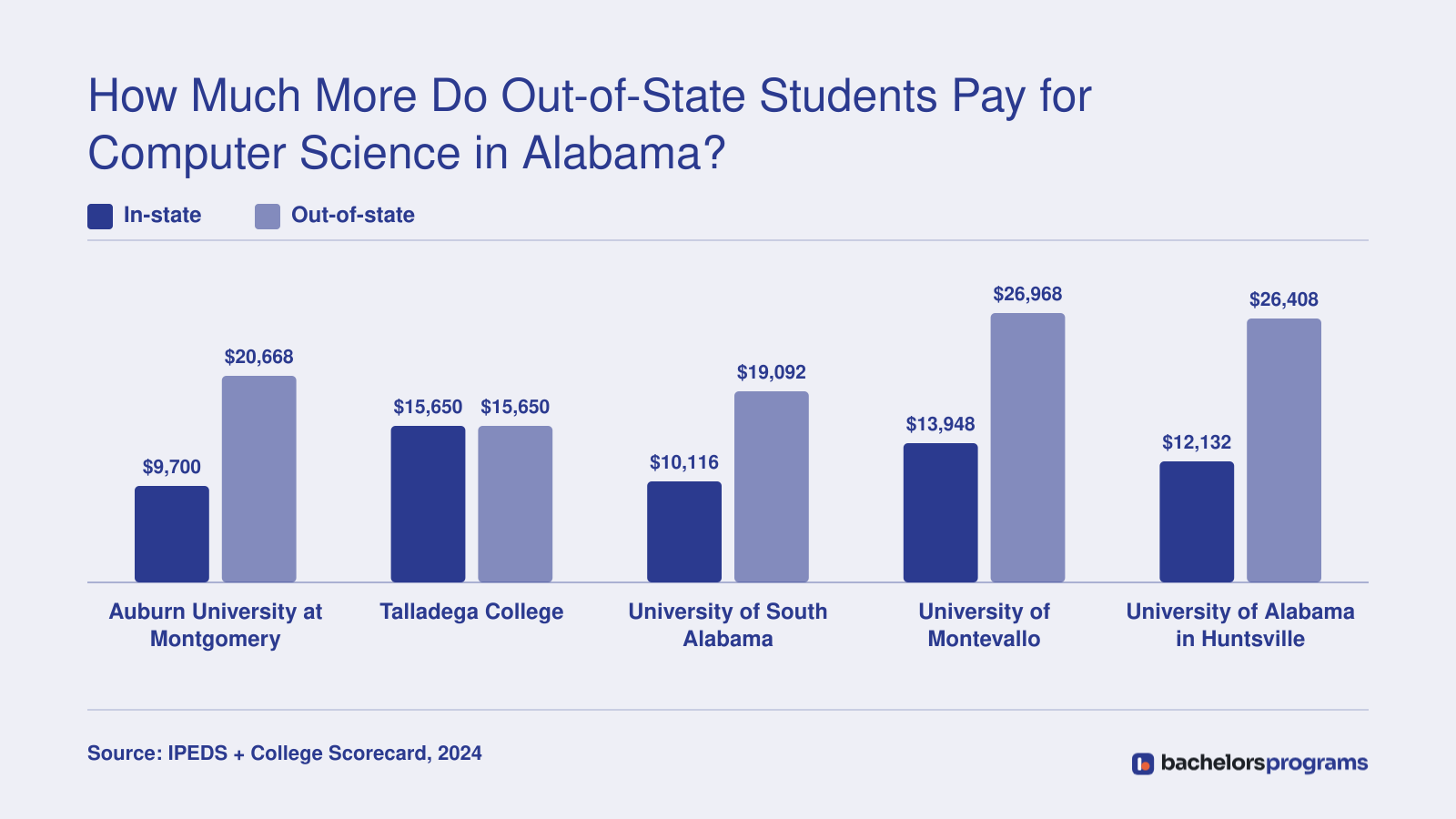
How Much More Do Out-of-State Students Pay for Computer Science in Alabama?
Residency roughly doubles the sticker price at Alabama's public universities. Nonresidents pay $8,976-$14,276 more per year in tuition and fees, with the widest gap at the University of Alabama in Huntsville and the University of Montevallo. Talladega College, a private HBCU, charges every student $15,650, which puts it below every public school's out-of-state rate in this chart.
Computer Science Careers and Salaries in Alabama
Staying in Alabama after graduation can mean trading the top end of national pay for a smaller, more connected job market. The numbers show how wide that gap runs, though the state-level picture is thinner than the national one.
How Pay Compares With the Nation
The May 2025 federal wage data gives national medians of $135,980 for software developers1 and $109,470 for computer occupations overall.2 The median for all U.S. occupations is $50,980.2 The state-level software developer medians for Alabama were not available in the material reviewed, so treat any Alabama figure you see elsewhere cautiously. In the Birmingham metro area, computer and mathematical occupations averaged $48.67 an hour, or roughly $101,000 a year at full-time hours, and made up about 2.6% of local employment.3 Those are broader occupation groups, not software developers alone.
Demand is steady nationally. Software developers, quality assurance analysts, and testers are projected to grow 10% from 2025 to 2035, with about 106,100 openings a year.1 Computer and IT occupations as a whole are projected at about 280,000 openings a year.2
Where the Jobs Are
- Huntsville: The metro area covers Madison and Limestone counties.4 Work centers on Redstone Arsenal, aerospace and defense, and cybersecurity, and many roles involve federal contracting. Graduates of the University of Alabama in Huntsville and Oakwood University are based here.
- Birmingham: Healthcare IT and financial technology are the main draws. University of Alabama at Birmingham graduates are close to both.
- Mobile: The market is smaller, but University of South Alabama and Spring Hill College students can find work in regional industry, logistics, and public-sector IT.
Some Huntsville defense roles require U.S. citizenship and a security clearance, so check this early if that path interests you.
Licensure, Accreditation, and Graduate Earnings
Computer science has no state licensure in Alabama. No exam stands between you and a job, so employers look at your skills, your portfolio, and your internships. ABET accreditation can help with some employers, especially federal and defense-related ones, and internships often turn into offers.
When you look at graduate earnings for the schools ranked here, check which time window each figure covers. Pay measured shortly after graduation reflects entry-level roles, so it will sit below the national medians above, which include experienced workers. Comparing a school's early-career earnings with those medians shows a starting point, not a ceiling.
Common Questions About Computer Science Degrees in Alabama
These answers summarize the rankings, costs, online options, and career rules covered above. Confirm current details on each school's program page before you apply.
What is the best computer science school in Alabama?
What is the cheapest computer science school in Alabama?
Can you get a bachelor's degree in computer science online from an Alabama school?
Do you need a license to work in computer science in Alabama?
Compare Computer Science programs on the data that matters
Explore more Computers & IT majors or browse every field of study.
All Computers & IT programs Browse every field of study