Cheapest Online Elementary Education Degree Programs
Compare 1,050+ accredited cheapest online Elementary Education programs, with net price after aid, graduation rates, earnings and debt from IPEDS and the U.S. College Scorecard.

What does a fully online elementary education degree actually cost? Net price runs from $1,471 at St. Petersburg College to $9,329 at Gods Bible School and College, and that gap rarely reflects teaching quality.
A low price only pays off if the program leads to an initial teaching license in your state. Every program here is fully online, but field placements and student teaching still happen in person, usually near your home district.
Key Points
- University of West Florida charges $220.23 per credit, about $29,070 total.
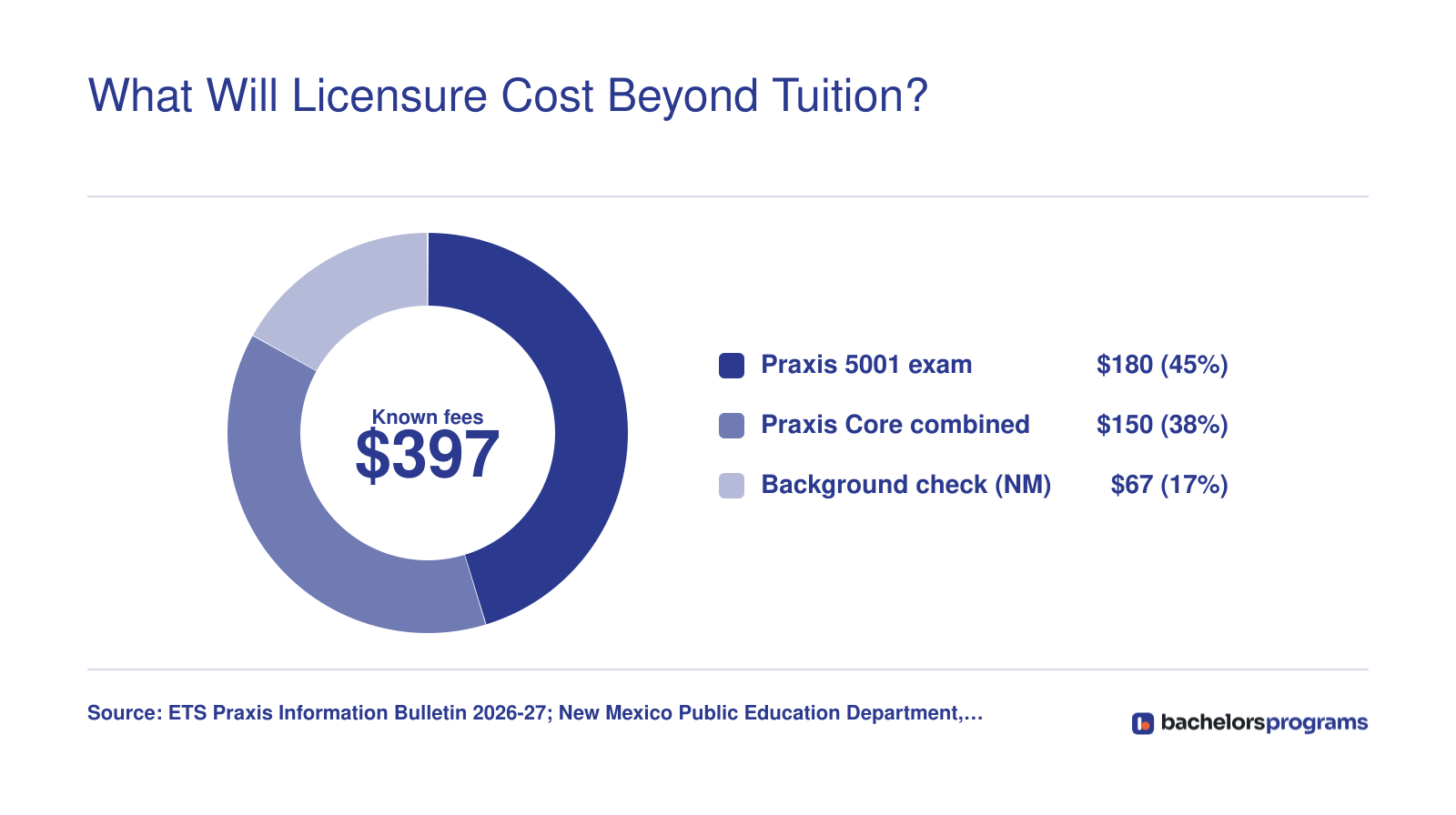
- Testing and screening fees add about $397 before state licensing fees.
- Northwest Florida State College graduates earned a median $51,900 four years out.
Top 10 Cheapest 100% Online Elementary Education Degrees for 2027
Every program below can be completed through online coursework, with the in-person hours that licensure requires, such as field placements and student teaching, arranged in schools near you or in the program's home state. A few colleges still offer optional campus class days or occasional practicum visits, so confirm the field-placement policy before you apply. Price after aid is what separates these ten, and the spread between the lowest and the highest is wide.
Indian River State College
#1Fort Pierce, FL · ~$3,800/yr (est.)
Best for: Florida residents seeking reading endorsements
Indian River State College in Fort Pierce built its elementary education bachelor's around literacy and teaching English learners, so graduates finish with both Reading and ESOL endorsements attached to the degree. The program is available fully online, though field experiences still take place in Florida schools, which matters if you live elsewhere. The college reports a 100% job placement rate for its education graduates and offers dozens of scholarships aimed at education majors.
- Fully online option available
- Reading and ESOL endorsements built into the degree
- Field experiences completed in Florida schools
- College reports 100% job placement for education graduates
- Coursework centers on literacy and English language learning
- Scholarships and financial aid available to education majors
Northwest Florida State College
#2Niceville, FL · $4,600/yr (est. net price)
Best for: Transfer students with an associate degree
Northwest Florida State College runs a 2+2 elementary education bachelor's for students who already hold an associate degree or roughly 60 transferable credits, and it leads to Florida K-6 certification after two years of full-time study. ESOL and Reading endorsements are embedded in required coursework at no extra credit hours, and students finish with a 15-week full-time student teaching internship under a certified mentor teacher. Delivery is blended rather than purely online: selected courses run fully online, while most students attend a campus one or two days a week.
- 2+2 format for students with an associate degree or 60 credits
- 120 total credit hours completed over two years
- ESOL and Reading endorsements at no extra credit hours
- 15-week full-time student teaching internship
- Elementary school placements every semester
- Selected courses fully online; campus classes one to two days weekly
- Prepares students for Florida K-6 certification
St Petersburg College
#3St. Petersburg, FL · ~$1,500/yr (est.)
Best for: Working adults needing part-time pacing
St. Petersburg College's elementary education bachelor's is built for Florida K-6 certification and folds ESOL and Reading endorsements into the required coursework rather than adding them on top. The degree can be completed fully online, meets state Department of Education certification requirements, and finishes with practicums and a supervised internship in area schools. Florida residents pay a far lower upper-division rate than nonresidents, so submitting residency documentation before classes begin has real financial consequences.
- Fully online option available
- Full-time and part-time study options
- Estimated total program cost of $10,157.84
- 2.5 GPA minimum for admission and graduation
- Requires passing all sections of the Florida Teacher Certification Examination
- Practicums plus a final internship supervised by veteran educators
- ESOL and Reading endorsements infused into the degree
University of Florida
#4Gainesville, FL · ~$7,000/yr (est.)
The University of Florida offers a two-year elementary education bachelor's that starts each fall and admits rising juniors and transfer students who arrive with about 60 credits. Clinical rotations run every semester in local elementary schools, followed by a full-year internship during the senior year, and the degree leads to Florida K-6 certification with Reading and ESOL endorsements. It is a selective, limited-access program with an online option, so admission depends on prerequisites and test scores rather than on the format you choose.
- Two-year, full-time program starting each fall
- 2.6 GPA and 60 credits required for admission
- Supervised clinicals in local elementary schools each semester
- Full-year senior classroom internship
- Leads to Florida K-6 certification
- Reading and ESOL endorsements included
- Online option available for the degree
- Personal Goals Statement and general knowledge test scores required
Northern New Mexico College
#5Espanola, NM · $7,000/yr (est. net price)
Northern New Mexico College in Española offers an elementary education bachelor's that stacks directly onto its associate degree and lets students choose a concentration in language arts, social studies, math, science, or bilingual education. The degree is accredited by the New Mexico Public Education Department and CAEP, and graduates who pass the state teacher assessments can apply for a K-8 license with a TESOL endorsement. The college enrolls a very high share of Pell-eligible students, which helps explain how low the average net price runs.
- Stacks onto the college's Associate of Arts in Elementary Education
- Five concentration options, including a bilingual education endorsement
- Accredited by the New Mexico Public Education Department and CAEP
- Leads to a K-8 license with TESOL endorsement
- Field experience and student teaching included
- Application requires a letter of intent and philosophy statement
Gods Bible School and College
#6Cincinnati, OH · ~$9,000/yr (est.)
God's Bible School and College in Cincinnati takes a distinct approach: its elementary track prepares students for preschools, child-care centers, and private religious schools as the primary path rather than public district classrooms. The track meets Ohio licensure requirements and ACSI standards, holds CAEP accreditation, and requires 135 to 141 credits with Bible and theology coursework built in. Most tracks can be studied online, though the college lists the program as a campus degree with online availability rather than a fully online program.
- CAEP-accredited elementary education track
- $295 per credit hour
- 135 to 141 total credits, including Bible and theology coursework
- Eligible for Ohio teacher licensure
- Meets ACSI requirements for Christian schools
- Online study available for most tracks
- Prepares graduates for private and religious school settings
Eastern New Mexico University
#7Portales, NM · ~$4,900/yr (est.)
Eastern New Mexico University pairs elementary licensure with special education licensure, so graduates leave eligible to teach both K-8 general classrooms and preK-12 special education settings. Coursework runs through foundations, technology, bilingual education, special education, and reading, with extensive field experiences taught by faculty who have public school classroom experience. New Mexico's licensure reciprocity with many states and territories is a practical draw for students who expect to move.
- Dual licensure in elementary K-8 and special education preK-12
- Offered as a Bachelor of Arts or Bachelor of Science
- Extensive field experiences in public school classrooms
- Coursework in bilingual education, special education, and reading
- New Mexico licensure shares reciprocity with many states
- Faculty have public school teaching experience
Seminole State College of Florida
#8Sanford, FL · ~$9,000/yr (est.)
Seminole State College of Florida structures its elementary education bachelor's as a 2+2 with the college's Associate of Arts in Education, and the 120-credit degree leads to a Florida K-6 teaching certificate. Students complete field experiences in Seminole County Public Schools, a 12-week full-time student teaching internship, and preparation for the Florida Teacher Certification Exam, with ESOL and Reading endorsement competencies built into the coursework. An online degree option exists, though most courses are offered both in person and online.
- 120-credit 2+2 with the Associate of Arts in Education
- Leads to Florida K-6 teaching certification
- ESOL and Reading endorsement competencies included
- 12-week full-time student teaching internship
- Field experiences in Seminole County Public Schools
- 2.5 GPA and EDF 2005 with a C or better required for admission
- Background screening and fingerprinting required
CUNY Medgar Evers College
#9Brooklyn, NY · ~$6,000/yr (est.)
Medgar Evers College, part of the City University of New York, offers a childhood education bachelor's that prepares students for New York State licensure in grades 1 through 6. Candidates choose a concentration in English, mathematics, science, or social sciences, complete clinical practice alongside working teachers in Brooklyn schools, and attend seminars aimed at the state's content and educating-all-students exams. A 100% online track is open to students who already hold an associate degree in education and clear a higher GPA bar.
- Prepares students for New York State licensure in grades 1 through 6
- Four concentrations: English, mathematics, science, and social sciences
- 100% online track for students holding an A.A. or A.S. in Education
- 3.0 GPA minimum for the major
- Clinical practice in local schools plus exam preparation seminars
- Synchronous and asynchronous online options
- Four-year program with full-time and part-time study
Utah Valley University
#10Orem, UT · $5,000 – $10,000/yr (est.)
Utah Valley University offers a 120-credit elementary education bachelor's that recommends graduates for the Utah Professional Educator License and prepares them for K-8 classrooms. The degree combines general education with a large discipline core covering literacy, math, science, social studies, and fine arts methods, plus an 8-credit student teaching semester in grades K-6. Admission to the teacher preparation program runs through a separate application with a 2.7 GPA and a LiveScan background check, and graduation requires a 3.0 cumulative GPA.
- 120 semester credits, including 8 credits of K-6 student teaching
- Recommended for the Utah Professional Educator License
- 2.7 GPA required to enter the teacher preparation program
- 3.0 cumulative GPA required to graduate
- LiveScan criminal background check required
- Coursework in literacy, math, science, social studies, and fine arts methods
- Teacher Assessment Project capstone
- 30 residency credits must be completed at the university
Cost & outcomes by school
Federal data for the highest-earning Elementary Education programs, independent of the ranking above. Earnings are this field's bachelor's graduates four years after completing where the Scorecard reports them, else the school's undergraduate median.
| School | Net price / yr | Grad rate | Earnings | Debt | Grads/yr | Format |
|---|---|---|---|---|---|---|
| George Mason University VA | $17,915 | 68% | $76,343 | $19,500 | 77 | Hybrid |
| University of Florida FL | $4,815 | 85% | $71,588 | $15,000 | — | Online or campus |
| University of New Hampshire NH | $23,805 | 76% | $66,479 | $26,814 | — | Online |
| Western Governors University UT | $12,548 | 46% | $60,615 | $11,116 | 1,660 | Online |
| The University of Tennessee-Knoxville TN | $18,976 | 74% | $60,249 | $20,500 | — | Online or campus |
| Florida International University FL | $9,288 | 74% | $53,854 | $16,100 | 226 | Online or campus |
| Touro University NY | $29,627 | 72% | $53,419 | $15,547 | — | Online |
| University of Florida FL | $6,541 | 91% | $53,079 | $14,757 | 40 | Online or campus |
Sources: U.S. Department of Education. Net price, graduation rate, earnings and debt: College Scorecard (earnings and debt for this field's bachelor's graduates where reported, else school-wide); graduates: IPEDS. A dash means no figure is reported.
Cost, debt & payoff
Median earnings of this field's bachelor's graduates (4 yrs after completing, else the school's undergraduate median) vs. their median federal loan debt · U.S. College Scorecard
Across these programs the median graduate earns about $48,824 and finishes with roughly $24,000 in debt — a ratio that clears a common rule of thumb (keep debt below first-year salary). Net price and debt vary widely school to school, so check the per-school figures in the table above before you shortlist.
How Much Does an Online Elementary Education Degree Cost?
At the bottom of the 2026 public-university range, University of West Florida charges $220.23 per credit, and its full program is listed at $29,070.2 At the top, $662 per credit pushes the same degree past $79,000.1
Doing the multiplication
Take 120 credits and multiply by the rate you will actually be billed. LSUA lists $353 per credit and $42,360 for the full degree; Old Dominion sits at $443 in state.
Residency and transfer credits
Some flat-rate programs charge one price wherever you live. Others keep the residency premium: UWF's out-of-state rate is $361.32 against $220.23 in state, and Old Dominion's is $453 against $443. Transfer credit moves the total fastest. Your bill swings by tens of thousands depending on whether you arrive with zero credits, 60 credits (an associate degree) or 90 credits. LSUA accepts up to 75% of the degree in transfer, but Old Dominion still requires 30 credits completed there.4
Speed and savings
Accelerated 8-week terms and competency-based formats shorten the calendar, though student teaching sets the floor; Arkansas State requires a full fall semester in an Arkansas classroom.3 - FAFSA: file it to claim Pell Grants and federal loans. - TEACH Grant: you keep it as a grant rather than a loan only if you complete a service obligation in a high-need school or field. - Employer and military discounts: ask before you enroll, since institutional rates often apply on top of aid.
What Will Licensure Cost Beyond Tuition?
Testing and screening fees add up even at the cheapest online elementary education programs. These figures come to about $397, but they leave out your state's license application fee and any student teaching or placement fee, both of which vary by state and program. Some states require the newer Praxis 7001 ($220) instead of the 5001, and background check prices differ by state (New Mexico's $67 is shown as one example). The bigger cost is student teaching: expect a semester of roughly 12-16 weeks that is usually unpaid and in person, even in a fully online program, so budget for lost income and travel.
Related Articles
Accreditation and Licensure: CAEP, State Approval, and Teaching Across State Lines
States have spent the past several years tightening how online programs disclose licensure eligibility, and that paperwork now separates a smooth path to a classroom from an expensive detour.
Three separate stamps
Institutional accreditation covers the whole college. CAEP or AAQEP accreditation is voluntary national recognition of an educator preparation program. State approval is the one that carries legal weight: a state education agency confirms the program meets its requirements for recommending candidates for an initial license. CAEP does not issue a license and does not replace state approval.1
Can an online degree lead to a license?
Yes, when the program is state-approved and designed for initial licensure. Avoid education studies or other non-licensure tracks that do not recommend graduates for a certificate.
Read the disclosure before you enroll
Under 34 CFR 668.43, programs advertised as meeting licensure requirements must state, before you enroll, whether they meet, do not meet, or have not evaluated requirements in each state, based on where you are when you apply.2 Check that your home state is listed as meeting them.
NASDTEC is not reciprocity
The Interstate Agreement helps a state recognize another state's approved preparation and valid credential, but the receiving state can still require tests, coursework, background checks, and fees. Confirm details with the licensing authority where you plan to teach.
What Elementary Teachers Earn Nationally
Is an Online Elementary Education Degree Worth It?
Graduates of Northwest Florida State College's elementary education program earned a median $44,340 one year after completion and $51,900 four years out, against median debt of $11,750, about $125 a month on a 10-year plan. University of Florida graduates show a similar pattern: $46,209 at one year and $53,079 at four years, with median debt of $14,757 ($156 monthly). Indian River State College graduates reached $48,612 one year after finishing.
Where Value Concentrates
At the institution level, which is a schoolwide proxy and not a program result, low-tuition schools such as God's Bible School and College, Paradise Valley Community College and Northern New Mexico College post the strongest earnings relative to debt. Keeping borrowing low matters more than prestige.
Location and Legitimacy
Where you get licensed shapes the payoff. BLS reports May 2025 mean wages of $97,970 in Washington and $95,670 in California, versus $52,300 in Mississippi and $52,320 in Oklahoma.1 That is a gap of more than $45,000 for the same job. An online degree from an accredited, state-approved program leads to the same license as a campus degree, and districts hire based on that license.
Loan Forgiveness Boosts
Teacher Loan Forgiveness offers up to $5,000 to highly qualified elementary teachers after five consecutive full-time years at an eligible low-income school, or up to $17,500 for special education. Public Service Loan Forgiveness can also help public school teachers who borrow.
Elementary Education programs by state
Compare Elementary Education programs on the data that matters
Explore more Education & Teaching majors or browse every field of study.
All Education & Teaching programs Browse every field of study