Cheapest Online Mechanical Engineering Degree Programs
Compare 430+ accredited cheapest online Mechanical Engineering programs, with net price after aid, graduation rates, earnings and debt from IPEDS and the U.S. College Scorecard.

The first question in any search for a cheap mechanical engineering bachelor's is whether a program is fully online or hybrid. The discipline depends on lab work in thermodynamics, fluids and materials testing, so a program like Arizona State's online BSME is the exception; most low-cost routes bring students to campus for hands-on work.
Many competing rankings fold master's programs into their bachelor's lists. The focus here stays on ABET-accredited BSME degrees, where per-credit tuition multiplies across 120 credits at Arizona State and 128 at North Dakota.
Key Points
- UND charges residents and nonresidents the same online rate across 128 credits.
- Arizona State graduates carry the lowest median debt here, $18,974.
- Most mechanical engineering bachelor's degrees still require some on-campus lab time.
Most Affordable Online & Hybrid Mechanical Engineering Bachelor's Programs
Few mechanical engineering bachelor's degrees can be finished without any campus lab time, so this list includes both online and hybrid programs, from Arizona State's online track to schools that bring distance students in for summer labs. Each card pairs institution-wide net price with in-state and out-of-state tuition, since residency can swing the sticker price dramatically at a public university. Net price is an average after aid across all undergraduates at the school, not a quote for any one student, and it usually lands well below the published tuition.
University of Southern Maine
#1Portland, ME · $11,000 – $28,000/yr (est.)
Best for: New England residents wanting public-university pricing
Maine's public university in Portland awards an ABET-accredited Bachelor of Science in Mechanical Engineering that runs 127.5 credits, with a 27-credit engineering core, a 40-credit mechanical core and 19 credits of mathematics ending in linear algebra and probability. Honors in the Major adds a research or service activity plus a passing score on the Fundamentals of Engineering exam. Resident tuition is a fraction of the nonresident rate, so Maine students see the largest savings here. Program graduates reported a median of $68,318 one year after finishing and $88,515 four years after finishing.
- ABET, EAC accredited
- 127.5 credits to graduate
- 27-credit engineering core plus 40-credit mechanical core
- 19-credit mathematics sequence ending with Calculus C
- 12 credits of upper-level technical electives
- Honors track requires 3.5 major GPA and FE exam passage
- 2.0 GPA required overall and in engineering courses
Saint Cloud State University
#2Saint Cloud, MN · ~$14,000/yr (est.)
Best for: Upper Midwest students wanting industry-sponsored design work
A Minnesota State system campus in St. Cloud whose ABET-accredited mechanical engineering degree is built around company-funded senior design projects, with an engineer from the sponsoring company joining the student team and results that occasionally earn patents. Faculty specialize in controls and robotics, automation, quality engineering, computer-aided design and lean manufacturing, and a 100,000 square foot integrated science and engineering laboratory provides the lab space. Resident and nonresident students pay the same tuition rate, which removes the usual residency penalty. Program graduates reported a median of $70,179 one year after finishing and $87,503 four years after finishing.
- ABET accredited
- Company-funded senior design projects with an industry engineer on the team
- 100,000 sq. ft. Integrated Science and Engineering Laboratory Facility
- Faculty specialize in controls, robotics and lean manufacturing
- Dedicated mechanical and manufacturing engineering scholarships
- Select classes available online
- Student chapter of ASME
Arizona State University
#3Scottsdale, AZ
Best for: Online learners who want a large research university
A large public research university that offers its ABET-accredited mechanical engineering bachelor's degree both online and on the Tempe and ASU Local campuses. The 120-credit curriculum covers energy transfer, mechanical design, sensors and control devices, starting with Calculus for Engineers I. First-year applicants can qualify through test scores, a 3.00 competency-course GPA or top 25 percent class rank, and transfers with a 2.50 GPA plus strong math and physics grades have a defined pathway. Program graduates reported a median of $75,146 one year after finishing and $95,090 four years after finishing.
- Engineering Accreditation Commission of ABET accredited
- 120 total credit hours
- Online and on-campus tracks at Tempe and ASU Local
- 3.0 GPA minimum
- First math course: MAT 265 Calculus for Engineers I
- Accelerated bachelor's plus master's option in five years
- Change-of-major pathway for current ASU students
- Sample courses: Mechanics of Materials, Dynamics, Computer-Aided Engineering I
Oregon State University
#4Corvallis, OR · $15,000 – $20,000/yr (est.)
Oregon's land, sea, space and sun grant university in Corvallis runs its ABET-accredited mechanical engineering bachelor's degree at the Corvallis campus, through Ecampus online and at OSU-Cascades. Students choose among eight options, including aerospace engineering, computational engineering, energy and fluid systems, materials design and manufacturing, product design and manufacturing, and robotic control. The 180-credit degree finishes with a two-course capstone design sequence. Nonresident tuition runs roughly triple the resident rate, so Oregon students carry a clear pricing advantage. Program graduates reported a median of $68,686 one year after finishing and $93,740 four years after finishing.
- ABET accredited
- 180 total credit hours
- Eight option areas, including aerospace and robotic control
- MIME Capstone Design I and II required
- Available at Corvallis, through Ecampus online and at OSU-Cascades
- Computational Engineering option offered online
- Four-year sample plan published
University of North Dakota
#5Grand Forks, ND · ~$19,000/yr (est.)
North Dakota's flagship university in Grand Forks makes its ABET-accredited mechanical engineering bachelor's degree available on campus and online, with distance students taking asynchronous classes and coming to campus for portions of the program and summer labs. Students choose among mechanical design, thermal sciences, manufacturing and materials, and aerospace, and the 128-credit degree meets the education requirement to sit for the Fundamentals of Engineering exam. Co-op internships have placed students with employers such as Coca-Cola, Honeywell and Textron. Program graduates reported a median of $73,603 one year after finishing and $89,704 four years after finishing.
- ABET accredited
- 128 total credit hours, 4+ years
- Asynchronous online classes with campus visits and summer labs
- Four areas: mechanical design, thermal sciences, manufacturing, aerospace
- Meets NCEES Fundamentals of Engineering exam eligibility
- Co-op internships with Coca-Cola, Honeywell and Textron
- First-year design project and prototype
- Four lab science courses in the first two years
Eastern Michigan University
#6Ypsilanti, MI · $15,000 – $20,000/yr (est.)
A public university in Ypsilanti, Michigan, whose ABET-accredited mechanical engineering bachelor's degree sits in the GameAbove College of Engineering and Technology and requires 85 major hours inside a 120-credit degree. Coursework covers engineering materials, solid mechanics, thermodynamics, fluid mechanics, heat transfer and manufacturing processes, with laboratory experiments and computer-aided engineering tools built into the sequence. Students finish with a two-course senior capstone that solves design problems supplied by outside customers. Admission calls for a 2.7 cumulative GPA, prerequisite physics and calculus courses, and a meeting with a faculty member.
- ABET accredited
- 120 total credit hours, 85 in the major
- 2.7 cumulative GPA plus prerequisite physics and calculus
- Two-course senior capstone with problems from outside customers
- Coursework in thermodynamics, fluids, heat transfer and manufacturing
- STEM-designated with OPT extension
- On-campus and hybrid classes in Ypsilanti
- Mandatory faculty meeting as part of admission
Sacred Heart University
#7Fairfield, CT · ~$46,000/yr (est.)
A private university in Fairfield, Connecticut, that awards its mechanical engineering bachelor's degree through the School of Computing and Engineering in an on-campus and hybrid format. The curriculum covers mechanics, thermodynamics, materials science and system design, with courses in machine design, CAD and fluid mechanics. Students work in the IDEA Lab, which holds 3D printers, laser cutters and electronics, and can add a 4+1 path to an MBA or a cybersecurity MS. Tuition is private-school level and nearly identical for residents and nonresidents, so in-state status buys no discount here.
- Core areas: mechanics, thermodynamics, materials science
- Coursework in machine design, CAD and fluid mechanics
- IDEA Lab with 3D printers, laser cutters and electronics
- 4+1 MBA and 4+1 Cybersecurity MS dual degree paths
- Internships, co-ops and faculty-led research available
- On-campus and hybrid format in Fairfield, Connecticut
None of the ranked Mechanical Engineering programs match the cheapest online lens yet. The full ranking is at the link above.
Cost, debt & payoff
Median earnings of this field's bachelor's graduates (4 yrs after completing, else the school's undergraduate median) vs. their median federal loan debt · U.S. College Scorecard
Across these programs the median graduate earns about $88,830 and finishes with roughly $23,031 in debt — a ratio that clears a common rule of thumb (keep debt below first-year salary). Net price and debt vary widely school to school, so check the per-school figures in the table above before you shortlist.
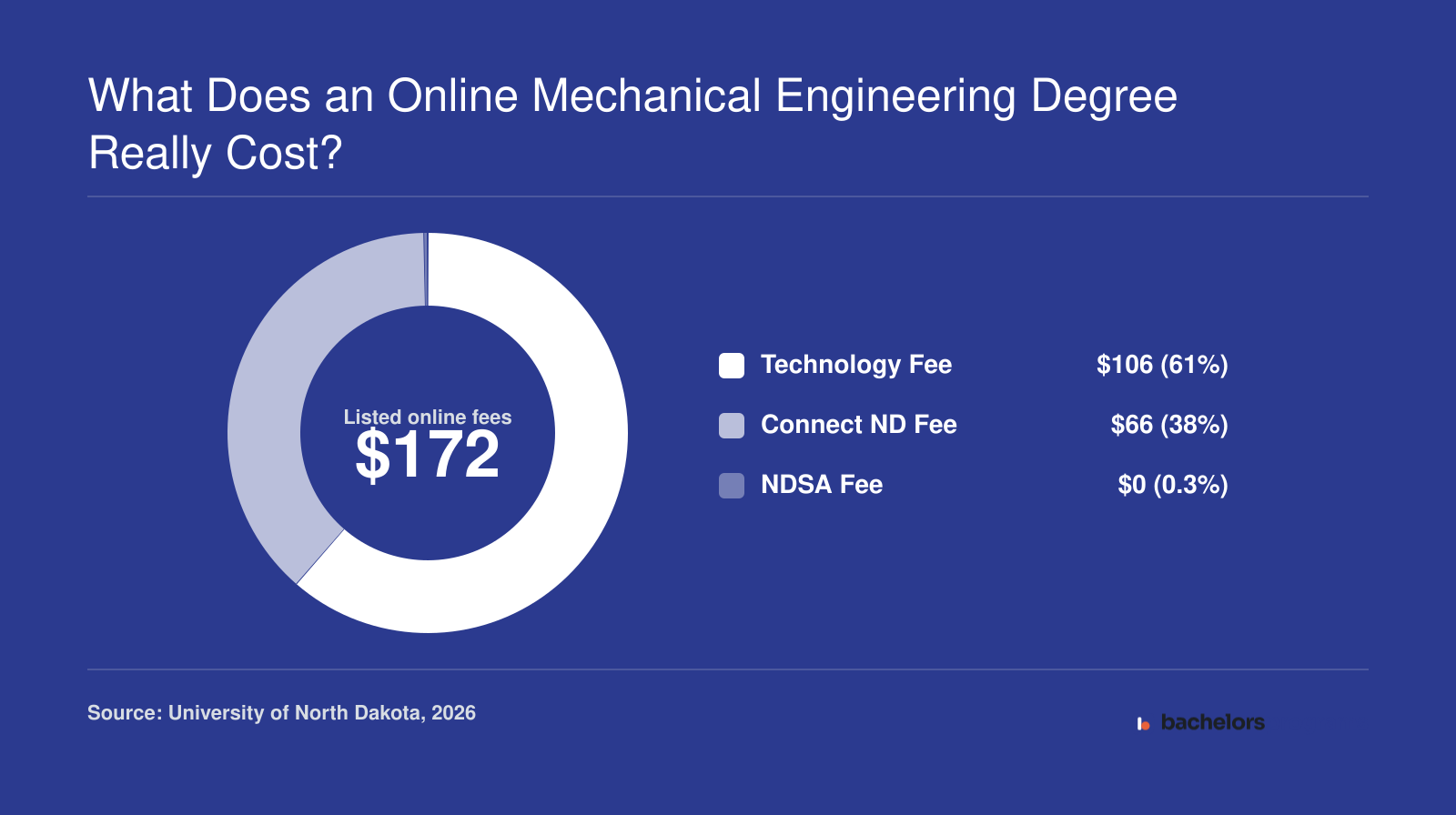
What Does an Online Mechanical Engineering Degree Really Cost?
At the University of North Dakota, the biggest cost is tuition: the online per-credit rate, which is the same for residents and nonresidents, multiplied by the 128 credits the online BSME requires, so check UND's current cost page for the 2026-2027 rate. The mandatory online fees charted below are capped at 12 credits per semester, but tuition has no cap, and students taking fewer than 12 credits also pay a $79.59 per-credit Student Fee. Budget separately for engineering software and any travel or kits tied to lab courses such as ME 323L and ME 418L, and keep in mind that the average net price after aid shown in the ranking reflects what students paid after grants, so your own cost may land above or below it.
Online vs. Hybrid: Lab Visits, Proctored Exams and ABET Accreditation
A mechanical engineering bachelor's can be largely online, but whether it is completely online depends on the program, and the accreditation of that pathway matters more than the delivery label.
Labs, campus visits and proctored exams
Many BSME pathways add some in-person work, such as summer lab sessions or proctored exams. Requirements differ by school and change over time, so confirm them with the University of North Dakota, Arizona State University, the University of Alabama or any other school you consider. ABET treats a program as "100% online" only when every graduation requirement can be completed online.1
Why ABET matters
ABET's Engineering Accreditation Commission (EAC) accredits bachelor's and master's engineering programs and applies the same criteria whether delivery is online, on-site or mixed.1 Accreditation affects FE exam eligibility, the path to PE licensure in most states, and how many employers will look at your application.
Competitor pages often make conflicting claims about ASU, UND and Alabama. UND appears in ABET's institution listings, but that alone does not show that a particular online degree and delivery mode are accredited.2 Don't rely on a school's marketing page or a third-party summary.
A two-step check
- Step 1: Search ABET's accredited-program database for the school and the Mechanical Engineering degree under the EAC.
- Step 2: Confirm the delivery mode listed, then match it to the school's own program page and ask admissions about on-campus requirements.
Related Articles
Ways to Cut Your Cost: Transfer Credit, Flat-Rate Tuition and Aid
Transfer credit does more to lower the price than any other step. The University of North Dakota's transfer scholarship pays $2,000 to entrants with a 3.90 to 4.00 college GPA and $1,000 at 3.50 to 3.89, with fall and spring deadlines of Aug. 15 and Dec. 15.3 Students arriving with more than 120 credits fall outside that award, so plan your community college math and physics around the cutoff.
Nonresident pricing and exam credit
Several online engineering programs charge one flat per-credit rate regardless of residency, which can beat the out-of-state figure in a cost table. North Dakota bills online tuition per credit with no 12-credit cap, and mandatory online fees stop at 12 credits.1 CLEP subject exams count when scores go to the school, and military transcripts often shorten the path, but confirm each school's evaluation rules first.2
Aid worth filing for
- Federal aid: Online students enrolled at least half time can draw Pell Grants and loans through FAFSA.
- Institutional: North Dakota's Scholarship Central opens one application to more than 1,400 awards, Oct. 1 to Feb. 1.2
- Societies and employers: ASME and SWE run national scholarship programs, and employer tuition assistance is common in engineering-adjacent jobs.
Part-time students who transfer a full year of calculus and physics can finish roughly a year sooner, but the real timeline comes from the transcript evaluation.
Mechanical Engineering vs. Mechanical Engineering Technology
Mechanical engineering technology is the cheaper, more often fully online route, but it gives up theory depth and some licensure flexibility. A bachelor's in mechanical engineering technology (BSMET) trims the advanced math that anchors a mechanical engineering degree (BSME) and focuses on applied design, manufacturing and testing.
- Curriculum: BSME programs go deep into calculus, thermodynamics and fluid mechanics. BSMET programs emphasize applied, hands-on problem solving.
- Accreditation: Look for ABET's Engineering Accreditation Commission (EAC) for a BSME and its Engineering Technology Accreditation Commission (ETAC) for a BSMET.
- Licensure: EAC graduates follow the standard path from the FE exam to the PE license. ETAC graduates can often sit for the FE, but many state boards require additional work experience before PE licensure, and rules vary. Check your state board before enrolling.
- Job titles: Mechanical engineer or design engineer for BSME graduates. Engineering technologist, test technician or manufacturing specialist for BSMET graduates.
- Pay: The U.S. Bureau of Labor Statistics reports a May 2025 median of $104,110 for mechanical engineers1 and $74,510 for mechanical engineering technologists and technicians2, a field that typically requires only an associate's degree to enter.
The verdict: choose a BSME if you want design authority or a clear path to a PE license. Choose a BSMET if you want a lower-cost, applied degree that fits around a full-time job.
Early-Career Earnings for Mechanical Engineering Graduates
Mechanical engineering graduates from the schools ranked here earn strong early-career pay.
Is an Online Mechanical Engineering Degree Worth It?
A low-debt route and a high-debt route can lead to the same engineering title, but they feel very different once the loan payments start. Among the schools here that report program-level figures, median debt runs from $18,974 at Arizona State University to $30,933 at the University of Southern Maine. That works out to roughly $201 to $328 a month over a 10-year repayment.
Earnings make the case. Arizona State graduates earned a median $75,146 one year after finishing and $95,090 four years out. University of North Dakota graduates reported $73,603 at one year and $89,704 at four years, against $22,500 in debt and a $239 monthly payment.
For institution-level context only, Arizona State's earnings-to-cost ratio is 3.21 and North Dakota's is 2.88. Those ratios describe the whole school, not the engineering major.
The long-run benchmark is higher still. The Bureau of Labor Statistics puts the national median wage for mechanical engineers at $104,110 (May 2025)1, with 11% job growth projected for 2025 to 2035.2
The degree pays off fastest when the program is ABET-accredited, when you finish at or below average net price, and when the credential leads to FE and PE eligibility.
Mechanical Engineering programs by state
Frequently Asked Questions
Is there a free online mechanical engineering degree?
Are there self-paced online mechanical engineering degree programs?
How long does an online mechanical engineering bachelor's degree take with transfer credit?
Compare Mechanical Engineering programs on the data that matters
Explore more Science & Engineering majors or browse every field of study.
All Science & Engineering programs Browse every field of study