Cheapest Online Public Health Degree Programs
Compare 590+ accredited cheapest online Public Health programs, with net price after aid, graduation rates, earnings and debt from IPEDS and the U.S. College Scorecard.

Tacoma Community College reports an average net price after aid of $8,376 a year, lower than any other school on this list. Treat that as an average, not a quote: aid, transfer credits, and residency change every bill.
Every program listed is 100% online with no hybrid or in-person requirements, and a lower net price moves a school up the list. Sticker tuition for online public health bachelor's degrees varies widely, and nonresident rates can push the total far higher.
Key Points
- Old Dominion University accepts up to 90 transfer credits toward 120.
- University of North Dakota charges online students one rate regardless of residency.
- Without regional accreditation, students lose access to federal financial aid.
10 Cheapest Fully Online Public Health Degree Programs
Every program on this list can be completed entirely online, with no required campus visits and no hybrid components. Schools appear in order of affordability, and every card shows the school's average net price after aid (an approximate figure) alongside in-state and out-of-state tuition and the institution's overall graduation rate, so you can see what a degree would actually cost before you apply.
Tacoma Community College
#1Tacoma, WA · $8,000/yr (est. net price)
Best for: Washington residents entering community health
A Washington community college that also awards applied bachelor's degrees, Tacoma Community College keeps the public health path practical and local, with coursework aimed at health equity and underserved communities. Students can specialize in community health, advanced respiratory care, or paramedicine, which suits people already working in a clinical or emergency setting.
- 180 total credit hours across the degree
- Concentrations in community health, advanced respiratory care, and paramedicine
- Coursework in population health, prevention, and health policy analysis
- Emphasis on reducing disparities in underserved communities
- Prepares for roles in public health agencies, hospitals, and nonprofits
Weber State University
#2Ogden, UT · ~$10,000/yr (est.)
Best for: Working adults balancing school and jobs
Weber State University is a public institution in Ogden, Utah, with a long record of serving working adults through flexible formats and independent study. Its public health bachelor's can be completed entirely online, and the school publishes a separate online-only tuition category that holds costs near resident rates for students studying from outside Utah.
- Can be completed 100% online or through face-to-face classes
- Coursework in epidemiology and population health
- Builds skills in leadership, management, communication, and program planning
- Independent study option available
- Prepares students for a master's in public health or health administration
University of South Florida
#3Tampa, FL · ~$10,000/yr (est.)
Best for: Students wanting several concentration choices
The University of South Florida is a large public research university in Tampa whose College of Public Health is a recognized name in the field. Undergraduates get a research-driven curriculum in epidemiology, biostatistics, and health policy, with a fully online route and a choice of four concentration areas.
- Fully online option; program sits in an accredited college of public health
- Four concentration areas including global health, nutrition, and environmental health
- Core coursework in epidemiology, biostatistics, and health policy
- Described as the first bachelor's in public health in Florida
- Prepares for roles such as health educator and disease intervention specialist
University of West Florida
#4Pensacola, FL · $5,000 – $10,000/yr (est.)
The University of West Florida is a public institution in Pensacola that has built out a substantial online catalog, and its public health bachelor's runs on eight- and 16-week courses rather than a fixed semester calendar. A capstone and an accelerated path into the master's degree give students a clear finish line and a defined next step.
- 120 credit hours, typically completed in 48 months
- 100% online with 8-week and 16-week course options
- Capstone applies skills to real community health problems
- Accelerated B.S. to MPH track available
- Built on the Council on Linkages competency framework
American Public University System
#5Charles Town, WV · $5,000 – $10,000/yr (est.)
American Public University System is an online institution based in Charles Town, West Virginia, that enrolls a large share of military, public safety, and government students. Its public health bachelor's leans on faculty who work in the field, offers four concentration tracks, and accepts up to 90 transfer credits.
- Four concentrations, including emergency and disaster management
- Also offers nutrition and wellness and public health informatics tracks
- Up to 90 transfer credits accepted
- Courses start monthly and run 8 to 16 weeks
- Faculty include working public health professionals and first responders
Mississippi University for Women
#6Columbus, MS · ~$12,000/yr (est.)
Mississippi University for Women is a small public institution in Columbus, Mississippi, whose public health education degree requires an internship and offers a healthcare navigator concentration. The program pairs biostatistics and epidemiology with the insurance, ethics, and health information coursework that patient-facing roles demand.
- 120 semester hours, including a required public health education internship
- Healthcare Navigator concentration adds ethics, medical terms, and insurance
- Core work in biostatistics, epidemiology, and social determinants of health
- Electives in patient education, wellness counseling, and chronic disease
Western Governors University
#7Salt Lake City, UT · ~$13,000/yr (est.)
Western Governors University is a nonprofit, competency-based online institution where students pay a flat rate per six-month term rather than by the credit. That structure rewards students who can move quickly, and the public health bachelor's includes a bridge into the university's master's program.
- Self-paced, fully online, with rolling admissions
- Flat tuition per six-month term instead of per-credit billing
- 33 courses, ending with a public health capstone
- Four bachelor's-level courses can count toward the WGU master's in public health
- No entrance exam required
Lamar University
#8Beaumont, TX · ~$9,000/yr (est.)
Lamar University is a public institution in Beaumont, Texas, whose online public health bachelor's carries a healthcare administration concentration. Students study health disparities, epidemiology, and workplace health promotion, while the concentration adds the reimbursement, technology, and delivery system knowledge that health management roles require.
- 120-credit fully online degree with full-time and part-time options
- Concentration in healthcare administration
- Coursework in epidemiology, health disparities, and workplace health promotion
- Explores U.S. and international health systems
- Prepares for health educator and wellness consultant roles
San Jose State University
#9San Jose, CA · ~$14,000/yr (est.)
San Jose State University is a large public university in California's Silicon Valley with a public health department that emphasizes health equity. Its online bachelor's is a degree-completion route for students who already hold roughly 60 transferable credits, with a mix of synchronous and asynchronous classes.
- Fully online degree completion program for students with 60+ transferable units
- Accredited by CEPH
- Synchronous and asynchronous course options
- Capstone required, with core courses graded C or better
- Focus on documenting and eliminating health disparities
Empire State University
#10Saratoga Springs, NY · ~$12,000/yr (est.)
Empire State University is the State University of New York's dedicated online and distance institution, built around flexible study for adults returning to college. The public health bachelor's uses the ASPPH competencies framework and lets students assemble upper-division electives in areas such as health informatics, environmental health, and global health.
- 124 total credit hours
- Online, blended, and independent study formats
- Guided by the ASPPH undergraduate learning outcomes model
- Upper-division electives in environmental health, informatics, and global health
- Core courses in epidemiology, statistics, and health policy
Cost & outcomes by school
Federal data for the highest-earning Public Health programs, independent of the ranking above. Earnings are this field's bachelor's graduates four years after completing where the Scorecard reports them, else the school's undergraduate median.
| School | Net price / yr | Grad rate | Earnings | Debt | Grads/yr | Format |
|---|---|---|---|---|---|---|
| Northwestern University IL | $29,167 | 95% | $89,363 | $14,684 | 86 | Online |
| San Jose State University CA | $13,760 | 69% | $78,988 | $15,000 | 162 | Online |
| California State University-Long Beach CA | $10,440 | 69% | $57,296 | $13,200 | — | Hybrid |
Sources: U.S. Department of Education. Net price, graduation rate, earnings and debt: College Scorecard (earnings and debt for this field's bachelor's graduates where reported, else school-wide); graduates: IPEDS. A dash means no figure is reported.
Cost, debt & payoff
Median earnings of this field's bachelor's graduates (4 yrs after completing, else the school's undergraduate median) vs. their median federal loan debt · U.S. College Scorecard
Across these programs the median graduate earns about $56,469 and finishes with roughly $23,275 in debt — a ratio that clears a common rule of thumb (keep debt below first-year salary). Net price and debt vary widely school to school, so check the per-school figures in the table above before you shortlist.
How Much Does an Online Public Health Degree Cost Beyond Tuition?
Advertised tuition is only the first line of the bill; fees, books, and term charges decide whether a tight budget holds.
What the per-credit rate buys
At the most affordable schools here, online public health tuition runs about $220 per credit. University of West Florida charges $220.23 per in-state credit and $361.32 out of state with its waiver, so 120 credits at the resident rate land near $26,400.1 Arizona Online's $525 per credit comes to roughly $63,000 for the same 120 credits, and Louisville's $568 carries a $10 per-credit online-course fee, $578 total, or about $1,200 more across a degree.2
The lines schools omit
- Course and technology fees: Louisville publishes its $10 per-credit figure; Cincinnati says online fees vary by program, so get the number in writing.4
- Books and materials: North Dakota budgets $800 a year for books and supplies.3
- Term-based charges: some campuses bill certain fees each semester rather than each credit.
Request a full cost of attendance sheet: tuition, every mandatory fee, books, and the annual total. Then compare average net price after grant aid, which at West Florida is $9,364 a year and folds in living costs.1 That after-aid figure predicts what you borrow far better than a headline rate.
Online Public Health Degrees With No Out-of-State Tuition
Several schools here charge online students the same rate wherever they live, while others still bill nonresidents more. The University of North Dakota also says its online students pay one rate regardless of residency for 2026/2027. Federal tuition figures often reflect campus rates (the University of West Florida, for example, shows $5,776 in-state vs. $18,658 out-of-state), so confirm the online-specific rate on each school's bursar page before you budget.
| School | In-State Rate | Out-of-State Rate | Rate Basis | Residency Policy |
|---|---|---|---|---|
| Mississippi University for Women | $8,492 | $8,492 | Annual tuition and fees (federal data) | Same rate for residents and nonresidents |
| American Public University System | $8,400 | $8,400 | Annual tuition and fees (federal data) | Same rate for residents and nonresidents |
| Western Governors University | $8,658 | $8,658 | Annual tuition and fees (federal data); $4,210 flat rate per 6-month term | Same rate for residents and nonresidents |
| Arkansas State University | $302 | $302 | Online per credit, fees included | One pay-by-the-course rate for all U.S. residents; may change annually |
| LSU Health New Orleans | $380 | $380 | Online per credit (about $22,800 for the final 60 credits) | Flat rate with no out-of-state fees; subject to change |
| University of Louisville | $568 | $568 | Online per credit, plus $10 per credit online course fee | Standard rate for fully online undergraduates; no separate nonresident rate listed; eligible military pay $250 per credit |
| UT Arlington | $362 | N/A | Online per credit (120 credits required) | Single online rate listed, but residency independence not stated |
| Youngstown State University | $473.80 | $478.80 | Online per credit | Students outside Ohio pay the higher rate |
| Metropolitan State University of Denver | $326.25 | $663.40 | Online per credit (2026-2027) | Colorado rate assumes the Colorado Opportunity Fund; a reduced rate applies only to eligible students from participating western states |
Related Articles
CEPH, Regional Accreditation, and CHES Eligibility: What to Verify
A low tuition bill only pays off if the degree carries credentials that employers, graduate schools, and certifying bodies recognize.
Institutional (regional) accreditation is the non-negotiable baseline. Without it, you lose access to federal financial aid, and other colleges may refuse your credits.
CEPH accreditation is a separate, program-level layer. The Council on Education for Public Health accredits schools and programs of public health, including standalone bachelor's programs such as Albany College of Pharmacy & Health Sciences'. Many online bachelor's programs do not hold it. NMSU Global Campus's online Bachelor of Public Health is CEPH-accredited1, and National University states its online BS is as well.2 Chicago State and Curry College appear only on CEPH's applicant list, which is not the same as accreditation.
CHES Eligibility
NCHEC's CHES exam eligibility rests on academics alone. You need a bachelor's from an accredited institution plus either a transcript showing a health education major or at least 25 semester (37 quarter) credits, each with a C or better, covering its nine areas of responsibility. A health education focus makes qualifying simpler.
Practicum Hours
Field requirements vary widely: at least 20 hours at National University, 120 at Abilene Christian3, and 320 at NMSU Global.1 Online students typically complete them at an approved local site under a preceptor.
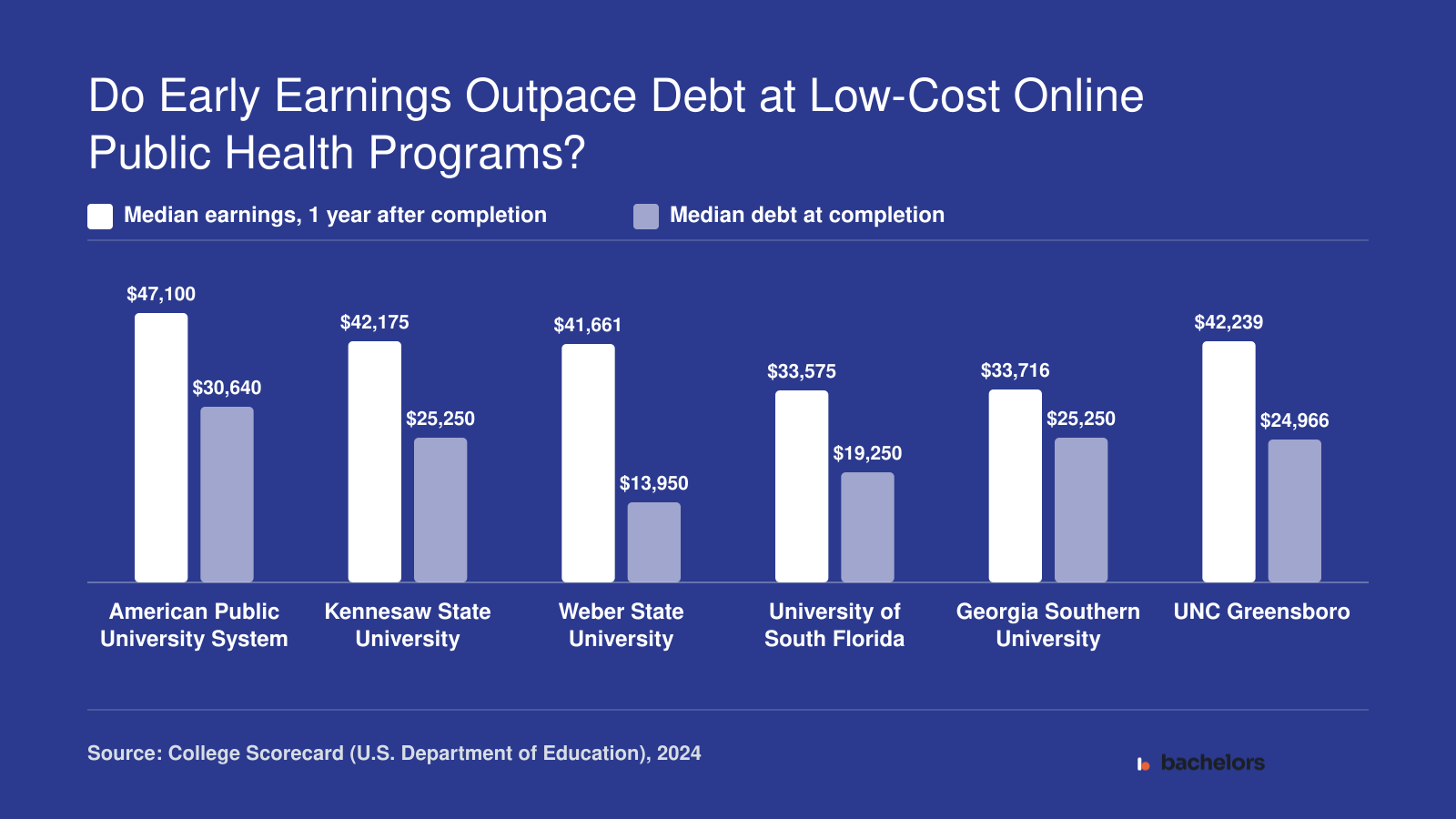
Do Early Earnings Outpace Debt at Low-Cost Online Public Health Programs?
A low sticker price only pays off if graduates can handle what they borrowed. This chart sets each program's median earnings one year after completion against the median federal debt its graduates carry at completion, using public health bachelor's outcomes only. Weber State stands out, with graduates earning $41,661 against $13,950 in median debt. Use this view alongside tuition, and do not choose on price alone: a low cost paired with manageable debt relative to early earnings is the clearest sign of real value.
Cutting Costs Further: Transfer Credits, Aid, and the Bachelor's-to-MPH Shortcut
How many credits can you bring with you, and what does that save? Transfer credit is the biggest single saving. Old Dominion University accepts up to 90 of the 120 credits needed, though at least 30 must be completed at ODU.1 The University of West Florida also lists up to 90 as a maximum.2 At its $220.23 per-credit rate, a student transferring the full amount would pay for roughly 30 credits, about $6,607, and could finish in a fraction of the usual four years.2 Treat 90 as a ceiling, not a promise, and get a transcript evaluation before you apply.
Aid and Faster Formats
File the FAFSA even if you assume you won't qualify. Pell Grants reach a large share of students at these schools: about 87% at American Public University System, 86% at Chicago State University, and 68% at the University of West Florida.
Shorter terms also cut costs. UWF runs 8 and 16 week courses, and American Public University System offers 8 to 16 week classes. Rasmussen University advertises self-directed assessments that save money. Fewer semesters mean fewer fees and less time out of the workforce.
The Bachelor's-to-MPH Shortcut
Accelerated pathways let graduate credits count twice. ODU lets qualified students apply up to 12 bachelor's credits to its online MPH.1 Nebraska Wesleyan's 3+2 with UNMC lets up to 18 graduate credits count toward both degrees; its MPH requires 42 credits and a 3.3 GPA.3 UWF, Sam Houston State, Arizona, and Georgia State also offer accelerated tracks. Confirm with an adviser whether each track is fully online.
Public Health programs by state
Compare Public Health programs on the data that matters
Explore more Healthcare majors or browse every field of study.
All Healthcare programs Browse every field of study