Best Online Computer Science Degree Programs
Compare 180+ accredited online Computer Science programs, with net price after aid, graduation rates, earnings and debt from IPEDS and the U.S. College Scorecard.

Many programs marketed as online computer science degrees are not fully online. They still require campus residencies, scheduled live sessions, or hybrid labs. Every school ranked here delivers the degree entirely online.
Even within that group, the choice carries real money and risk. Average net price after aid runs from about $9,800 at the University of Illinois Springfield to about $22,100 at Maryville University. Institution-wide six-year graduation rates range from roughly 46% at Western Governors University to 66% at Maryville. A cheaper school is not automatically the better bet, and a higher completion rate does not guarantee a smaller bill.
Key Points
- The lowest net prices in our data all belong to public universities.
- ABET accredits a single program; regional accreditation covers the entire university.
- Bringing 60 transfer credits can cut a 120-credit degree roughly in half.
Top 10 Fully Online Computer Science Degree Programs
Every program in this list can be completed 100% online, with no hybrid or in-person component required at any point. The ten are ordered by a blend of cost, completion and outcome measures rather than by sticker price or name recognition alone, so a low tuition does not automatically put a school at the top. What follows is what each school does well and what its computer science graduates actually earn and owe.
Thomas Edison State University
#1Trenton, NJ · $5,000 – $10,000/yr (est.)
Best for: Adult learners with prior college credit
Thomas Edison State University is a public institution in Trenton, New Jersey, built around adult learners who arrive with prior coursework and work experience. Its Bachelor of Arts in Computer Science is a 120-credit, fully online degree that pairs a liberal arts foundation with programming, data structures, operating systems and computer architecture. Students can start in multiple terms each year, and the university is unusually generous about accepting credits earned elsewhere. The program suits working professionals who want a self-paced route rather than a fixed campus schedule.
- 120 credits required for the degree
- Fully online with no on-campus requirement
- Liberal arts foundation plus programming and data structures
- Includes operating systems and computer architecture courses
- Generous credit transfer policies for prior learning
- Multiple start dates across the year
- Ethical computing and teamwork emphasized
- Prepares for software engineer and IT director roles
University of Illinois Springfield
#2Springfield, IL · ~$10,000/yr (est.)
Best for: Career changers seeking a public-university degree
The University of Illinois Springfield is a public university whose computer science department holds National Security Agency certification as a National Center of Academic Excellence. The online Bachelor of Science in Computer Science emphasizes software design, analysis and implementation and prepares graduates for both public-sector and private-industry work, with an information systems security option alongside the main degree. The school graduates 53% of students. Computer science graduates report median earnings of $102,020 four years after finishing, with median debt of $30,301.
- Department holds National Security Agency certification
- Designated a National Center of Academic Excellence
- Software-oriented curriculum in design, analysis and implementation
- Prepares graduates for public and private sector careers
- Information systems security option also offered
University of Central Missouri
#3Warrensburg, MO · ~$14,000/yr (est.)
Best for: Aspiring game developers wanting a CS foundation
The University of Central Missouri is a public university in Warrensburg with one of the larger computer science departments in Missouri. Its ABET-accredited Bachelor of Science in Computer Science lets students specialize in game development or software development, backed by hands-on labs, a senior capstone and internship opportunities. The school graduates 54% of students, and the department reports a 95% employment or graduate school rate for its graduates. Computer science graduates earn a median of $90,822 four years after finishing, with median debt of $21,500.
- ABET-accredited computer science program
- Game Development concentration
- State-of-the-art computing labs with Linux and Windows systems
- Senior capstone project required
- Internship opportunities with industry partners
- Undergraduate research and programming competitions available
- ABET-accredited computer science program
- Software Development concentration
- Focus on algorithms and data structures
- Programming in C and Java
- Courses in software testing and quality assurance
- Secure software engineering and architecture topics
- Senior project course required
- Career paths include software engineer and project manager
Western Governors University
#4Salt Lake City, UT · ~$13,000/yr (est.)
Western Governors University is a nonprofit, competency-based institution based in Salt Lake City that serves working adults across the country. Its ABET-accredited Bachelor of Science in Computer Science runs on six-month terms at $4,125 each with no per-credit fees, so students who move quickly pay less overall; the university cites an average completion time of 25 months. The school graduates 46% of students. Graduates report median earnings of $83,860 one year after finishing, with median debt of $17,796.
- ABET-accredited computer science program
- Tuition is $4,125 per six-month term with no per-credit fees
- 37 courses, average completion within 25 months
- Industry certifications in Linux Essentials and ITIL Foundation included at no extra cost
- Admissions require a high school diploma and precalculus readiness
- Focus on artificial intelligence, machine learning and data structures
- Java and back-end development coursework
- Project-based learning with a final team project
Indiana University-Indianapolis
#5Indianapolis, IN · $11,000 – $35,000/yr (est.)
Indiana University Indianapolis is a public research university whose Luddy School offers the Bachelor of Science in Computer Science fully online. The 120-credit degree requires a C- or better in every course and a 2.0 GPA to graduate, and combines 37 credits of core computer science, 42 credits of general education, career readiness coursework and electives plus an internship or capstone. The school graduates 54% of students. Computer science graduates earn a median of $94,380 four years after finishing, with median debt of $25,000.
- 120 credit hours required
- C- or higher required in every course, with a 2.0 GPA to graduate
- 37 credits of core computer science courses
- 42 credits of general education
- Career readiness plus computer science electives
- Internship or capstone satisfies experiential learning
- Some courses run only once a year, so plan with an advisor
Rasmussen University-Minnesota
#6St. Cloud, MN · ~$18,000/yr (est.)
Rasmussen University is a private, career-focused institution, and its Minnesota campus administers this online computer science bachelor's. The degree is a completion program: students enter with an associate degree or about 60 quarter credits and finish 90 credits across 23 courses in as few as 18 months, at $332 per credit, roughly $29,880 total. The curriculum was reviewed by engineers from Intel and Lockheed Martin and mixes live sessions with virtual labs and self-paced options. The school graduates 53% of students. Graduates earn a median of $84,899 four years after finishing, with median debt of $38,409.
- Degree-completion format for students with an associate degree or about 60 quarter credits
- 90 credits across 23 courses, finishable in as few as 18 months
- $332 per credit, about $29,880 total tuition
- Live sessions, virtual labs and real-world projects
- Curriculum reviewed by experts from Intel and Lockheed Martin
- Prepares students for Java Foundations and Database Foundations exams
- Self-paced Empowered Learning courses available
- 24/7 tech support, tutoring and career services
University of North Dakota
#7Grand Forks, ND · ~$19,000/yr (est.)
The University of North Dakota is a public research university in Grand Forks whose computer science department is ABET-accredited. The online Bachelor of Science in Computer Science runs 124 credits over a typical four to five years, with asynchronous coursework, optional live lectures and no campus visits required. Students work in artificial intelligence, cybersecurity, database design, user interfaces and software testing, with research opportunities through the university's AI Research Center. The school graduates 60% of students.
- 124 credit hours, typically four to five years
- ABET-accredited program
- Asynchronous online courses with optional synchronous lectures
- No campus visits required
- Covers AI, cybersecurity, database systems and software testing
- Free online tutoring and 24/7 technical support
- Hands-on research through the AI Research Center
University of the Cumberlands
#8Williamsburg, KY · ~$14,000/yr (est.)
The University of the Cumberlands is a private university in Williamsburg, Kentucky, offering a computer science degree priced at $220 per credit hour. The Bachelor of Science in Computer Science requires 52 credit hours in the major inside a 120-credit degree, covering programming, algorithms, data structures, databases, software engineering, computer architecture and networks. Students choose from 300- and 400-level electives, and the department also offers a minor and an associate degree option. The school graduates 50% of students.
- 52 credit hours in the major, 120 total for the degree
- $220 per credit hour, about $9,875 for the major coursework
- Covers programming, algorithms, data structures and databases
- Computer architecture and networks included
- 300- and 400-level electives available
- Minor in computer science and associate degree option offered
- Transfer credits may be accepted
Maryville University
#9Saint Louis, MO · ~$22,000/yr (est.)
Maryville University is a private institution in Saint Louis that runs its computer science bachelor's entirely online and built it with employer input. Six specialization tracks let students steer toward blockchain, cybersecurity, artificial intelligence, software development, data science or user experience, and coursework uses C++, Java and Python. Admission is test-optional, with a 2.5 GPA for first-year applicants and 2.0 for college applicants, a $0 application fee and provisional admission for those below the threshold. The school graduates 66% of students, and about 90% of faculty hold doctorates.
- Six concentration tracks, including blockchain and cybersecurity
- Tracks also cover artificial intelligence, data science and user experience
- Coursework completed 100% online
- No SAT or ACT scores required
- 2.5 GPA for high school applicants, 2.0 for college applicants
- $0 application fee
- Programming in C++, Java and Python
- Provisional admission for applicants below the GPA threshold
Youngstown State University
#10Youngstown, OH · ~$13,000/yr (est.)
Youngstown State University is a public university in northeast Ohio whose online computer science degree is built for transfer students. The 120-credit Bachelor of Science in Computer Science accepts up to 90 transfer credits, runs in accelerated seven-week terms, and costs $460 per credit hour for in-state students. Coursework covers software engineering, data structures and computer network security, and a mathematics minor is required. The school graduates 50% of students. Graduates earn a median of $85,028 four years after finishing, with median debt of $21,000.
- 120 credit hours required
- $460 per credit hour for in-state students
- Up to 90 transfer credits accepted
- 100% online with accelerated seven-week courses
- Minimum 2.0 GPA for admission
- Coursework in software engineering, data structures and network security
- Mathematics minor required
Cost & outcomes by school
Federal data for the highest-earning Computer Science programs, independent of the ranking above. Earnings are this field's bachelor's graduates four years after completing where the Scorecard reports them, else the school's undergraduate median.
| School | Net price / yr | Grad rate | Earnings | Debt | Grads/yr | Format |
|---|---|---|---|---|---|---|
| University of Florida FL | $4,815 | 85% | $71,588 | $15,000 | — | Online |
Sources: U.S. Department of Education. Net price, graduation rate, earnings and debt: College Scorecard (earnings and debt for this field's bachelor's graduates where reported, else school-wide); graduates: IPEDS. A dash means no figure is reported.
Cost, debt & payoff
Median earnings of this field's bachelor's graduates (4 yrs after completing, else the school's undergraduate median) vs. their median federal loan debt · U.S. College Scorecard
Across these programs the median graduate earns about $62,377 and finishes with roughly $23,026 in debt — a ratio that clears a common rule of thumb (keep debt below first-year salary). Net price and debt vary widely school to school, so check the per-school figures in the table above before you shortlist.
How We Ranked Fully Online Computer Science Programs
The word "online" now covers everything from fully remote degrees to programs with required campus residencies, so format was the first gate every school had to clear: the program is delivered 100% online. Hybrid and in-person formats were excluded, however flexible they look.
What Decides the Order
Schools that clear that gate are ranked by a composite score built from federal data. It combines IPEDS cost and graduation figures with College Scorecard program earnings and debt, so the order reflects affordability, completion, and what graduates earn and owe rather than marketing claims.
Limits Worth Knowing
No federal dataset fits a computer science applicant perfectly, so keep these caveats in mind:
- Graduation rate: It is institution-wide, not specific to computer science, so it signals how many students finish their degree overall.
- Net price: It is an average after grant aid, not a personal quote. Your own cost depends on transfer credits, aid eligibility, and residency.
- Earnings: Some programs have no published Scorecard earnings, so those schools are judged on the measures that do exist.
What Comes Later
Accreditation, per-credit tuition, and format details such as proctoring are not part of the composite. They come from school sources rather than federal data and appear in later sections. Treat the ranking as a starting shortlist, then verify those details with each school before you apply. A lower-ranked school can still be the better fit if it offers the specialization, schedule, or transfer policy you need.
Cheapest Online Computer Science Degrees: Net Price vs. Per-Credit Tuition
The lowest-cost online computer science programs in our data are all public schools, ranked here by average net price after grants and scholarships (U.S. Department of Education, College Scorecard), with published tuition shown alongside so you can see the out-of-state gap that remains at each. To estimate a total degree cost, multiply the per-credit rate by the credits required (120 semester credits, or 180 quarter credits, which equal 120 semester credits) and add per-credit fees: LSU Alexandria's $353 rate times 120 credits gives the $42,360 total one ranking reports, and a technology fee like Great Basin College's $11.50 per credit adds about $1,380 over 120 credits. Some public universities charge one flat e-tuition rate regardless of residency, so ask before assuming the out-of-state figure applies, and compare private options carefully: University of the Cumberlands lists $220 per credit and $26,400 total with textbooks included, while Western Governors University charges a flat $4,125 per six-month term instead of per credit.
| School | Sector | Cost figure used for ranking | Average net price (after aid, per year) | Published annual tuition (in-state / out-of-state) | Published per-credit rate | Credits required and estimated total |
|---|---|---|---|---|---|---|
| South Texas College (McAllen, TX) | Public | Net price after aid | $1,751 | $5,220 / $7,620 | N/A | N/A |
| Louisiana State University at Alexandria (Alexandria, LA) | Public | Net price after aid | $7,065 | $7,050 / $14,725 | $353 (one ranking; sources disagree) | 120 credits; about $42,360 total per one ranking |
| Indiana University Southeast (New Albany, IN) | Public | Net price after aid | $7,888 | $8,424 / $22,811 (in-state rate extended to Kentucky residents) | N/A | 120 credit hours |
ABET vs. Regional Accreditation for Online CS Degrees
Regional (institutional) accreditation covers the whole university. ABET accreditation covers one program. ABET's Computing Accreditation Commission (CAC) accredits computing programs at the associate, baccalaureate, and master's level, and in the U.S. it only accredits programs at regionally accredited institutions, so ABET sits on top of institutional accreditation and never replaces it. ABET's policy defines an online program as one where students and instructors communicate via computers for all coursework, which means a program is evaluated by its delivery mode. An ABET listing for a school's on-campus CS degree does not automatically cover the online version, so confirm the online delivery in ABET's Find Programs search.
| Dimension | Regional (Institutional) Accreditation | ABET CAC Program Accreditation |
|---|---|---|
| What is evaluated | The whole institution: governance, finances, faculty, student services, and overall academic quality | One computing program: curriculum, faculty, facilities, student outcomes, and continuous improvement |
| Who requires it | Required for federal aid, most credit transfer, and recognized degrees | Voluntary. Programs choose to apply, and only those at regionally accredited institutions are eligible |
| Federal aid eligibility | Required. Aid is tied to the institution's accreditation | No effect. Aid depends on institutional accreditation, not ABET status |
| Credit transfer | Strongly affects it. Many schools accept credits only from regionally accredited institutions | Minor effect. Receiving schools usually look at institutional accreditation first |
| Graduate school admission | Baseline expectation. Most graduate programs expect a degree from an accredited institution | Helpful for some graduate programs and engineering-oriented tracks, but rarely a strict requirement for CS master's programs |
| Employer and government hiring | Baseline credential. Employers commonly verify the school is accredited | A plus for some government, defense, and licensure-adjacent roles. Most software employers focus on skills and portfolio |
| Applies to online format? | Applies to the institution, including its online offerings | Reviewed by delivery mode. Verify that the online version is listed, not just the campus program |
| Ranked online programs verified | Not confirmed here for Oregon State, Arizona State, Southern New Hampshire, University of Florida, or Penn State World Campus. Check each school's accreditation page | ABET CAC accreditation of the online version could not be verified here for any ranked school. Check ABET's Find Programs search before applying |
Related Articles
Transfer Credits and How Long an Online CS Degree Really Takes
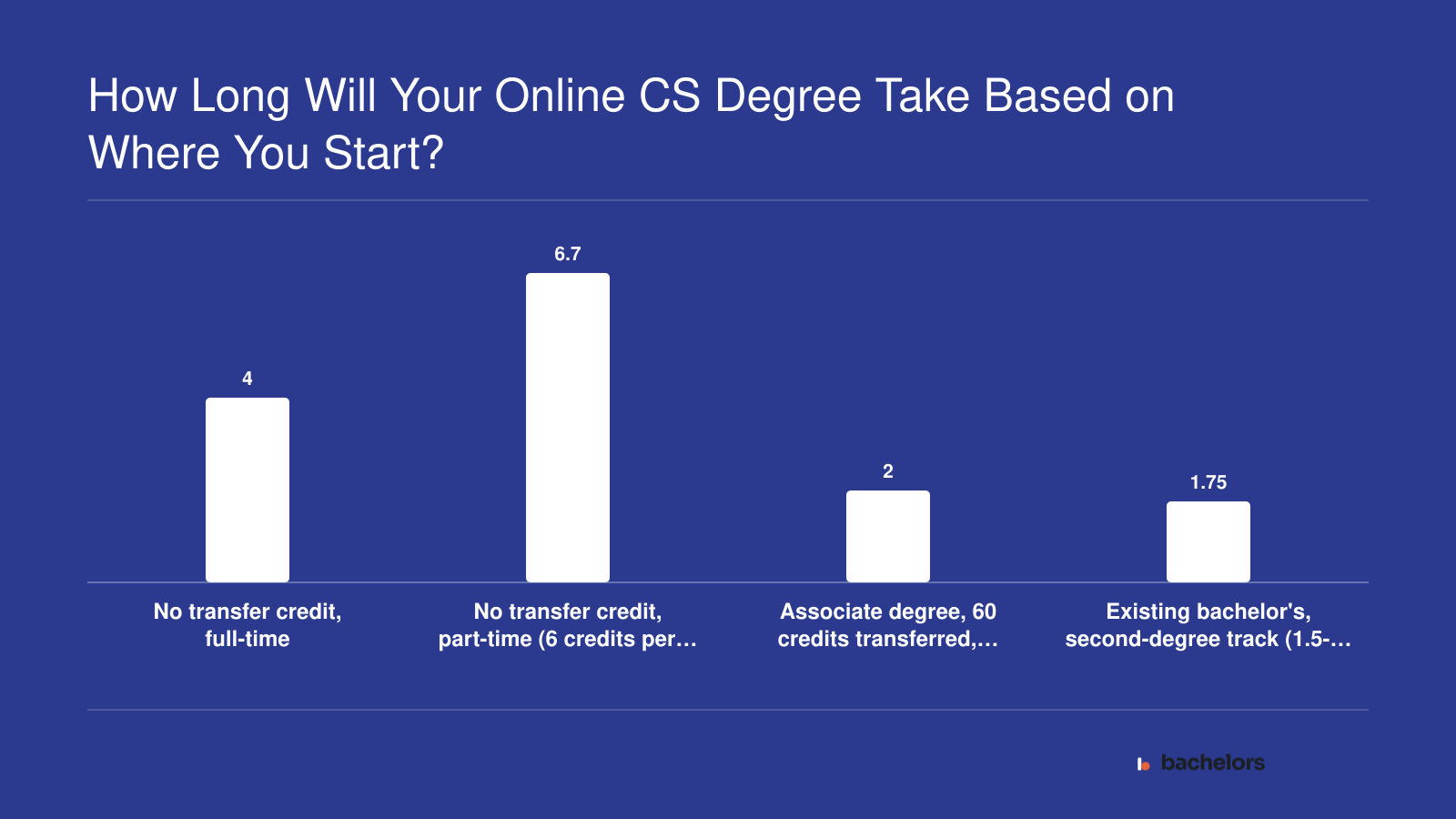
A student who arrives with 60 transferable credits can finish a computer science bachelor's in about half the time of someone starting from zero. That gap, not the calendar on the program page, is what really determines how long an online CS degree takes.
The Baseline: About 120 Credits
Most bachelor's degrees in computer science require roughly 120 semester credits, or about 180 quarter credits, which works out to four years of full-time study. Working adults rarely move at that pace. A two-course load across year-round terms stretches the timeline, and part-time students often take five or six years unless they bring credits with them.
At quarter-based schools such as Oregon State Ecampus, one quarter credit equals about 0.67 semester credits, so a 180-quarter-credit degree lines up with the 120-semester-credit norm.
How Many Credits You Can Bring
Caps vary widely. Southern New Hampshire University publishes the clearest ceiling, accepting up to 90 credits, or 75% of the bachelor's, while requiring 30 credits completed there and 12 within the major.1 Transfer coursework generally needs a C- or better from an accredited institution and must fit degree requirements.
Arizona State University Online generally cites up to 64 undergraduate transfer credits, though one page qualifies that figure by institution type and notes that how credits apply depends on the program and college. ASU requires 30 credits completed at the university. Oregon State Ecampus states no total transfer maximum but requires at least 45 of your final 75 credits there, online or on campus.
Terms, Pace, and Prior Learning
Accelerated calendars matter as much as transfer credit. ASU Online runs fall and spring sessions of 7.5 weeks and summer sessions of 6 weeks, with individual courses listed anywhere from 7.5 to 15 weeks. Oregon State uses 10-week quarters. Year-round enrollment lets you keep accumulating credits through the summer instead of stopping.
CLEP exams, prior-learning assessment, and military credit evaluated through ACE transcripts can shorten the path further, though schools apply their own limits and not every CS requirement is open to exam credit.
If you already hold a bachelor's degree, a post-baccalaureate second-degree track in computer science can be much shorter, since general education requirements are typically considered satisfied.
Watch the Math and Programming Rules
Technical courses carry stricter transfer scrutiny than electives. Math and programming credits often need to be recent or earned at a minimum grade, and an older IT course may count only as a general elective rather than substituting for a specific requirement. Confirm in writing how each technical course will apply before you enroll.
How Long Will Your Online CS Degree Take Based on Where You Start?
These bars show illustrative credit math for a standard 120-semester-credit bachelor's degree. They are not school guarantees. Your real timeline depends on how many credits a program actually accepts in transfer, not on how fast a program says you can finish. Get a written credit evaluation before you enroll.
Software Developer Pay at a Glance
This is a national figure for the occupation as a whole. It is not an earnings outcome for graduates of any program ranked here.
Questions to Ask Yourself
Do you plan to pursue graduate school or government work?
How many of your existing credits will transfer, and are they quarter or semester hours?
Can you attend live sessions in the school's time zone and take webcam-proctored exams?
Do you want the calculus-heavy traditional CS path, or an applied software degree?
Computer Science programs by state
Compare Computer Science programs on the data that matters
Explore more Computers & IT majors or browse every field of study.
All Computers & IT programs Browse every field of study