Cheapest Online Criminal Justice Degree Programs
Compare 930+ accredited cheapest online Criminal Justice programs at 870+ colleges, with net price after aid, graduation rates, earnings and debt from IPEDS and the U.S. College Scorecard.

Where can you earn an accredited criminal justice bachelor's degree online without overpaying? At the low end, Texas A&M University-Central Texas posts an average annual net price of $1,300 after grants and scholarships, against $7,363 in published in-state tuition and fees.
Every program ranked here is 100% online, with no hybrid or campus requirements. Real cost goes beyond the per-credit rate: fees, transfer and military credit, and accreditation all shift the final bill.
Agencies and graduate schools expect institutional accreditation. A cheap degree without it is no bargain.
Key Points
- Compare total cost: per-credit rate times 120 credits plus mandatory fees.
- Most programs accept transfer credit for up to about 75 percent.
- American Public University System graduates earn a $57,409 median one year out.
Top 10 Cheapest 100% Online Criminal Justice Bachelor's Programs
Every program below is delivered fully online; hybrid and campus-based options were excluded from this list. Schools appear in order of a composite score weighted most heavily toward net price after aid and financial aid availability, with baseline quality measures such as graduation rate filling out the rest. Each entry shows the institution-wide average net price after aid (not a tuition quote), in-state and out-of-state tuition, school type, and the school's graduation rate.
Texas A&M University-Central Texas
#1Killeen, TX · under $5,000/yr (est.)
Best for: Transfer students with prior college credit
A public university in Killeen, Texas, serving largely nontraditional and transfer students. Its 120-credit criminal justice bachelor's runs fully online, bookended by a first-semester proseminar and a final capstone. The institution-wide net price after aid is about $1,300, among the lowest here, though out-of-state tuition is more than double the in-state rate, and non-Texas residents should confirm state authorization before applying. The school's graduation rate is 41%.
- 120 total credit hours
- First-semester proseminar and final capstone required
- Coursework covers courts, corrections, victims and offenders
- Careers in local, state and federal law enforcement
- Omega Lambda chapter of Alpha Phi Sigma honor society
- Criminal Justice Association membership available
- Upper-level criminal justice electives
CUNY John Jay College of Criminal Justice
#2New York, NY · ~$3,200/yr (est.)
Best for: Urban justice policy and reform focus
A senior college of the City University of New York dedicated entirely to criminal justice, located in Manhattan. Its criminal justice major treats crime as a social problem and emphasizes analytical skills, ethical reasoning, and critical assessment of the justice system. The institution-wide net price after aid is roughly $3,200, and graduates of the program report strong earnings a few years out. The school's graduation rate is 56%.
- One of 31 undergraduate majors at the college
- Crime treated as a social problem
- Builds analytical skills, ethical reasoning and problem solving
- Critically assesses the structure of the justice system
- Linked Criminal Justice BA/MA option
- Housed in the Department of Criminal Justice
California State University-San Bernardino
#3San Bernardino, CA · $4,600/yr (est. net price)
Best for: California residents wanting flexible pacing
A public university in San Bernardino, California, offering a 120-unit criminal justice bachelor's delivered completely online through its college of extended and global education. The major totals 45 units, spanning crime theory, research methods, statistics, corrections, and police systems, with electives in victimology, gangs, and white collar crime. The institution-wide net price after aid is about $4,600, and out-of-state tuition is more than three times the in-state rate. The school's graduation rate is 55%.
- 120 total units to graduate
- 45 units in the criminal justice major
- C or better required in core courses
- Three enrollments allowed per required course
- Up to 9 transfer units toward electives
- Internship, independent study and senior honors project options
- Electives include victimology, gangs and white collar crime
Texas A & M International University
#4Laredo, TX · $3,600/yr (est. net price)
A public university in Laredo, Texas, on the U.S.-Mexico border, with a 120-credit criminal justice bachelor's that requires 45 advanced hours and an 18-hour minor. Students choose fields of study such as juvenile justice and criminal investigation, and a combined bachelor's-to-master's path is available. The institution-wide net price after aid is about $3,600, well below the out-of-state tuition figure, so non-residents should check the cost before applying. The school's graduation rate is 46%.
- 120 total credit hours, 45 at the advanced level
- 18-hour minor requirement
- Combined BS/MS in Criminal Justice available
- Juvenile justice field of study option
- Coursework in courts, corrections, criminal law and criminology
- Senior pro-seminar writing-intensive capstone
- Spanish placement exam before language enrollment
Northwest College
#5Powell, WY · ~$7,000/yr (est.)
A public college in Powell, Wyoming, whose Bachelor of Applied Science in Criminal Justice Studies builds on an associate degree or prior training. The 120-credit upper-division degree lets students tailor coursework toward a specialized law enforcement role, public service leadership, or graduate study, and it is offered in Hyflex format with fall and spring entry terms. The institution-wide net price after aid is about $7,500. The school's graduation rate is 49%.
- 120 total credit hours
- Bachelor of Applied Science degree
- Builds on an associate degree or prior training
- Hyflex format with fall and spring entry terms
- Customize studies toward a specialized law enforcement role
- Prepares students for graduate-level study
- Topics cover law enforcement, corrections and courts
Dalton State College
#6Dalton, GA · $3,300 – $11,000/yr (est.)
A public college in Dalton, Georgia, offering a criminal justice bachelor's that prepares students for municipal, state, and federal law enforcement, corrections, juvenile justice, and probation work. The program also builds analytical and research skills for students headed to law school or graduate study, and alumni work for agencies including the Dalton and Chattanooga police departments and the U.S. Capitol Police. The institution-wide net price after aid is about $5,000, and in-state tuition is well under the out-of-state rate. The school's graduation rate is 25%.
- Fully online option available
- Covers law enforcement, corrections and juvenile justice
- Prepares students for law and graduate school
- Alumni at Dalton and Chattanooga police departments
- Median salary data published for Georgia graduates
- Also offers an Associate of Science in Criminal Justice
Florida International University
#7Miami, FL · ~$9,000/yr (est.)
A large public research university in Miami, Florida, with a criminal justice bachelor's built on 18 credits of core courses, 18 credits of criminal justice electives, and 24 general electives, closing with a senior capstone. The degree is available on campus and through FIU Online, and full-time justice employees with three years of experience can petition to substitute an ethics course for the introductory requirement. The institution-wide net price after aid is about $9,300. The school's graduation rate is 74%.
- 18 credits of core courses and 18 of criminal justice electives
- 24 credits of general electives
- Senior capstone required
- Two Global Learning courses required
- Second-semester foreign language sequence required
- Internship encouraged
- Available on campus and through FIU Online
Atlanta Metropolitan State College
#8Atlanta, GA · ~$5,000/yr (est.)
A public college in Atlanta, Georgia, that delivers its criminal justice bachelor's through eMajor, a collaborative online format shared across institutions. The degree sits in the School of Arts and Sciences, and students can download degree worksheets and pathway maps to plan the major. The institution-wide net price after aid is about $5,300, and in-state tuition is a fraction of the out-of-state rate. The school's graduation rate is 17%.
- Delivered through eMajor
- Housed in the School of Arts and Sciences
- Downloadable degree worksheet available
- Program and pathway maps published as PDFs
Eastern New Mexico University
#9Portales, NM · ~$4,900/yr (est.)
A public university in Portales, New Mexico, offering both a Bachelor of Science and a Bachelor of Arts in Criminal Justice that students can finish in about four years. Courses run fully online through Canvas or recorded lectures, and an internship is required. More than $22 million in financial aid is awarded each year, the online application is free, and military and veterans resources are available. The institution-wide net price after aid is about $4,900. The school's graduation rate is 45%.
- Four-year degree with a fully online option
- Free online application
- Internship required
- Recorded, live and fully online course formats
- Prepares for law enforcement or victim advocacy careers
- Scholarships and military and veterans resources
- Free job placement assistance
Utah Valley University
#10Orem, UT · $5,000 – $10,000/yr (est.)
A large public university in Orem, Utah, whose 120-credit criminal justice bachelor's includes a 77-credit discipline core running through criminal law, investigations, forensic science, policing, corrections, evidence, and ethics, then a capstone seminar. Students add 18 elective credits, at least 12 upper-division, and an internship is strongly recommended; both campus and online graduation plans are published. The institution-wide net price after aid is about $6,400, and in-state tuition is roughly a third of the out-of-state rate. The school's graduation rate is 45%.
- 120 total credit hours
- 77-credit discipline core requirement
- 18 elective credits, 12 at the upper-division level
- Capstone seminar required
- Internship strongly recommended
- 2.0 GPA and 30 residency credits required
- Two writing-enriched courses required
Cost & outcomes by school
Federal data for the highest-earning Criminal Justice programs, independent of the ranking above. Earnings are this field's bachelor's graduates four years after completing where the Scorecard reports them, else the school's undergraduate median.
| School | Net price / yr | Grad rate | Earnings | Debt | Grads/yr | Format |
|---|---|---|---|---|---|---|
| Boston College MA | $41,704 | 91% | $103,937 | $19,000 | 7 | Online or campus |
| University of New Hampshire NH | $23,805 | 76% | $81,768 | $26,814 | — | Online |
| Mount Saint Mary's University CA | $21,413 | 53% | $72,379 | $25,949 | — | Online or campus |
| University of Florida FL | $4,815 | 85% | $71,588 | $15,000 | — | Online or campus |
| University of Florida FL | $6,541 | 91% | $71,588 | $15,000 | — | Online or campus |
| Herzing University-Kenosha WI | $23,066 | 72% | $69,601 | $19,310 | 2 | Online |
| American Public University System WV | $9,597 | 57% | $69,546 | $20,888 | 550 | Online |
| University at Albany NY | $17,167 | 62% | $67,979 | $19,500 | 150 | Online or campus |
| University of New Hampshire at Manchester NH | $9,992 | 50% | $66,479 | $26,814 | — | Online |
| Charter Oak State College CT | $15,815 | 67% | $64,209 | $18,750 | 43 | Online |
| University of Washington-Tacoma Campus WA | $10,163 | 63% | $63,311 | $11,628 | 50 | Online or campus |
| California State University-San Marcos CA | $10,229 | 55% | $62,908 | $17,350 | — | Online |
Sources: U.S. Department of Education. Net price, graduation rate, earnings and debt: College Scorecard (earnings and debt for this field's bachelor's graduates where reported, else school-wide); graduates: IPEDS. A dash means no figure is reported.
Cost, debt & payoff
Median earnings of this field's bachelor's graduates (4 yrs after completing, else the school's undergraduate median) vs. their median federal loan debt · U.S. College Scorecard
Across these programs the median graduate earns about $53,916 and finishes with roughly $24,212 in debt — a ratio that clears a common rule of thumb (keep debt below first-year salary). Net price and debt vary widely school to school, so check the per-school figures in the table above before you shortlist.
How Much Does an Online Criminal Justice Degree Cost?
A low per-credit rate is only part of the story; what hits your budget is the total bill for a full degree. The cleanest comparison multiplies the per-credit rate by 120 credits, adds mandatory fees, and assumes you transfer nothing in.
Standardized Totals at Three Schools
- Kennesaw State University: $192 per credit × 120 = $23,040 in tuition. Confirm online fees separately.
- Colorado State University Global: $385 per credit × 120 = $46,200, with no mandatory fees advertised.
- University of Arizona Online: $525 per credit × 120 = $63,000 before fees.1
Across online criminal justice bachelor's programs, Forbes Advisor reports per-credit rates of $179 to $553 and full-program totals of roughly $21,000 to $66,000. The report does not say whether fees are included. Financial aid changes the picture sharply. Average yearly net price after grants at the schools ranked here runs from $1,300 at Texas A&M University-Central Texas to $6,928 at Georgia Highlands College.
Residency Can More Than Double the Bill
Kennesaw State, CSU Global, and LSU Online charge online students one rate no matter where they live. Other public universities split pricing by state. Texas A&M University-Central Texas lists $7,363 in yearly tuition and fees for Texas residents versus $17,154 for nonresidents, so ask whether online students pay the resident rate.
Compare total cost with fees and your residency status, not the advertised per-credit rate.
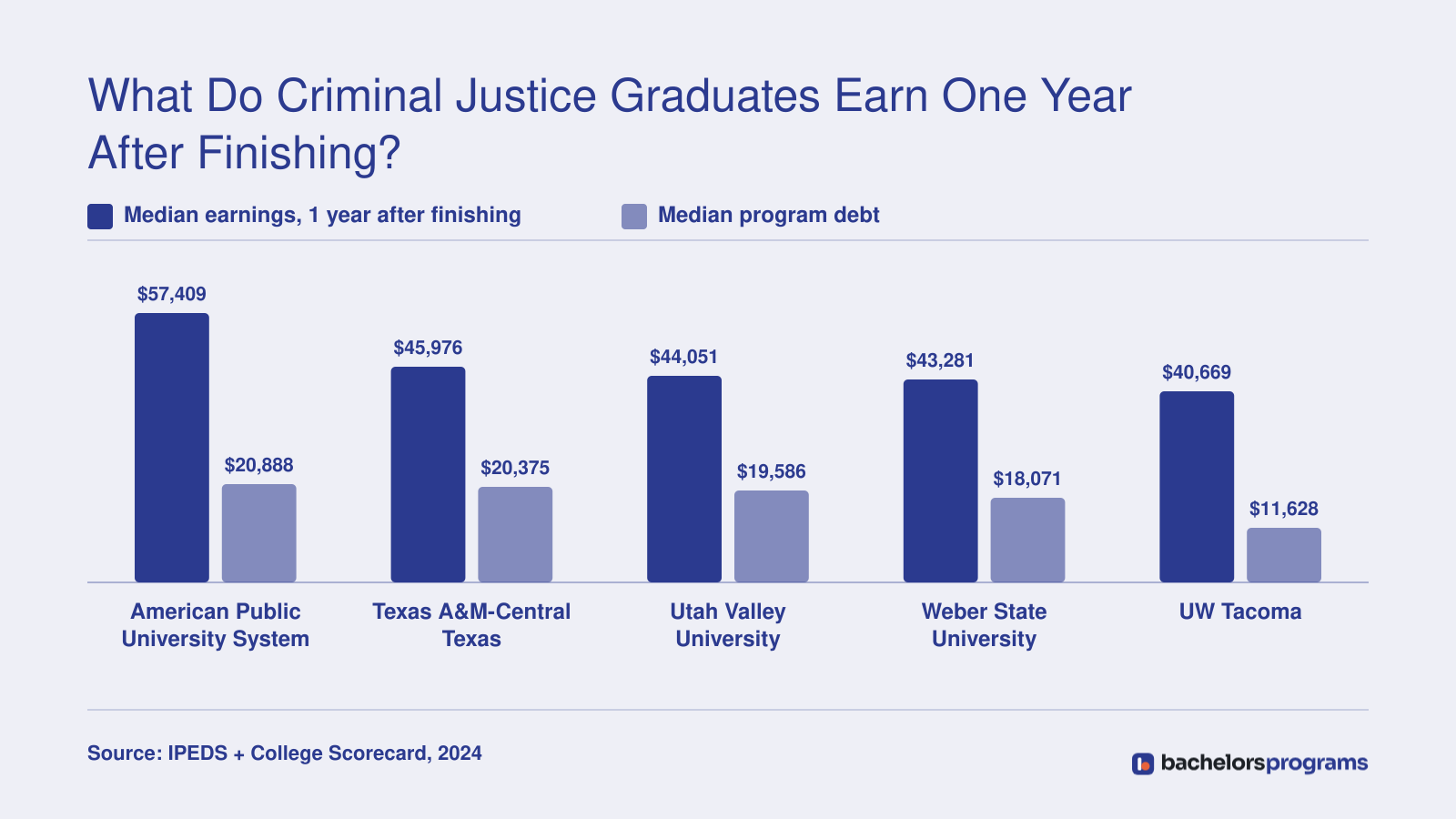
What Do Criminal Justice Graduates Earn One Year After Finishing?
Sticker price is only half the value equation. This chart compares median earnings one year after finishing a criminal justice bachelor's degree with the median debt graduates carried from the same program. American Public University System leads with $57,409 in first-year earnings against $20,888 in median debt. University of Washington Tacoma posts the lowest median debt here, at $11,628, alongside $40,669 in earnings. Utah Valley and Weber State both pair first-year pay above $43,000 with debt under $20,000.
Related Articles
Cut Your Cost With Transfer, Military, and Police Academy Credit
Transfer credit is coursework or training you've already completed that a university counts toward your 120-credit bachelor's degree, so you don't pay for it twice. Most online criminal justice programs cap transfer at about 75 percent of the degree, or 90 credits. Southern New Hampshire University, Campbellsville University, and LSU Alexandria each list a 90-credit maximum. LSUA's allowance depends on academic evaluation.
The Associate Degree Shortcut
A community college associate degree usually covers about 60 credits, roughly half a bachelor's, at a lower tuition rate. Transferring it in can come close to halving your total bill. To estimate savings, multiply transferred credits by your target school's per-credit rate. At an illustrative $300 per credit, 60 transferred credits equal $18,000 you never pay.
Credit for Academy, Military, and Exams
- Police academy: SNHU awards up to 12 credits for basic police, corrections, or probation and parole training, reportedly outside the cap in most cases. Campbellsville grants up to 12 credits in Criminology for Kentucky-approved academies2 and up to 16 in Criminal Justice Administration for Kentucky training.1
- Military: Submit your Joint Services Transcript. ACE recommendations are reviewed case by case.
- CLEP and DSST: Many schools accept these exams, but limits vary, so confirm with admissions before testing.
Accreditation and Hidden Costs to Check Before You Enroll
A low sticker price only pays off if the degree carries weight with employers and the bill stays the same after you enroll.
Accreditation Comes First
Institutional (regional) accreditation is the baseline that federal agencies, police departments and graduate schools expect. It also determines eligibility for federal financial aid and makes credits easier to transfer. Texas State University and the University of Louisville are accredited by SACSCOC.2 The University of Cincinnati is accredited by the Higher Learning Commission (HLC).4 Criminal justice has no required programmatic accreditor, so confirm any school's status in the U.S. Department of Education's DAPIP database or the CHEA directory.
Fees and Schedules That Change the Math
Louisville adds a $10 per credit fee to online courses.3 Texas State automatically adds BookSmart textbook fees each semester unless you opt out by the start of the term.2 In LSU Alexandria's program, proctoring and book costs vary by course. Cincinnati's online course fees differ by program.4 CSU Global and Kansas run asynchronous courses1, but not every program says whether live sessions are required; fixed meeting times can undercut "fully online" flexibility.
Before you enroll, verify the accreditor in DAPIP. Then request a complete fee schedule that covers proctoring, technology and textbook charges. Finally, get written confirmation that no required coursework meets at set times.
Questions to Ask Yourself
Are you aiming for local policing, corrections, courts, or a federal agency?
Do you already hold police academy or military training that a school will convert to credit?
Do you need a concentration such as homeland security or forensics, or just the cheapest general degree?
Will you pay in-state or out-of-state online rates?
Criminal Justice programs by state
Online Criminal Justice Degree FAQ
What is the cheapest online criminal justice degree?
Are online criminal justice degrees respected by employers?
What is the fastest online criminal justice degree?
Can I get a criminal justice degree online for free?
Compare Criminal Justice programs on the data that matters
Explore more Criminal Justice & Law majors or browse every field of study.
All Criminal Justice & Law programs Browse every field of study