Cheapest Online Software Engineering Degree Programs
Compare 140+ accredited cheapest online Software Engineering programs, with net price after aid, graduation rates, earnings and debt from IPEDS and the U.S. College Scorecard.

A 120-credit software engineering bachelor's at $300 per credit comes to $36,000 in tuition before a single fee, and advertised online rates swing far wider than that. Some schools quote per credit, some per term, some a flat rate for however many courses you carry.
That inconsistency makes comparison hard. Two programs with similar sticker prices can land five figures apart once credit requirements and fees are counted, and ABET status or a graduate's early earnings can separate them further. Fully online delivery has loosened the old residency penalty, though not everywhere.
Key Points
- Estimate total cost: per-credit tuition times required credits, plus mandatory fees.
- ABET judges online programs by the same criteria it uses on campus.
- Arizona State software engineering graduates earned $112,543 median after four years.
Top 10 Cheapest 100% Online Software Engineering Bachelor's Programs
Every program below can be completed entirely online, so no campus visits, hybrid residencies or in-person labs are required. Each card pairs published tuition and fees with an approximate net price after aid, which is an institution-wide average rather than a quote for any individual student.
Western Governors University
#1Salt Lake City, UT · ~$13,000/yr (est.)
Best for: Working adults accelerating at their own pace
In-state and out-of-state tuition and fees are $8,658, and average net price after aid is about $12,548. Schools offering this program have graduation rates of 46%, and flat six-month terms let students finish extra courses at no added cost.
- 39 courses; 12 start dates per year
- $4,125 per six-month term, flat rate
- Five credentials included: AWS Developer, ITIL 4, three microcredentials
- Capstone: proposal, implementation, post-implementation report
- 60% of graduates finish within 35 months
- No entrance exam; ACT and SAT not required
- AI coursework plus Java and Python throughout
- Transfer credits accepted from accredited institutions
University of Michigan-Dearborn
#2Dearborn, MI · ~$9,000/yr (est.)
Best for: Cost-focused Michigan residents staying in state
In-state tuition and fees are $15,640 against $32,896 out of state, with average net price after aid near $9,492. Schools offering this program have graduation rates of 58%, and the Go Blue Guarantee can cover full tuition for qualifying Michigan residents.
- ABET-accredited by the Engineering Accreditation Commission
- Four sequences: Information Systems, Game Design, Web Engineering, AI
- Accelerated bachelor's and master's in five years
- Go Blue Guarantee covers tuition for qualifying Michigan residents
- Rolling admissions with early applicants prioritized for aid
- Software developer median salary $134,040
University of Minnesota-Crookston
#3Crookston, MN · ~$12,000/yr (est.)
Best for: Rural learners needing asynchronous coursework
Tuition and fees are $13,288 for in-state and out-of-state students alike, and average net price after aid is about $12,212. Schools offering this program have graduation rates of 50%, and the online track runs asynchronously.
- Fully online, asynchronous delivery
- Three emphasis areas including gaming and simulation
- Minor in cybersecurity and information assurance
- 2026-27 online tuition and fees: $13,096 full-time
- Interns and graduates hired at Amazon, NASA, Microsoft
- Undergraduate Collaborative Learning and Applied Research Lab
Kennesaw State University
#4Kennesaw, GA · ~$15,000/yr (est.)
In-state tuition and fees are $5,808, out-of-state tuition is $17,736, and average net price after aid is near $15,048. Schools offering this program have graduation rates of 52%.
- 120 credits; fall, spring and summer starts
- Offered face-to-face, online or hybrid
- Double Owl pathway into the Software Engineering MS
- Labs, team projects and after-hour class options
- Marietta campus is the primary location
University of Arizona
#5Tucson, AZ · ~$17,000/yr (est.)
In-state tuition and fees are $13,926 against $42,278 out of state, with average net price after aid near $16,674. Schools offering this program have graduation rates of 68%, and the online software engineering degree bills $525 per credit across 120 credits.
- 120 credits at $525 per credit
- ABET accredited software engineering BS
- Coursework in Agile, DevOps and automated testing
- Math base: calculus, physics and discrete math
- Top 5% online bachelor's programs nationally, U.S. News 2026
Saint Cloud State University
#6Saint Cloud, MN · ~$14,000/yr (est.)
In-state and out-of-state students pay the same $10,245 in tuition and fees, and average net price after aid is about $13,529. Schools offering this program have graduation rates of 40%.
- Accelerated online B.S. option
- Project work every semester
- Curriculum developed with industry partners
- Courses in game design, big data and software cybersecurity
- One of two such programs in the Minnesota State system
Colorado State University-Fort Collins
#7Fort Collins, CO · ~$21,000/yr (est.)
In-state tuition and fees are $13,373 against $34,783 out of state, with average net price after aid near $21,279. Schools offering this program have graduation rates of 67%.
- Software engineering concentration inside the Computer Science B.S.
- Offered on campus and online
- Housed in the College of Natural Sciences
- Catalog lists no separate credit total for the concentration
Colorado Technical University-Colorado Springs
#8Colorado Springs, CO · ~$17,000/yr (est.)
In-state and out-of-state tuition and fees are both $12,750, and average net price after aid is roughly $16,745. Schools offering this program have graduation rates of 19%, the lowest figure in this ranking, so completion support matters here.
- 183 credits: 51 general education, 88 core, 44 concentration
- Five-week courses starting about every five weeks
- Fast Track exams can cut completion time by 30%
- Not programmatically accredited; outcomes align with ABET standards
- 20 elective credits inside the concentration
- Linux programming, UI design and software quality assurance
Arizona State University
#9Scottsdale, AZ
Arizona State delivers the software engineering BS through ASU Online as well as its Polytechnic campus, and the degree holds Engineering Accreditation Commission of ABET status. Its online bachelor's programs placed in the top 5% nationally in a recent U.S. News ranking.
- ABET-accredited software engineering BS
- 120 credits; Polytechnic campus, ASU Online or ASU Local
- Accelerated bachelor's plus master's in five years
- First-year admission: 3.00 GPA, or 1210 SAT / 24 ACT
- Transfer applicants need a 2.75 GPA
- Technical electives in web, mobile and embedded systems
Grand Canyon University
#10Phoenix, AZ · ~$22,000/yr (est.)
Online tuition is $490 per credit, in-state and out-of-state tuition and fees are both listed at $17,850, and average net price after aid is about $22,472. Schools offering this program have graduation rates of 43%, and online courses run in seven-week terms.
- $490 per credit online; 120 credits total
- Online courses run in 7-week terms
- Up to 90 transfer credits accepted
- Capstone project required
- 2.8 unweighted GPA required for admission
- Python, Java, C, cloud computing and embedded systems
Cost & outcomes by school
Federal data for the highest-earning Software Engineering programs, independent of the ranking above. Earnings are this field's bachelor's graduates four years after completing where the Scorecard reports them, else the school's undergraduate median.
| School | Net price / yr | Grad rate | Earnings | Debt | Grads/yr | Format |
|---|---|---|---|---|---|---|
| Arizona State University AZ | $14,967 | 68% | $112,543 | $25,000 | 202 | Online or campus |
| Pennsylvania State University PA | $32,875 | 86% | $112,269 | $26,471 | 93 | Online or campus |
| University of Michigan-Dearborn MI | $9,492 | 58% | $111,740 | $21,064 | 56 | Online or campus |
| Kennesaw State University GA | $15,048 | 52% | $103,054 | $23,250 | 146 | Online or campus |
| Oregon State University OR | $19,604 | 70% | $64,010 | $21,221 | — | Online or campus |
| Western Governors University UT | $12,548 | 46% | $60,615 | $11,116 | 880 | Online |
Sources: U.S. Department of Education. Net price, graduation rate, earnings and debt: College Scorecard (earnings and debt for this field's bachelor's graduates where reported, else school-wide); graduates: IPEDS. A dash means no figure is reported.
Cost, debt & payoff
Median earnings of this field's bachelor's graduates (4 yrs after completing, else the school's undergraduate median) vs. their median federal loan debt · U.S. College Scorecard
Across these programs the median graduate earns about $70,550 and finishes with roughly $23,000 in debt — a ratio that clears a common rule of thumb (keep debt below first-year salary). Net price and debt vary widely school to school, so check the per-school figures in the table above before you shortlist.
Total Degree Cost: Converting Per-Credit Prices Into One Comparable Number
A sticker rate tells you little; only an estimated total shows what a degree costs. The formula is simple: per-credit tuition times total credits required, plus mandatory fees. Comparing totals beats comparing rates, because credit requirements and fees differ from school to school.
These estimates come from each school's program and tuition pages:
- St. Cloud State: $385.67 x 122 credits is about $47,050, before any additional fees the school says may apply.
- University of Minnesota Online: $483.70 x 120 credits is $58,044, plus a $250 campus fee each semester. Eight semesters adds $2,000, for roughly $60,000.
- Capital Technology University: ($460 + $55 IT fee) x 120 credits is $61,800. The lower partnership rate of $375 plus the fee comes to $51,600, if you qualify.
- University of Arizona Online: $525 x 120 credits is $63,000, and its page does not state mandatory fees.
Watch for extras that rarely appear in headline prices: technology fees, e-textbooks and exam proctoring. Western Governors University charges a flat rate per six-month term, so its total depends on how fast you finish, and it adds a $200 e-books and resources fee each term.
Tuition changes yearly, so confirm current rates on each school's page before you budget.
ABET Accreditation: Which Affordable Online Programs Qualify?
As online engineering enrollment has grown, ABET has made clear that it accredits online and on-site programs under the same criteria, with no separate standard for distance delivery.1 That matters because employers, state licensure boards and graduate admissions committees treat ABET as the baseline signal of a legitimate engineering credential, and the accreditation attaches to an individual program, not to the university as a whole.
Among the schools here, Kennesaw State University's online Bachelor of Science in Software Engineering carries accreditation from ABET's Engineering Accreditation Commission with no in-person requirements, and Penn State World Campus offers a 100% online, EAC-accredited software engineering degree of at least 126 credits.
Regional accreditation is no substitute: a fully accredited university can run a non-ABET software program, and the cheapest option on a list may be exactly that. Search the program by name in ABET's accredited program database before you enroll.
In-State vs. Out-of-State Pricing and Competency-Based Options
Many public online programs charge one per-credit rate to every student, so residency matters less than it does on campus. Others still add a non-resident fee or split pricing by residency, so check each school's current tuition page before you apply. Penn State World Campus also lists a flat-rate semester price, which can reward students who carry a full course load.
| Program | Residency pricing | Listed rate |
|---|---|---|
| UW-Madison Online | Same rate for all students regardless of Wisconsin residency | $500 per credit hour |
| University of Kansas Online | No additional out-of-state tuition | $445 or $495 per credit hour, depending on program |
| University of Arizona Online | In-state rate listed; confirm the out-of-state online rate with the school | $525 per credit hour |
| Penn State World Campus | Slightly higher rate for non-Pennsylvania students | $644 in-state or $657 out-of-state (59 or fewer credits); $692 or $706 (60 or more credits) |
| Penn State World Campus, flat-rate term pricing | One price per semester for 12 to 19 credits | $7,833 (59 or fewer credits) or $8,455 (60 or more credits) per semester |
| University of Cincinnati Online | Students outside Ohio pay an additional non-resident fee; fees vary by program | Varies by program |
| University of Colorado Boulder Online | Residents and nonresidents are classified differently, except Coursera-hosted programs, which charge one per-credit rate | Varies by program |
Related Articles
Cutting Costs With Transfer Credits and Accelerated Paths
Transfer credit now lowers the price of an online software engineering degree more than the tuition rate does. Every 3-credit course you bring in erases one course's worth of tuition at your school's per-credit rate, so a completed 60-credit associate degree can cut roughly half a bachelor's bill at a credit-priced program.
Several schools here publish generous ceilings. CSU Global accepts up to 90 transfer credits, including 64 from community colleges and 60 from prior learning or credit by exam.1 Thomas Edison State University and Charter Oak State College also cap transfer at 90, with 30 residency credits required at TESU and both accepting CLEP, DSST and portfolio review.1 Liberty allows 90 hours, up to 75% of a prior degree, plus 30 experience hours.2 WGU reviews transcripts case by case, and an associate degree usually brings upper-division standing.
Check these before committing:
- Calculus: Penn State requires calculus-based math and sciences for direct entry to the major.
- Programming: Introductory coursework often transfers only with a matching course description.
- General education: Confirm which requirements your credits satisfy.
Finishing faster through year-round terms or heavier loads trims fees and living costs, not the per-credit price itself.
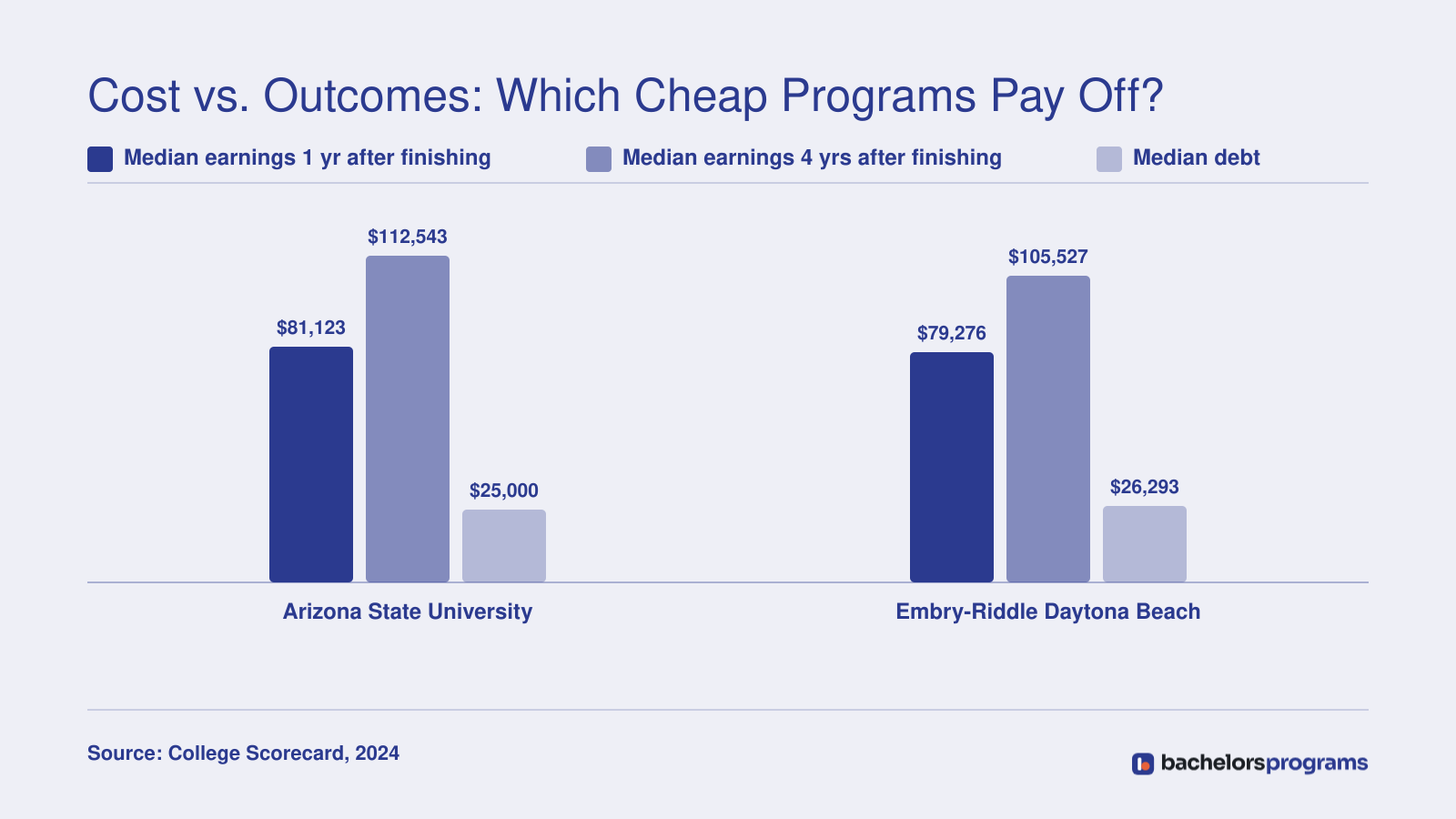
Cost vs. Outcomes: Which Cheap Programs Pay Off?
Arizona State University software engineering graduates earned a median $81,123 one year after finishing and $112,543 four years after finishing, against median debt of $25,000. At Embry-Riddle Aeronautical University-Daytona Beach, graduates earned $79,276 after one year and $105,527 after four years, with median debt of $26,293. ASU's four-year earnings run about 4.5 times its median debt, the stronger earnings-to-debt ratio here, a reminder that the lowest sticker price is not always the best value.
Software Engineering programs by state
Common Questions About Cheap Online Software Engineering Degrees
Prices change by term, residency, and fees, so use these answers as a starting point. The ranking and total-cost sections above show the comparable numbers.
What is the cheapest online software engineering degree?
Is there a free online software engineering degree?
Is a software engineering degree cheaper than a computer science degree online?
Can I finish an online software engineering degree faster to save money?
Compare Software Engineering programs on the data that matters
Explore more Science & Engineering majors or browse every field of study.
All Science & Engineering programs Browse every field of study