Best Criminology Schools in Kentucky
Compare 3 accredited Criminology programs in Kentucky, with net price after aid, graduation rates, earnings and debt from IPEDS and the U.S. College Scorecard.

In Kentucky, a criminology bachelor's degree comes from a public campus or a private one, and both Western Kentucky University and Campbellsville University also deliver the major online. Campbellsville University lists $27,998 in tuition and fees, while the public schools run on state rates.
Programs award either a Bachelor of Science (B.S.) or a Bachelor of Arts (B.A.) in Criminology, and at Western Kentucky University majors stack a minor, certificate, or second major on top. Kentucky's public-safety agencies hire criminology and criminal justice graduates into similar entry roles, so the deciding figure is often net price after aid, not the title on the diploma.
Key Points
- Western Kentucky University's online criminology B.A. requires a second field of study.
- Campbellsville University's $27,998 tuition drops to a $19,341 average net price.
- Median WKU criminology pay rises from $32,370 to $45,124 by year four.
Best Criminology Schools in Kentucky: Ranked List
Kentucky offers a short list of bachelor's degrees in criminology, and the three programs below take genuinely different approaches. One asks majors to add a second field, one runs a face-to-face program aimed at criminal justice agencies, and one is a faith-based campus program with required fieldwork. Read each entry for the structure that fits your goals, then compare cost and admissions in the sections that follow.
Western Kentucky University
#1Bowling Green, KY · $12,000 – $27,000/yr (est.)
Best for: Liberal arts learners adding a second major
Western Kentucky University houses criminology in its Department of Society, Culture, Crime, and Justice Studies, so the major treats crime as a social question rather than only a police procedure. The Bachelor of Arts requires 35 credit hours in the major plus a minor, certificate, or second major, which gives students room to pair criminology with psychology, sociology, or a language. The university reports a 55.6% graduation rate, and criminology graduates had median earnings of $45,124 four years after completing the program.
- 35 credit hours in the major; 120 total for the degree
- Requires a minor, certificate, or second major
- Core includes Criminal Justice, Criminology, and Social Statistics
- Social research methods is part of the core sequence
- Restricted electives: Correlates of Crime, Systems of Social Control
- Choose four unrestricted electives across forensics, law, and policing
- Finish in Four plan totals 122 credit hours
Morehead State University
#2Morehead, KY · ~$10,000/yr (est.)
Best for: Career changers wanting face-to-face classes
Morehead State University's criminology and criminal justice bachelor's degree is a four-year, face-to-face program on the Morehead campus, built around writing, speaking, collaboration, critical thinking, and professionalism. Coursework prepares students for courts, treatment centers, corrections, law enforcement, homeland security, and federal criminal justice administration, and the university names the Kentucky State Police and the Kentucky Department of Corrections among employers of graduates. Applicants use the standard undergraduate application or the Common Application, and students can add a criminology minor. The university reports a 52.2% graduation rate.
- Builds writing, speaking, collaboration, and critical thinking
- Prepares students for courts, corrections, and law enforcement
- Also covers homeland security and federal justice administration
- Graduates work at Kentucky State Police and the Department of Corrections
- Criminology minor available alongside the major
- Standard undergraduate application or Common Application
Campbellsville University
#3Campbellsville, KY · ~$19,000/yr (est.)
Best for: Faith-based learners who value internship experience
Campbellsville University awards either a Bachelor of Arts or a Bachelor of Science in Criminology, with coursework in criminal law, corrections, policing, forensics, and justice policy. The program builds internships, fieldwork, and community-based projects into the degree and emphasizes ethical analysis, research, and leadership. Admission requires a high school diploma or GED and a minimum 2.0 GPA, and transfer applicants may need college transcripts and specific course prerequisites. The university reports a 42.0% graduation rate.
- Awarded as either a Bachelor of Arts or Bachelor of Science
- Coursework spans criminal law, corrections, policing, and forensics
- Internships, fieldwork, and community-based projects are included
- Emphasizes ethical analysis, research, and leadership
- Minimum 2.0 GPA plus high school diploma or GED
- Transfer applicants may need transcripts and course prerequisites
- Christ-centered program with case studies and experiential work
Cost & outcomes by school
Federal data for the highest-earning Criminology programs, independent of the ranking above. Earnings are this field's bachelor's graduates four years after completing where the Scorecard reports them, else the school's undergraduate median.
| School | Net price / yr | Grad rate | Earnings | Debt | Grads/yr | Format |
|---|---|---|---|---|---|---|
| Western Kentucky University KY | $10,990 | 56% | $45,124 | $25,815 | 98 | Online or campus |
| Morehead State University KY | $9,793 | 52% | $43,197 | $22,250 | — | Campus |
| Campbellsville University KY | $19,341 | 42% | $41,583 | $17,156 | — | Campus |
Sources: U.S. Department of Education. Net price, graduation rate, earnings and debt: College Scorecard (earnings and debt for this field's bachelor's graduates where reported, else school-wide); graduates: IPEDS. A dash means no figure is reported.
Cost, debt & payoff
Median earnings of this field's bachelor's graduates (4 yrs after completing, else the school's undergraduate median) vs. their median federal loan debt · U.S. College Scorecard
Across these programs the median graduate earns about $43,197 and finishes with roughly $22,250 in debt — a ratio that clears a common rule of thumb (keep debt below first-year salary). Net price and debt vary widely school to school, so check the per-school figures in the table above before you shortlist.
How We Ranked Kentucky's Bachelor's in Criminology Schools
Applicants now open a net price calculator before they read a single course description, so a useful comparison has to lead with cost and outcomes.
The Measures We Compare
- Cost and net price: published tuition for Kentucky residents, set beside the average price students actually pay after grants and scholarships.
- Completion and retention: graduation and retention rates, which signal whether enrolled students stay and finish.
- Earnings and debt: typical pay for graduates and median debt among those who borrowed.
- Completions and selectivity: how many students finish the major, and how competitive admission is.
- Delivery format: whether the program runs on campus, online, or both ways.
What the Numbers Do and Do Not Cover
Net price and graduation rate are institution-wide averages, not figures for the criminology major alone. A school's overall graduation rate counts nursing, business, and education students alongside criminology majors, so read it as context rather than a verdict on the department.
Earnings need the same care. They are measured at a stated window after completion, four years out for the WKU criminology graduates cited below, and an institution-wide figure is labeled as institution-wide, never attached to the major.
What is program-specific is the credential itself. Only Kentucky-based schools that award a bachelor's degree in criminology are ranked, campus and online alike, so every entry answers the same two questions: can you earn this degree here, and what does it take to finish it?
Bachelor's Degree in Criminology vs. Criminal Justice at Kentucky Schools
A bachelor's degree in criminology and a criminal justice degree answer different questions, and choosing the wrong one costs you time. Criminology studies why crime happens, using theory and research methods to examine causes, patterns, and social responses. Criminal justice studies how the system operates: policing, courts, and corrections.
What the Ranked Schools Offer
Each Kentucky program's title shows where the school leans.
- Western Kentucky University: A standalone Bachelor of Arts in Criminology. It requires a minor or second major, studies crime through a societal lens, and covers theory and policy.
- Morehead State University: A combined degree titled Criminology & Criminal Justice. Its program materials point to careers in courts, corrections, and law enforcement, including the Kentucky State Police and the Kentucky Department of Corrections.
- Campbellsville University: A Criminology degree awarded as a B.A. or B.S. Its listed career paths include crime analyst, forensic specialist, and criminal investigator, and internships and fieldwork are part of the program.
Beyond these titles and highlights, check each school's catalog for the specific courses before you commit.
Which Degree Fits Your Goal
If you want to do research, apply to graduate school, or move into social services and policy work, a criminology-centered degree is the stronger fit. Western Kentucky's theory-and-policy focus and its required minor or second major suit that path well, since the pairing lets you build a second area of expertise.
If you want to step directly into an agency, a justice-oriented degree maps more closely to the work. Morehead's combined title and its stated agency employers speak to that goal. Campbellsville sits between the two: a criminology title paired with applied fieldwork and investigative career paths.
Start with your target job. Then pick the program whose title and highlights point toward it.
Questions to Ask Yourself
Do you want to study why crime happens, or train for a specific agency job?
Will you stay near campus in Kentucky, or do you need an online or hybrid format while working?
Are you starting fresh, or transferring KCTCS credits?
Does your target employer care about the degree title?
Online and Hybrid Criminology Bachelor's Options at Kentucky Schools
Western Kentucky University's online Bachelor of Arts in Criminology requires at least 120 unduplicated semester hours, 35 or more of them inside the major, plus a minor, certificate, or second major. The structure matches the campus degree, so an online criminology degree in Kentucky is not a lighter or shortened version of the on-campus program.
The Fully Online Option
WKU Online lists the criminology B.A. as fully online. The credit math is the deciding detail for transfers: 35 hours inside the major leaves a large block of general education and elective hours to fill, and the required minor or second major adds another set of courses on top of that. Map those out with an advisor in your first term, not your last.
Regional Campuses and Hybrid Formats
WKU's regional campuses also list the Criminology, B.A. among their bachelor's programs. Glasgow describes the degree as completable 100% at Glasgow. Somerset lists it among its bachelor's programs and describes delivery options that include live-streaming and online web-based courses. None of those campus pages label the criminology degree itself as on-campus, hybrid, or fully online, so treat the format as unconfirmed until an advisor puts it in writing. Morehead State lists its criminology and criminal justice program with face-to-face classes in Morehead, and Campbellsville lists its criminology B.A. or B.S. as a campus program.
What Out-of-State Students Should Confirm
WKU's online criminology page does not state whether out-of-state students are accepted into the online degree, and it does not say whether online students pay the in-state rate. WKU publishes separate in-state and out-of-state tuition figures, so ask which one applies to you before you budget a year.
Who Online Fits Best
Online study suits working adults with fixed shifts, transfer students finishing a degree without relocating, and rural Kentuckians who live hours from Bowling Green. If that describes you, ask one question before you deposit: which required major courses run asynchronously, and which expect a live session.
Admissions Requirements for Kentucky Criminology Bachelor's Programs
Admission to Kentucky's criminology bachelor's programs hinges on transcripts and transfer credit far more than on published GPA cutoffs. None of the schools here posts a hard minimum GPA for the major in the admissions material available. That leaves three details that shape your application: test policy, how many credits carry over, and whether a community college pathway feeds directly into the program.
School-by-School Admissions Snapshot
- Western Kentucky University (B.A. in Criminology): Minimum GPA: no published policy located. Test policy (ACT/SAT): test-optional, with a 2.50 unweighted high school GPA generally enough to be admitted without scores and a 2.00-2.49 GPA requiring them. Transfer: Kentucky's public two-year colleges list an Associate in Arts in Criminology that transfers into WKU's Criminology B.A., the most direct two-year route on this page.
- Morehead State University (Criminology & Criminal Justice): Minimum GPA: no published policy located. Test policy: no published policy located. Transfer: no criminology-specific agreement located, so ask the transfer office how prior courses apply to the major.
- Campbellsville University (B.A. or B.S. in Criminology): Minimum GPA: no published policy. Test policy: not stated for the online program. Transfer: up to 90 of the 120 required credits may come from an accredited institution, and up to 12 credits can apply for a basic academy approved by the Kentucky Law Enforcement Council.1
Community College Transfer Pathways
Kentucky's public two-year colleges maintain statewide transfer agreements and publish guides showing how an associate degree maps to a specific bachelor's program.2 For criminology, the clearest example is the Associate in Arts in Criminology that leads into WKU's B.A.
Campbellsville takes a different approach. It offers a $1,500 transfer scholarship to bachelor's students coming from any of the state's 70-plus community college campuses, plus priority admission and a credit-transfer process it describes as straightforward.1 It does not publish a criminology-specific articulation agreement, a minimum transfer grade, or a rule on whether every transferred credit counts toward the major. Request a credit evaluation before you enroll.
Expect to send official transcripts from every college you have attended; transfer applicants are routinely asked for them.3
How Selectivity Compares
Because none of these schools posts a GPA cutoff for criminology, your full transcript, the rigor of your coursework, and any college credit you have already earned carry the weight.
Related Articles
Cost of a Criminology Bachelor's Degree in Kentucky
Two numbers drive the cost of a criminology bachelor's degree: sticker tuition and net price, the figure left after grants and scholarships are subtracted. Here is how the three schools compare.
Tuition vs. Net Price
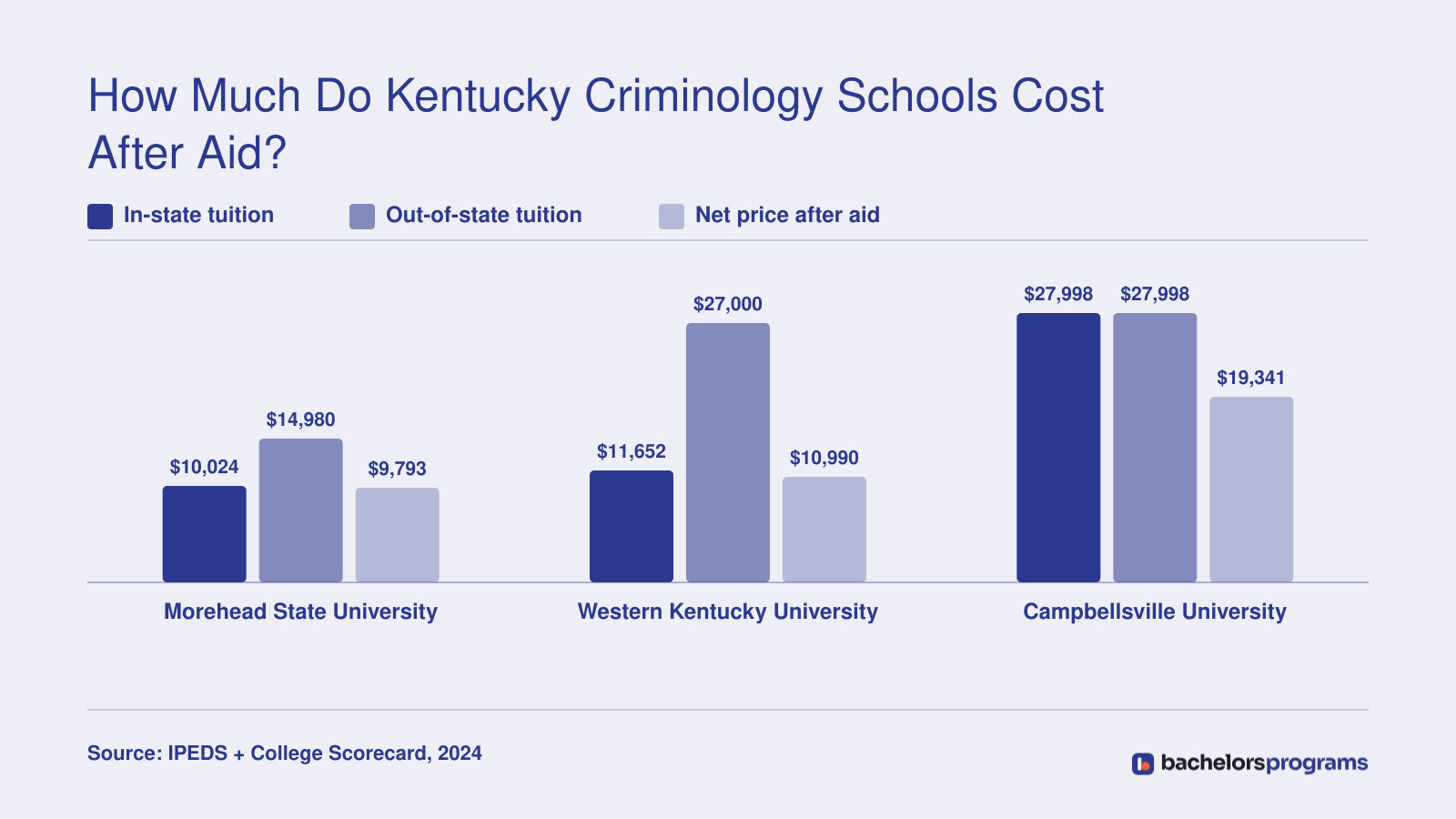
- Morehead State University: $10,024 in-state tuition and fees, $9,793 net price.
- Western Kentucky University: $11,652 in-state tuition and fees, $10,990 net price.
- Campbellsville University: $27,998 tuition and fees, $19,341 net price.
Morehead State is the cheapest criminology degree in Kentucky on both measures. Campbellsville is private, so one tuition rate applies to everyone, but aid trims about $8,700 a year off the sticker price. Residency matters at the public schools: out-of-state tuition is $14,980 at Morehead and $27,000 at WKU.
Kentucky Aid in Plain Terms
KEES (Kentucky Educational Excellence Scholarship) awards are earned in high school. Starting in 2026-27, students need a 2.75 GPA in a given year2, and a 3.5 GPA freshman earns $375 per college year.3 The average disbursed award is about $1,710 a year, so treat that as typical, not guaranteed.1 KEES covers up to eight semesters within five years of high school graduation.1
The College Access Program (CAP) grant helps financially needy Kentucky residents who do not already hold a bachelor's degree. It pays up to $5,300 a year at a four-year school ($2,650 per semester), with an expected family contribution of $6,206 or less.4 File the FAFSA early, because awards go first come, first served. The Work Ready Scholarship covers workforce certificates and associate degrees at community and technical colleges, so it will not apply to these bachelor's programs.
In-state rates generally go to Kentucky residents, and the Council on Postsecondary Education notes that some family members of former residents may qualify for waivers or reduced tuition.5 Ask each school's admissions office how it classifies you.
Debt After Graduation
Program-level figures are available for WKU's criminology graduates: median debt of $25,815, or roughly $274 a month on a 10-year repayment plan.
Your Cost Will Vary
Those net prices cover every major at the institution, not criminology alone. Your own cost depends on family income, KEES and CAP eligibility, housing, and whether you attend full time, so price a year at each school before you compare.
How Much Do Kentucky Criminology Schools Cost After Aid?
The biggest takeaway is the gap between sticker price and what aided students actually pay. Campbellsville University lists $27,998 in tuition and fees, but its average net price drops to $19,341, while Western Kentucky University's $27,000 out-of-state rate sits far above its $10,990 net price. Net price is calculated differently by sector: at public schools like Morehead State and WKU it reflects in-state students receiving aid, and at private Campbellsville it reflects all aided first-year students, so treat it as an average rather than a quote.
Criminology Careers and Salaries in Kentucky
What do criminology graduates actually earn in Kentucky, and which jobs do they take? Graduates move into several public-safety and social-service paths, and the pay varies a lot between them.
Where Graduates Work
- Policing: Municipal, county and state agencies hire patrol officers. Morehead State University points to Kentucky State Police among its graduates' employers.
- Corrections: Jails and prisons employ correctional officers. Morehead State also lists the Kentucky Department of Corrections as an employer of its graduates.
- Probation and parole: Probation officers and correctional treatment specialists supervise and support people serving sentences in the community.
- Victim services and analysis: Advocacy roles and analytical work, including crime analyst and criminal investigator, are career paths Campbellsville University highlights for its program.
What Program Graduates Earn
Western Kentucky University's criminology graduates had median earnings of $45,124 four years after completing the degree. About 94.5 percent were working one year after completion. These are medians and shares for people who finished the program, so they describe no single graduate and cover only those who were working. Earnings figures for Morehead State and Campbellsville graduates in this field are not reported.
Kentucky Occupation Wages
The figures below describe each occupation statewide, not criminology graduates, and they include workers of every education level and experience.
- Police and sheriff's patrol officers: About 7,890 employed in Kentucky, with a median of $60,490 a year ($29.08 an hour). The middle half earns roughly $47,940 to $68,990.1
- Correctional officers and jailers: About 6,770 employed, with a median of $42,310 ($20.34 an hour). The 10th percentile is $29,910 and the 90th is $61,820.1
- Probation officers and correctional treatment specialists: About 830 employed, with a median of $59,610. The 75th percentile is $62,590 and the 90th is $69,000.1
For comparison, national BLS medians are higher: $79,200 for police officers, $58,940 for correctional officers and $66,270 for probation officers.2
A Realistic Read
Many entry-level roles in this field pay modestly, especially in corrections, and pay rises with experience, rank and agency size. Probation work offers a smaller number of positions at a steadier wage. Police and corrections offer far more openings, so a graduate's first job often comes from one of those two paths. Treat the program-level median as a starting benchmark rather than a promise.
What Kentucky Criminology Graduates Earn After Finishing
Western Kentucky University's Bachelor of Arts in Criminology graduates reported a median of $32,370 one year after finishing, rising to $45,124 by year four.
Compare Criminology programs on the data that matters
Explore more Criminal Justice & Law majors or browse every field of study.
All Criminal Justice & Law programs Browse every field of study