Best Information Technology Schools in Kentucky
Compare 8 accredited Information Technology programs in Kentucky, with net price after aid, graduation rates, earnings and debt from IPEDS and the U.S. College Scorecard.

A bachelor's degree in information technology, most often the Bachelor of Science (B.S.) in Information Technology, is one of the few undergraduate credentials where a Kentucky student can reach a median salary above $85,000 within five years of graduating. The spread between schools is wide, though, and so is the gap between sticker price and what students actually pay.
The schools here suit students who want to study in Kentucky or who want an online degree from a Kentucky-based institution. Program names vary from Information Technology to Computer Information Systems, and the differences in curriculum matter more than the label.
Employers in Louisville, Lexington, and Northern Kentucky hire on demonstrated skills and certifications as much as on the diploma.
Key Points
- Northern Kentucky University has the lowest average net price: $8,191 per year.
- University of Kentucky ICT graduates earn a median $91,572 after five years.
- Fully online IT bachelor's options include NKU, WKU, Sullivan and Campbellsville.
Best Bachelor's Degree in Information Technology Schools in Kentucky
Every school below awards a bachelor's degree in information technology or a closely related computing field, and all are based in Kentucky, whether you plan to study on campus, online or in a hybrid format. Each entry covers what the program emphasizes, how it is delivered and what makes the school distinct, so you can compare them side by side.
University of Kentucky
#1Lexington, KY · $19,000/yr (est. net price)
Best for: Research-campus seekers who prefer test-optional admission
The flagship public research university in Lexington, UK awards a Bachelor of Arts or Bachelor of Science in Information Communication Technology through the College of Communication and Information. Students complete 120 credit hours of core work in databases, technology policy and data analysis, plus an internship, and can finish the degree online. UK is test-optional for admission and scholarships through 2028-29, and the university's IT services run a statewide higher education partnership that connects students with working IT professionals.
- 120 credit hours with core courses ICT 200, 201 and 202
- Coursework in databases, technology policy and data analysis
- Internship in ICT (ICT 596) built into the degree
- Fully online option available
- Test-optional for admission and scholarships through 2028-29
- $50 domestic application fee, $60 international
- KCTCS transfer pathway for community college graduates
University of the Cumberlands
#2Williamsburg, KY · ~$14,000/yr (est.)
Best for: Online learners wanting multiple concentration tracks
A private university in Williamsburg, University of the Cumberlands offers its Information Technology Sciences degree on campus or fully online, with seven 18-credit emphasis areas that run from cybersecurity and data science to gaming and software engineering. Every student completes an IT capstone, and transfer and prior learning credit count toward the 120-hour degree. Tuition is charged per credit hour, which makes part-time and accelerated schedules easier to plan.
- Seven 18-credit emphasis areas, from cybersecurity to gaming
- 30 required IT hours plus 6 elective hours outside the emphasis
- 120 total credit hours; transfer and prior learning credit accepted
- Information technology capstone required of every student
- $220 per credit hour
- Available on campus or fully online
- 16:1 student-to-faculty ratio
Western Kentucky University
#3Bowling Green, KY · $12,000 – $27,000/yr (est.)
Best for: Transfer students holding an associate degree
Western Kentucky University in Bowling Green awards a Bachelor of Science in Computer Information Technology that can be completed fully online. The degree pairs a core in web development, systems architecture, database administration and telecommunications with five upper-level electives and a senior research capstone. It is built to accept transfer students who already hold an Associate of Applied Science in computer technology, who need 30 CIT hours rather than 48.
- 120 credit hours; 48 CIT hours for non-transfer students
- Transfer students with an AAS in computer technology need 30 CIT hours
- Five 400-level CIT electives plus CIT 490 Senior Research capstone
- No minor or second major required
- Major courses require a grade of C or better
- Completed fully online
- At least 30 hours must be earned at WKU
Northern Kentucky University
#4Highland Heights, KY · $8,000/yr (est. net price)
Northern Kentucky University sits in Highland Heights, just outside Cincinnati, and its Bachelor of Science in Information Technology puts hands-on labs in every IT course. Students choose among day, evening, hybrid and online class formats and can add internships or co-ops, including virtual placements. The degree prepares students for the CompTIA A+ certification and feeds into software development and full stack engineering roles, with a path to a master's in cybersecurity or information systems.
- Hands-on labs in every IT course
- Day, evening, hybrid and online class formats
- Prepares students for CompTIA A+ certification
- Internships and co-ops, including virtual placements
- Coursework in cybersecurity, database design and network administration
- Pathway to an M.S. in Cybersecurity or Information Systems
- Student organizations and on-campus competitions
Sullivan University
#5Louisville, KY · ~$26,000/yr (est.)
Sullivan University is a private institution based in Louisville with a career-focused Bachelor of Science in Information Technology taught at its Louisville campus, its Lexington location and online. Students pick a concentration in cybersecurity, network support administration and security, web design and application development, or system support and administration, and most finish the 32-course program in 36 to 48 months. Tuition bundles e-books, 24/7 tutoring, career services and parking, and military benefits and employer reimbursement are accepted.
- Four concentrations, including cybersecurity and web development
- 32 courses; estimated completion in 36 to 48 months
- 48 credits of IT Academy electives plus 12 free electives
- Day, night and weekend classes in Louisville, Lexington or online
- E-books, 24/7 tutoring and career services included in tuition
- Military benefits and employer tuition reimbursement accepted
- Five skill areas: support, networking, databases, web design, programming
Campbellsville University
#6Campbellsville, KY · ~$19,000/yr (est.)
Campbellsville University offers a B.S.B.A. in Business Information Technology that pairs a business foundation with IT coursework in systems design, data management and IT strategy. The degree is available on the Campbellsville campus and fully online through CU Online, and a Business Information Technology minor is also offered alongside the major. It fits students aiming at technology leadership and business innovation roles rather than purely technical ones, and a separate associate-level option exists for those starting out.
- Blends a business core with IT coursework
- Focus on systems design, data management and IT strategy
- Business Information Technology minor available
- Offered on the Campbellsville campus and fully online through CU Online
- Prepares graduates for technology leadership roles
- Associate-level Business Information Technology option also offered
Georgetown College
#7Georgetown, KY · ~$14,000/yr (est.)
Georgetown College is a private liberal arts college in Georgetown, Kentucky, where the Information Technology major sits in the Department of Mathematics, Physics, and Computer Science. The program leads to a Bachelor of Science, and a separate Information Technology minor is available for students majoring in another field. Small classes and a 13 to 1 student-to-faculty ratio give students close access to faculty in a residential campus setting.
- Housed in the Department of Mathematics, Physics, and Computer Science
- Information Technology minor offered alongside the major
- 13:1 student-to-faculty ratio
- Residential liberal arts campus in Georgetown, Kentucky
Simmons College of Kentucky
#8Louisville, KY · $18,000/yr (est. net price)
Simmons College of Kentucky, a historically Black college in Louisville, awards a Bachelor of Science in Computer Information Systems with two tracks: Data Science & Analytics or App Development. Coursework covers Python and Java programming, database design and implementation, networking, internet programming and project management, plus an occupational internship and business foundations in management and finance. The data science track adds data visualization, decision science and big data analytics for students heading toward advanced study or analytics roles.
- Two concentrations: Data Science & Analytics or App Development
- Coursework in Python and Java, database design and networking
- Business foundations in management and finance required
- Occupational internship required
- Data science track covers data visualization and big data analytics
- Pathway to advanced degrees in data science
Cost & outcomes by school
Federal data for the highest-earning Information Technology programs, independent of the ranking above. Earnings are this field's bachelor's graduates four years after completing where the Scorecard reports them, else the school's undergraduate median.
| School | Net price / yr | Grad rate | Earnings | Debt | Grads/yr | Format |
|---|---|---|---|---|---|---|
| University of Kentucky KY | $18,851 | 71% | $99,535 | $21,453 | 137 | Online or campus |
| Northern Kentucky University KY | $8,191 | 52% | $82,982 | $22,925 | 129 | Online or campus |
| Western Kentucky University KY | $10,990 | 56% | $73,300 | $18,836 | 69 | Online |
| Sullivan University KY | $25,532 | 71% | $68,887 | $27,750 | 5 | Online or campus |
| Georgetown College KY | $14,095 | 49% | $52,074 | $25,200 | — | Online or campus |
| University of the Cumberlands KY | $14,107 | 50% | $45,036 | $21,635 | 59 | Online or campus |
| Campbellsville University KY | $19,341 | 42% | $41,583 | $17,156 | — | Online or campus |
| Simmons College of Kentucky KY | $18,434 | 14% | — | — | — | Campus |
Sources: U.S. Department of Education. Net price, graduation rate, earnings and debt: College Scorecard (earnings and debt for this field's bachelor's graduates where reported, else school-wide); graduates: IPEDS. A dash means no figure is reported.
Cost, debt & payoff
Median earnings of this field's bachelor's graduates (4 yrs after completing, else the school's undergraduate median) vs. their median federal loan debt · U.S. College Scorecard
Across these programs the median graduate earns about $68,887 and finishes with roughly $21,635 in debt — a ratio that clears a common rule of thumb (keep debt below first-year salary). Net price and debt vary widely school to school, so check the per-school figures in the table above before you shortlist.
Most Affordable Bachelor's in IT Schools in Kentucky
Northern Kentucky University is the most affordable option here, with an average net price of $8,191 per year after grants and scholarships, according to 2024 IPEDS and College Scorecard data from the U.S. Department of Education. The schools below are ordered by that net price, not by tuition, and the two figures can differ widely: Georgetown College lists $42,840 in tuition and fees but averages $14,095 after aid, while University of the Cumberlands charges $9,875 in tuition yet has a higher net price than Northern Kentucky University or Western Kentucky University. Net price reflects the full cost of attendance minus aid, so compare it alongside graduation rate and typical debt before deciding.
| School | City | Program | Format | In-State Tuition and Fees | Average Net Price After Aid | Graduation Rate | Median Graduate Debt |
|---|---|---|---|---|---|---|---|
| Northern Kentucky University | Highland Heights | Information Technology, B.S. | Campus and online | $11,088 | $8,191 | 52% | $23,000 |
| Western Kentucky University | Bowling Green | Computer Information Technology | Online | $11,652 | $10,990 | 56% | $22,095 |
| Georgetown College | Georgetown | Information Technology Major | Campus and online | $42,840 | $14,095 | 49% | $25,200 |
| University of the Cumberlands | Williamsburg | Information Technology Sciences | Campus and online | $9,875 | $14,107 | 50% | $14,911 |
| Simmons College of Kentucky | Louisville | Computer Information Systems | Campus | $16,398 | $18,434 | 14% | N/A |
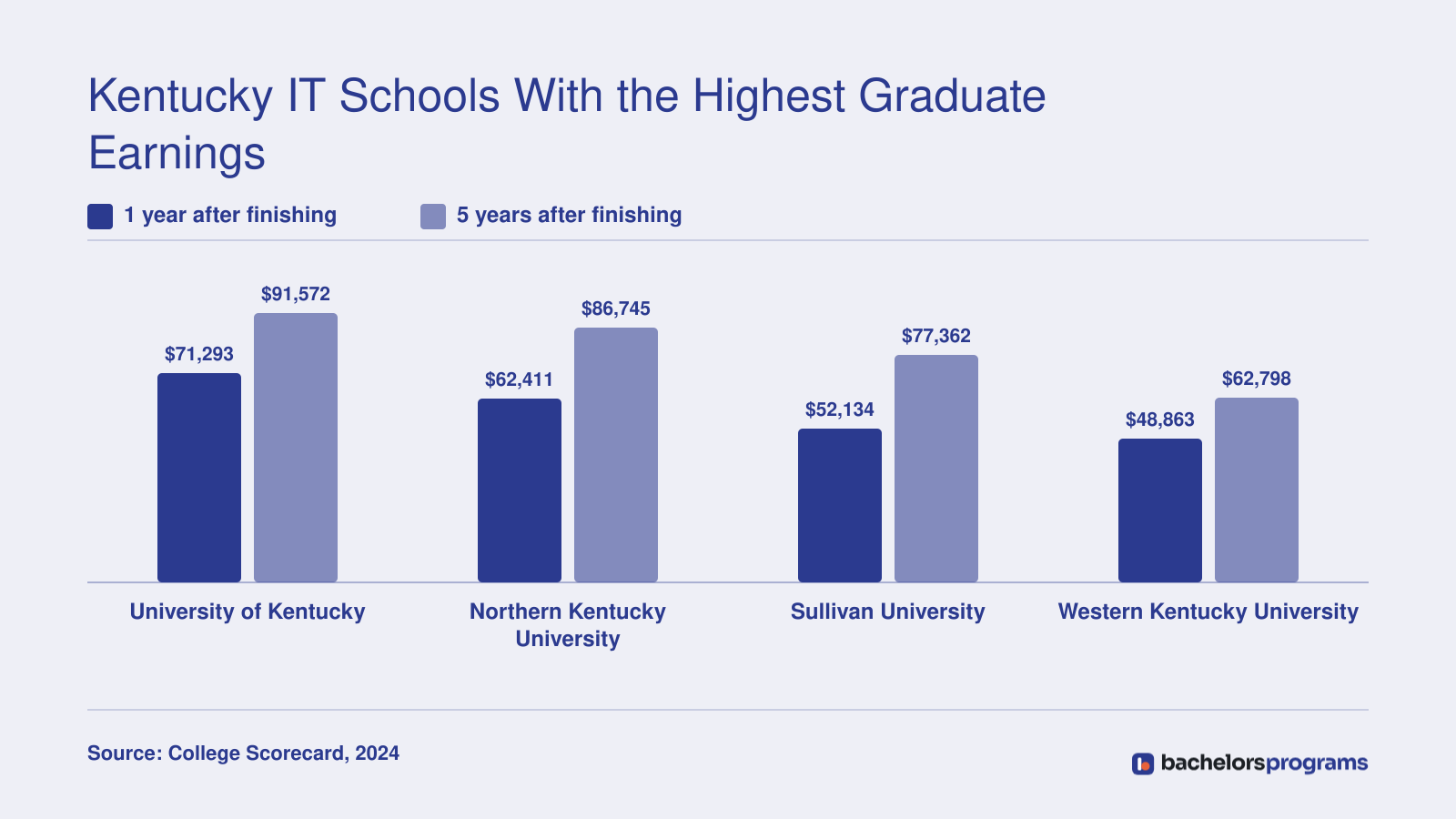
Kentucky IT Schools With the Highest Graduate Earnings
University of Kentucky's Information Communication Technology graduates lead this chart with median earnings of $91,572 five years after finishing, followed by Northern Kentucky University's B.S. in Information Technology at $86,745. Debt stays modest next to that pay: UK graduates carry median federal loan debt of $21,453, and NKU graduates carry $22,925, both under a third of their five-year earnings. University of the Cumberlands graduates earn a median $40,725 one year after finishing.
Online and Hybrid Bachelor's in IT Options at Kentucky Schools
Which Kentucky schools offer a bachelor's degree in information technology online? University of Kentucky, University of the Cumberlands, Western Kentucky University, Northern Kentucky University, Sullivan University and Campbellsville University all list a fully online option. Every one of them is based in Kentucky, so you can study from anywhere while enrolling with an in-state institution.
Sorting the Schools by Format
- Fully online or both online and on campus: UK, Cumberlands, NKU, Sullivan and Campbellsville. NKU's B.S. in Information Technology is 100% online and asynchronous, and it also runs day, evening and hybrid formats.
- Online-focused: WKU lists its Computer Information Technology degree with a fully online option.
- Campus-based: Simmons College of Kentucky teaches its Computer Information Systems program on campus.
- Unclear: Georgetown College's program page does not spell out an online route, so confirm with admissions.
Specializations and Start Dates
NKU's online degree offers Cloud and System Administration, Cybersecurity, General, and Network and System Administration tracks. Cumberlands lists seven concentration options and Sullivan lists four, with networking and databases among its skill areas. UK's program page points toward network administration and cybersecurity careers.
Start-date frequency is not clearly published on these program pages. Ask each admissions office how many terms start per year before you plan around a calendar.
What Online Students Should Check
Online tuition does not always match the campus sticker price, so ask for the exact online rate. Published in-state and out-of-state tuition shows why:
- NKU: $11,088 in-state, $21,912 out-of-state.
- WKU: $11,652 in-state, $27,000 out-of-state.
- UK: $13,502 in-state, $34,140 out-of-state, though UK notes in-state tuition through the Academic Common Market.
- Cumberlands and Sullivan: one rate for everyone ($9,875 and $15,480).
If you live outside Kentucky, a school with a single rate may cost less than a public university's out-of-state price. Ask also whether your specialization can be completed fully online.
Questions to Ask Yourself
Do you need to keep a full-time job in Louisville, Lexington, or Northern Kentucky while you study, or can you attend classes on campus?
Are you starting from a KCTCS associate degree, and which university's transfer pathway accepts the most of your credits?
Do you want a specialization such as cybersecurity or networking, and does your shortlisted school actually offer it?
Admission Requirements for Kentucky IT Bachelor's Programs
First-year and transfer applicants face different processes at Kentucky schools, and the transfer rules vary more. Policies below come from each school's admissions and transfer pages. Where a school states nothing, that is noted rather than guessed.
GPA and Test Policy
- University of Kentucky: A 2.0 applies to the transfer pathway into Information Communication Technology, which has selective admission.1 ACT and SAT scores are optional through 2028-29.2
- University of the Cumberlands: A 2.0 high-school GPA is a condition only for applicants with 0 to 11 college credits.3 Its ACT 17 and SAT 920 figures are English-proficiency minimums for non-native speakers, and no general test policy is published.
- Campbellsville University: A 2.0 is listed for transfer applicants. It publishes no ACT/SAT policy.4
- Northern Kentucky University: No admissions policy specific to the bachelor's in information technology is published.5
Western Kentucky, Sullivan, Georgetown and Simmons were not confirmed on these points, so check their admissions pages directly.
Transfer Credit and the KCTCS Path
KCTCS is the usual on-ramp for budget-minded students. UK's Associate in Science pathway is built to satisfy both associate-degree and UK Core requirements, and a UK Transfer Advisor is available each semester.2 Cumberlands accepts KCTCS coursework at the 100 level and above only if it applies to your degree, and up to 75% of a degree plan may be credited.3 Campbellsville's pathway from the KCTCS associate degree into its business information technology bachelor's requires 60 credits, a 2.0 cumulative GPA and 15 credits earned at Campbellsville, and it accepts only regionally accredited credit.4 NKU's approved KCTCS pathways grant junior standing with 60 or more credits at 2.0 or higher, though none is specific to IT.5 Western Kentucky asks AAS transfers to complete 30 hours of computer information technology courses and earn at least 30 hours at WKU.
Practical tip: before you enroll in a single community college course, ask your target university for a written course-by-course credit evaluation. A pathway that exists on paper does not guarantee every class counts toward the IT major.
Most Accessible Options
By admission rate, Simmons College of Kentucky (100%), Cumberlands (about 99%), Western Kentucky (about 94%), UK (about 93%) and Georgetown (about 91%) admit most applicants. Campbellsville (about 80%) and NKU (about 68%) are more selective. For transfers, Cumberlands' 75% credit allowance and Campbellsville's defined KCTCS pathway are the clearest published routes.
Cost of a Bachelor's in Information Technology in Kentucky
In Kentucky, two numbers rarely match: the tuition rate a school publishes and the net price students actually pay once grants and scholarships are applied.
At Northern Kentucky University, in-state tuition runs about $11,088 a year while the average net price lands near $8,191. Western Kentucky University publishes $11,652 and nets about $10,990. The gap widens sharply at private colleges: Georgetown College lists $42,840 but reports an average net price near $14,095. The University of Kentucky charges Kentucky residents $13,502 with a net price around $18,851, and Sullivan University lists $15,480 against a net price near $25,532. Net price is a school-wide average across all undergraduates, not a quote for you, and it usually folds in housing, fees and books, which is why it can land above tuition.
Kentucky Aid You Should Claim
- KEES: the Kentucky Educational Excellence Scholarship pays $187 to $500 a year for 2026-27, with ACT bonuses of $36 to $500 and exam bonuses of $200 to $300.2 The current schedule requires a 2.75 high school GPA, and the deadline is June 30.1
- College Access Program (CAP): up to $5,300 a year at four-year schools for financially needy Kentucky residents enrolled at least six semester hours.1 File the FAFSA by Oct. 1, 2026 for fall and Mar. 1, 2027 for spring, and apply early because awards are first come, first served.3
- Work Ready Kentucky Scholarship: covers whatever tuition remains after other aid, up to KCTCS in-state rates, but it targets certificates, diplomas and associate degrees for students who have not already earned an associate's or higher degree.4 Confirm whether your program qualifies before counting on it. Deadlines are Oct. 1, 2026 and Mar. 1, 2027, and KHEAA does not guarantee funding.3
Residency and In-State Rates
Kentucky rates hinge on establishing domicile in the state. The rules are detailed, so confirm your status with the admissions or residency office instead of assuming. Students who do not qualify pay the higher out-of-state rate, and a few programs take part in regional tuition arrangements that can narrow that difference for eligible majors.
The Practical Move
File the FAFSA as early as you can, then compare aid offers on net price rather than sticker price.
Questions to Ask Yourself
Does the net price, not the sticker price, fit your budget after KEES and CAP?
Is the program accredited by ABET, or only the school by SACSCOC?
Would the median debt at completion be manageable against the earnings you could expect one to four years later?
Related Articles
IT Careers and Job Outlook in Kentucky
National pay figures are easy to find; the Kentucky numbers that describe your job market take more digging. National pay for IT roles is well documented, but what you earn in Louisville, Lexington, or Northern Kentucky depends on local employers, and you have to go look that up yourself. Here is how to do it well.
Look Up Current Wages by Occupation and Place
Start with the Bureau of Labor Statistics Occupational Employment and Wage Statistics program. Search by occupation code rather than job title so you are comparing consistent categories: network and computer systems administrators are 15-1244, information security analysts are 15-1212, and computer user support specialists are 15-1232.1 Once you pick an occupation, switch the geography filter from national to Kentucky, then to the metro level for Louisville/Jefferson County, Lexington-Fayette, or the Northern Kentucky portion of the Cincinnati metro area.
The May 2025 national figures for network and computer systems administrators show about 314,340 jobs, a median wage near $99,130, and a middle range from roughly $78,010 at the 25th percentile to $126,640 at the 75th. Treat those as a yardstick, not a Kentucky forecast. The Kentucky Center for Statistics (KYSTATS) publishes state wage and employment data that will tell you how local figures compare.
Check the Long-Term Outlook
The BLS Occupational Outlook Handbook gives the current national ten-year projection for each occupation. KYSTATS produces its own five- and ten-year state projections, counting openings from growth, workforce exits, and job transfers.2 Its 2024-2034 file projects computer and information systems managers in Kentucky rising from 2,901 to 3,045 jobs and computer programmers from 1,727 to 1,844.3 Always check the publication date on any table you use, since state and federal projection windows do not line up.
Verify Demand With Employers and Programs
- Program pages: Review career services pages, advisory board rosters, and employer-partner lists at the Kentucky schools you are considering, and email a program coordinator for metro-specific internship and placement information.
- Associations: CompTIA, ISACA, and ISC2 run certification and networking channels that surface who hires locally; regional technology councils do the same.
- Live postings: Search LinkedIn and Indeed by metro area, and check chamber of commerce member directories, to see which employers are hiring right now and what credentials they ask for.
Common Questions About IT Degrees in Kentucky
These answers draw on the program and tuition figures covered earlier on this page. Tuition and fees are subject to change, so confirm current rates with each school before you apply.
What is the best IT school in Kentucky?
Which Kentucky schools offer a bachelor's degree in information technology online?
How much does a bachelor's degree in information technology cost in Kentucky?
Are information technology degrees in Kentucky accredited?
Compare Information Technology programs on the data that matters
Explore more Computers & IT majors or browse every field of study.
All Computers & IT programs Browse every field of study