Best Forensic Science Schools in Kentucky
Compare 5 accredited Forensic Science programs in Kentucky at 4 colleges, with net price after aid, graduation rates, earnings and debt from IPEDS and the U.S. College Scorecard.
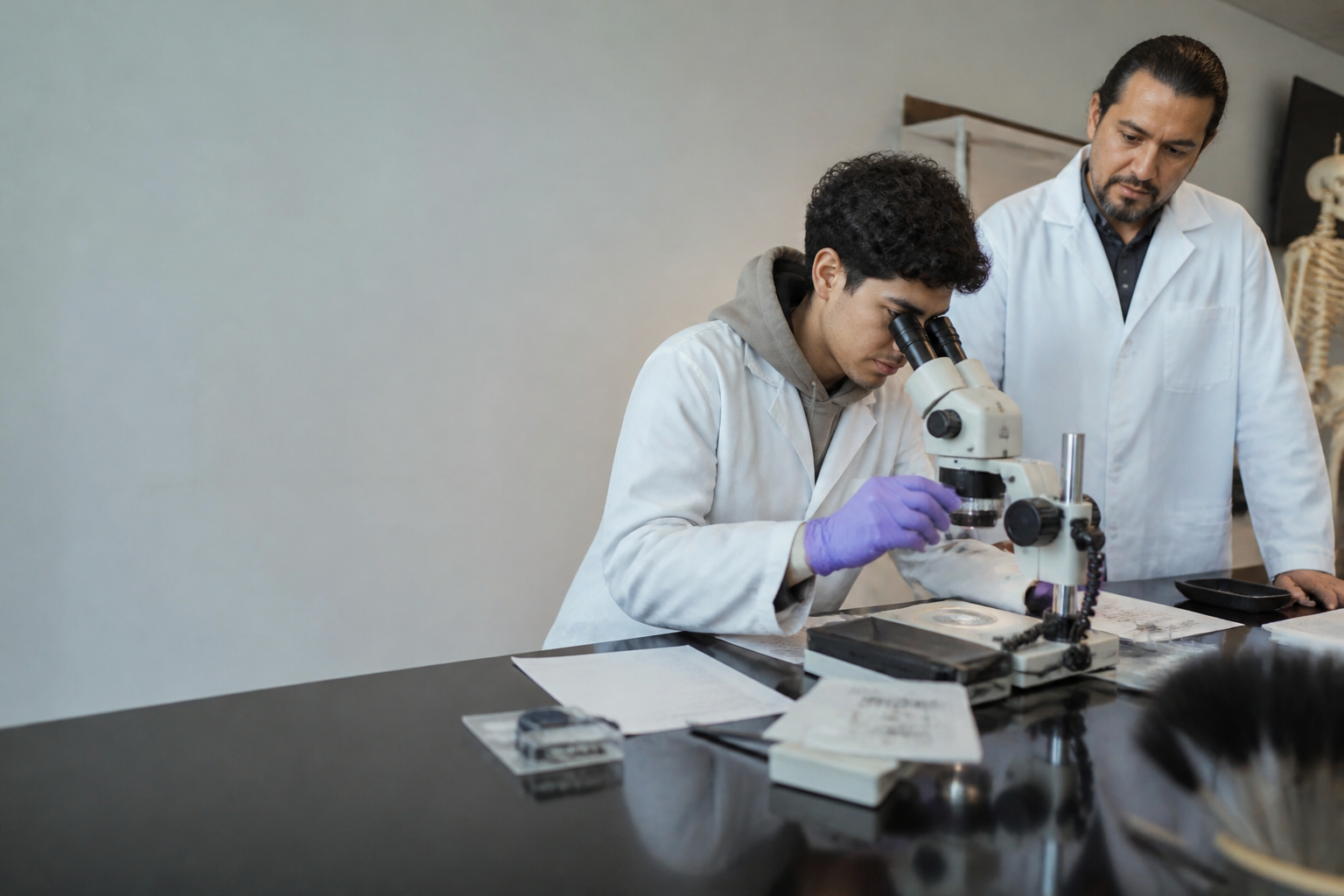
Kentucky issues no forensic science license; crime lab employers screen on the bachelor's degree instead. Few Kentucky colleges award one as a dedicated Bachelor of Science (B.S.) or Bachelor of Arts (B.A.) in Forensic Science; most forensic pathways in the state sit inside a chemistry major with a forensics emphasis.
The distinction matters for FEPAC accreditation, tuition, aid, and for whether a Kentucky State Police lab counts your coursework toward an analyst opening.
Hiring panels read transcripts closely. Chemistry with forensic coursework and a dedicated forensic science degree both clear a lab's minimum, but the chemistry route leaves less room for trace evidence and toxicology electives.
Key Points
- Eastern Kentucky University's B.S. in Forensic Science offers two science tracks.
- Stack KEES scholarships and CAP grants, then compare net price, not tuition.
- Kentucky does not license forensic scientists; employers set hiring standards.
Best Bachelor's Degree in Forensic Science Programs in Kentucky: Ranked
Only a handful of Kentucky colleges publish a forensic science pathway at the bachelor's level, and they do not all structure it the same way. One awards a Bachelor of Science in Forensic Science with two science tracks, one embeds the field in a chemistry degree with a criminal justice minor, and two deliver it as a concentration inside Chemistry. The entries below flag which is which so you can compare like with like.
Eastern Kentucky University
#1Richmond, KY · $11,000/yr (est. net price)
Best for: Future crime lab scientists wanting science-heavy tracks
Eastern Kentucky University in Richmond describes its forensic science program as one of the longest running in the country, and the campus backing is unusual for the state: a Crime Scene House for processing simulated scenes and an instrumentation lab stocked with analytical equipment students actually run. Undergraduates choose the forensic chemistry or forensic biology track inside the same 120-credit Bachelor of Science, and both close with a capstone. Faculty have pulled National Institute of Justice funding for fire-investigation research. The university reports an institution-wide graduation rate of 50%.
- 28 credit hours of forensic chemistry inside a 120-credit degree
- Analytical chemistry with lab, mass spectrometry, physical chemistry I
- Forensic trace evidence plus toxicology and drugs coursework
- Capstone required; a forensic lab internship is strongly recommended
- Curriculum meets Forensic Science Education Programs Accreditation Commission guidelines
- 2.50 GPA keeps students in the program and is required to graduate
- Forensic biology track built on genetics and molecular biology
- Prepares graduates for DNA and serology laboratory work
- Nine hours of concentration electives within the track
- 39 upper-division credit hours required
- Students who fall below the GPA cutoff move to the chemistry track
Murray State University
#2Murray, KY · $10,000 – $20,000/yr (est.)
Best for: Chemistry-focused students adding a criminal justice minor
Murray State University in Murray puts its forensic science degree inside the Chemistry Department, so the lab science carries the weight while a required criminal justice minor supplies the legal and investigative side. The program sits in the College of Science, Engineering and Technology. At about 61%, it reports the strongest institution-wide graduation rate among the Kentucky schools in this comparison. Ask an advisor directly for credit totals and start terms, which the catalog page does not lay out.
- Bachelor of Science in Forensics taught in the Chemistry Department
- Requires a minor in Criminal Justice
- Housed in the College of Science, Engineering and Technology
Kentucky Wesleyan College
#3Owensboro, KY · $15,000 – $20,000/yr (est.)
Best for: Criminalistics-minded students starting from a chemistry major
Kentucky Wesleyan College in Owensboro does not award a standalone forensic science degree, and that matters if a dedicated major is your goal. Students instead build a Bachelor of Science in Chemistry with a forensic science emphasis aimed at criminalistics careers, pulling in anatomy and physiology, criminal justice, criminal investigation and criminology alongside a 34-credit chemistry core. It is a small private liberal arts college of roughly the size where faculty know students by name, with an institution-wide graduation rate of 47%.
- Forensic science emphasis of 28 semester credit hours
- Degree runs 57 to 66 credit hours with a 34-credit chemistry core
- Includes anatomy and physiology plus criminal justice and criminology
- Calculus I required; coursework aimed at criminalistics careers
- 19-credit chemistry minor available alongside the emphasis
- A four-year sample plan is published year by year
Thomas More University
#4Crestview Hills, KY · ~$22,000/yr (est.)
Thomas More University in Crestview Hills also delivers the field as a concentration rather than a named forensic science major, layered inside Chemistry under either the B.S. or the B.A. The concentration deliberately mixes chemistry, biology and criminal justice coursework, and the B.S. curriculum carries American Chemical Society endorsement. Both degrees require at least 120 credits and include experiential learning, with students able to pursue faculty-mentored research. The university reports an institution-wide graduation rate of 41%.
- Concentration blends chemistry, biology and criminal justice hours
- 6 criminal justice hours through CRJ 101 and CRJ 301
- C or above required in every concentration course
- B.S. requires 43 chemistry hours; B.A. requires 37
- Experiential learning through CHE 411 and CHE 412
- 120 credits minimum for either degree
- Optional genetics and psychology courses round out the concentration
Cost & outcomes by school
Federal data for the highest-earning Forensic Science programs, independent of the ranking above. Earnings are this field's bachelor's graduates four years after completing where the Scorecard reports them, else the school's undergraduate median.
| School | Net price / yr | Grad rate | Earnings | Debt | Grads/yr | Format |
|---|---|---|---|---|---|---|
| Thomas More University KY | $21,835 | 41% | $59,384 | $26,236 | — | Campus |
| Kentucky Wesleyan College KY | $17,131 | 47% | $46,747 | $23,250 | — | Campus |
| Eastern Kentucky University KY | $11,040 | 50% | $45,795 | $22,500 | 11 | Campus |
| Murray State University KY | $9,096 | 61% | $44,737 | $20,500 | — | Campus |
Sources: U.S. Department of Education. Net price, graduation rate, earnings and debt: College Scorecard (earnings and debt for this field's bachelor's graduates where reported, else school-wide); graduates: IPEDS. A dash means no figure is reported.
Cost, debt & payoff
Median earnings of this field's bachelor's graduates (4 yrs after completing, else the school's undergraduate median) vs. their median federal loan debt · U.S. College Scorecard
Across these programs the median graduate earns about $45,795 and finishes with roughly $22,500 in debt — a ratio that clears a common rule of thumb (keep debt below first-year salary). Net price and debt vary widely school to school, so check the per-school figures in the table above before you shortlist.
How We Ranked Kentucky Forensic Science Schools (And Who Has a Dedicated Degree)
Does a forensic science emphasis count the same as a dedicated bachelor's degree in forensic science?
For this ranking, no. The comparison weighs campus and online bachelor's options at Kentucky schools on published cost, graduation rate and earnings outcomes, along with the credential a school actually awards. A standalone bachelor's degree in forensic science is treated differently from a chemistry, biology or criminal justice major with a forensic emphasis. That distinction decides who appears in the ranked list.
Dedicated Degree vs. Emphasis
Eastern Kentucky University awards a Bachelor of Science in Forensic Science. Kentucky Wesleyan College lists chemistry with a forensic science emphasis, which is a related major with specialized coursework rather than a standalone forensic science degree. Thomas More University lists chemistry. Murray State University lists a forensics offering, and its exact credential is best confirmed with the department before you apply.
What Gets Excluded
Schools that offer only a minor, a concentration inside criminal justice, or a general science major without a formal forensic sequence are not ranked as forensic science bachelor's programs. A catalog that lists criminal justice as a BA and BS with a criminology minor, but no forensic science bachelor's, does not clear the bar.1 The goal is not to dismiss related majors; it is to show what appears on the transcript and what required courses come with it. These options may still be worthwhile, but they do not carry the same named degree or the same depth of forensic coursework. Many competitor lists blur that line by counting a minor or a single course as a program.
Reading the Numbers
Cost, graduation rate and earnings outcomes give a common baseline, but they are broad signals. The net price shown is an after-aid average, so your real cost depends on family income, housing and scholarships. Graduation rate is institution-wide, not specific to forensic science. Use these figures to narrow the comparison, then check each curriculum for laboratory work, internships and required chemistry.
Forensic Science vs. Digital Forensics: Choosing the Right Bachelor's Pathway
The hard part of choosing a forensic path is that two very different degrees share one name: one puts you at a lab bench with chemicals and biological samples, the other puts you in front of hard drives and network logs. Searching "forensic science" pulls up both, so settle which one you want before comparing schools.
Lab-Based Tracks at Kentucky Schools
Every program ranked here rests on chemistry or biology rather than on computing. Here is how each is built:
- Eastern Kentucky University: A Bachelor of Science (B.S.) in Forensic Science with Forensic Chemistry and Biology tracks. The program is FEPAC accredited and its materials point to trace evidence, toxicology and drug identification work.
- Murray State University: A Forensics degree taught in the Chemistry Department. It requires a minor in Criminal Justice.
- Kentucky Wesleyan College: A Chemistry degree with a Forensic Science Emphasis and a criminalistics career focus.
- Thomas More University: A Chemistry degree with a Forensic Science concentration, built on 43 chemistry hours for the B.S.
Digital forensics and cybersecurity are separate degrees with a different curriculum. Check each school's catalog for them rather than assuming a forensic science major covers that ground.
Matching the Track to the Job
- Crime lab analyst: Chemistry-heavy tracks, such as EKU's Forensic Chemistry, fit drug identification and toxicology. Biology-oriented coursework fits biological evidence work.
- Digital evidence examiner: This role usually comes from a digital forensics or cybersecurity degree, not a chemistry-based forensic science major.
- Investigator: The criminal justice coursework at Murray State, Thomas More and Kentucky Wesleyan gives you a base for investigative roles, though employers set their own hiring requirements.
A Simple Rule
Pick a chemistry or biology track if you want lab work analyzing physical evidence. For cyber work, choose a digital forensics or cybersecurity degree. If you are torn, favor the lab-based path at a FEPAC-accredited school; that credential matters to many crime lab employers.
Related Articles
Admission Requirements for Kentucky Forensic Science Bachelor's Programs
Admission rules for a bachelor's degree in forensic science in Kentucky usually appear on two pages at each school: the undergraduate admissions page and the forensic science or chemistry program page. Start with searches such as "[school name] forensic science admission requirements," "test optional policy," "transfer credit equivalency," and "prerequisite courses." Use the worksheet below to record each school's answers along with the link and the date you checked, and if a detail is missing, email or call admissions and the program advisor, compare their written replies, and never assume a requirement the school has not published.
| School | Minimum GPA / Selectivity | Test Policy | Recommended Prerequisites | Transfer Credit |
|---|---|---|---|---|
| Eastern Kentucky University (Forensic Science, B.S.) | Check the undergraduate admissions page for the university minimum, then ask whether the forensic science major admits students directly or uses a later competitive entry point with its own GPA standard | Search "Eastern Kentucky University test optional policy" and ask whether testing is fully optional or waived only above a certain GPA | Search "EKU forensic science prerequisite courses" and list any required chemistry, biology, and math courses from high school or college | Use EKU's transfer equivalency resources and request written confirmation of how prior science and math courses count toward the major |
| Murray State University (Forensics) | Confirm the general freshman standard on the admissions page and ask the program whether a separate GPA applies before you can declare the major | Ask admissions whether submitting ACT or SAT scores affects admission or scholarship review, and get the answer in writing | Ask the program advisor which chemistry, biology, and math courses you should complete before your first semester | Request a course-by-course equivalency review and confirm whether older science credits are still accepted |
| Kentucky Wesleyan College (Chemistry, Forensic Science Emphasis) | Ask admissions for the college minimum and ask the chemistry department when students formally enter the Forensic Science Emphasis | Confirm whether testing is optional for every applicant or only for those who meet other criteria | Ask which chemistry and math sequence you need to start on schedule, since the emphasis sits within the chemistry major | Get written confirmation of how transfer chemistry, biology, and lab courses apply to the emphasis |
| Thomas More University (Chemistry) | Check the admissions page for the university minimum and ask the chemistry program whether continuation standards apply after enrollment | Search "Thomas More University test optional policy" and confirm whether scores are optional, required, or conditionally waived | Ask the program which high school or college chemistry, biology, and math courses best prepare you for the chemistry major | Use the school's transfer equivalency information and request written confirmation of how lab science credits will transfer |
Kentucky Forensic Scientist Licensure and Certification at a Glance
Kentucky Forensic Science Degree: Common Questions
These answers draw on Eastern Kentucky University's program and catalog pages and on the accreditation information from the American Academy of Forensic Sciences. Confirm details with each school's admissions office before you apply.
Is EKU's forensic science program FEPAC accredited?
Can you get a forensic science degree online in Kentucky?
Is a chemistry degree or a forensic science degree better for crime lab jobs?
Can I transfer community college credits into a Kentucky forensic science bachelor's program?
Compare Forensic Science programs on the data that matters
Explore more Criminal Justice & Law majors or browse every field of study.
All Criminal Justice & Law programs Browse every field of study