Best Communications Degree Programs in Kentucky
Compare 23 accredited Communications programs in Kentucky at 18 colleges, with net price after aid, graduation rates, earnings and debt from IPEDS and the U.S. College Scorecard.

A bachelor's degree in communications from a Kentucky school can lead to work in public relations, media, marketing and corporate communication, fields where a portfolio and internship record often count as much as the diploma. The standard credential is a Bachelor of Arts (B.A.) in Communications, though titles range from Strategic Communication to Mass Communication and Journalism to Communication Studies.
The real tension is between price and placement. Private colleges post high tuition and then discount it heavily; public universities start lower and vary more in how much hands-on media experience they build into the major.
With only a handful of sizable media markets in the state, internship access in Louisville and Lexington can shape outcomes as much as a school's name does.
Key Points
- Berea College lists $51,658 tuition but averages a $6,106 net price.
- Northern Kentucky University graduates earn a $55,596 median five years out.
- Online communications bachelor's options include Eastern Kentucky University and University of Louisville.
Best Bachelor's in Communications Schools in Kentucky: Our Top Picks
Ten Kentucky colleges award a bachelor's degree in communications, and they differ sharply in setting, price and delivery. Some are small liberal arts campuses where a senior project or a required internship anchors the major; others run fully online terms with six start dates a year. Every entry below names the program details worth comparing before you apply.
Berea College
#1Berea, KY · ~$6,000/yr (est.)
Best for: Work-study students wanting a small campus
Berea is a small liberal arts work college in Madison County where a required campus labor program is built into the curriculum. For communications majors that means a nine-to-one classroom and a student newsroom that feeds a 24-hour streaming station and an online news channel. The major leans on service-learning partnerships with nearby businesses and nonprofits, and recent internships have reached as far as the Winter Olympics and Lilly Pharmaceuticals.
- Minors in Communication or Broadcast Journalism
- Multimedia work through Berea College News and Radio
- 24-hour streaming station and online news channel
- Internships have included the Winter Olympics and Lilly Pharmaceuticals
- Graduates employed at NPR, WLEX-TV and WYMT-TV
- Service-learning projects with local businesses and nonprofits
- 9-to-1 student-to-faculty ratio supports close advising
University of Louisville
#2Louisville, KY · ~$18,000/yr (est.)
Best for: Working adults needing asynchronous online classes
Louisville is the state's largest research university and the only school on this list that offers the communications major entirely online, with asynchronous courses leading to either a B.A. or a B.S. A defined KCTCS associate degree pathway gives Kentucky community college students a clear route in. With 177 communications graduates in the most recent federal count, it produces more majors than any other school here, and the residential campus sits in the state's biggest media market.
- 121 credit hours; separate B.A. and B.S. paths
- B.A. requires 36 core communication credits and 35 supporting credits
- B.S. requires 48 core credits plus a required internship
- Asynchronous online courses with a $10 per credit online fee
- New students need a 2.5 GPA and ACT 21; test-optional review case by case
- KCTCS Associate in Arts pathway requires COMM 201 with a C and a 2.0 GPA
- $568 per credit hour; $30 application fee
- Transfer up to 60 community college or 90 four-year credits
Western Kentucky University
#3Bowling Green, KY · $12,000 – $27,000/yr (est.)
Best for: Student media leaders seeking agency experience
Western Kentucky's communication tradition runs deep in Bowling Green, and the university pairs a 39-hour major with one of the strongest student media ecosystems in the state. A required capstone, internship and study abroad options give majors portfolio work before graduation, and the student advertising agency took a national title in 2026. A joint undergraduate track lets strong students begin organizational communication coursework early.
- 39 credit hours in the communication major
- Required capstone course and an optional internship
- Minor, certificate or second major outside the department required
- Contexts include health, sport, leadership, persuasion and crisis communication
- Imagewest student agency won the 2026 AAF National Student Advertising Competition
- Joint undergraduate track in organizational communication for 3.50 GPA students
- Study abroad option in communication
Transylvania University
#4Lexington, KY · $22,000/yr (est. net price)
Transylvania is a small private liberal arts college beside downtown Lexington, and its Writing, Rhetoric, and Communication major suits students who want to write and argue for a living. Majors complete a senior project with an oral defense, and the program expects three internships before graduation. Classes are small at 10 to 1, and alumni networks skew toward law, publishing and media.
- Senior project plus an oral defense before graduation
- Three internships expected before graduation
- Coursework in cross-cultural, nonverbal, gender and interpersonal communication
- Speech and debate team, student newspaper and The Writing Center
- Semester study abroad in Australia, England, France and other sites
- Recent internships at University Press of Kentucky and Lexington law firms
- 10-to-1 student-to-faculty ratio
Northern Kentucky University
#5Highland Heights, KY · $8,000/yr (est. net price)
Northern Kentucky University sits in Highland Heights, minutes from Cincinnati, which gives communication studies majors co-op access to employers such as Duke Energy, Fidelity Investments and the Cincinnati Reds. The degree is available fully online with seven-week courses, and the department also runs a London study abroad trip. It is a practical, clearly career-labeled program, with graduates pointed toward corporate training, presentation coaching and social media coordination.
- Fully online option for the communication studies degree
- Seven-week courses with six annual start points
- Co-op placements with Duke Energy, Fidelity Investments and the Cincinnati Reds
- Study abroad trip to London
- Coursework in interpersonal, workplace and public communication
- Career paths include corporate trainer, presentation specialist and social media coordinator
Asbury University
#6Wilmore, KY · ~$21,000/yr (est.)
Asbury is a Christian liberal arts university in Wilmore, and its communication major stands out for a required internship that has placed students at Disney, Nike and the U.S. Senate. Three concentrations let students aim at leadership and global communication, sport communication or strategic communication, and a student-run PR agency handles real client work. The Miller Communication Arts Center supplies the production space.
- Concentrations in Leadership & Global Communication, Sport Communication, Strategic Communication
- Required internship, with past placements at Disney, Nike and the U.S. Senate
- Student-run public relations agency on campus
- Miller Communication Arts Center production facilities
- PRSA chapter on campus
- Study abroad opportunities
University of the Cumberlands
#7Williamsburg, KY · ~$14,000/yr (est.)
The University of the Cumberlands in Williamsburg offers its communication and media arts degree both on campus and fully online, which makes it one of the more flexible options here for working students. A 24-hour core runs through video production, social media, law and ethics into a capstone, then students add a 15-hour concentration. The speech and debate team and campus digital media studio give residential students an outlet beyond the classroom.
- B.A. and B.S. options, on campus or fully online
- 120 credit hours; about four years of study
- $220 per credit hour
- Concentrations include advertising and public relations, journalism and media production
- Also offers professional communication and sports communication concentrations
- 24-hour core covers video production, social media, law and ethics, capstone
- Digital media studio, campus newspaper and podcasting course
- Nationally recognized speech and debate team
Eastern Kentucky University
#8Richmond, KY · $11,000/yr (est. net price)
Eastern Kentucky University in Richmond runs its communication studies degree online with accelerated seven-week terms and six start dates a year, and it accepts up to 90 transfer hours. The curriculum centers on the skills employers name most often: public speaking, conflict management, and intercultural and organizational communication. There is no application fee, and active-duty military members and spouses pay a reduced rate.
- Accelerated seven-week terms with six start dates per year
- Up to 90 transfer credit hours accepted; no application fee
- Coursework in conflict management, public speaking and organizational communication
- Online and on-campus formats
- Reduced tuition for active-duty military members and spouses
- Low-cost textbooks through the BookSmart program
Morehead State University
#9Morehead, KY · ~$10,000/yr (est.)
Morehead State's strategic communication degree is a face-to-face program on a traditional residential campus in eastern Kentucky, built around crisis communication and persuasive writing. It points squarely at applied roles such as communications director, public information officer and branding manager, and alumni have landed at regional broadcasters and healthcare companies. The university also frames the degree as preparation for further study.
- Face-to-face classes on the Morehead campus
- Four-year program in strategic communication
- Coursework in crisis communication, conflict management and persuasive writing
- Prepares students for communications director and public information officer roles
- Alumni employed at WKYT-TV, Zynex Medical and the Council of State Governments
- Requires admission to Morehead State
Bellarmine University
#10Louisville, KY · ~$21,000/yr (est.)
Bellarmine is a private Catholic university in Louisville with one of the more production-heavy communication majors in the state. Students choose among four focus areas, and much of the work happens in Mac labs, media production suites, a student radio station and a sports broadcasting channel that covers Bellarmine athletics. A 12-to-1 student-faculty ratio and more than 50 study abroad destinations round out the residential experience.
- 120 credit hours on campus in Louisville
- Four focus areas, including graphic and digital design
- Sports broadcasting and television/radio production focus available
- Journalism and new media writing; advertising, public relations and marketing
- Mac labs, media production suites and student-run Bellarmine Radio
- NEXU Student Agency handles client work
- Sports broadcasting channel covering Bellarmine athletics
- 12-to-1 student-to-faculty ratio; 50+ study abroad destinations
Cost & outcomes by school
Federal data for the highest-earning Communications programs, independent of the ranking above. Earnings are this field's bachelor's graduates four years after completing where the Scorecard reports them, else the school's undergraduate median.
| School | Net price / yr | Grad rate | Earnings | Debt | Grads/yr | Format |
|---|---|---|---|---|---|---|
| Thomas More University KY | $21,835 | 41% | $58,479 | $26,236 | 7 | Campus |
| University of Louisville KY | $17,988 | 61% | $55,636 | $20,735 | 101 | Online |
| Transylvania University KY | $21,913 | 72% | $54,705 | $27,000 | 20 | Campus |
| Northern Kentucky University KY | $8,191 | 52% | $53,082 | $22,431 | 53 | Online or campus |
| Georgetown College KY | $14,095 | 49% | $51,395 | $24,000 | 26 | Campus |
| Bellarmine University KY | $21,499 | 64% | $50,665 | $25,853 | 27 | Campus |
| Western Kentucky University KY | $10,990 | 56% | $50,392 | $23,000 | 31 | Campus |
| Spalding University KY | $25,491 | 52% | $49,438 | $25,250 | 1 | Campus |
| Eastern Kentucky University KY | $11,040 | 50% | $45,795 | $22,000 | 20 | Online |
| Morehead State University KY | $9,793 | 52% | $44,149 | $24,857 | 19 | Campus |
| Asbury University KY | $21,401 | 65% | $42,368 | $24,028 | 6 | Campus |
| Berea College KY | $6,106 | 58% | $41,723 | $3,591 | 13 | Campus |
Sources: U.S. Department of Education. Net price, graduation rate, earnings and debt: College Scorecard (earnings and debt for this field's bachelor's graduates where reported, else school-wide); graduates: IPEDS. A dash means no figure is reported.
Cost, debt & payoff
Median earnings of this field's bachelor's graduates (4 yrs after completing, else the school's undergraduate median) vs. their median federal loan debt · U.S. College Scorecard
Across these programs the median graduate earns about $44,972 and finishes with roughly $24,014 in debt — a ratio that clears a common rule of thumb (keep debt below first-year salary). Net price and debt vary widely school to school, so check the per-school figures in the table above before you shortlist.
Most Affordable Bachelor's in Communications Schools in Kentucky
These schools post the lowest average net price, the amount students actually pay after grants and scholarships, based on 2024 U.S. Department of Education data from IPEDS and the College Scorecard. Berea College shows why net price matters more than sticker price: its published tuition is the highest in this table, yet it has the lowest average net price. Kentucky State University, in our directory, is the most affordable public option, and Northern Kentucky University offers the lowest-cost online format.
| School | City | Program | Format | Average Net Price (per year) | In-State Tuition & Fees |
|---|---|---|---|---|---|
| Berea College | Berea | Communication | Campus | $6,106 | $51,658 |
| Kentucky State University | Frankfort | Mass Communication and Journalism | Campus | $8,040 | $9,387 |
| Northern Kentucky University | Highland Heights | Communication Studies | Online | $8,191 | $11,088 |
| Morehead State University | Morehead | Strategic Communication | Campus | $9,793 | $10,024 |
| Western Kentucky University | Bowling Green | Communication, Bachelor of Arts | Campus | $10,990 | $11,652 |
Highest-Earning Bachelor's in Communications Programs in Kentucky
Northern Kentucky University posts the strongest five-year median among the schools ranked here at $55,596, and Thomas More University, a school in our directory, reports $58,479 measured four years after graduation. First-year medians run from $34,858 to $38,637, so expect pay to climb as graduates build experience.
| School | City | Format | Median Earnings 1 Year After Graduation | Most Recent Median Earnings | In-State Tuition and Fees | Average Net Price |
|---|---|---|---|---|---|---|
| Thomas More University | Crestview Hills | Campus | N/A | $58,479 (4 years after graduation) | $39,800 | $21,835 |
| Northern Kentucky University | Highland Heights | Online | $38,637 | $55,596 (5 years after graduation) | $11,088 | $8,191 |
| Georgetown College | Georgetown | Campus | $35,442 | $52,299 (5 years after graduation) | $42,840 | $14,095 |
| University of Louisville | Louisville | Online | $38,219 | $51,634 (5 years after graduation) | $13,136 | $17,988 |
| Bellarmine University | Louisville | Campus | $34,858 | $51,043 (5 years after graduation) | $48,770 | $21,499 |
Communications Specializations Offered at Kentucky Schools
A communications major and a journalism major can sit in the same building and still train you for different work. Journalism teaches reporting: sourcing, verification, news writing, and deadline production for an audience that expects neutrality. A bachelor's degree in communications is broader and usually more strategic, covering persuasion, audience research, organizational messaging, and media production, with the goal of shaping a message on behalf of a brand, employer, or client. Several Kentucky programs blend the two: Berea College offers both a communication minor and a broadcast journalism minor, and Transylvania University students staff the campus newspaper and radio station while majoring in Writing, Rhetoric, and Communication.
What the tracks look like
Concentration counts vary widely across Kentucky. The University of the Cumberlands builds Communication & Media Arts around five concentration options, Bellarmine University lists four, Asbury University three, and the University of Louisville two. Other departments skip formal concentrations and let coursework do the sorting: Western Kentucky University runs a core in organizational communication with specialized contexts in health, sport, and leadership, and Eastern Kentucky University layers conflict management and public speaking into its Communication Studies degree.
Picking the right one
- Strategic communication and PR: Best for students who want to run campaigns rather than cover them. Morehead State University's Strategic Communication B.A. teaches crisis communication and branding and points toward communications director and branding manager roles; Asbury runs a student-led PR agency and a campus PRSA chapter.
- Media production and broadcast: Best for hands-on makers. Bellarmine has student-run radio, Mac labs, production suites, and a sports broadcasting channel; Cumberlands has a digital media studio and a podcasting course.
- Organizational and corporate communication: Best for students aiming at training, internal communication, or sales. Northern Kentucky University names corporate trainer, presentation specialist, and regional sales director among its career paths.
- Writing and rhetoric: Best for law, policy, or marketing-bound students. Transylvania requires a senior project with an oral defense and three internships.
Integrated strategic communication tracks tend to feed media relations, brand and content work, social media management, and internal communications roles.
Online and Hybrid Bachelor's in Communications Options at Kentucky Schools
An online bachelor's degree in communications is the same four-year degree taught through web-based courses instead of a campus classroom. Yes, you can earn it from a Kentucky-based school. Northern Kentucky University, Eastern Kentucky University, the University of Louisville and the University of the Cumberlands all offer an online route.
Online, Hybrid and Campus Formats
- Fully online: NKU's B.A. in Communication Studies and EKU's B.A. in Communication Studies are both 100% online, and EKU requires no campus visits. Louisville offers a fully online Bachelor of Arts or Science in Communication with asynchronous classes.
- Hybrid: Western Kentucky University's B.A. in Communication is hybrid, and The Cumberlands lists its Communication & Media Arts program as hybrid while also noting a fully online option.
- Campus: Berea College, Transylvania University, Asbury University, Morehead State University and Bellarmine University teach their communication programs on campus.
Credits, Cost and Transfer
NKU requires 120 credits at $514 per credit plus a $16 university fee. Its Path to Success rate is $409 plus the same fee. NKU accepts up to 90 transfer credits.
EKU also requires 120 credits and lists online tuition at $443 per credit.1 That rate appears on its General Studies page, so confirm it applies to the communication major. EKU accepts up to 90 transfer hours, but 30 must be completed at EKU.2
Louisville's online program runs 121 credit hours at $568 per credit, with a $10 per credit online fee. It accepts up to 90 college credits, and KCTCS associate degrees transfer fully. The Cumberlands lists $220 per credit for 120 credits and accepts transfer and prior learning credit.
Pacing and Support for Adult Learners
NKU and EKU both use accelerated 7-week terms with six starts a year, so you can begin without waiting for fall. NKU frames its program around students balancing work and personal responsibilities. Louisville offers full-time and part-time enrollment, and its asynchronous classes let you study around a work schedule.
EKU publishes the most detail on support: personal enrollment counselors, free online tutoring and career services for online students. For NKU, Louisville and the Cumberlands, ask admissions which advising, tutoring and career services online students can use before you apply.
Related Articles
Admission Requirements: GPA, SAT/ACT Policy and Transfer Credit
Getting admitted is rarely the hard part at Kentucky schools. The stricter checkpoint is often the communications program itself, and the published rules vary a lot from one school to the next.
GPA and Selectivity
Admission rates here run from effectively open access to well under one in five applicants. Berea College admits about 19 percent of applicants, making it the most selective option here by a wide margin. Asbury University (about 63 percent) and Northern Kentucky University (about 68 percent) sit in the middle. Morehead State, Eastern Kentucky, and the University of Louisville admit roughly 77 to 79 percent. Transylvania and Bellarmine are near 86 percent, Western Kentucky University is about 94 percent, and University of the Cumberlands, at nearly 99 percent, is effectively open access.
Only one program page we reviewed states a minimum GPA: the University of Louisville lists 2.5 for its Bachelor of Arts or Science in Communication. For the other schools above, we found no published minimum, so treat that as unknown and ask the admissions office. Ranking guides suggest 2.5 is a common expectation and 3.0 or higher is typical at more competitive programs, but they do not say which schools use which threshold.1
SAT/ACT: Required or Not?
Short answer: you probably do not need scores, but confirm before you apply. The University of Louisville reviews applicants case by case and lists a composite ACT of 21 for new students, so check its current admissions page. For the other schools we found no clearly published policy. Test flexibility is common in Kentucky, and scores can still matter for some scholarships, so a strong score may help even where it is not required.
Transfer Credit
Published transfer details are thin outside a few schools:
- University of Louisville: Its program page cites up to 90 transferable credits, and also up to 60 from community colleges. Because those figures differ, ask which applies to you. It says KCTCS associate degrees transfer fully.
- Eastern Kentucky University: Describes a generous credit transfer policy and a fast track for students with 80 or more credit hours.
- University of the Cumberlands: States that transfer and prior learning credit are accepted, without a cap we could verify.
- All other schools here: We found no published transfer policy in what we reviewed.
One practical tip for community college transfers: pick your target school before you pick your courses. Credits that transfer in general do not always count toward the communication major, so ask for a written course-by-course evaluation or a KCTCS pathway guide, and map your associate coursework to that school's major requirements early.
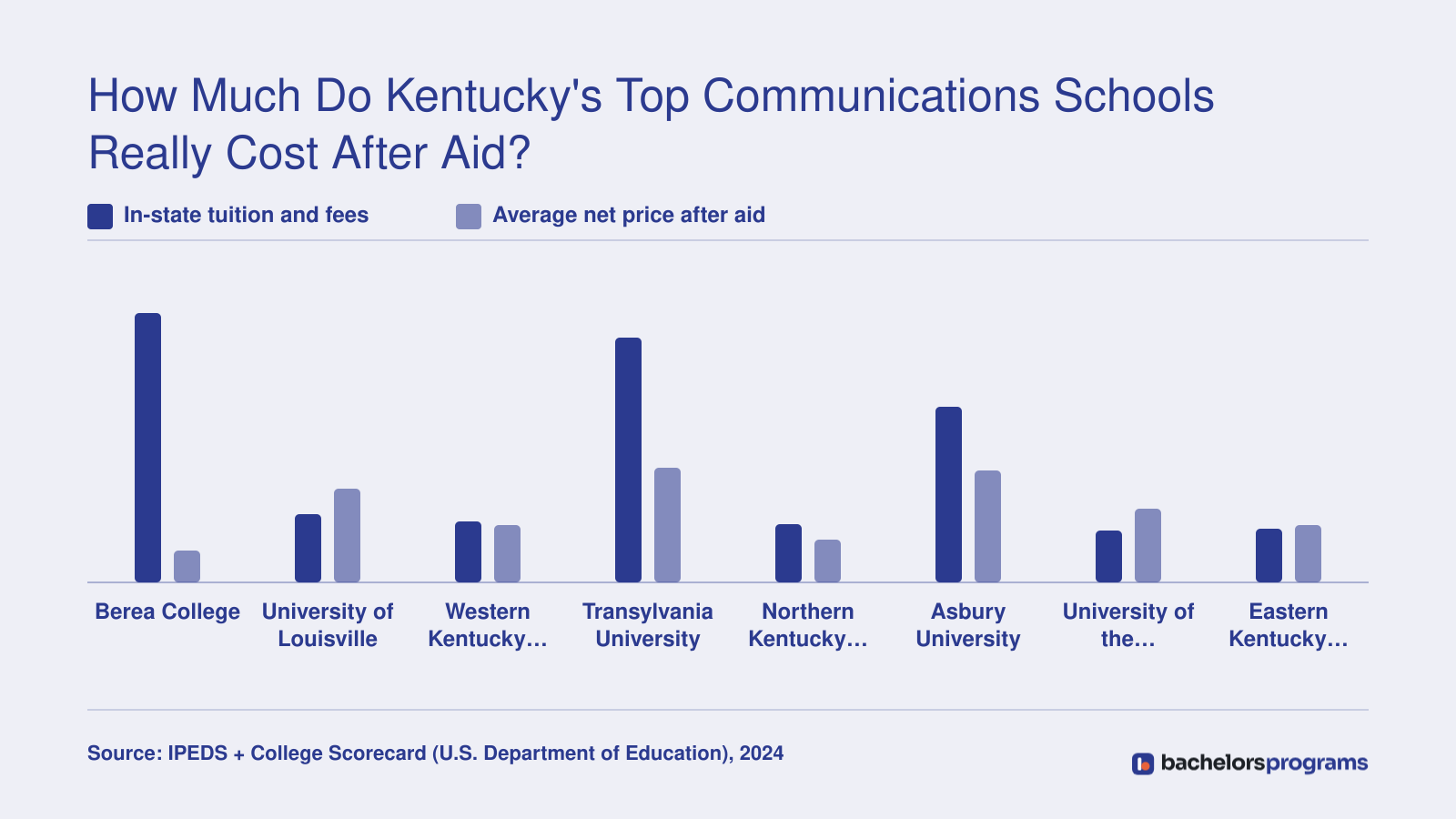
How Much Do Kentucky's Top Communications Schools Really Cost After Aid?
Published tuition can overstate what families pay, especially at private colleges. Berea College lists $51,658 in tuition and fees, but its average net price after aid is $6,106, and Transylvania University drops from $46,870 to $21,913. At several public universities, net price runs higher than in-state tuition because it also counts housing, books and other living costs. Net price figures are institution-wide averages for all aided undergraduates, not figures for communications majors specifically.
Kentucky Communications Degree FAQs
These answers cover the questions prospective students ask most often about studying communications in Kentucky. Policies change, so confirm details with each school before you apply.
Do Kentucky colleges require the SAT or ACT for communications majors?
Can you earn a bachelor's degree in communications online from a Kentucky school?
What is the difference between a communications degree and a journalism degree?
Do you need a license to work in communications in Kentucky?
Compare Communications programs on the data that matters
Explore more Communications & Media majors or browse every field of study.
All Communications & Media programs Browse every field of study