Best Accounting Schools in Rhode Island
Compare 8 accredited Accounting programs in Rhode Island, with net price after aid, graduation rates, earnings and debt from IPEDS and the U.S. College Scorecard.

The bachelor's degree is the standard entry point to accounting in Rhode Island, and since June 23, 2026 it anchors one of the state's three CPA licensure routes: a bachelor's plus qualifying work experience, with no fifth year of coursework required. Most students earn the Bachelor of Science (B.S.) in Accounting at a Rhode Island school, on campus or online.
The payoff varies by campus. Median earnings five years after graduation reach $97,691 for Providence College accounting graduates and $80,974 for the University of Rhode Island's.
Rhode Island College posts the lowest net price of the schools ranked here, $9,478 a year after aid, and it is not the campus with the strongest graduate earnings. Price and outcome rarely point to the same school.
Key Points
- Rhode Island College has the lowest net price: $9,478 a year.
- Providence College accounting graduates earn a median $97,691 five years out.
- Since June 23, 2026, Rhode Island offers three CPA licensure routes.
Best Schools for a Bachelor's Degree in Accounting in Rhode Island
The University of Rhode Island is the best school in the state for a bachelor's degree in accounting if you want a large public research university behind you, while Bryant University is the stronger pick for students aiming at Big Four recruiting from day one. Each card below shows the net price, the school-wide graduation rate and whether the program runs on campus, online or both. Those graduation rates are institution-wide numbers: the schools offering this program report rates running from roughly 48% to 86%, which describes the institution overall rather than accounting majors specifically.
University of Rhode Island
#1Kingston, RI · ~$21,000/yr (est.)
Best for: Rhode Islanders seeking a research university option
The University of Rhode Island is the state's flagship public research university, and its AACSB-accredited business school houses the accounting program on the Kingston campus. Coursework runs through financial reporting, auditing, tax and cost accounting, and an optional accelerated pathway lets strong students move from the bachelor's into a master's in five years. It is the most nationally visible accounting option in Rhode Island and the natural first stop for students who want a large university with a broad course catalog and research resources.
- AACSB-accredited business school
- Prepares students for the CPA exam
- Coursework in financial reporting, auditing, tax and cost accounting
- Optional accelerated bachelor's-to-master's pathway
- Targets roles such as corporate controller, treasurer and auditor
- Government and nonprofit accounting career options
Bryant University
#2Smithfield, RI · ~$41,000/yr (est.)
Best for: Career-focused students targeting Big Four recruiting
Bryant University runs a business-focused campus in Smithfield, so accounting students spend four years surrounded by finance, marketing and management coursework rather than a general liberal arts population. The accounting concentration is built around CPA preparation, with faculty-supervised internships and case competitions that routinely place graduates at Deloitte, PwC, KPMG and Ernst & Young. It is the strongest choice for students who want visible recruiting exposure and a career-first business curriculum.
- Prepares students for the CPA exam
- CPA pass rates above the national average
- Elijah Watt Sells Award recipients among students
- Faculty-supervised internships with Big Four employers
- PwC Challenge case competition participation
- Builds a foundation for CMA, CIA, CFM and CISA credentials
- Study abroad opportunities
Providence College
#3Providence, RI · ~$49,000/yr (est.)
Best for: Students seeking a tight-knit campus with ethics focus
Providence College pairs an AACSB-accredited accountancy program with a liberal arts core on its Providence campus. Classes lean on case analyses, computer labs, team projects and presentations, and internships at Big Four and regional firms help students accumulate the 150 credit hours that CPA licensure requires. It suits students who want small classes, ethics-focused coursework and a traditional residential college experience alongside their accounting training.
- AACSB-accredited accountancy program
- Coursework covers all major CPA exam topics
- Pathways to complete the 150-credit CPA requirement
- Internships at Big Four and regional firms
- Ethics Case Competition and PwC Challenge participation
- Faculty include CPAs and Ph.D.s
- Student organizations include the PC Accounting Association and NABA
Rhode Island College
#4Providence, RI · $9,000/yr (est. net price)
Rhode Island College is the state's public college in Providence, and its accounting department awards a bachelor's degree that students can complete in person, online or in a hybrid mix. It is the lowest-cost route to an accounting bachelor's degree in Rhode Island on this list, helped by free junior and senior year tuition for eligible in-state students and a 40% tuition discount for residents of neighboring states. Classes are smaller than at the flagship and the student body is largely commuter based.
- In-person, online and hybrid class formats
- Coursework in auditing, fraud examination and business statistics
- Accounting minor available for non-majors
- Free junior and senior year tuition for eligible Rhode Islanders
- 40% Northeast Neighbors discount off out-of-state tuition
- Scholarships available to accounting students
Salve Regina University
#5Newport, RI · ~$37,000/yr (est.)
Salve Regina University sits on a waterfront campus in Newport and teaches accounting through a 120-credit curriculum that ends in a strategic business planning capstone. Coursework runs from intermediate accounting through two federal income tax courses to accounting research and analytics and strategic cost management. Cohorts are small and the setting is a classic residential campus, which makes it the most seminar-style private option in the state for accounting.
- 120 total credit hours
- Strategic business planning capstone required
- Prepares students for CPA, CMA, CFE and CIA certifications
- Federal income taxes covered across two courses
- Accounting research and analytics course included
- Strategic cost management in the senior year
- Combined bachelor's and M.B.A. pathway available
Roger Williams University
#6Bristol, RI · ~$38,000/yr (est.)
Roger Williams University teaches accounting inside the AACSB-accredited Mario J. Gabelli School of Business, on a coastal campus in Bristol. The major mixes financial reporting and auditing coursework with internships, and it offers unusually flexible acceleration: 3+1 and 4+1 M.B.A. paths, a 150-credit undergraduate track built for CPA licensure, and a 3+3 route into law school. It fits students who want a private business school experience with several ways to shorten the time to a second credential.
- AACSB-accredited Mario J. Gabelli School of Business
- Prepares students for CPA certification
- Real-world internship opportunities
- 3+1 and 4+1 M.B.A. options
- 150-credit undergraduate pathway for CPA licensure
- 3+3 accelerated Juris Doctor track
Johnson & Wales University
#7Providence, RI · ~$20,000/yr (est.)
Johnson & Wales University delivers its accounting bachelor's degree online, using 7-week or 15-week course terms and a 19:1 student-to-faculty ratio. Tuition is charged at a flat per-credit rate, transfer credit is evaluated within 48 hours, and the Providence campus version of the degree adds a required six-credit internship for students who want in-person work experience. It is the most flexible option here for working adults and transfer students.
- Fully online with 7- or 15-week course terms
- $495 per credit for 2026-27 undergraduate tuition
- Prepares students for the CPA exam
- Coursework in federal taxation, auditing and business analytics
- 19:1 student-to-faculty ratio
- Career Catalyst Scholarship offers 20% tuition savings
- Transfer credit evaluation within 48 hours
- Providence campus version adds a required six-credit internship
Cost & outcomes by school
Federal data for the highest-earning Accounting programs, independent of the ranking above. Earnings are this field's bachelor's graduates four years after completing where the Scorecard reports them, else the school's undergraduate median.
| School | Net price / yr | Grad rate | Earnings | Debt | Grads/yr | Format |
|---|---|---|---|---|---|---|
| Providence College RI | $48,523 | 86% | $103,245 | $27,000 | 64 | Campus |
| Roger Williams University RI | $37,999 | 69% | $98,701 | $26,121 | 21 | Campus |
| Bryant University RI | $41,219 | 80% | $97,515 | $26,668 | 70 | Campus |
| University of Rhode Island RI | $21,440 | 73% | $86,076 | $22,458 | 97 | Campus |
| Salve Regina University RI | $36,967 | 77% | $76,599 | $27,000 | 17 | Campus |
| Johnson & Wales University RI | $31,027 | 55% | $73,476 | $26,229 | 6 | Campus |
| Johnson & Wales University RI | $20,252 | — | $73,476 | $26,229 | 8 | Online |
| Rhode Island College RI | $9,478 | 48% | $68,616 | $15,783 | 44 | Hybrid |
Sources: U.S. Department of Education. Net price, graduation rate, earnings and debt: College Scorecard (earnings and debt for this field's bachelor's graduates where reported, else school-wide); graduates: IPEDS. A dash means no figure is reported.
Cost, debt & payoff
Median earnings of this field's bachelor's graduates (4 yrs after completing, else the school's undergraduate median) vs. their median federal loan debt · U.S. College Scorecard
Across these programs the median graduate earns about $81,338 and finishes with roughly $26,229 in debt — a ratio that clears a common rule of thumb (keep debt below first-year salary). Net price and debt vary widely school to school, so check the per-school figures in the table above before you shortlist.
How We Ranked Rhode Island Accounting Schools
The cheapest school is not always the one with the strongest track record, so the ranking weighs both. It is meant to give you a fair starting point, not a final verdict.
What the Rankings Draw On
The ranking relies on College Scorecard, the federal government's public database of college outcomes. From it we pulled what graduates earn, what students pay, and how many finish. We paired that with program information from each school's own pages, so you can see which degree is actually offered and where.
What the Numbers Can and Can't Tell You
Two caveats matter when you read the list:
- Net price: This is the average price students pay once grants and scholarships are counted, for the whole institution and not for accounting majors alone. What you pay depends on your aid package and your program.
- Graduation rate: This also reflects the entire school. A university's overall rate may differ from the rate among students in its accounting program.
Treat these as useful signals rather than promises about your own experience. Before you apply, check each school's financial aid estimator and ask the accounting department how its students fare.
Bachelor's Programs Only
The list is limited to undergraduate programs. Every school listed offers a B.S. in Accounting or a close equivalent, such as the B.S. in Business Administration with an accounting focus at the University of Rhode Island or the accounting concentration at Bryant University. Programs differ in name and structure, so read the curriculum details on each school's page to see how the degree is organized.
That way you are comparing like with like: four-year accounting degrees in Rhode Island, from the first course through graduation.
Cheapest Accounting Schools in Rhode Island
Rhode Island College is the most affordable option here, with an average net price of $9,478 a year after grants and scholarships, and the state's two public universities generally cost less than its private schools. Net price is the federal College Scorecard's approximate average annual cost (tuition, fees, housing, and books minus grant aid), so your figure will differ: public school figures reflect in-state students receiving aid, while private schools use one figure for all students. Published tuition matters more if you live outside Rhode Island, where out-of-state rates at Rhode Island College and the University of Rhode Island more than double, while Johnson & Wales University charges the same $13,365 to everyone.
| School | City | Sector | Average Net Price After Aid (per year) | Published In-State Tuition and Fees | Published Out-of-State Tuition and Fees |
|---|---|---|---|---|---|
| Rhode Island College | Providence | Public | $9,478 | $11,300 | $27,299 |
| Johnson & Wales University | Providence | Private nonprofit | $20,252 | $13,365 | $13,365 |
| University of Rhode Island | Kingston | Public | $21,440 | $16,942 | $37,146 |
| Salve Regina University | Newport | Private nonprofit | $36,967 | $50,100 | $50,100 |
| Roger Williams University | Bristol | Private nonprofit | $37,999 | $44,418 | $44,418 |
AACSB and Other Accreditation for Rhode Island Accounting Programs
AACSB and IACBE both accredit business schools, but they are not interchangeable, and in Rhode Island the two point to different schools. Yes, the state has an AACSB-accredited accounting option: the University of Rhode Island.
Which Schools Hold Which Accreditation
- University of Rhode Island: AACSB business accreditation since 1972, reaffirmed in 2024. Its undergraduate and graduate accounting programs also carry separate AACSB accounting accreditation, reportedly the only separately accredited accounting programs in the state.
- Rhode Island College: IACBE accreditation, first granted in April 2020 for a seven-year term. The next review is in 2027, so check the college's accreditation page for the outcome if you plan to enroll around that time.
For Bryant University, Providence College, Johnson & Wales University, Salve Regina University and Roger Williams University, we could not confirm current AACSB or IACBE status. Ask each business department directly before you rely on a particular accreditation.
AACSB vs. IACBE
AACSB is the more widely recognized name and is often the one recruiters and large accounting firms look for. Its accounting accreditation is a supplement: a school must first hold, or be pursuing, AACSB business accreditation. IACBE is another recognized business accreditor, and it emphasizes outcomes assessment and teaching quality. Employers may weigh the two differently, but neither one decides whether you can sit for the CPA exam.
What CPA Boards Actually Require
State boards of accountancy look for a degree from a regionally accredited college or university, along with the required accounting and business credit hours. AACSB or IACBE status is a quality signal, not a licensing requirement.
Online and Hybrid Accounting Bachelor's Options at Rhode Island Schools
An online or hybrid accounting bachelor's is the same four-year undergraduate credential, delivered partly or fully at a distance: lectures, problem sets and exams run through a learning platform instead of a classroom in Kingston or Providence, and you come to campus only for the pieces a school requires in person. What separates the formats is scheduling, pacing, and how much of the campus you can still use.
Which Schools Offer a Distance Option
Johnson & Wales University lists a fully online B.S. in Accounting through JWU Online, described as a separate offering from its Providence campus Accounting B.S. Both award a B.S. in Accounting, but JWU presents them as format-specific programs rather than one degree with two delivery modes, so compare the online course sequence directly. Rhode Island College lists its Accounting BS with in-person, online, and hybrid classes, which gives you room to mix formats. The University of Rhode Island's accounting program is listed as a campus program in Kingston.
Schedule, Pacing, and Campus Access
- Online: JWU Online runs courses in 7-week or 15-week formats and lists the degree at four years. Compressed 7-week terms mean fewer courses at once and quicker feedback, with little slack if life interrupts a term.
- Hybrid: a mix like Rhode Island College's lets you take some coursework remotely while keeping faculty office hours, labs, and campus recruiting events within reach.
- In person: a traditional semester calendar, more built-in structure, and the shortest path to on-campus internships and accounting recruiting.
Cost and Credit Transfer
JWU Online's 2026-27 undergraduate rate is $495 per credit hour, or $1,485 for a three-credit course, and the university evaluates transfer credit within 48 hours. Listed online start dates include January 11 and March 15.
On eligibility for the CPA credential, JWU lists the online program as preparing students for the CPA exam, and the curriculum covers accounting and business coursework rather than a general business degree. Because Rhode Island sets its own education rules, confirm course by course with the state board that your chosen format satisfies them.
Related Articles
Admission Requirements for Rhode Island Accounting Bachelor's Programs
How selective a school is and how much it publishes about admissions are two different things. Some Rhode Island schools admit the large majority of applicants, while the one that publishes the most detailed admission criteria is also the one asking for the strongest high school record. Knowing which is which keeps you from over-preparing for a school that admits nearly everyone, or under-preparing for one that does not.
How selective each school is
Admission rates give you a quick read on your odds before you look at anything else:
- Rhode Island College: roughly 92 percent of applicants admitted, the highest rate among the schools here.
- Roger Williams University: about 88 percent.
- University of Rhode Island: about 72 percent.
- Salve Regina University: about 68 percent.
- Bryant University: about 65 percent.
- Providence College: about 51 percent, the most selective of this group.
- Johnson & Wales University: about 33 percent for the online division.
What URI publishes, and what the others do not
URI is the one school in this group with a fully documented 2026 profile. Admitted first-year students fell in a 3.7 to 4.1 GPA band, with SAT scores from 1170 to 1340 and ACT scores from 27 to 32. Those are ranges describing who got in, not cutoffs, and URI is test-optional, so scores are welcome but never required. If you do send them, they must come officially and electronically; the ACT writing section and the optional SAT essay are not part of the review.
Rhode Island College, Johnson & Wales, Bryant, Salve Regina, Roger Williams and Providence College do not publish a specific first-year GPA minimum or a stated test requirement that we can confirm for 2026. Check each admissions office directly rather than assuming URI's numbers apply.
Transfer credit and a tip for community college students
URI's transfer thresholds scale with how far along you are. Under 24 transferable credits, you need at least a 2.8 GPA plus all the first-year requirements. At 24 credits or more, the bar drops to 2.5 but adds college-preparatory units: four English, three math, two science, two history or social science, and two of the same foreign language. Arrive with a completed associate's or bachelor's from a regionally accredited school and the requirement is 2.4, with no high school transcript needed.
That last route is the practical tip: finishing the associate degree before you transfer lowers your GPA bar and clears the high school paperwork entirely. Only grades of C or better move; a C-minus does not. The College of Business adds its own gate, asking 2.8 under 60 credits, 2.5 above that, and at least a 2.7 across six prerequisite courses. Plan on at least 30 credits in residence at URI.
Cost of an Accounting Degree in Rhode Island: Tuition, Net Price, and Aid
Published tuition is the wrong number to budget from at a Rhode Island accounting program. What students actually pay after institutional and federal aid often lands far from the sticker price, sometimes above it and sometimes below.
Tuition Versus Net Price
At the public options, Rhode Island College publishes $11,300 in in-state tuition and fees and $27,299 for out-of-state students, while its average net price across all students is about $9,478. The University of Rhode Island publishes $16,942 in-state and $37,146 out-of-state, with an average net price near $21,440. That figure sits above in-state tuition because net price measures the whole cost of attendance, including housing and food, not tuition alone.
Private tuition is a different scale. Bryant University publishes $52,677 and an average net price around $41,219. Providence College publishes $63,550 with a net price near $48,523. Salve Regina University publishes $50,100, net about $36,967, and Roger Williams University $44,418, net about $37,999. Johnson & Wales University's online B.S. in Accounting lists $495 per credit, and its average net price is about $20,252. Every net price here is an average across aided students, not a quote for your situation.
Rhode Island Aid to Know
Rhode Island Promise covers up to two years of tuition and mandatory fees at the state's public two-year college, applied after federal and all other aid.1 Eligibility requires Rhode Island residency, a Rhode Island high school diploma or equivalent, full-time enrollment, a FAFSA on file, no prior Promise award, and a commitment to live, work, or continue studying in Rhode Island after graduation. Students renew by staying enrolled full-time.2
The state's need-based grant programs also run through the FAFSA, and March 1 is the filing deadline for state-sponsored aid.3 Separate residency rules extend in-state tuition to students who attended a Rhode Island high school for at least three consecutive years and remain state residents.3
What Borrowing Looks Like
Median federal debt for accounting graduates at these schools falls between $20,500 and $27,000. On a standard 10-year repayment plan, a balance in that range works out to payments in the low hundreds of dollars per month, a manageable load for most graduates heading into staff accounting roles. Borrowing less matters most at the private schools, where aid packages vary widely.
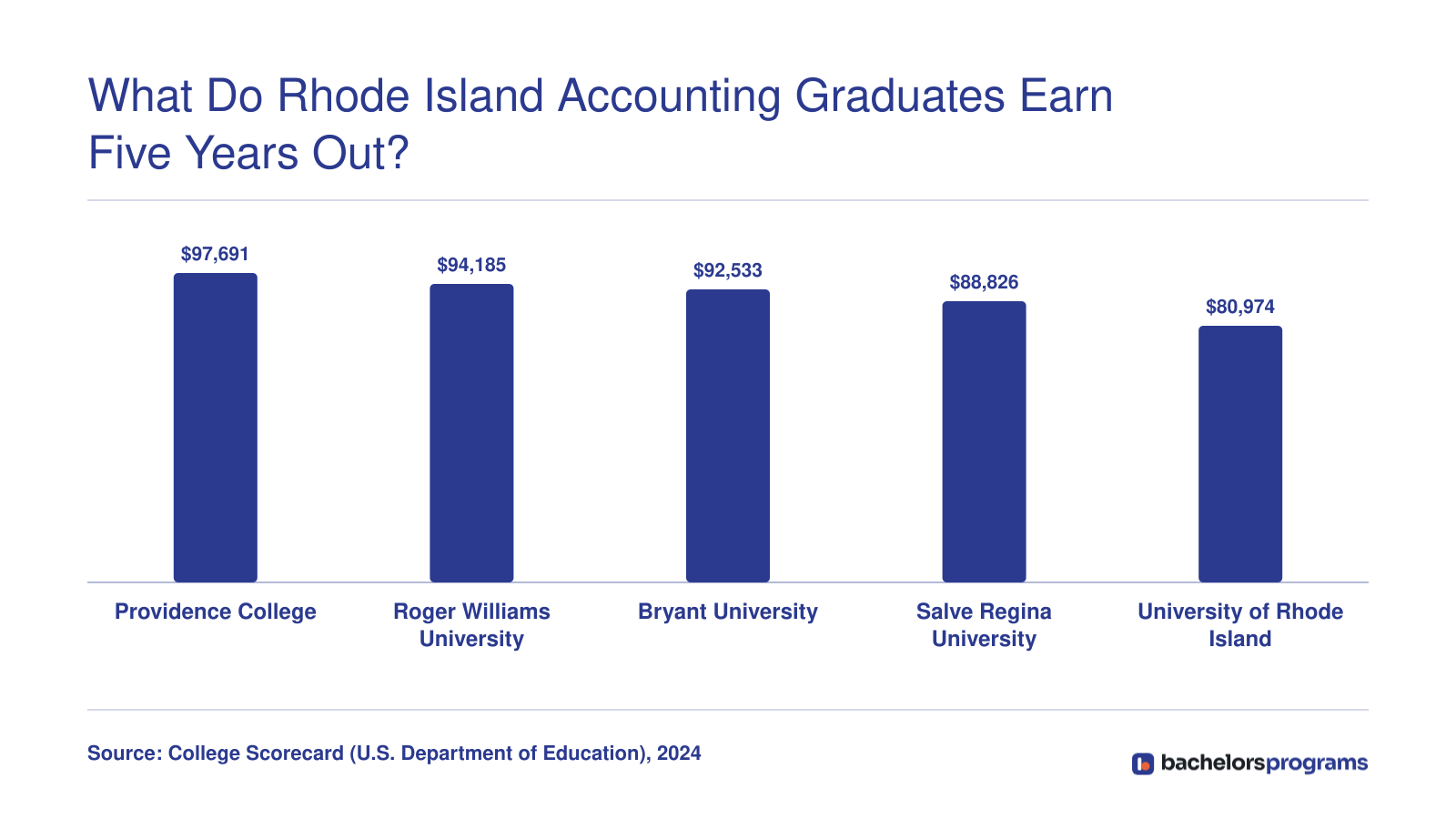
What Do Rhode Island Accounting Graduates Earn Five Years Out?
Each bar shows median earnings for graduates of that school's own accounting bachelor's program, measured five years after completion, not a campus-wide average. Providence College leads at $97,691, and the University of Rhode Island sits at $80,974. The gaps mostly reflect graduating class size and where alumni take jobs: a small cohort, such as Salve Regina University's, can move its median more than a large one.
Rhode Island CPA Requirements: Does a Bachelor's Degree in Accounting Qualify You?
Since June 23, 2026, Rhode Island has offered three routes to a CPA license, and one of them is built around a bachelor's degree in accounting plus work experience.1 The old rule that every candidate needed 150 semester hours is no longer the only path.
Sitting for the CPA Exam With a Bachelor's
Yes, a bachelor's can get you to the exam. Rhode Island lets candidates sit for the Uniform CPA Examination after 120 semester hours, as long as they also meet an education condition set in Board regulation.1 Passing the exam at 120 hours does not earn you a license on its own. You still have to finish the education and experience requirements for licensure.
Accounting and Business Credit Minimums
Under the traditional education route, Board regulations call for a bachelor's or higher from a Board-recognized accredited institution, plus:
- Accounting: 24 semester hours, undergraduate or graduate
- Business: 24 semester hours in non-accounting business courses
- Core accounting: at least 6 hours combining fundamental and intermediate financial accounting
- Upper-level topics: at least 3 hours each in advanced financial accounting, tax accounting, and auditing
That route totals 150 semester hours.2 Compare your program's required courses against this list early, so you are not scrambling for an auditing or tax class in your final semester.
The Three Licensure Pathways
- Pathway 1: a post-baccalaureate accounting degree or equivalent accounting education, plus 1 year (1,820 hours) of experience verified by a CPA licensed in any U.S. jurisdiction.
- Pathway 2: a bachelor's degree plus 30 additional college credits, with an accounting major or concentration, plus 1 year (1,820 hours) of verified experience.
- Pathway 3: a bachelor's degree with an accounting major or concentration, plus 2 years (3,640 hours) of verified experience.
Every pathway also requires passing all parts of the CPA exam and scoring at least 90 on the AICPA Comprehensive Ethics Course.3
Closing the 30-Credit Gap
A standard bachelor's runs about 120 credits, so Pathway 2 leaves roughly 30 to make up. Students usually close it with extra undergraduate courses (summer terms or an added minor), a fifth year of study, or a graduate program, which also opens Pathway 1. If you would rather not add coursework, Pathway 3 trades those credits for a second year of supervised work.
The Board's published materials do not spell out every type of work that counts toward experience, so ask before you accept a job you plan to use. Confirm current rules with the Rhode Island Board of Accountancy at the Department of Business Regulation and NASBA's Rhode Island CPA exam requirements before you map out your credits.
Accounting Careers and Pay in Rhode Island
The Bureau of Labor Statistics counted 1,595,200 accountant and auditor jobs nationally in May 2025, with a median annual wage of $83,680, or $40.23 an hour.1 That median spans the whole occupation, from staff accountants a year out of school to controllers and firm partners, so new graduates should read it as a mid-career marker rather than a starting salary.
Rhode Island Wage Detail
The current federal release does not publish a separate Rhode Island or Providence-Warwick wage line for accountants,2 so the national median is the practical benchmark when you weigh an offer. Pay in the state's public accounting and industry roles is generally set against nearby New England markets rather than national averages.
Where the Jobs Are
Rhode Island accounting work clusters in a handful of settings: Big Four and regional CPA firms, insurance carriers, banks and credit unions, hospital and health systems, state and municipal government, and in-house finance teams at manufacturers, nonprofits and universities. Providence concentrates much of the professional-services employment. Internships with local firms, insurers and health systems are the most direct route into these roles, and several of the schools ranked here build them into the degree.
Job Outlook
BLS projects 5% growth for accountants and auditors nationally between 2025 and 2035, about 79,400 additional jobs, with roughly 115,300 openings a year as workers retire or leave the field.1 The agency cautions that national projections do not always reflect local conditions,3 and Rhode Island's market is small enough that a few large employers can shift the numbers.
Two Different Numbers
Occupational wages from BLS describe everyone working in the field. Graduate earnings figures describe what alumni of particular programs reported. Keep them separate: one tells you what the job pays, the other tells you what a school's graduates tend to earn.
Compare Accounting programs on the data that matters
Explore more Business & Management majors or browse every field of study.
All Business & Management programs Browse every field of study