Best Business Degree Programs in Rhode Island
Compare 15 accredited Business programs in Rhode Island at 9 colleges, with net price after aid, graduation rates, earnings and debt from IPEDS and the U.S. College Scorecard.

Rhode Island's CPA license requires 150 semester hours, 24 of them in accounting, so the accounting concentration a business major picks in sophomore year can determine whether a fifth year of coursework follows.
The bachelor's programs ranked below are campus and online degrees at schools based in Rhode Island, and published tuition across them runs from $13,365 to $52,677 a year. That spread rarely survives contact with financial aid, which is why net price, not sticker price, does more to separate these schools.
Format and accreditation narrow the field faster than reputation does.
Key Points
- URI business graduates earn a median $79,692 four years after finishing.
- Published annual tuition here ranges from $13,365 to $52,677.
- Rhode Island CPA candidates need 150 semester hours, 24 in accounting.
Rhode Island's Top Bachelor's in Business Programs, Ranked
The best overall bachelor's in business in Rhode Island is the University of Rhode Island's business administration program, which pairs a 73% graduation rate with median pay of $79,692 four years after finishing. Bryant University is the strongest private alternative, with 11 concentrations and the highest four-year median earnings in the state. The list that follows runs from a flagship public university to a fully online degree, so there is a fit for campus, hybrid, and online learners alike.
University of Rhode Island
#1Kingston, RI · ~$21,000/yr (est.)
Best for: In-state students wanting a broad business core
The state's flagship public university, URI runs its business programs through the College of Business in Kingston, where students complete a broad business core before specializing. Recent Rhode Island-focused work includes the RISE-UP innovation initiative and partnerships with the Naval Undersea Warfare Center Division Newport, plus a new Business Analytics and Artificial Intelligence certificate and specialization for 2026-27. Business graduates report median pay of $79,692 four years after finishing, and the university's graduation rate is 73%.
- Complete 42 units before entering the major
- Minimum 2.50 overall GPA for admission to the major
- Prerequisites include BAI 111, ACC 201, BAI 210 and ECN 201
- Those four courses require at least a 3.00 GPA
- Alternative entry with ACC 202 and ECN 202 at 2.70 GPA
- URI 101 is also required
- Advisors assigned for years 1-2 and years 3-4
- Curriculum sheets posted for 2021 through 2026
- Bachelor of Science in Business Administration
- Global business focus
- Interdisciplinary program
- Builds cultural understanding
- Skills for the international marketplace
Bryant University
#2Smithfield, RI · ~$41,000/yr (est.)
Best for: Aspiring finance professionals targeting corporate recruiting
Bryant is a private, business-focused university in Smithfield whose College of Business awards the Bachelor of Science in Business Administration in 11 concentrations, from accounting and finance to healthcare management and global supply chain. Every business administration student also completes a minor outside the business college, so coursework stays grounded in the humanities, social sciences, or health and behavioral sciences. Median pay for business graduates reaches $89,929 four years after finishing, the highest in this group, and the graduation rate is 80%.
- 11 concentrations, including finance, accounting and supply chain
- Every student completes a minor outside the College of Business
- Four business degrees, including data science and entrepreneurship
- 2026-2027 catalog edition
- Graduate business program running since 1969
- Covers leadership, communication, problem solving and technology
Salve Regina University
#3Newport, RI · ~$37,000/yr (est.)
Best for: Leadership-focused students wanting small cohorts
Salve Regina is a private university in Newport whose business administration bachelor's is accredited by the International Accreditation Council for Business Education. Students build a foundation in accounting, finance, marketing, and management, then finish with a capstone in which teams write business plans for the annual Seahawk Tank competition. Business graduates earn a median of $70,694 four years after finishing, and 77% of students complete their degrees.
- IACBE accredited business administration program
- Core in accounting, finance, marketing and management
- Capstone teams write plans for the Seahawk Tank competition
- Combined bachelor's and master's option available
- Salve Compass career development program
- Study abroad, including an Oxford summer program
- Business law, ethics, statistics and analytics coursework
New England Institute of Technology
#4East Greenwich, RI · ~$36,000/yr (est.)
New England Institute of Technology in East Greenwich runs a business management bachelor's built for students who already hold an associate degree in any field, with a typical six-term plan that can be finished in as little as 18 months. Courses blend online conferencing with face-to-face options, and students can take everything online if they prefer. Median pay for business graduates is $76,351 four years after finishing, and the graduation rate is 60%.
- For students holding an associate degree in any field
- 92 to 94 quarter credits across a six-term plan
- Can be completed in as little as 18 months
- Hybrid model; courses can be taken fully online
- Early evening and Saturday liberal arts classes
- Automotive/transportation or healthcare management concentration
- CAPM and MOS certificate preparation
- Average class size of 15 to 20 students
Johnson & Wales University
#5Providence, RI · ~$20,000/yr (est.)
Johnson & Wales University's Providence campus anchors a business school that also delivers its Bachelor of Science in Business Administration fully online, with courses running 7 or 15 weeks and a 19:1 student-to-faculty ratio. Online students can add a College of Business internship, directed experiential education, or study abroad, and transfer credit reviews usually wrap up within 48 hours. Business graduates earn a median of $59,186 four years after finishing.
- $495 per credit for 2026-27
- Courses run 7 or 15 weeks
- 19:1 student-to-faculty ratio
- Transfer credit review usually within 48 hours
- 20% tuition savings through the Career Catalyst Scholarship
- Internship, experiential education or study abroad built in
- Start dates in January and March
- Launch Pad entrepreneurship mentorship group
Cost & outcomes by school
Federal data for the highest-earning Business programs, independent of the ranking above. Earnings are this field's bachelor's graduates four years after completing where the Scorecard reports them, else the school's undergraduate median.
| School | Net price / yr | Grad rate | Earnings | Debt | Grads/yr | Format |
|---|---|---|---|---|---|---|
| Bryant University RI | $41,219 | 80% | $90,008 | $26,849 | 1,376 | Campus |
| Providence College RI | $48,523 | 86% | $87,054 | $27,000 | 2,302 | Campus |
| Salve Regina University RI | $36,967 | 77% | $72,975 | $27,000 | 1,108 | Campus |
| Roger Williams University RI | $37,999 | 69% | $70,266 | $26,940 | 1,836 | Campus |
| University of Rhode Island RI | $21,440 | 73% | $69,743 | $22,250 | 7,734 | Campus |
| Rhode Island College RI | $9,478 | 48% | $56,318 | $20,500 | 2,280 | Campus |
| New England Institute of Technology RI | $36,483 | 60% | $48,684 | $16,668 | 282 | Hybrid |
| Johnson & Wales University RI | $31,027 | 55% | $43,418 | $26,000 | 1,536 | Online or campus |
| Johnson & Wales University RI | $20,252 | — | $43,418 | $26,000 | 568 | Online |
Sources: U.S. Department of Education. Net price, graduation rate, earnings and debt: College Scorecard (earnings and debt for this field's bachelor's graduates where reported, else school-wide); graduates: IPEDS. A dash means no figure is reported.
Cost, debt & payoff
Median earnings of this field's bachelor's graduates (4 yrs after completing, else the school's undergraduate median) vs. their median federal loan debt · U.S. College Scorecard
Across these programs the median graduate earns about $69,743 and finishes with roughly $26,000 in debt — a ratio that clears a common rule of thumb (keep debt below first-year salary). Net price and debt vary widely school to school, so check the per-school figures in the table above before you shortlist.
How We Sorted Rhode Island's Bachelor's Business Programs
What data decides which Rhode Island business school lands first? The ranking draws on two federal sources: the College Scorecard and the Integrated Postsecondary Education Data System (IPEDS). Three measures carried the most weight: how many students finish their degree, what they pay after grants and scholarships, and what graduates earn after they leave.
What Was Left Out
Only bachelor's programs in business administration, business management or a close equivalent were considered. Master's degrees, MBAs, certificates and doctoral programs were excluded, even when a school is better known for them.
Limits Worth Knowing
The federal data has gaps you should keep in mind when comparing schools:
- Net price: This figure is a sector average, not what a business major at a particular school will pay. Your own aid offer may differ a lot.
- Graduation rate: This reflects the whole institution, not the business program alone.
- Earnings: Figures cover graduates in general and may not isolate business majors.
Why the List Is Short
Rhode Island is a small state with a limited number of colleges that offer a bachelor's in business. The list stays focused on those schools instead of padding it with weaker matches.
AACSB and ACBSP Accreditation Across Rhode Island Business Schools
AACSB International is the most widely recognized business accreditor, and its seal tells graduate schools and some employers that a program meets demanding standards for faculty, curriculum and research. ACBSP accredits business programs with a stronger emphasis on teaching quality, which is a legitimate credential but can carry less weight with some MBA admissions offices and corporate recruiters. Based on AACSB International's accredited-schools search and 2026 lists of AACSB-accredited schools, Bryant University and the University of Rhode Island hold AACSB accreditation, no AACSB status turned up for Johnson & Wales University or Salve Regina University, and ACBSP status could not be confirmed for any school ranked here; New England Institute of Technology's status could not be confirmed from the directory results reviewed, so check both the AACSB and ACBSP directories before you apply.
| School | AACSB | ACBSP | Notes |
|---|---|---|---|
| Bryant University | Accredited | Not confirmed | AACSB International lists Bryant as accredited since 1994, one of the longest-standing AACSB credentials in the state. |
| University of Rhode Island | Accredited | Not confirmed | The College of Business Administration appears on 2026 lists of AACSB-accredited Rhode Island business schools. |
| Johnson & Wales University | Not identified | Not confirmed | No AACSB accreditation status was identified in the AACSB directory results reviewed. Ask the business school directly about its programmatic accreditation. |
| Salve Regina University | Not identified | Not confirmed | No AACSB accreditation status was identified in the AACSB directory results reviewed. Confirm current status with the university before you enroll. |
Studying Business Online or Hybrid at a Rhode Island School
An online business bachelor's is the same credential as its campus counterpart, with lectures, discussions and group projects delivered through a learning platform instead of a classroom. A hybrid program blends the two, usually reserving a handful of sessions for in-person work. How much of a business degree you can finish remotely depends heavily on which Rhode Island school you pick.
Where the Degree Is Fully Online
Johnson & Wales University's Bachelor of Science in Business Administration is the state's clearest fully online route: 100% online, 120 credits, no required campus visits. Concentrations include finance, entrepreneurship and supply chain management, and courses run in 7- or 15-week terms. New England Institute of Technology's BS in Business Management publishes both formats, including a fully online track with synchronous and asynchronous classes and an 18-month path built for students who arrive with an associate degree.
Hybrid and Flexible Formats
Johnson & Wales also runs hybrid versions of its business program with occasional in-person sessions. The University of Rhode Island's B.A. in Business Studies, announced for 2026-2027, is competency-based and interdisciplinary with flexible online delivery, though it is a newer and less conventional route than a traditional business administration major. Bryant University and Salve Regina University list their business administration bachelor's as campus-based programs.
Who Benefits Most
Online study rewards students who can hold themselves to a schedule no classroom imposes, while hybrid suits applicants within commuting distance of Providence who want recruiting events and face time with faculty. Working adults finishing a degree part-time are the clearest fit, particularly where courses run in short 7-week terms.
Starting at CCRI: Transfer Routes to URI and Rhode Island College
A guaranteed-admission route and the Joint Admissions Agreement (JAA) both begin at CCRI, but they ask different things of you.
Two Routes, Different Rules
Students who finish CCRI's Associate in Science in business with at least a 2.4 cumulative GPA are guaranteed admission to RIC or URI. The JAA is narrower. It covers first-time college students who enroll before earning 30 college-level credits and have no prior attendance elsewhere. They complete an approved transition plan, earn the associate degree, and graduate with a 2.4 GPA. In substance it works as a 2+2: completers get guaranteed acceptance to their intended major and guaranteed course transfer, and URI's business pathway says entrants arrive with 60 credits and junior status.
How Credits Apply
Outside the JAA, the receiving school decides how credits count toward the bachelor's. Guaranteed admission does not mean every business course satisfies a specific requirement. RIC says the JAA lets students start one of 23 of its bachelor's degrees, though not all are necessarily business pathways. The published materials describe guarantees rather than completion statistics, so ask for outcomes directly.
What It Does to Your Bill
JAA participants may receive a tuition discount of up to 30 percent at the receiving school, depending on GPA, plus a waived application fee. Spending the first two years at a community college can lower the total price of the bachelor's.
The One Question to Ask
Before enrolling, ask an advisor: "Which of my planned CCRI business courses will count toward my intended major's requirements, and can you confirm that in writing?"
Related Articles
What a Bachelor's in Business Costs in Rhode Island, and How State Aid Helps
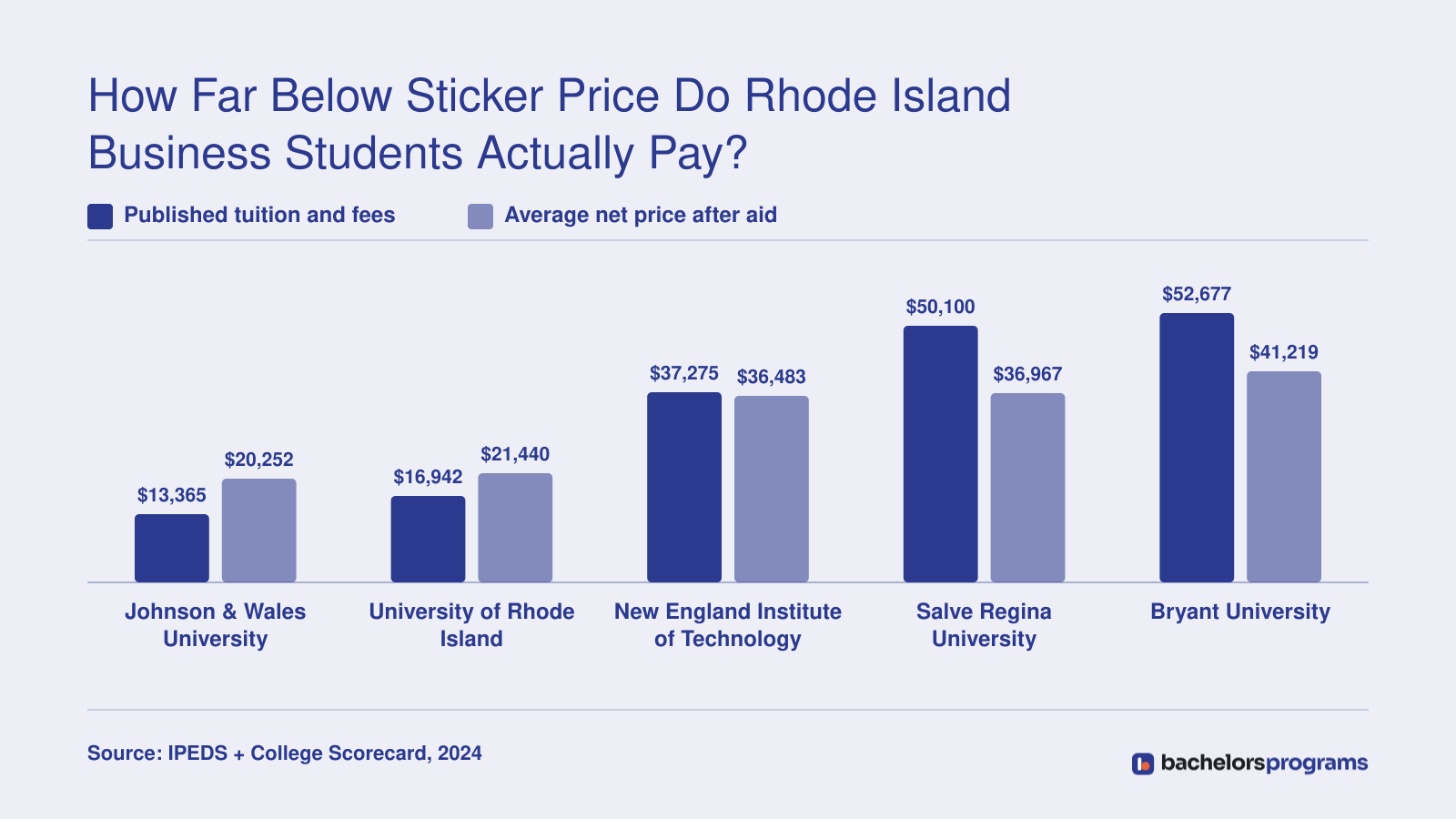
The cost of a business bachelor's in Rhode Island depends heavily on which sector you choose. Published annual tuition and fees at the schools ranked here run from $13,365 to $52,677, and the gap between the public flagship and the private colleges is wide.
Public vs. Private Sticker Prices
- University of Rhode Island: $16,942 in-state tuition and fees; out-of-state students pay $37,146.
- Johnson & Wales University: $13,365 for the online BSBA, billed at $495 per credit with no out-of-state premium.
- New England Institute of Technology: $37,275.
- Salve Regina University: $50,100.
- Bryant University: $52,677.
For a Rhode Island resident who wants a campus experience, URI is the strongest value on sticker price alone.
What Students Pay After Aid
Sticker price overstates what many students pay at private schools. Average net price subtracts grants and scholarships but includes living costs: $41,219 at Bryant, $36,967 at Salve Regina and $36,483 at New England Tech. Bryant's figure lands roughly $11,500 below its tuition, and Salve Regina's about $13,000 below. URI averages $21,440, and Johnson & Wales comes in at $20,252, above its online tuition because housing and other expenses are counted. Treat these as approximations. They average all aided undergraduates rather than business majors, and public figures reflect in-state students only. Your own aid offer is the only exact number.
Rhode Island Promise and Other Aid
Rhode Island Promise is the state's signature scholarship, but it funds associate-degree study at the state's community college, not a bachelor's. For 2026-2027 you must:
- Be a Rhode Island resident.
- Finish high school or a GED before age 19 (appeals exist for students 19 to 21).
- File the 2026/2027 FAFSA and enroll right after graduation.
- Take at least 6 credits each fall and spring.
Keeping the award for a second year requires a 2.5 GPA, 24 first-year credits, continuous enrollment and staying on track to graduate; 12 credits a semester is recommended.
Federal Pell Grants depend on your FAFSA results, and Supplemental Educational Opportunity Grants go first to Pell recipients with exceptional need. URI adds the University Fund Grant, merit awards such as the Presidential and University scholarships, and the Feinstein Junior Scholars award for Rhode Island residents.
A Practical Way to Cut the Bill
Use Promise to cover your first two years of general-education credits, then transfer to URI, where Transfer Merit, Transfer Achievement and Phi Theta Kappa scholarships target incoming transfers. Plan early: URI's Bachelor of Arts in Business Studies requires 42 credits in total, so choose courses that count toward it.
How Far Below Sticker Price Do Rhode Island Business Students Actually Pay?
Published tuition and fees run from $13,365 at Johnson & Wales University to $52,677 at Bryant University, but sticker price rarely tells the full story. Salve Regina University shows the widest gap among the schools here, with $50,100 in tuition against a $36,967 average net price, a difference of $13,133. Net price is an institution-wide average for aided students. It reflects the full cost of attendance, including housing and books, minus grants, so it can run higher than tuition alone, as it does at Johnson & Wales and the University of Rhode Island (shown at in-state tuition). Treat it as a benchmark, not a quote. Your own figure depends on your aid package.
Early-Career Earnings Snapshot
Bryant University shows the highest early-career earnings among the programs below.
Business Careers and Wages in Rhode Island
What a business bachelor's is worth depends less on the diploma than on the occupation and employer you target. Before you enroll, look up Rhode Island pay yourself rather than trusting a national average on a brochure.
Pull the State Wage Tables First
Start at the Bureau of Labor Statistics Occupational Employment and Wage Statistics page and open the Rhode Island state table. Search each occupation you are weighing: accountants and auditors, financial managers, market research analysts and marketing specialists, human resources specialists, and management analysts. Record the median annual wage and the employment count for each one. State figures are revised with every release, so check the date on the page and rely only on the newest set. If a wage does not display on the HTML page, the downloadable state file carries the full breakdown.
Read What Each School Reports
Next, go to the business school pages at the University of Rhode Island, Bryant University, Salve Regina University, Johnson & Wales University, and New England Institute of Technology. Look for career outcome reports, employer partner lists, internship databases, and alumni networking resources. These pages answer something a wage table cannot: which organizations actually hire that school's business graduates, and into what roles.
Cross-Check With State Labor Data
Rhode Island Department of Labor and Training publishes labor market information and job-posting data showing which industries and occupations are hiring in volume. Compare live postings with the employer lists you gathered from each career center. Where the two overlap, you are looking at genuine local demand rather than marketing copy.
Use Associations for Salary Detail
Professional groups publish targeted salary surveys and job boards: AICPA for accounting, SHRM for human resources, the American Marketing Association for marketing, and local chambers of commerce for regional networking and employer contacts.
Rhode Island CPA Licensure for Accounting Graduates
Compare Business programs on the data that matters
Explore more Business & Management majors or browse every field of study.
All Business & Management programs Browse every field of study