Best Accounting Schools in South Carolina
Compare 33 accredited Accounting programs in South Carolina at 30 colleges, with net price after aid, graduation rates, earnings and debt from IPEDS and the U.S. College Scorecard.
In-state tuition at South Carolina's public universities runs $10,760 to $11,640 a year, less than half what out-of-state students pay, and that gap shapes nearly every accounting degree decision here.
The Bachelor of Science in Accounting is the common credential, though some campuses award it as a B.S.B.A. or B.B.A. with an accounting major. The top 10 ranking weighs affordability, earnings, online options, admissions, cost and aid, and CPA licensure across campus and online programs at South Carolina-based schools. Skim the ranked list first.
Demand rewards graduates who plan for the 150-hour CPA rule from the start.
Key Points
- In-state tuition at ranked public schools runs $10,760 to $11,640 yearly.
- Coastal Carolina University posts the lowest average net price: $13,966.
- South Carolina CPAs need 150 semester hours or longer work experience.
Best Bachelor's Degree in Accounting Schools in South Carolina
The ten bachelor's degree in accounting programs below rose to the top of our comparison, and together they span large public research universities, a military college, private liberal arts campuses, and a school with a fully online option. Each card looks past the degree title to what a school actually offers: concentrations, internship pipelines, accelerated routes into graduate study, and the kind of student who tends to thrive there. Net prices shown alongside each school are sector-based averages drawn from federal data, so they describe a typical student who received aid rather than a firm quote for every applicant.
Clemson University
#1Clemson, SC · $20,000 – $25,000/yr (est.)
Best for: Future CPAs wanting a broad business foundation
Clemson's School of Accountancy pairs a broad business and liberal arts core with financial reporting, cost accounting, taxation, auditing, and accounting information systems. The 122-credit Bachelor of Science in Accounting is AACSB-accredited and IMA-endorsed, aligning the coursework with the Certified Management Accountant credential. Students aiming for a CPA license can move into Clemson's Master of Professional Accountancy, and graduates work across public accounting firms, corporate finance, internal audit, and government agencies.
- AACSB International accredited
- 122 total credit hours
- 2.0 GPA minimum
- Coursework in financial reporting, cost accounting, taxation and auditing
- Prepares students for the CPA certification path
- Pathway to Clemson's Master of Professional Accountancy
University of South Carolina
#2Columbia, SC · ~$23,000/yr (est.)
Best for: Students adding a business analytics concentration
The Darla Moore School of Business offers a 125-credit B.S.B.A. in Accounting with optional concentrations in business analytics and sustainability in business, plus an accelerated track that lets strong students start graduate accountancy work while still undergraduates. Coursework runs through financial and managerial accounting, taxation, accounting information systems, and auditing, with nine hours of international coursework and ethics training built in. Paid summer internships after the junior and senior years are encouraged, and the Columbia campus sits in the state capital among government agencies and a wide range of corporate employers.
- 125 total credit hours
- Business Analytics concentration available
- Sustainability in Business concentration available
- Accelerated B.S.B.A./MACC option for top students
- Nine hours of international coursework required
- 3.3 GPA minimum for admission
- Paid summer internships encouraged after junior and senior years
Citadel Military College of South Carolina
#3Charleston, SC · $13,000 – $39,000/yr (est.)
Best for: Cadets wanting leadership and internship structure
The Citadel's Tommy and Victoria Baker School of Business offers a B.S. in Business Administration with an accounting track that stresses financial statement analysis, tax consequences, and ethical practice. Cadets pair accounting coursework with internships and accounting extracurriculars, and the program builds toward the CPA, CMA, and Certified Forensic Accountant credentials. Graduates move into audit, corporate finance, and executive roles across public, private, and nonprofit organizations, and a number go on to own businesses of their own.
- Prepares for CPA, CMA and forensic accounting credentials
- Coursework in financial statement analysis and tax consequences
- Internships and accounting extracurriculars available
- Emphasis on ethical practice and long-term financial health
- Graduates pursue audit, CFO and executive roles
Wofford College
#4Spartanburg, SC · ~$19,000/yr (est.)
Wofford's accounting major sits in the Department of Accounting, Business and Finance and pairs a liberal arts foundation with practical business preparation. Students choose from a wide menu of business courses taught by faculty with backgrounds in business, nonprofit, and academic settings, and the department recognizes an outstanding senior in accounting each year. Small classes and a residential campus in Spartanburg make this a fit for students who want accounting inside a traditional liberal arts education.
- Accounting major housed with Finance in one department
- Faculty from business, nonprofit and academic backgrounds
- Wide menu of business course electives
- Departmental award for outstanding accounting senior
- Scholarships available
Bob Jones University
#5Greenville, SC · ~$17,000/yr (est.)
Bob Jones University offers a B.S. in Accounting that covers auditing, financial and managerial accounting, and taxation, taught with a biblical worldview and a steady emphasis on integrity and ethical leadership. The program prepares students to sit for the CPA exam and blends in communication, technology, and teamwork skills through applied projects. An annual recruiting event draws more than 20 firms, internships are available with accounting firms, and career support starts in the freshman year.
- Prepares students to sit for the CPA exam
- Coursework in auditing, taxation and financial accounting
- Annual recruiting event with more than 20 firms
- Internships at accounting firms
- Career support starting freshman year
- Bible principles integrated into business coursework
College of Charleston
#6Charleston, SC · $13,000 – $38,000/yr (est.)
The College of Charleston's B.S. in Accounting requires 66 or more credit hours in the major and covers intermediate accounting, federal taxation, auditing theory, cost accounting, and accounting information systems. An internship, independent study, or special topics course can count toward the major, and students are encouraged to finish foundational business courses by the end of sophomore year. The School of Business also plans four 12-credit graduate accountancy certificates for 2026-27 in taxation, management accounting, accounting data analytics, and forensic accounting.
- AACSB accredited business program
- 66 or more credit hours in the major
- Accounting internship or independent study option
- Federal taxation and auditing theory required
- Cannot be combined with a Business Administration major
Furman University
#7Greenville, SC · ~$30,000/yr (est.)
Furman offers a Bachelor of Arts in Accounting that combines a rigorous accounting core with liberal arts breadth, plus tax research, data analytics projects, and integrated team assignments. Every accounting major takes part in engaged learning, and students gain real filing experience through the United Way VITA program preparing returns for low-income taxpayers. Study-away options include MayX trips to New York and international business hubs, and relationships with graduate programs help students reach the credit hours CPAs need.
- Bachelor of Arts in Accounting with liberal arts core
- 100% of accounting majors complete engaged learning
- 58% of majors complete an internship
- United Way VITA tax return service project
- MayX study away to New York and international hubs
- Tax research and data analytics coursework
- Alumni mentor network and graduate program pathways
Anderson University
#8Anderson, SC · ~$24,000/yr (est.)
Anderson University offers accounting two ways: a campus-based Bachelor of Science in Business with an accounting concentration and an online Bachelor of Business Administration in Accounting with six start dates a year. Both cover generally accepted accounting principles, taxation, auditing, accounting information systems, and managerial accounting, and both are taught by faculty with executive experience in small classes. The online track requires no previous degree and is built for working adults who need a flexible schedule.
- 128 total credit hours
- Rolling admissions with fall and spring starts
- Eight accounting courses in auditing, tax and managerial accounting
- Prepares students for the CPA exam
- I-20 approved for international students
- 121 total credit hours
- Fully online format
- Six start dates per year
- No previous degree required
- Prepares for roles such as financial advisor and public auditor
- Prepares for MBA or graduate study
Coastal Carolina University
#9Conway, SC · $10,000 – $15,000/yr (est.)
Coastal Carolina's B.S.B.A. in Accounting comes in two 120-credit tracks, one built around CPA exam topics and one around the CMA, and both rest on a business core of marketing, finance, operations, and strategic management. Coursework covers intermediate accounting, individual and business taxation, cost accounting, and auditing theory, with fraud detection as a recognized career path.
- 120 total credit hours
- Built around CPA exam topics
- Coursework in intermediate accounting, individual and business taxation, auditing theory
- Fraud detection career path
- Oriented to management accounting and cost accounting
- Prepares for the CMA designation
- Audit engagement planning covered
- Careers in corporate finance and management accounting
Converse University
#10Spartanburg, SC · ~$23,000/yr (est.)
Converse University's B.S. in Accounting covers financial accounting, auditing, tax accounting, and business law, with hands-on projects built around local businesses and nonprofits. Faculty are practicing accountants turned educators, business ethics runs through the curriculum, and Spartanburg's concentration of international companies supports internships; recent students interned at Ford Motor Credit and Dixon Hughes. Graduates work as audit associates, tax associates, and staff accountants, and many continue on to CPA certification or an M.S. in Accounting.
- Prepares GAAP-based financial statements
- Hands-on case studies with local companies and nonprofits
- Faculty are practicing accountants turned educators
- Recent interns placed at Ford Motor Credit and Dixon Hughes
- Business ethics integrated throughout the curriculum
- Path to CPA certification or an MS in Accounting
Cost & outcomes by school
Federal data for the highest-earning Accounting programs, independent of the ranking above. Earnings are this field's bachelor's graduates four years after completing where the Scorecard reports them, else the school's undergraduate median.
| School | Net price / yr | Grad rate | Earnings | Debt | Grads/yr | Format |
|---|---|---|---|---|---|---|
| University of South Carolina SC | $22,811 | 79% | $86,507 | $25,283 | 149 | Campus |
| College of Charleston SC | $18,960 | 66% | $85,826 | $25,000 | 48 | Campus |
| Clemson University SC | $22,253 | 87% | $84,458 | $21,500 | 180 | Campus |
| Bob Jones University SC | $16,641 | 65% | $84,369 | $21,500 | 16 | Campus |
| Citadel Military College of South Carolina SC | $20,723 | 75% | $83,337 | $21,096 | 22 | Campus |
| Anderson University SC | $23,544 | 66% | $79,844 | $23,500 | 22 | Campus |
| Wofford College SC | $18,732 | 84% | $78,576 | $26,424 | 37 | Campus |
| Furman University SC | $30,308 | 79% | $68,635 | $23,250 | 20 | Campus |
| Strayer University-South Carolina SC | $17,979 | 17% | $66,108 | $41,625 | 10 | Online |
| Coastal Carolina University SC | $13,966 | 49% | $63,239 | $25,000 | 46 | Campus |
| North Greenville University SC | $21,063 | 55% | $62,411 | $23,082 | 14 | Campus |
| Presbyterian College SC | $20,528 | 52% | $60,194 | $26,000 | — | Campus |
Sources: U.S. Department of Education. Net price, graduation rate, earnings and debt: College Scorecard (earnings and debt for this field's bachelor's graduates where reported, else school-wide); graduates: IPEDS. A dash means no figure is reported.
Cost, debt & payoff
Median earnings of this field's bachelor's graduates (4 yrs after completing, else the school's undergraduate median) vs. their median federal loan debt · U.S. College Scorecard
Across these programs the median graduate earns about $58,600 and finishes with roughly $25,000 in debt — a ratio that clears a common rule of thumb (keep debt below first-year salary). Net price and debt vary widely school to school, so check the per-school figures in the table above before you shortlist.
Most Affordable Bachelor's in Accounting Programs in South Carolina
In-state students at South Carolina's public universities pay the least: published in-state tuition at the public schools below runs from $10,760 to $11,640 a year, compared with $21,218 to $29,628 for out-of-state students at the same schools and $20,650 at private Spartanburg Methodist College. Francis Marion University has the lowest net price in this table at $11,386. Coastal Carolina University, a ranked school, combines in-state tuition of $11,640 with a net price of $13,966. Net price is the average yearly cost after grants and scholarships, and it includes more than tuition, so it can come in above or below the published rate. Spartanburg Methodist's $20,650 sticker price drops to a $14,580 net price, while net price at the public schools is slightly higher than in-state tuition. Figures come from IPEDS and the College Scorecard (2024).
| School | City | Sector | In-State Tuition | Out-of-State Tuition | Net Price After Aid |
|---|---|---|---|---|---|
| Francis Marion University | Florence | Public | $11,160 | $21,544 | $11,386 |
| University of South Carolina Aiken | Aiken | Public | $10,760 | $21,218 | $11,641 |
| University of South Carolina-Upstate | Spartanburg | Public | $11,588 | $23,090 | $13,557 |
| Coastal Carolina University | Conway | Public | $11,640 | $29,628 | $13,966 |
| Spartanburg Methodist College | Spartanburg | Private nonprofit | $20,650 | $20,650 | $14,580 |
Cost of a Bachelor's in Accounting in South Carolina and How State Aid Helps
Public and private schools post very different sticker prices, but net price after aid narrows the gap. Coastal Carolina University averages $13,966, the lowest among the schools here. Clemson University comes in at $22,253 and the University of South Carolina at $22,811. Private Wofford College lists tuition and fees of $56,005 yet averages $18,732 after aid, while Furman University averages $30,308. Always compare net price, not the posted rate.
State Aid for In-State Students
Four state aid programs matter here, and they are not equally useful for a four-year accounting degree.
- LIFE Scholarship: Up to $5,000 a year at eligible four-year schools.1 Initial eligibility requires two of three: a 3.0 GPA, an 1100 SAT or 22 ACT, or a top 30% class rank.2 It covers up to eight terms.1
- Palmetto Fellows: Up to $6,700 in the first year and up to $7,500 a year in later years, for South Carolina residents4, across a maximum of eight full-time terms.3
- LIFE and Palmetto enhancements: Approved math, science and related STEM programs can raise awards to $7,500 (LIFE) or $10,000 (Palmetto) in the sophomore through senior years.3 Confirm with each school whether accounting qualifies.
- SC Lottery Tuition Assistance and SC WINS: Both are limited to two-year and technical college programs2, so they generally do not apply to a bachelor's degree in accounting.
Where to Start
Check LIFE first, since its three criteria are common benchmarks and you need two of them, then see whether grades and scores point to Palmetto Fellows. File the FAFSA, then ask your high school counselor and the school's financial aid office about deadlines and how each school applies awards to its cost of attendance.
Debt Benchmark
Program-level data for accounting completers shows median debt of $21,500 at Clemson and $25,283 at the University of South Carolina.
Accounting Careers in South Carolina: Job Outlook and Pay
The first questions are what accountants and auditors actually earn in South Carolina and whether demand is growing. Confirm the exact figures at the source, because state numbers are revised on a schedule and secondhand figures go stale. For national context only, the median annual wage was $83,680 in May 20251, and BLS projects 5.0% employment growth from 2025 to 20352. South Carolina's own numbers may differ.
Where to Look
- BLS Occupational Employment and Wage Statistics: Open the South Carolina page and find Accountants and Auditors (SOC 13-2011). Look for state employment, median wage, and wage percentiles, plus metro-area breakdowns.
- BLS Employment Projections: Search SOC 13-2011 for the 2025-2035 growth rate and projected openings3. These are national figures.
- South Carolina Department of Employment and Workforce: Use its occupational projections to find state-level growth and annual openings for the same occupation4.
Cross-Check Your Salary Expectations
- School career services: Ask the programs you're considering for graduate placement reports, typical starting offers, and the employers that recruit on campus.
- Professional associations: The SC Association of CPAs and AICPA publish career resources, and they can show what employers in the state look for.
- Local context: Pay in a larger metro area will not match a small town, and cost of living changes what the same salary buys. Compare offers against local housing and living costs, not the state median alone.
South Carolina CPA Requirements: How a Bachelor's Degree Fits the 150-Hour Rule
South Carolina gives you two ways to close the gap between a bachelor's degree and a CPA license: add credits to reach 150 semester hours, or qualify through a longer experience pathway. The choice affects your timeline and your tuition bill.
Exam eligibility comes first
The South Carolina Board of Accountancy lets you sit for the Uniform CPA Exam with 120 semester hours or a conferred bachelor's degree from an accredited institution.1 You also need at least 24 semester hours of accounting at junior level or above and 24 semester hours of non-accounting business, all completed when you apply. A bachelor's degree in accounting is the usual way to cover those subject minimums. Once you begin, you have 36 months to pass all sections.
Reaching 150 for licensure
Licensure generally requires 150 semester hours including at least a bachelor's degree. Licensure generally requires 150 semester hours including at least a bachelor's degree, and the specified accounting and business minimums are 36 semester hours each. A typical bachelor's program lands near 120, so the bachelor's-plus-150 pathway requires planning: a second major, a minor, or additional undergraduate coursework can supply the difference. You then need one year of relevant experience instead of two.2
Experience and where to apply
The bachelor's-only pathway calls for at least two years of relevant accounting experience.2 The work must use accounting, attest, tax, advisory, or consulting skills, and a licensed CPA or NASBA must verify it.3 Apply through the South Carolina Board of Accountancy.
In your first year, map the 24 accounting hours, 24 business hours, and 150 total hours on one sheet with an advisor. Do not assume graduation equals licensure eligibility. Confirm current rules with the SC Board before you register for the exam.
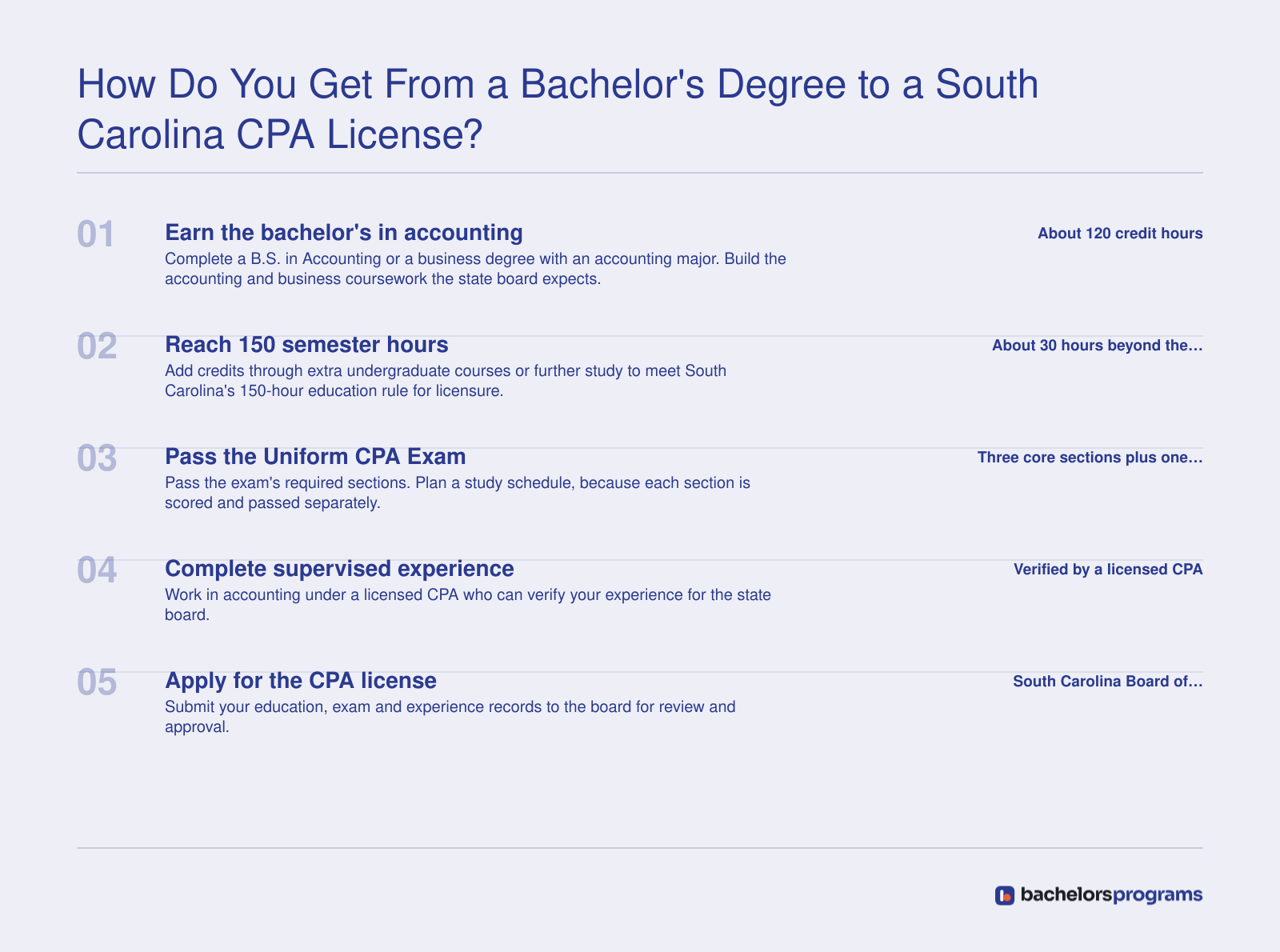
How Do You Get From a Bachelor's Degree to a South Carolina CPA License?
A bachelor's degree in accounting is the first step toward a South Carolina CPA license, not the last. The steps below show the usual order, from your first accounting classes to the license itself.
Related Articles
Online and Hybrid Bachelor's in Accounting Options at South Carolina Schools
Two formats drive this decision: a campus degree and one you fit around a job. In South Carolina, the practical middle ground is hybrid.
Hybrid Is the Main Flexible Route
USC Aiken, USC Upstate, Francis Marion and Winthrop each list their accounting bachelor's as hybrid, generally a B.S. or B.B.A. in business administration with an accounting concentration. All four hold AACSB accreditation for business, the same credential carried by Clemson, Coastal Carolina and The Citadel, which list accounting as fully face-to-face.1 USC Columbia lists its program as both hybrid and face-to-face.
What Hybrid Does Not Tell You
A format label confirms scheduling, not coursework. It does not guarantee that every upper-level accounting course has an online section, and hybrid often includes required campus meetings. If you already hold an associate degree, ask the department whether it runs a degree-completion track into the accounting major; business schools frequently do, but get it confirmed for your program, along with a written transfer credit evaluation before you commit.
The Direct Answer
You can earn an accounting bachelor's degree in South Carolina in a hybrid format. A fully online bachelor's degree in accounting from a South Carolina-based school is not confirmed, and USC Upstate's fully online Bachelor of Applied Science in General Business is a general business degree, not accounting. When you compare, check that the program page sits on the South Carolina school's own site and that the degree is awarded by that institution rather than by a third-party platform using its name.
Questions to Ask Yourself
Do you plan to sit for the CPA Exam, and does this school's accounting sequence keep you on track for 150 credit hours?
Will an online or hybrid format matter more than campus access to recruiting events?
Do the employers you are targeting recruit from AACSB-accredited business or accounting programs?
Is a lower in-state net price worth more to you than smaller classes at a private college?
Common Questions About Accounting Schools in South Carolina
What is the best accounting school in South Carolina?
Which South Carolina accounting schools are AACSB-accredited?
Can you get an accounting bachelor's degree online in South Carolina?
What are the CPA education requirements in South Carolina?
How much do accounting graduates earn in South Carolina?
Compare Accounting programs on the data that matters
Explore more Business & Management majors or browse every field of study.
All Business & Management programs Browse every field of study