Accelerated Accounting Degree Programs
Compare 1,300+ accredited accelerated Accounting programs at 1,200+ colleges, with net price after aid, graduation rates, earnings and debt from IPEDS and the U.S. College Scorecard.

Most states require 150 semester hours for CPA licensure, but a standard bachelor's in accounting stops near 120. Accelerated pathways, including 4+1 and BS/MAcc tracks, close that gap by folding graduate coursework into the undergraduate years, often finishing in five years or fewer.
The trade-off is intensity and cost. Heavier course loads, earlier commitment to a master's, and state-specific credit rules can erase the time savings if a program misses a requirement.
Speed matters only when the credential still qualifies you to sit for the exam.
Key Points
- A 3-year bachelor's ends near 120 credits, short of CPA's 150.
- Most 4+1 BS/MAcc tracks reach 150 credit hours in five years.
- Fully online options exist, but CPA requirements still vary by state.
Best Accelerated Accounting Programs Ranked by Speed
Programs below are ordered by how quickly a student can finish, then by cost and outcomes, so the top entries are the ones that squeeze a bachelor's and a master's into the fewest years. Each card gives completion time, total credits, entry point and minimum GPA where the program publishes them, and names the student it suits. Graduation rates describe the whole institution, not the accounting major alone.
University of Notre Dame
#1Notre Dame, IN · ~$27,000/yr (est.)
Best for: CPA-bound students wanting data analytics depth
The Mendoza College of Business runs a 3+1 track that joins a bachelor's in accountancy to a Master of Science in Accountancy in four years, covering the 150 credit hours CPA licensure requires. Students need a 3.0 GPA, take a data analytics course built around data mining and simulation modeling, and get one-on-one CPA guidance that accounts for varying state rules. The school graduates 95% of students.
- Accelerated 3+1 bachelor's to MS in Accountancy in four years
- Covers the 150 credit hours CPA licensure requires
- 3.0 GPA minimum
- Data analytics course covers data mining and simulation modeling
- CPA guidance accounts for varying state requirements
- Accounting minor restricted to non-Mendoza majors
Virginia Polytechnic Institute and State University
#2Blacksburg, VA · $25,000/yr (est. net price)
Best for: Career switchers aiming at forensic accounting
Pamplin College of Business awards a 122-credit accounting and business analysis degree with three specialization options: financial accounting and auditing, tax, or information systems and controls. Students hold a 2.0 GPA overall and in the major with a C- or better in core accounting courses, and an accelerated master's in accounting and information systems lets strong students continue without changing schools. The school graduates 86% of students.
- 122 total credit hours
- 2.0 GPA minimum overall and in the major
- C- or better required in core accounting and business courses
- Three specializations: financial, tax, information systems
- Capstone plus two experiential learning requirements
- Accelerated master's in accounting and information systems
- Upper-level ACIS courses must be taken at Virginia Tech
Auburn University
#3Auburn, AL · $13,000 – $35,000/yr (est.)
Best for: Job-placement-focused students entering public accounting
Harbert College of Business awards a 123-credit accountancy degree, and its accelerated bachelor's to Master of Accountancy pathway lets seniors count 9 credits toward both degrees. Entry to that pathway requires a 3.50 GPA, 45 to 96 completed undergraduate credit hours with at least 24 earned at the school, and an A in Intermediate Accounting I, with a March 1 deadline. The school reports 94% job placement and graduates 82% of students.
- 123 total credit hours
- Accelerated bachelor's to MAcc shares 9 credits
- 3.50 GPA required to enter the accelerated pathway
- Apply with 45 to 96 undergraduate credit hours
- Grade of A in Intermediate Accounting I required
- March 1 application deadline
- 94% job placement rate
Baylor University
#4Waco, TX · ~$41,000/yr (est.)
Hankamer School of Business awards a BBA in accounting built on 18 hours of upper-level coursework in financial reporting, tax, accounting systems and audit. Qualified students can start an accelerated five-year track toward a Master of Taxation, Master of Accounting or MBA, with the graduate business portion opening after roughly 60 undergraduate credit hours and 12 graduate accounting credits counting toward the master's. Declaring the major takes a B average in the two introductory accounting courses, and the school graduates 80% of students. A good fit for students who plan for a master's from their first year.
- 18 hours of upper-level accounting coursework
- B average in Financial and Managerial Accounting to declare
- Five-year accelerated tracks to MTax, MAcc or MBA
- Graduate business pathway opens near 60 credit hours
- 12 graduate accounting credits count toward the master's
University of Iowa
#5Iowa City, IA · $11,000 – $33,000/yr (est.)
Tippie College of Business offers a bachelor's in accounting with a CPA track for licensure and a corporate accounting track that adds an analytics and finance focus. Students who arrive with 15 or more completed credits can add one year and finish both the BBA and a Master of Accountancy, and the program reports 97% employment within six months of graduation. The school graduates 75% of students. A good fit for students who enter with college credit already in hand.
- CPA track and corporate accounting track
- BBA and MAc in four years for students entering with 15+ credits
- 97% employed within six months of graduation
- Volunteer Income Tax Assistance program
- Top 25 undergraduate program, U.S. News
Saint Joseph's University - Philadelphia
#6Philadelphia, PA · ~$30,000/yr (est.)
The Haub School of Business offers an AACSB-accredited accounting major that pairs CPA preparation with a Certificate of Competence in SAP R/3 software, and an optional five-year track leads to an MBA or an MS. Philadelphia-area internships and the Accounting Society put students in front of Big Four recruiters, and admissions are rolling and test optional. The school graduates 79% of students. A good fit for students who want big-firm recruiting in a city setting.
- AACSB accredited, one of three such programs in Pennsylvania
- Certificate of Competence in SAP R/3 software
- Optional five-year bachelor's to MBA or MS track
- Philadelphia internship network and Big Four recruiting
- Rolling admissions and test optional
Loyola University Maryland
#7Baltimore, MD · ~$31,000/yr (est.)
This accounting BBA prepares students for public accounting, corporate finance, consulting and government work, and accelerated 3+1 and 4+1 pathways lead to a Master of Accounting. The curriculum meets the education requirements for both CPA and Certified Fraud Examiner credentials, and the business school holds AACSB accreditation. The school graduates 79% of students. A good fit for students who want licensure and fraud credentials from one track.
- Accelerated 3+1 and 4+1 MAcc pathways
- Meets CPA and Certified Fraud Examiner education requirements
- AACSB accredited, one of 169 programs worldwide
- Coursework in public accounting, consulting and government
- Ethics foundation built into the accounting curriculum
Iowa State University
#8Ames, IA · $19,000/yr (est. net price)
Ivy College of Business awards an accounting bachelor's that can be completed in three years, and a 4+1 option adds a Master of Accounting. Students get IRS-certified volunteer tax preparation experience through VITA, plus career coaching and Beta Alpha Psi membership, at an AACSB-accredited school that ranks in the top 2% of business schools. The school graduates 75% of students. A good fit for students who want to compress the bachelor's and keep a master's option open.
- Accelerated completion possible in three years
- 4+1 Master of Accounting option
- IRS-certified volunteer tax preparation through VITA
- AACSB accredited, top 2 percent of business schools
- Professional career coaching and Beta Alpha Psi
University of Vermont
#9Burlington, VT · $19,000 – $46,000/yr (est.)
The Grossman School of Business offers an accounting concentration inside the BSBA, with coursework in financial reporting, taxation, auditing, government accounting and fraud examination. An accelerated Master of Accountancy option lets students continue at the same campus, and recent graduates have landed at the Big Four. The school graduates 79% of students. A good fit for students who want fraud examination coursework alongside CPA preparation.
- Accounting concentration inside the BSBA
- Accelerated Master of Accountancy option
- Coursework in fraud examination and government accounting
- Prepares students for CPA and CMA credentials
- Recent graduates hired by the Big Four
Appalachian State University
#10Boone, NC · $8,000 – $25,000/yr (est.)
Walker College of Business awards a BSBA in accounting with required work in cost accounting, accounting systems and internal control, and individual income taxation, taught with current industry software. An accelerated bachelor's to master's pathway is available, and the AACSB-accredited school runs Business Career Services with coaching, resume reviews and employer networking. The school graduates 75% of students. A good fit for students who want hands-on software practice and direct employer connections.
- Accelerated bachelor's to master's pathway
- AACSB International accreditation
- Coursework in cost accounting, systems and income taxation
- Hands-on training with current industry software
- Business Career Services coaching and employer networking
- No minor required
None of the ranked Accounting programs match the accelerated lens yet. The full ranking is at the link above.
Cost, debt & payoff
Median earnings of this field's bachelor's graduates (4 yrs after completing, else the school's undergraduate median) vs. their median federal loan debt · U.S. College Scorecard
Across these programs the median graduate earns about $66,108 and finishes with roughly $23,250 in debt — a ratio that clears a common rule of thumb (keep debt below first-year salary). Net price and debt vary widely school to school, so check the per-school figures in the table above before you shortlist.
3+1, 4+1, BS/MAcc and Degree Completion: Which Pathway Fits
Can you finish an accounting degree in 3 years? Yes. A 3-year bachelor's is the fastest way to earn the degree itself, but it usually ends near 120 credits, short of the 150-credit CPA threshold. A 4+1 BS/MAcc takes longer but reaches 150 credits with a master's in hand. Online degree completion is the quickest route for students who already hold an associate degree.
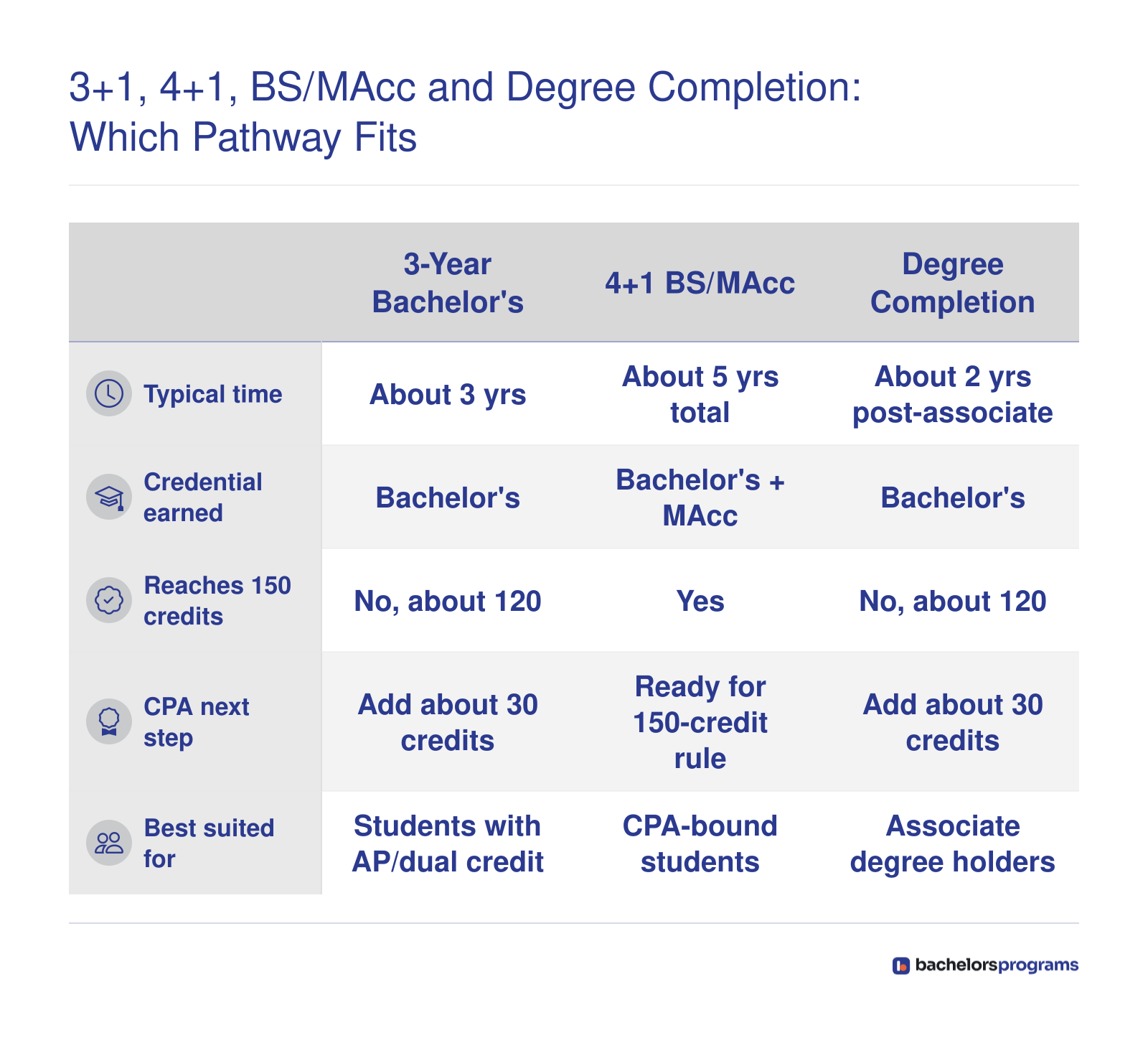
Do Accelerated Accounting Degrees Meet CPA Eligibility Requirements?
Will an accelerated accounting degree let you become a CPA? Usually yes, as long as the path reaches your state's credit and course requirements. The traditional model is a bachelor's in accounting, 30 more semester hours for 150 total, the Uniform CPA Exam, and typically one year of experience. NASBA says 48 state boards substantially follow that 150-hour standard.1
Graduate credits earned in a 4+1 or BS/MAcc program count toward the 150, so the pathway satisfies the rule while shortening the timeline.
The 150-hour rule often governs licensure rather than exam eligibility. NASBA's analysis found 19 states let candidates sit at 120 hours while still requiring 150 to be licensed.1 New York is one example: candidates may sit after 120 hours, with accounting-course conditions, but need 150 under that pathway.5 Its requirements also change for applications on or after Nov. 21, 2026.
A newer alternative from AICPA and NASBA pairs 120 semester hours with two years of experience.2 By May 2025, 14 states had adopted it.2 New Jersey accepts it as of Feb. 11, 20263, and Illinois is scheduled to begin Jan. 1, 2027.4
Rules differ by state, so check your state board through NASBA before you enroll.
Related Articles
How Much Does an Accelerated Accounting Degree Cost?
The lowest-cost options here are priced by average net price, meaning what undergraduates paid after grants and scholarships, so it is an average and not a quote for every student; your bill will depend on aid, residency and enrollment. A combined path can cut costs compared with a bachelor's plus a separate MAcc: schools advertise maximum savings of up to $5,700 at Weber State (up to 9 shared credits), up to $7,000 at Loyola University Maryland and up to $7,200 at the University of South Carolina (up to 12 shared credits), while standalone MAcc tuition in 2025-26 ran from $26,980 for Minnesota residents in a 30-credit track to $68,790 for nonresidents in a 44-credit track. Finishing a year sooner also means one fewer year of tuition and an earlier start to a full-time salary, though advertised savings are upper limits rather than guarantees.
| School | Location | Format | Cost | Cost Basis | Published In-State Tuition and Fees | Accelerated Option Noted |
|---|---|---|---|---|---|---|
| Michigan Technological University | Houghton, MI | On campus | $14,182 | Average net price (after aid, undergraduate) | $19,123 | Accelerated MS in one year |
| University of Houston | Houston, TX | On campus | $14,276 | Average net price (after aid, undergraduate) | $9,717 | CPA-ready Pathway for an accelerated path |
| Arizona State University | Tempe, AZ | Online | $14,967 | Average net price (after aid, undergraduate) | $12,223 | Accelerated bachelor's plus master's available |
Online vs. On-Campus Accelerated Accounting Programs
Can you earn an accelerated accounting degree entirely online? Yes. Several of the programs ranked here run fully online. Others are campus-based 4+1 tracks, and a few let you mix both formats.
Online programs usually gain their speed from the calendar. Many use 7- or 8-week terms with year-round enrollment, so you can take courses back to back through summer instead of waiting for a fall or spring start. For working adults, that structure can noticeably shorten the timeline.
Transfer credit matters just as much. If you hold an associate degree, many degree-completion programs accept roughly 60 to 90 credits, leaving mostly upper-division accounting coursework. First-year students on a 4+1 track follow a different path. They typically apply to the master's portion as juniors and often begin graduate courses during their senior year.
The trade-off is access to employers. Campus 4+1 programs tend to have stronger Big Four recruiting and internship pipelines, which can matter if public accounting is your goal. Online students should ask how a program connects them with firms.
Earnings and Outcomes After an Accelerated Accounting Degree
Finishing sooner pays off only if the credential converts into a paycheck and a passed exam. These earnings figures cover bachelor's accounting graduates at schools with accelerated pathways, not the accelerated track alone.
One year after finishing, median earnings run from $68,187 (Baylor) to $76,878 (Notre Dame). Virginia Tech sits at $70,303, Saint Joseph's at $69,807, and Loyola Maryland at $69,305. Five years out, Notre Dame graduates report $109,595 and Loyola Maryland graduates $106,160.
Debt tells the other side. Notre Dame's median is $19,000, about $201 a month. Loyola Maryland's is $27,000, about $286 a month. Both are modest next to those five-year earnings.
The CPA exam check
Pass rates vary by section. Cumulative national rates for the first three quarters of 2026 range from 43.54% on Financial Accounting and Reporting to 79.75% on Tax Compliance and Planning.1 Budget real study time.
The time advantage
The accelerated route puts you in a full-time salaried role a year earlier than the traditional five-year path. That is one extra year of professional pay and experience.
Questions to Ask Yourself
Which entry point does the program actually accept: first-year, junior, associate-degree holder, or working adult?
Will the pathway reach 150 credits, or will you need extra coursework for licensure?
Do you need Big Four recruiting access, or flexible 8-week online terms around a job?
Does the program count graduate courses toward both degrees?
Accounting programs by state
Accelerated Accounting Degree FAQs
Can you get an accounting degree in 3 years?
Is an accelerated accounting degree harder than a traditional one?
Can I start a 4+1 program if I've already finished my bachelor's?
Compare Accounting programs on the data that matters
Explore more Business & Management majors or browse every field of study.
All Business & Management programs Browse every field of study