Best Taxation Degree Programs
Compare 17 accredited Taxation programs, with net price after aid, graduation rates, earnings and debt from IPEDS and the U.S. College Scorecard.

A stand-alone Bachelor of Science (B.S.) in Taxation is rare. Most students headed for tax careers earn an accounting degree with a tax concentration, so a bachelor's degree in taxation, in practice, often means one of those hybrids. The programs here include both.
We compare schools on College Scorecard outcomes, net price, program earnings, and debt, not on reputation. CPA eligibility and pay vary enough by program, and between online and campus formats, to warrant separate comparison.
The practical catch is credit hours. Most states require 150 semester hours for CPA licensure, while a standard bachelor's degree runs 120, so a program's structure matters as much as its tax label.
Key Points
- Most taxation bachelor's degrees are accounting majors with a tax concentration.
- Enrolled Agents need no degree; CPAs are licensed by state boards.
- Rankings weigh on-time graduation and net price against tax coursework depth.
The 10 Best Taxation Degree Programs, Ranked
Ten programs made this list, judged on the two factors that most shape the return on a degree: whether students finish on time and what they actually pay after aid, set against the depth of each school's tax coursework. Each entry is a route into bachelor's-level tax work, and most build in a deliberate path toward CPA eligibility.
SUNY Old Westbury
#1Old Westbury, NY · $11,000/yr (est. net price)
Best for: Future CPAs wanting a combined bachelor's and master's
A public liberal arts college in Old Westbury, SUNY Old Westbury folds taxation into an integrated five-year accounting track instead of treating it as a stand-alone major. Students move from undergraduate accounting and business fundamentals into graduate tax coursework on corporate taxation, partnerships, S corporations, and estates and gifts. The result is one enrolled path that satisfies New York's CPA education requirements and costs fewer credits than earning the two degrees separately.
- Five-year program combining bachelor's and master's study
- 150 total credit hours, six fewer than earning the degrees separately
- Graduate admission granted before senior year
- GMAT waived with a qualifying undergraduate GPA
- Meets New York State CPA education requirements
- Advanced coursework in S corporations, partnerships, and LLCs
The University of Texas at Austin
#2Austin, TX · ~$20,000/yr (est.)
Best for: Students drawn to a large research university
One of the largest public research universities in the country, UT Austin houses its taxation focus inside its business school's accounting degree. The five-year integrated structure lets students earn both a BBA and a Master in Professional Accounting, with a tax track aimed at public accounting, industry, and nonprofit work. Small upper-level classes and an advisor who signs off on each concentration course keep the tax path coherent.
- Five-year integrated BBA and Master in Professional Accounting
- Taxation is one of three concentration options
- Internship satisfies the experiential learning requirement
- Small classes taught by full-time faculty
- Advisor approves each concentration course
- Admission requires at least 54 semester hours
Utah Valley University
#3Orem, UT · $5,000 – $10,000/yr (est.)
Best for: Budget-conscious students seeking an accounting foundation
Utah Valley University pairs a tax specialization with a broad business core, so accounting majors take marketing, finance, law, operations, and strategy alongside financial and managerial accounting. That breadth prepares graduates for tax examiner and tax preparer roles as well as audit, accounting, and financial risk work. A published four-year plan keeps students on schedule, and an executive lecture series puts working business leaders in front of them.
- Four concentration options, including tax
- 120 total credit hours
- Minimum 2.5 GPA in business courses
- Federal income taxation learning outcome required
- Business core spans marketing, finance, law, and operations
- Sample four-year plan and Executive Lecture Series
Rutgers University-Camden
#4Camden, NJ · $15,000 – $20,000/yr (est.)
Rutgers University Camden delivers its tax training through a Bachelor of Science in Accounting with a compact tax accounting concentration, so students add specialization without pushing back graduation. The business school brings AACSB accreditation, the Ragone Center for Excellence in Accounting, and options for honors theses, independent study, internships, and study abroad. Faculty with industry experience keep coursework tied to public accounting, corporate, government, and nonprofit practice.
- Tax accounting concentration requires 12 credits
- AACSB-accredited business school
- Ragone Center for Excellence in Accounting
- Honors thesis and independent study options
- Internships and study abroad available
- Prepares students for CPA, CMA, and CIA exams
West Virginia University
#5Morgantown, WV · ~$16,000/yr (est.)
West Virginia University builds its tax path into an AACSB-accredited business administration degree, and its CPA Exam track was updated for the 2024 CPA Evolution. Students can mix specialized tracks in data analytics, forensics, or corporate accounting, and an accelerated bachelor's-to-master's option serves those aiming at forensic and fraud examination. A capstone and a 2.5 GPA benchmark in the major keep the program rigorous.
- Four concentration options, including tax
- 120 total credit hours with a capstone
- 2.5 GPA minimum in the major
- CPA Exam track aligned with the 2024 CPA Evolution
- Specialized tracks in data analytics, forensics, or corporate accounting
- Accelerated bachelor's-to-master's option
- AACSB International accredited since 1997
Southern Illinois University-Carbondale
#6Carbondale, IL · $10,000 – $15,000/yr (est.)
Southern Illinois University Carbondale runs a taxation concentration inside its accounting bachelor's degree, with coursework reaching into partnership, corporate, estate, and trust taxation and into tax research. An online degree completion option makes the program workable for students already in the workforce. A capstone option trims core requirements, and the major requires at least a C in every accounting course.
- Two concentration options, including taxation
- 120 total credit hours; 150 needed for CPA licensure
- Online degree completion option available
- Minimum grade of C required in all major courses
- Capstone option reduces core requirements
- Coursework in partnership, corporate, estate, and trust taxation
Mercy University
#7Dobbs Ferry, NY · ~$14,000/yr (est.)
Mercy University leans hard into hands-on tax practice: students in the taxation specialization prepare returns for low-income taxpayers through the IRS VITA program and take on consulting projects with real clients. Classes run days, evenings, and weekends across two campuses, which suits working adults. The degree qualifies graduates for the CMA exam and, with added coursework, for CPA eligibility.
- Three concentration options, including taxation
- 120 total credit hours with a senior capstone
- Hands-on VITA tax assistance for low-income taxpayers
- Qualifies graduates to sit for the CMA exam
- CPA eligible with additional coursework
- Day, evening, and weekend classes at two campuses
Clayton State University
#8Morrow, GA · $5,000 – $10,000/yr (est.)
Clayton State University offers a bachelor's completion route for students who already hold a career associate degree or equivalent technical, military, or certification credit. The financial planning and taxation concentration mixes applied accounting, individual and business taxation, personal law, and financial management with core management coursework. A seminar in administrative and technology management ties the degree together, and the program accepts military credit and out-of-class clock hours.
- Bachelor's completion program for career associate degree holders
- 120 total credit hours
- 2.0 GPA minimum
- Military credit accepted for admission
- Accepts out-of-class clock hours
- Combines applied accounting, taxation, and personal financial planning
Indiana State University
#9Terre Haute, IN · $11,000/yr (est. net price)
Indiana State University emphasizes teaching and professional development inside its accounting degree, with faculty who are practicing CPAs and small class sizes. The taxation focus sits alongside auditing, data analytics, fraud examination, and nonprofit accounting, so graduates can move into public accounting, corporate tax, government, or IRS roles. The Meis Student Development Center and active Beta Alpha Psi and Delta Sigma Pi chapters support internships and networking.
- Seven concentration options, including taxation
- AACSB accredited
- Capstone in strategic management required
- Prepares students for CPA, CMA, CGMA, CFE, and CFP exams
- Faculty include practicing CPAs
- Meis Student Development Center for professional development
- Beta Alpha Psi and Delta Sigma Pi chapters
- Transfer credit accepted
University of Akron
#10Akron, OH · $10,000 – $15,000/yr (est.)
The University of Akron structures its tax training as an accelerated five-year path that awards both a bachelor's degree and a Master of Taxation, with dual-credit courses billed at undergraduate rates. Built-in CPA exam review and dedicated scholarships lower the cost of the graduate portion. The School of Accountancy reports job placement for nearly all of its students before graduation, reflecting close ties to regional accounting employers.
- Five-year accelerated bachelor's and Master of Taxation
- Dual-credit courses count toward both degrees
- Undergraduate tuition rate for dual-credit courses
- CPA exam review built into the curriculum
- Scholarships support both undergraduate and graduate years
- Program reports job placement for nearly all students before graduation
- Close advising from the School of Accountancy
Cost & outcomes by school
Federal data for the highest-earning Taxation programs, independent of the ranking above. Earnings are this field's bachelor's graduates four years after completing where the Scorecard reports them, else the school's undergraduate median.
| School | Net price / yr | Grad rate | Earnings | Debt | Grads/yr | Format |
|---|---|---|---|---|---|---|
| The University of Texas at Austin TX | $19,857 | 89% | $75,121 | $20,500 | — | Campus |
| Rutgers University-Camden NJ | $18,745 | 67% | $74,479 | $21,500 | — | Campus |
| SUNY Old Westbury NY | $11,282 | 45% | $58,526 | $14,997 | — | Campus |
| Marietta College OH | $21,083 | 61% | $57,180 | $27,000 | — | Campus |
| West Virginia University WV | $15,634 | 65% | $55,939 | $22,500 | — | Campus |
| Utah Valley University UT | $6,376 | 45% | $55,486 | $14,750 | — | Campus |
| Cleary University MI | $22,143 | 42% | $54,186 | $19,500 | — | Online |
| Western Illinois University IL | $12,937 | 45% | $54,163 | $25,251 | — | Campus |
| Southern Illinois University-Carbondale IL | $13,297 | 62% | $53,390 | $21,543 | — | Campus |
| Mercy University NY | $14,072 | 46% | $52,055 | $19,637 | — | Campus |
| Eastern Michigan University MI | $15,407 | 46% | $51,793 | $25,000 | — | Campus |
| Ohio Dominican University OH | $20,079 | 41% | $51,748 | $26,000 | — | Campus |
Sources: U.S. Department of Education. Net price, graduation rate, earnings and debt: College Scorecard (earnings and debt for this field's bachelor's graduates where reported, else school-wide); graduates: IPEDS. A dash means no figure is reported.
Cost, debt & payoff
Median earnings of this field's bachelor's graduates (4 yrs after completing, else the school's undergraduate median) vs. their median federal loan debt · U.S. College Scorecard
Across these programs the median graduate earns about $53,390 and finishes with roughly $22,500 in debt — a ratio that clears a common rule of thumb (keep debt below first-year salary). Net price and debt vary widely school to school, so check the per-school figures in the table above before you shortlist.
How We Ranked These Taxation Programs
Tax work is drifting from return preparation toward advisory and automation oversight, which makes a program's measurable outcomes more telling than a familiar name on a brochure.
The Inputs We Use
We built this list around program-level figures rather than institutional reputation. The core measures are the program's own graduate earnings, median federal debt at completion, average net price, school-wide graduation and retention rates, and the number of completions in the field. Completions matter because a program that produces a handful of graduates each year yields noisy earnings numbers, and we weigh those numbers accordingly.
Why Program-Level Data Beats Reputation Lists
Plenty of published rankings rest on peer surveys and name recognition, with no visible method and no numbers a reader can check. Outcome data tied to the program itself answers the question families actually ask: what do this program's graduates earn, and what does it cost to get there?
Limits Worth Knowing
Campus-wide graduation and net-price figures are not broken out for the tax major, so treat them as context rather than a verdict on the department. Some small programs publish no earnings figure at all, and where that happens we lean on cost, debt and completion numbers instead.
Both online and campus programs were eligible, and no format was favored. A well-run online tax sequence with strong outcomes can sit alongside a traditional classroom program.
What a Bachelor's Degree in Taxation Actually Looks Like
A stand-alone bachelor's degree in taxation barely exists in the United States. Search any list of undergraduate business credentials and, almost without exception, you get an accounting bachelor's that lets you push toward tax through a concentration, specialization, or track. The handful of programs that come closest still sit inside an accounting major.
The closest things to a tax-titled degree
Mercy University offers the clearest example: its 2026-2027 credential is a B.S. in General Accounting with a Taxation specialization.1 Students complete the standard accounting core (ACCT 120, 121, 240, 241, plus MGMT 460) and then layer on dedicated tax coursework in ACCT 340 and ACCT 341 along with a finance or business law requirement. Eastern Michigan University runs an Accounting and Tax Consulting program built on 150 hours. Arizona State's undergraduate credential is a 120-credit B.S. in Accountancy, with taxation reached through an accelerated path into a Taxation and Data Analytics master's.2
Depth versus breadth
The difference between a tax-focused program and a general accounting major is how much of the curriculum tax actually occupies. A broad accounting degree spreads your attention across auditing, financial reporting, and managerial or cost accounting, with tax appearing once. Binghamton University's B.S. in Accounting, for instance, covers tax through a single required course, ACCT 475 Survey of Taxation.3 Johnson & Wales handles it the same way, with ACCT 3011 Federal Taxes I inside a 120-credit curriculum that also requires a six-credit internship.4 Ball State's accounting degree, offered on campus or fully online as a B.A. or B.S., touches federal income taxation alongside financial, managerial, and audit content.5
Why the distinction matters
Accounting majors generally map more cleanly onto state CPA coursework requirements. Mercy is blunt about the tradeoff: its taxation specialization meets the educational requirements for the CMA exam but not for the CPA.1 A tax-heavy program suits preparation, compliance, and consulting work, while a broad accounting degree leaves more room for licensure.
The catalog test
Open the course catalog and count the dedicated tax courses. One survey course means you have an accounting degree. Separate courses in individual, corporate, partnership, and tax research means you have genuine tax depth.
Core Tax Courses and the Software You'll Train On
Current catalogs show that taxation coursework moves from individual returns to business entities, estates, and research, and much of it is taught inside the same preparation software practitioners use. The examples below come from published course listings. Several schools also build in hands-on training through the IRS Volunteer Income Tax Assistance (VITA) program, where students prepare real returns for qualifying taxpayers at no cost. Saint Anselm College's Federal Tax Preparation certificate, for instance, requires a full tax season as a VITA volunteer and a passing score on the IRS advanced preparation exam.
| Course Area | What You Learn | Common Tools or Software |
|---|---|---|
| Individual income tax (College of San Mateo ACTG 181 and ACTG 175; Saint Anselm College Federal Income Taxation I and II) | Federal and state individual returns, filing status and dependency rules, deductions and adjustments, and credits such as the EITC, Child Tax Credit, and Child and Dependent Care Credit | Tax software; TaxWise in College of San Mateo's VITA course |
| Business entity taxation, including pass-through entities (College of San Mateo ACTG 182) | How business entities are taxed, with entity returns prepared in software | Tax software |
| Estate, gift, and trust taxation (College of San Mateo ACTG 183) | Federal and California returns for trusts, estates, and gifts, including Forms 1041, 706, and 709, plus the underlying tax law and theory | Tax software and manual preparation |
| Tax research and IRS representation (College of San Mateo ACTG 261) | Researching tax questions and representing taxpayers before the IRS | N/A |
| Professional software training (College of San Mateo ACTG 264) | Core functions of a commercial preparation package used by tax firms | Lacerte Tax Software |
| Tax policy and practice (University of Pennsylvania ACCT2110) | General tax preparation, credits available to VITA-eligible taxpayers, and community tax service in West Philadelphia | VITA software |
| VITA internship (York College, CUNY ACC 292 and ACC 293) | Preparing federal and New York State income tax returns for community clients | TaxWise professional tax software |
| Advanced VITA practice (College of San Mateo ACTG 276 and ACTG 277) | Preparing more complex returns, quality review of other preparers' work, and updated tax law training | Tax preparation software |
Related Articles
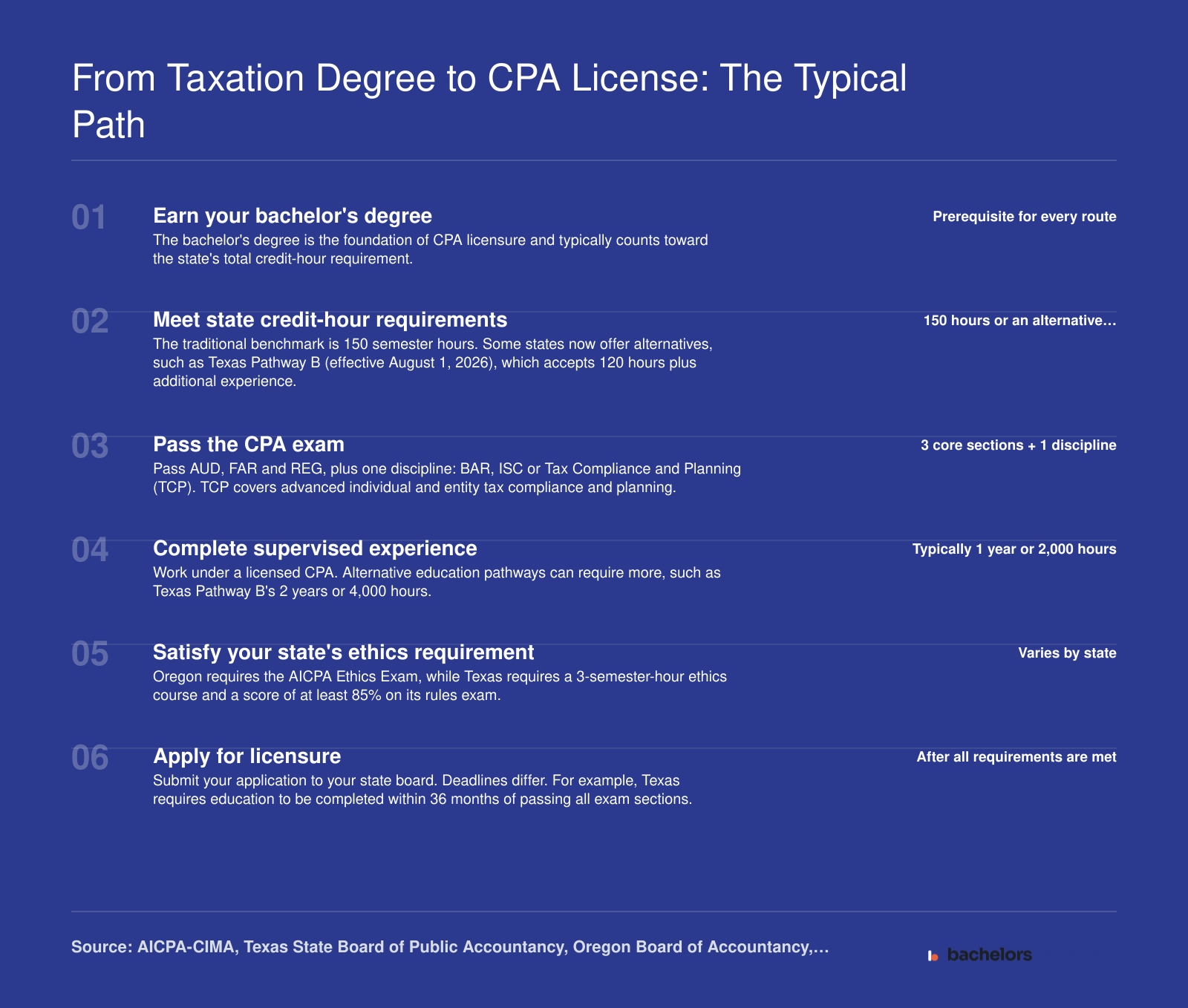
From Taxation Degree to CPA License: The Typical Path
A bachelor's degree in taxation is the starting point for CPA licensure, and the steps that follow happen in a fairly set order. Requirements vary by state, so confirm the details with your state board of accountancy before you plan your timeline.
CPA vs. Enrolled Agent: Two Licensing Routes After a Taxation Degree
A bachelor's degree in taxation can lead to either credential, but the two are built differently. The Enrolled Agent (EA) credential comes from the IRS and has no degree requirement, while CPA licensure runs through state boards of accountancy. Many graduates sit for the Special Enrollment Examination first, since it can be earned while they build the experience a state board may require for the CPA.
| Factor | Enrolled Agent (EA) | Certified Public Accountant (CPA) |
|---|---|---|
| Who issues it | The Internal Revenue Service enrolls EAs. | State boards of accountancy, the District of Columbia, and U.S. territories license CPAs. |
| Education requirement | None. The IRS pathway requires a PTIN, the exam, an application, and a suitability check, not a degree. | Accounting study at a college or university plus board requirements. Degree and credit rules vary by jurisdiction. |
| Exam structure | Special Enrollment Examination: three parts, all passed within three years. | Uniform CPA Examination. Scoring and eligibility rules are set by the state board. |
| Experience requirement | The IRS enrollment steps list no work-experience requirement. | Set by each state board, so check your jurisdiction. |
| Other screening | PTIN renewed annually, plus an IRS suitability check covering tax compliance and criminal background. | Good-character requirements set by the state board. The IRS suitability check does not apply. |
| Continuing education | At least 72 hours every three years, with a minimum of 16 per year including two hours of ethics. | Set by the state board. The 72-hour EA cycle does not apply. |
| Scope of practice | Generally may represent any taxpayer on any tax matter before any IRS office. | Governed by state licensing rules. |
| Fees and renewal | $140 enrollment fee paid through Pay.gov within one year of passing the exam. Status renews every three years. | Fees and renewal terms are set by the state board, with no single nationwide figure. |
| Best-fit career | Tax preparation, tax resolution, and IRS representation work. | Broader accounting careers where state licensure matters, including tax. |
Taxation programs by state
Taxation Degree FAQs
These answers cover the questions prospective students ask most often about a bachelor's degree in taxation. Figures for tuition and graduate pay vary by school, so check each program's published numbers before you decide.
Is a taxation degree worth it?
What is the difference between a taxation degree and an accounting degree?
Can I start preparing tax returns while still earning my degree?
How long does a bachelor's in taxation take, and can transfer credits shorten it?
Compare Taxation programs on the data that matters
Explore more Business & Management majors or browse every field of study.
All Business & Management programs Browse every field of study