Best Accounting Schools in South Dakota
Compare 11 accredited Accounting programs in South Dakota, with net price after aid, graduation rates, earnings and debt from IPEDS and the U.S. College Scorecard.

Public in-state tuition in South Dakota starts around $8,764 a year at Black Hills State University, while private colleges cut much higher sticker prices sharply with aid. That gap frames your first decision: which bachelor's degree in accounting to choose, usually a Bachelor of Science (B.S.) in Accounting.
Cost is only half the question. The public universities admit nearly every applicant, so what separates programs is AACSB accreditation, net price after aid, graduate earnings, and whether coursework runs on campus or online. Licensure adds one more constraint: South Dakota's CPA rules changed on July 1, 2026, and the credit math now depends on the pathway you take.
Key Points
- Oglala Lakota College has the lowest average net price on this list.
- The University of South Dakota and South Dakota State both hold AACSB accreditation.
- South Dakota's three CPA licensure pathways took effect July 1, 2026.
Best Accounting Schools in South Dakota: Our Ranked List of Bachelor's Programs
Augustana University
#1Sioux Falls, SD · $20,000 – $25,000/yr (est.)
Best for: CPA-exam-focused campus students in Sioux Falls
Augustana University is a private liberal arts university in Sioux Falls with about 2,000 students and a business school that pairs accounting with economics and business administration. Its accounting graduates who sat for the Uniform CPA Examination for the first time in 2024 earned the highest pass rate in South Dakota, and accounting majors intern with firms such as Eide Bailly, Clifton Larson Allen, and Ernst & Young. Students can also study away in London, Paris, Oslo, or Thailand.
- Bachelor of Arts in Accounting built on financial reporting, taxation, auditing, and business operations
- Accounting courses paired with business administration and economics coursework
- 2024 first-time CPA exam takers posted the highest pass rate in South Dakota
- Internship partners include Clifton Larson Allen, Eide Bailly, Ernst & Young, and the FDIC
- Study-away options in London, Paris, Oslo, and Thailand
- Master of Professional Accountancy pathway available after the bachelor's degree
South Dakota State University
#2Brookings, SD · $15,000 – $20,000/yr (est.)
Best for: In-state students wanting the lowest sticker price
South Dakota State University is the state's largest public research university, located in Brookings, and it offers accounting as both a Bachelor of Arts and a Bachelor of Science through the Ness School of Management and Economics. The 120-credit curriculum covers intermediate accounting, cost accounting, income tax, accounting systems, and auditing, capped by a strategic management capstone. Courses run on the Brookings campus and online, which suits working adults, and the resident rate is among the lowest in the state.
- Offered as either a Bachelor of Arts or a Bachelor of Science in Accounting
- 120 total credit hours with a strategic management capstone
- Core sequence includes Intermediate Accounting I and II, Cost Accounting, Income Tax, and Auditing
- Grade of C or better required in key business courses
- Courses offered on the Brookings campus and online for working adults
- Double majors need 15 distinct credits beyond the first major
University of South Dakota
#3Vermillion, SD · ~$20,000/yr (est.)
Best for: Transfer students arriving with an accounting associate degree
The University of South Dakota runs its accounting program through the Beacom School of Business in Vermillion, with a second location in Sioux Falls. The B.B.A. in accounting feeds public accounting, audit, tax, financial planning, and management consulting, and 26 CPA firms recruit on campus each year. USD also expanded a 2026 articulation agreement with Southeast Technical College that lets graduates of its accounting associate degree transfer up to 62 credits.
- Bachelor of Business Administration in Accounting through the Beacom School of Business
- Hands-on work through Big Four internships and the Coyote Business Consulting Group
- 26 CPA firms recruit on campus each year
- Southeast Technical College AAS in accounting graduates may transfer up to 62 credits
- Offered in Vermillion and Sioux Falls
- Beta Alpha Psi chapter and study abroad trips available
University of Sioux Falls
#4Sioux Falls, SD · $21,000/yr (est. net price)
The University of Sioux Falls is a private Christian university in Sioux Falls whose accounting major blends liberal arts coursework with a specialized accounting core in auditing, advanced accounting, and accounting information systems. Students can finish in as little as three years, study fully online with mostly asynchronous classes, or continue into the MBA to reach the credits a CPA license requires. Business programs hold specialized accreditation from the International Accreditation Council for Business Education.
- Bachelor of Arts in Accounting combining liberal arts and a specialized accounting core
- Finish in as little as three years through the accelerated format
- Fully online option with mostly asynchronous classes
- Core includes Accounting Information Systems, Advanced Accounting, Auditing, and Advanced Excel
- Pair the B.A. with the USF MBA to meet CPA credit requirements
- Business programs accredited by the International Accreditation Council for Business Education
Northern State University
#5Aberdeen, SD · $15,000 – $20,000/yr (est.)
Northern State University in Aberdeen offers a practical, 120-credit Bachelor of Science in Accounting on campus or fully online, with coursework in auditing, taxation, data analysis, cost accounting, and nonprofit accounting. Students work with industry-standard software and are prepared to pursue CPA licensure, and an accelerated track lets them add a master's in accounting analytics in one year after the bachelor's. Northern's resident tuition is the lowest of the public options on this list.
- Bachelor of Science in Accounting, 120 credits, four-year plan
- Available on campus in Aberdeen or fully online
- Curriculum covers auditing, taxation, data analysis, cost accounting, and nonprofit accounting
- Hands-on practice with industry-standard accounting software
- Accelerated one-year master's in accounting analytics after the bachelor's
- Prepares students to pursue CPA licensure
Dakota State University
#6Madison, SD · $10,000 – $13,000/yr (est.)
Dakota State University in Madison takes a technology-forward approach, and its Bachelor of Science in Professional Accountancy requires 150 credits, the full total South Dakota CPA candidates need before the exam. Students fill the extra credits with electives, a second major, a minor, or graduate work, and the program lists three flexible licensure pathways. Classes start in fall, spring, and summer, and the degree is available on campus or 100% online.
- Bachelor of Science in Professional Accountancy requiring 150 total credit hours
- 150 credits matches the total South Dakota CPA candidates need before the exam
- Three flexible CPA licensure pathways, including a master's plus one year of supervised experience
- 24-credit accounting specialization alongside business and information systems coursework
- Start dates in fall, spring, and summer
- Available on campus in Madison or 100% online
Black Hills State University
#7Spearfish, SD · $16,000/yr (est. net price)
Black Hills State University in Spearfish delivers accounting as a specialization inside its business administration degree, so students complete a broad 51-credit business core in finance, marketing, management, and analytics plus an 18-credit accounting sequence. The 120-credit program requires 36 upper-level hours and no minor, letting students concentrate entirely on accounting. Classes meet on campus, and graduates move into public accounting, corporate accounting, or further study.
- Accounting specialization within the Business Administration degree
- 51-credit business core in finance, marketing, management, and analytics
- 18-credit accounting sequence covering intermediate accounting, income tax, auditing, and advanced accounting
- 120 semester hours with 36 upper-level hours and no minor required
- Delivered on campus in Spearfish
Mount Marty University
#8Yankton, SD · ~$22,000/yr (est.)
Mount Marty University is a small Catholic university in Yankton whose accounting major covers 128 credits of financial accounting, managerial accounting, taxation, and auditing alongside marketing, management, economics, finance, and business law. Students gain applied experience through a Tax Clinic and internships, and an Investment Club gives them a way to explore financial markets outside class. The program also offers an associate degree option for a shorter path.
- 128-credit bachelor's program in accounting
- Coursework covers financial accounting, managerial accounting, taxation, and auditing
- Hands-on experience through a Tax Clinic and internships
- Investment Club available for students interested in financial markets
- Associate of Arts option for a shorter path
- Major and minor options available
Dakota Wesleyan University
#9Mitchell, SD · $15,000 – $20,000/yr (est.)
Dakota Wesleyan University in Mitchell builds its accounting major around CPA preparation and lays out three routes to the 150 credits the exam requires: summer courses and modest overloads to finish in four years, an MBA that adds the credits in one extra year, or a fifth year of full-time classes. The curriculum includes Intermediate Accounting I and II, Taxation I and II, Auditing, Cost Accounting, and governmental and not-for-profit accounting, ending in a senior capstone. The Musick Family Department of Business holds specialized IACBE accreditation.
- Three paths to the 150 credits the CPA exam requires, including an MBA add-on year
- Coursework includes Intermediate Accounting I and II, Taxation I and II, Auditing, and Cost Accounting
- Accounting Systems coursework using QuickBooks and Excel
- Senior capstone in business analysis and strategy
- Pair with a math minor for actuarial work or a criminal justice minor for forensic accounting
- Musick Family Department of Business holds IACBE specialized accreditation
National American University-Rapid City
#10Rapid City, SD · ~$31,000/yr (est.)
National American University in Rapid City offers a fully online Bachelor of Science in Accounting organized around six career pathways, from management accounting and strategic finance to forensic accounting, government and nonprofit accounting, and audit and internal controls. Coursework includes Principles of Accounting I and II, Cost Accounting, Accounting Information Systems, Accounting for Governmental Entities, and Auditing I and II. The program is built for working adults who want an online route to accounting roles.
- Bachelor of Science in Accounting delivered as an online program
- Six pathway areas, including forensic accounting and government and nonprofit accounting
- Core includes Principles of Accounting I and II, Cost Accounting, and Accounting Information Systems
- Auditing I and II plus Accounting for Governmental Entities
- Prepares students for cost accountant, fraud examiner, internal auditor, and grant accountant roles
- Accounting Case Analysis course included in the curriculum
Cost & outcomes by school
Federal data for the highest-earning Accounting programs, independent of the ranking above. Earnings are this field's bachelor's graduates four years after completing where the Scorecard reports them, else the school's undergraduate median.
| School | Net price / yr | Grad rate | Earnings | Debt | Grads/yr | Format |
|---|---|---|---|---|---|---|
| University of South Dakota SD | $19,858 | 60% | $71,179 | $22,750 | 51 | Campus |
| University of Sioux Falls SD | $21,383 | 63% | $70,772 | $19,000 | 14 | Hybrid |
| Black Hills State University SD | $15,911 | 43% | $69,079 | $26,000 | 8 | Campus |
| Augustana University SD | $23,894 | 73% | $68,523 | $25,000 | 31 | Campus |
| Northern State University SD | $15,812 | 49% | $67,072 | $25,000 | 12 | Online |
| South Dakota State University SD | $19,841 | 62% | $55,070 | $23,250 | 3 | Campus |
| Dakota Wesleyan University SD | $19,735 | 48% | $53,728 | $27,000 | 5 | Campus |
| National American University-Rapid City SD | $31,062 | — | $52,215 | $27,525 | 3 | Online |
| Dakota State University SD | $21,057 | 51% | $50,970 | $23,500 | 7 | Hybrid |
| Mount Marty University SD | $22,227 | 52% | $48,179 | $26,396 | 8 | Campus |
| Oglala Lakota College SD | $1,895 | 9% | $22,517 | — | — | Campus |
Sources: U.S. Department of Education. Net price, graduation rate, earnings and debt: College Scorecard (earnings and debt for this field's bachelor's graduates where reported, else school-wide); graduates: IPEDS. A dash means no figure is reported.
Cost, debt & payoff
Median earnings of this field's bachelor's graduates (4 yrs after completing, else the school's undergraduate median) vs. their median federal loan debt · U.S. College Scorecard
Across these programs the median graduate earns about $55,070 and finishes with roughly $25,000 in debt — a ratio that clears a common rule of thumb (keep debt below first-year salary). Net price and debt vary widely school to school, so check the per-school figures in the table above before you shortlist.
How We Ranked South Dakota Bachelor's Degree in Accounting Programs
Students now expect accounting programs to show what graduates earn and owe, not just describe the curriculum. The ranking here leans on that kind of evidence.
What went into the ranking
We drew on federal College Scorecard data for earnings, student debt, net price, and the number of students completing each accounting program. We also looked at accreditation, since AACSB or ACBSP status signals that a business school meets outside standards.
How to read the numbers
Two figures describe the whole institution rather than the accounting major alone: graduation rate and net price. A school's graduation rate blends every undergraduate program, and net price is an average of what students paid after grants and scholarships. It is not a quote. Your own cost depends on your aid package, residency, and housing choices, so treat it as a starting point and run each school's net price calculator.
The timing of earnings also differs. Program-level earnings are measured after students complete the accounting credential. Institution-wide figures are measured from the point of first enrollment, so they include students who left without finishing. Placing the two side by side without that context would mislead you.
Use the ranking to build a shortlist, then confirm details such as costs, requirements, and accreditation directly with each school before you apply.
Cheapest Accounting Schools in South Dakota
The schools below are sorted by average net price, what students pay after grants and scholarships, using 2024 federal data from IPEDS and the College Scorecard. Oglala Lakota College, a tribal college in Kyle listed in our directory, has the lowest figure at $1,895, and Northern State University is the most affordable ranked school at $15,812. Dakota Wesleyan University has the highest sticker price at $33,790, but aid lowers its net price to $19,735, just under South Dakota State University.
| School | City | Sector | In-State Tuition & Fees | Out-of-State Tuition & Fees | Average Net Price | Accounting Program | Format |
|---|---|---|---|---|---|---|---|
| Oglala Lakota College | Kyle | Public (tribal college) | $2,684 | $2,684 | $1,895 | Business Administration, Specialization in Accounting | Campus |
| Northern State University | Aberdeen | Public | $8,845 | $11,947 | $15,812 | Accounting Bachelor's Degree | Campus and online |
| Black Hills State University | Spearfish | Public | $8,764 | $11,866 | $15,911 | Business Administration, Specialization in Accounting | Campus |
| Dakota Wesleyan University | Mitchell | Private nonprofit | $33,790 | $33,790 | $19,735 | Accounting | Campus |
| South Dakota State University | Brookings | Public | $9,299 | $12,809 | $19,841 | Accounting (B.A. or B.S.) | Campus |
Cost of a Bachelor's Degree in Accounting in South Dakota
Published Tuition vs. Net Price
The public universities have the lowest sticker prices. Published in-state tuition runs about $8,764 at Black Hills State University, $8,845 at Northern State University, $9,299 at South Dakota State University, $9,432 at the University of South Dakota and $9,654 at Dakota State University. Average net price after aid at these schools is higher, from roughly $15,800 at Northern State and Black Hills State to about $21,057 at Dakota State. Net price covers more than tuition, including housing, food and books, so at public schools it usually lands above the tuition line.
The private schools show the biggest gap between sticker price and net price. Augustana University lists tuition and fees of $40,160 against an average net price of $23,894. Dakota Wesleyan University drops from $33,790 to $19,735, and Mount Marty University from $34,600 to $22,227. University of Sioux Falls barely moves, from $21,750 to $21,383.
South Dakota Aid for Residents
The South Dakota Opportunity Scholarship provides up to $7,500 over eight terms at participating South Dakota campuses.1 To qualify, you must:
- Be a South Dakota resident at high school graduation.
- Hold a 3.0 high school GPA and complete the required curriculum.
- Score at least 24 on the ACT or 1180 on the SAT (SDSU's stated equivalent).
- Enter college within five years of graduating.
To keep it, maintain a 3.0 GPA and reach 30 credits before your third semester, 60 before your fifth and 90 before your seventh.1 Time spent studying outside the state, including out-of-state online enrollment, can end eligibility. Some federal sources list a lower total, so confirm the current amount with the Board of Regents.2
Build Dakota is a full-ride scholarship, but it applies only at South Dakota's four technical colleges, in fields such as welding, healthcare and IT.3 Accounting is not among its listed program areas, so it is not a path for the bachelor's programs here.
Stacking Aid and a Reminder
File the FAFSA first, since federal grants and school aid both depend on it. Then add the Opportunity Scholarship and ask each school what institutional scholarships it will combine with it. Stacking matters most at the private schools, where discounts are largest.
Remember that net price is an institution-wide average, not a quote for accounting majors. Your own award could land well above or below it.
Admission Requirements: GPA, Test Policy, and Transfer Credit
South Dakota State University admits 98.3% of applicants and the University of South Dakota admits 98.8%, according to federal Scorecard data, so the real gate is entry into the accounting major, not entry into the university. The selective end looks different: Mount Marty University admits 42.6% and Augustana University 67.8%, with Dakota State (88.1%) and Black Hills State (96.3%) in between.
SDSU: several routes in, one gate later
SDSU publishes a 2.6 high school GPA, ACT 18, SAT 970, top 60% class rank, or Smarter Balanced Level 3, and the page does not make an ACT or SAT score mandatory when another route is satisfied. Transfer applicants need a 2.0 cumulative GPA and good standing; anyone bringing fewer than 24 transferable credits must also meet freshman rules. Expect the $25 application fee, a final high school transcript, a test report, and transcripts from every college attended. The number that matters for an accounting major is 2.90: that cumulative GPA is required for upper-division accounting coursework.
USD and Northern State
USD asks for a 2.6 GPA or upper-half class rank, ACT 21, or SAT 1070, and does not require a test when other criteria are met. Transfers should carry 24 or more semester credits at a 2.0; below that, freshman criteria apply. USD warns that programs may add requirements but publishes no accounting-specific GPA. Northern State accepts transfers at a 2.0 in good standing and asks for ACT or SAT scores only from applicants under 22.
Where no policy is published
Dakota State and Black Hills State list no accounting-specific GPA or test threshold, and neither states a transfer credit cap for the accounting degree. At the private universities here, general first-year admission governs; the accounting program pages add no separate cutoff, so check the admissions office directly.
Transfer credit in practice
SDSU evaluates transcripts after admission and posts course equivalencies, without stating a maximum number of transferable credits. Students moving between South Dakota public institutions may need only an application and fee when they have not been enrolled in the last three terms.
AACSB vs. ACBSP Accreditation for South Dakota Accounting Programs
Accreditation is the first filter worth applying to a South Dakota accounting degree, and the state's largest business schools hold AACSB International accreditation.
Who Holds AACSB Accreditation
The University of South Dakota, South Dakota State University, and Black Hills State University each appear in AACSB's accredited-school directory with business accreditation, and each lists accounting among its programs:
- University of South Dakota: AACSB business accreditation1
- South Dakota State University: AACSB business accreditation2
- Black Hills State University: AACSB business accreditation3
AACSB's directory distinguishes Business and Accounting, Business, and Accounting accreditation. These South Dakota entries sit in the business category, so the listing establishes the school's business accreditation rather than a separate accounting stamp. Not every accounting program in the state carries AACSB accreditation, and a department's own page is the fastest place to confirm what it holds.
How AACSB and ACBSP Differ
AACSB is research-oriented and more selective. It weighs faculty scholarship and expects a substantial share of doctoral-qualified instructors, which often means larger lecture sections and a more theoretical treatment of the material. ACBSP is teaching-focused: its standards center on classroom instruction, student learning outcomes, and the working adults many of its member schools serve. A degree from either can be solid. The difference is the culture of the program and how the faculty spend their time.
Does Accreditation Decide CPA Eligibility?
No. South Dakota's CPA requirements turn on credit hours and specific accounting and business coursework set by the state Board of Accountancy, not on a business school's accreditor. Accreditation is a quality signal for you, not a gate for the license. The licensure section walks through the credit requirements in detail.
Related Articles
Accounting Careers and Pay in South Dakota
Starting pay and long-run earning power are different numbers, and South Dakota's data shows why they should stay separate.
What the Wage and Outlook Data Show
Bureau of Labor Statistics data for May 2023 counts 6,170 accountants and auditors (SOC 13-2011) working in South Dakota, with a mean annual wage of $77,840.1 That is an average across every experience level, not an entry salary. Nationally, the median annual wage for the occupation was $83,680 in May 2025.2 The state mean sits somewhat below that, but the two figures use different measures and different years, so treat the comparison as a rough guide.
BLS projects national employment of accountants and auditors to grow 5% from 2025 to 2035, adding about 79,400 jobs.2 The South Dakota Department of Labor and Regulation publishes its own occupational projections, and its current release is the best place to confirm the state's outlook.3
Reading the Earnings Table
The post-graduation earnings in the earnings table come from federal College Scorecard data. They describe graduates a set number of years after finishing, which means early-career pay. Expect those figures to run below the statewide mean, which also includes senior accountants, managers, and CPAs with decades of experience. Use them to compare schools, not to predict a paycheck.
Some schools, such as Black Hills State University and Oglala Lakota College, offer accounting as a specialization within business administration. Their earnings figures may reflect a broader group of business graduates than accounting majors alone.
Typical Entry Roles
Graduates with a bachelor's degree in accounting usually start in one of these jobs:
- Staff accountant: Handles reconciliations, general ledger entries, and month-end close for a company or firm.
- Staff auditor: Tests financial records and controls, often at a public accounting firm.
- Tax preparer or tax associate: Prepares individual and business returns, with a busy season each winter and spring.
- Accounts payable or payroll specialist: Manages vendor payments and employee pay inside an organization.
South Dakota CPA Licensure: How Many Credits Do You Need?
South Dakota sets its own credit requirements for CPA licensure. Start with the state itself, not a blog post or a school brochure. Licensure rules can change, and only the licensing authority can tell you what applies to you today.
Start With the Official Source
The South Dakota Board of Accountancy is the first stop. On its website, look for the pages covering CPA licensure, exam eligibility, and education requirements. Read those directly rather than relying on secondary summaries, which can lag behind rule changes.
Next, check the rules behind those pages. The 150-semester-hour requirement and the specific accounting and business credit rules are set out in the South Dakota Codified Laws and the Board's administrative rules. Confirm the details there before you enroll in courses or submit an application. A bachelor's degree in accounting typically covers fewer hours than the licensing standard, so plan how you will reach the total.
Supporting Resources
Once you know the official rules, these sources add useful context:
- BLS.gov: General background on CPA careers and licensing.
- School websites: Credit details for the accounting programs at the schools ranked here, including how coursework may line up with licensure.
- Professional associations: AICPA, NASBA, and the South Dakota CPA Society offer guidance on the exam and the licensing process.
Your Licensure Checklist
Treat this as a practical sequence:
- Identify the official source: Bookmark the Board's licensure and education pages.
- Confirm requirements: Verify the education rules, current exam eligibility, and work-experience requirements directly with the Board.
- Ask questions early: Contact the Board before choosing courses or scheduling the exam, especially if you are transferring credits or studying online.
- Keep written confirmation: Save any email or notice that affects course selection or licensure timing.
A short message to the Board now can prevent a costly surprise later, such as a missing course or a credit shortfall discovered after graduation.
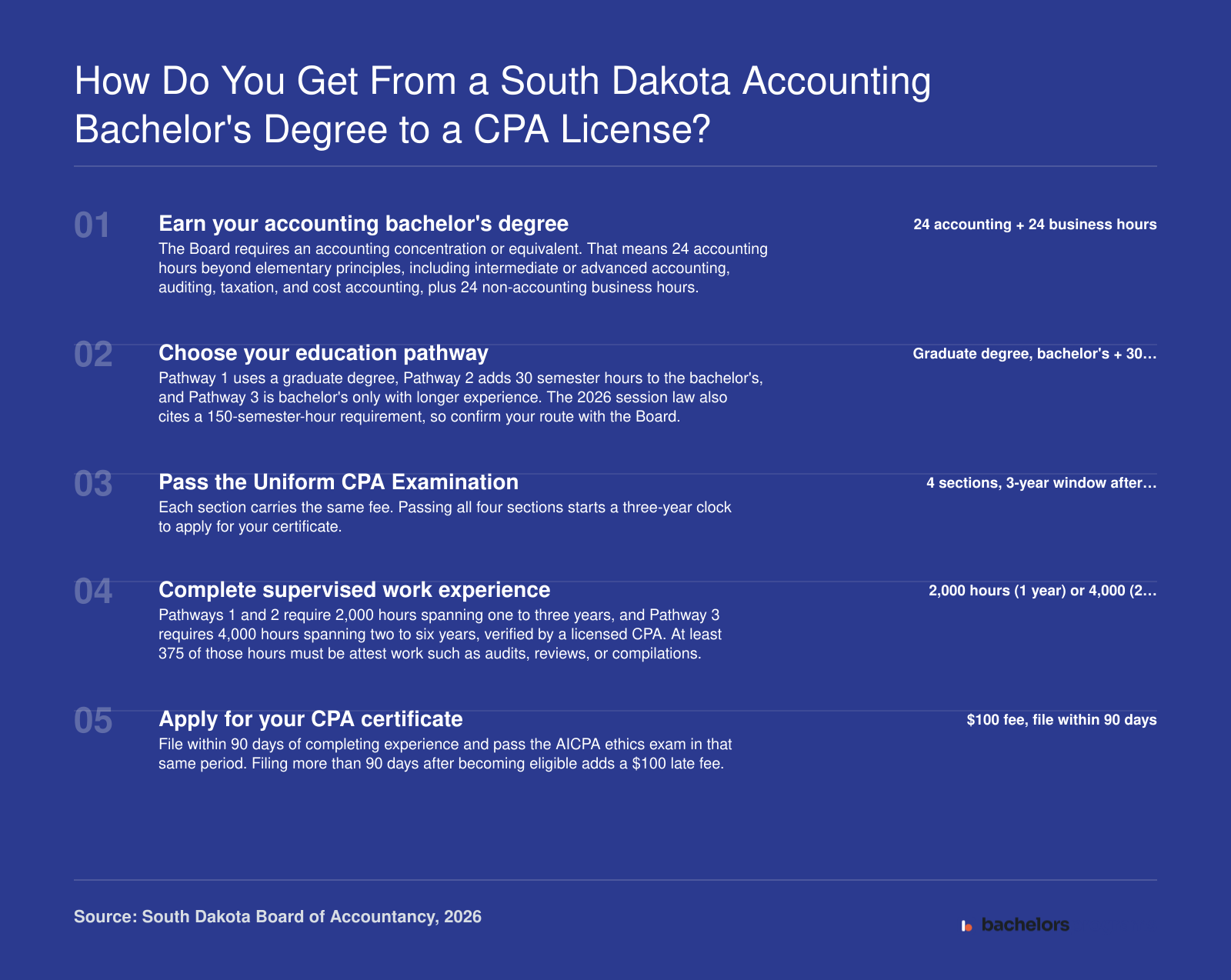
How Do You Get From a South Dakota Accounting Bachelor's Degree to a CPA License?
South Dakota's three licensure pathways took effect July 1, 2026, so candidates who finished earlier fall under prior rules. The steps below follow the South Dakota Board of Accountancy's current requirements.
South Dakota Accounting School Questions, Answered
Quick answers to the questions students ask most about studying accounting in South Dakota. Each one draws on the program and licensure details covered earlier on this page.
Can you earn a bachelor's degree in accounting online in South Dakota?
How many credits do you need to become a CPA in South Dakota?
Which South Dakota accounting programs are AACSB accredited?
What is the SDSU acceptance rate for accounting students?
Compare Accounting programs on the data that matters
Explore more Business & Management majors or browse every field of study.
All Business & Management programs Browse every field of study