Best Online Accounting Degree Programs
Compare 300+ accredited online Accounting programs, with net price after aid, graduation rates, earnings and debt from IPEDS and the U.S. College Scorecard.

Most states require 150 semester hours of college credit to earn a CPA license, yet a bachelor's degree covers only 120. That gap shapes the decision for working adults and career changers weighing an online accounting degree.
Every program ranked here is 100% online, with no hybrid sessions or in-person residencies, so a job or family schedule does not have to bend around a campus visit. Regional accreditation is the baseline, and business accreditation from AACSB or ACBSP adds another signal for employers.
State boards of accountancy review coursework and accreditation, not delivery format. An online degree can lead to licensure, but only if the credits and accounting content match your state's rules.
Key Points
- CUNY Lehman College ranks first, with the lowest net price here.
- An associate degree can cut an online bachelor's to two years.
- State boards judge accreditation and coursework, not whether you studied online.
The 10 Best Fully Online Accounting Degree Programs for 2027
CUNY Lehman College takes the top spot on this list of fully online accounting programs, in part because its accounting major courses can be completed entirely at a distance at the lowest net price of any school here. Every program below is delivered fully online, with no campus visits or hybrid components required. Hybrid and partially online programs were excluded before the list was built.
CUNY Lehman College
#1Bronx, NY · $3,100/yr (est. net price)
Best for: New York residents on a tight budget
CUNY Lehman College in the Bronx is a public senior college in the City University of New York system, and it delivers its accounting major entirely at a distance. The school pairs a 51 percent graduation rate with the lowest net price on this list after aid, which makes it the strongest value entry among these ten programs. It also offers a Master of Science in Accounting for students who want to keep going after the bachelor's.
- Accounting major courses delivered 100 percent online or on campus
- Part of the business field, with a foundation across accounting and business
- Leads to an optional Master of Science in Accounting at the same college
- Accounting major courses completed online or in person
- Award is a Bachelor of Arts rather than a Bachelor of Science
- Open to freshman and transfer applicants under CUNY general admission rules
Eastern Florida State College
#2Melbourne, FL · $5,000 – $10,000/yr (est.)
Best for: Associate degree holders finishing a bachelor's
Eastern Florida State College in Melbourne offers an accounting specialization inside its Bachelor of Applied Science in Organizational Management, built specifically for students who already hold an associate degree. The accounting track is fully online, while the shared core business courses can be taken online or on campus. It is one of the cheapest paths to an accounting bachelor's on this list, with a published total program tuition estimate for Florida residents.
- Accounting track is fully online within the 12-track BAS
- Starts with eight core business courses shared across all tracks
- Five upper-level accounting courses including cost accounting and auditing
- 120 credit hours, typically about two years to finish
- Spring, summer and fall start dates each year
- Admission requires an associate degree, and an A.A.S. does not qualify
Thomas Edison State University
#3Trenton, NJ · $5,000 – $10,000/yr (est.)
Thomas Edison State University in Trenton is built around adult learners, and its accounting degree is designed to be assembled from online courses, guided study, exams and prior learning assessment. The Bachelor of Science in Accounting/CPA is a 120-credit program that satisfies the New Jersey prerequisites for sitting the CPA exam and feeds into a CPA and master's track. It is one of the most flexible ways to finish an accounting bachelor's entirely at a distance.
- 120 credit hours, available fully online
- Meets New Jersey CPA exam prerequisites
- Coursework includes Intermediate Accounting I and II, Advanced Accounting and Auditing
- Area-of-study credits can be earned through courses, exams or prior learning assessment
- Feeds into the CPA and Master's Track at the same university
- Check your own state board of accountancy for CPA exam requirements
Texas A & M International University
#4Laredo, TX · $3,600/yr (est. net price)
Texas A&M International University in Laredo runs a 120-credit accounting BBA with 45 advanced hours and a capstone in the final semester. Students work through financial and managerial accounting, intermediate accounting, federal taxation, auditing and accounting systems, with a faculty advisor each semester. The online format is aimed at working students who want a rigorous, career-focused curriculum without attending in person.
- 120 semester credit hours, 45 of them advanced
- Capstone taken in the final semester
- Covers intermediate accounting, federal taxation, auditing and accounting systems
- Writing-intensive requirements across the program
- Upper-level business electives and a faculty advisor each semester
American Public University System
#5Charles Town, WV · $5,000 – $10,000/yr (est.)
American Public University System in Charles Town is an online institution serving working adults, including a large share of military and veteran students. Its accounting bachelor's blends theory with simulations and labs, and it accepts up to 90 transfer credits, so students can carry in most of a prior degree. Monthly course starts and eight-to-sixteen-week classes make it one of the more flexible schedules on this list.
- 120 credit hours at a standard $360 per credit rate
- Up to 90 transfer credits accepted
- Monthly course starts, with classes running 8 to 16 weeks
- Covers Sarbanes-Oxley and SEC regulations plus intermediate and cost accounting
- Senior capstone required; no entrance exam
- Textbooks and ebooks included in tuition
University of Houston
#6Houston, TX · $10,000 – $23,000/yr (est.)
The University of Houston delivers its accounting BBA fully online through UH Extend while keeping students connected to the Bauer College of Business. The curriculum emphasizes applying generally accepted accounting principles to real business situations, valuing organizations by income and costs, and communicating findings clearly. With six concentration options and a 65 percent graduation rate, it is one of the larger and more established programs here.
- Fully online program from the Bauer College of Business
- Six concentration options
- $409 per credit
- Analyze financial information using GAAP and value organizations by income and costs
- Adapt to changing accounting procedures across industries
Strayer University-Florida
#7Tampa, FL · ~$16,000/yr (est.)
Strayer University is a private, career-focused institution with campuses across the country, and its accounting bachelor's is available online. The program runs 180 quarter credit hours with 81 credits in accounting and business courses, including federal taxation, auditing, accounting information systems and data analytics for accounting. Courses are 4.5 quarter credits, and students can stack micro-credentials along the way.
- 180 total quarter credit hours
- 81 credits in accounting and business coursework
- Includes federal taxation, auditing, accounting information systems and data analytics
- ACC 499 Undergraduate Accounting Capstone required
- All courses are 4.5 quarter credit hours
- Micro-credentials can be earned during the degree
Arizona State University
#8Tempe, AZ · ~$15,000/yr (est.)
Arizona State University's W. P. Carey School of Business offers an online accountancy degree that prepares students for public accounting careers in audit, tax and consulting. A second online option, the Business (Corporate Accounting) program, emphasizes managerial accounting and prepares students for the Certified Management Accountant exam. The school's 68 percent graduation rate and its large accounting cohort make it one of the most visible programs on this list.
- Prepares for public accounting careers in audit, tax and consulting
- CPA designation encouraged, with state-specific certification requirements noted
- Available through ASU Online from the W. P. Carey School of Business
- Managerial accounting emphasis with six major courses in the concentration
- Prepares for the Certified Management Accountant exam
- Accelerated bachelor's plus master's option available
- Online format with multiple sessions and reduced tuition for western states
New Mexico State University
#9Las Cruces, NM · $8,000 – $25,000/yr (est.)
New Mexico State University in Las Cruces runs its Bachelor of Accountancy through the Global Campus, delivered 100 percent online with fall and spring starts. The 120-credit program covers financial and cost accounting, federal taxation, auditing and accounting data analytics, with 48 credits at the 300 level or above. It also offers internships with public accounting firms and one of the lower tuition rates among the schools listed.
- 120 credit hours delivered 100 percent online
- $395 per credit hour, with a reduced rate for active military
- Prepares for the CPA and CMA exams
- 48 credits must be at the 300 level or above
- Upper-division accounting exams are proctored
- Internships with public accounting firms available
Appalachian State University
#10Boone, NC · $8,000 – $25,000/yr (est.)
Appalachian State University in Boone delivers its accounting BSBA through App State Online, aimed at working adults finishing a degree in eight-week terms. The Walker College of Business holds AACSB accreditation and has held it since 1976, and the program accepts prior learning credit alongside transfer work. Students can choose a public accounting or managerial accounting concentration, and both lead toward CPA licensure.
- Public accounting concentration among the available tracks
- Managerial accounting concentration also offered
- 120 credit hours at $424 per credit for in-state students
- Multiple eight-week term starts, with prior learning credit accepted
- Optional internships and an annual accounting networking event
Cost & outcomes by school
Federal data for the highest-earning Accounting programs, independent of the ranking above. Earnings are this field's bachelor's graduates four years after completing where the Scorecard reports them, else the school's undergraduate median.
| School | Net price / yr | Grad rate | Earnings | Debt | Grads/yr | Format |
|---|---|---|---|---|---|---|
| University of South Florida FL | $9,812 | 77% | $78,918 | $17,529 | 321 | Hybrid |
Sources: U.S. Department of Education. Net price, graduation rate, earnings and debt: College Scorecard (earnings and debt for this field's bachelor's graduates where reported, else school-wide); graduates: IPEDS. A dash means no figure is reported.
Cost, debt & payoff
Median earnings of this field's bachelor's graduates (4 yrs after completing, else the school's undergraduate median) vs. their median federal loan debt · U.S. College Scorecard
Across these programs the median graduate earns about $66,108 and finishes with roughly $23,250 in debt — a ratio that clears a common rule of thumb (keep debt below first-year salary). Net price and debt vary widely school to school, so check the per-school figures in the table above before you shortlist.
What Put These 100% Online Programs on Top
Every school here cleared one hard gate before quality was even considered: the entire degree can be finished online. Programs that require hybrid sessions, campus residencies or in-person capstones were left out, even when their reputations are strong. If you need to complete coursework from another state or around a full-time job, that filter protects you from surprises.
What the Quality Check Looks At
Once a program passed the online test, it was judged on four things that matter to a working student:
- Affordability: net price after aid, not the sticker price.
- Completion: graduation and retention rates, which show whether students actually finish.
- Outcomes: graduate earnings and debt for the accounting program itself, taken from the federal College Scorecard.
- Access: how open the school is to adult learners, including admission selectivity and the share of students receiving Pell Grants.
Where the Data Falls Short
The numbers are useful, but they have limits. Graduation rates describe the whole institution, not the accounting major alone. Net price is an average across all aided students, so your own cost could land higher or lower. Some programs also have no published program-level earnings, usually because too few graduates were tracked, so those schools are judged on the remaining measures.
What You Will Need to Check Yourself
Public data cannot tell you what a credit costs, how many transfer credits a school will accept, or whether the coursework satisfies your state's CPA rules. Those details decide whether a program fits your situation, so each one gets its own section: per-credit rates, transfer caps and licensure requirements.
Online Accounting Degree Cost: Per-Credit Rates, Fees and Total Price
Many online programs have dropped the old resident and nonresident split in favor of a single rate for every student, so total cost is easier to work out than it used to be. Across the schools here, published per-credit rates run from $353 at LSUA to $692 at Penn State World Campus. Multiplied across a 120-credit degree, that is roughly $42,360 to $83,040 before fees.
Per-Credit Rates Times 120 Credits
- LSUA: $353 x 120 = $42,3601
- CSU Global: $385 x 120 = $46,200
- Florida Southern College: $390 x 120 = $46,800
- Southwest Minnesota State: $406.25 x 120 = $48,7506
- Concordia University St. Paul: $420 x 120 = $50,400
- Oregon State Ecampus: $438 x 120 = $52,5603
- UW-Parkside: $473 x 120 = $56,7607
- Florida Tech Online: $572.92 x 120 = about $68,750
- Penn State World Campus: $644 to $692 x 120 = $77,280 to $83,0402
Three Pricing Models
Flat online rates are the most common, and LSUA, CSU Global, Oregon State, UW-Parkside and Southwest Minnesota State all charge every student the same. Traditional in-state versus out-of-state pricing still matters at schools that tie online tuition to residency. Annual tuition and fees at Texas A&M International run $7,894 in-state and $19,454 out-of-state; New Mexico State runs $8,183 versus $25,307. Private schools such as Florida Tech and Concordia St. Paul charge one per-credit rate, usually higher on paper.
Fees That Raise the Sticker Price
Check for add-ons before comparing totals. Florida Tech estimates technology fees of $155 to $3104, and Florida Southern adds $25 to $100 per semester depending on credit load5. CSU Global lists no required student fees. Oregon State's listed rate excludes course materials3, and some programs, New Mexico State among them, use proctored exams at testing centers, so budget for software, textbooks and proctoring.
Why Net Price Matters More
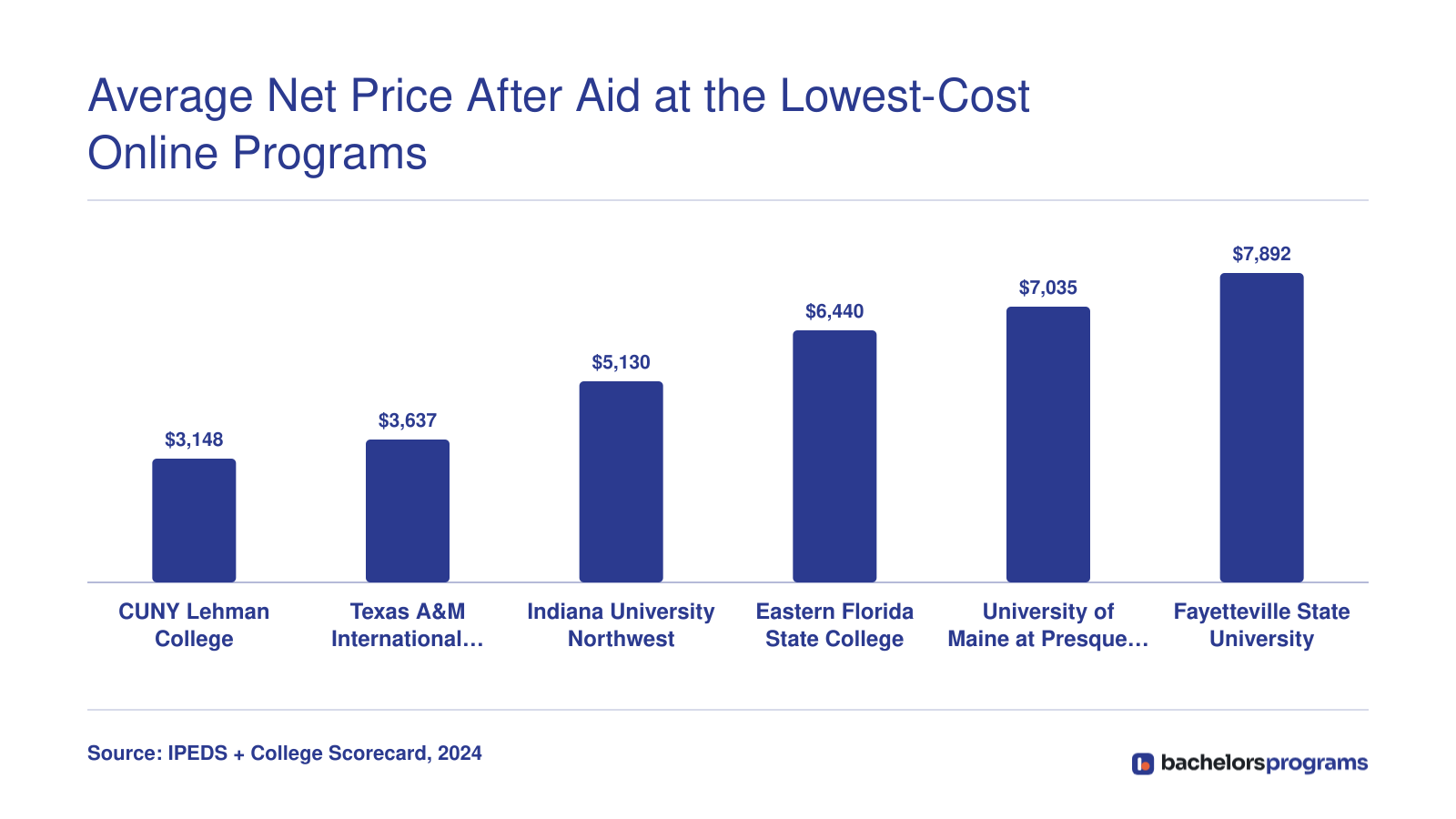
The published rate is rarely what students pay. In the data here, average annual net price after aid at public schools runs from $3,148 at CUNY Lehman College to $9,406 at Walla Walla Community College, while the private American Public University System averages $9,597. For an affordable online accounting degree, compare after-aid figures and fee schedules, not headline rates alone.
Transfer Credits Cut the Bill
Every 30 transferred credits removes about a quarter of the total tuition. At LSUA that saves $10,5901, and at CSU Global $11,550. That is why transfer credit deserves a closer look.
Average Net Price After Aid at the Lowest-Cost Online Programs
Net price is the average yearly amount students paid after grants and scholarships, as federally reported for each public institution. It is a school-wide average, not an exact bill: your cost will shift with your aid package, residency, enrollment status and credit load. Every school at the low end of this chart is a public institution, so state universities and colleges clearly dominate the most affordable online accounting options.
Using Transfer Credits to Finish Your Online Bachelor's in Accounting Faster
Starting from zero with a full course load, most students need about four years of full-time study to finish an online bachelor's in accounting. Arrive with an associate degree and the timeline often drops to two years or less, since the first half of the degree is largely general education and lower-division business coursework.
How Much Credit Schools Will Take
Published transfer maximums differ sharply. Colorado State University Global accepts up to 90 credits, with a 64-credit ceiling on community college work. Southern New Hampshire University also caps transfer at 90, and its undergraduate policy allows up to 45 credits from associate-level study. Eastern Oregon University accepts up to 135 prior-college credits.1
Residency requirements set the floor on what you must actually take there: 30 credits at CSU Global, 30 at SNHU, 20 at Eastern Oregon. Block transfer is the other lever. Rasmussen University awards a 90-quarter-credit block to holders of a conferred accounting associate degree3, and WGU estimates an associate degree satisfies roughly 14 of 40 courses, leaving 27 to complete.2
Exams, Military Training and Prior Learning
Ask each admissions office what it accepts beyond graded college coursework. Eastern Oregon evaluates prior learning through APEL and accepts Agency Sponsored Learning credit, capped at 45 credits, which can cover military, union and government agency training.1 Thomas Edison State University accepts Prior Learning Assessment credit toward its accounting degree. Policies on credit-by-exam options vary enough that you should confirm them in writing rather than assume.
Accelerated Terms and a Realistic Load
CSU Global and SNHU run 8-week courses, and CSU Global opens new sessions monthly, so you can start without waiting for a semester to turn over. Working full time, most students manage one or two courses per term and still finish within a few years.
Request an unofficial transcript evaluation before you apply. Upper-level accounting courses are the least likely to transfer, and learning that early tells you how many terms you are genuinely signing up for.
Related Articles
Online Accounting Degree CPA Eligibility by State: The 150-Credit Rule and New 120-Credit Pathways
Yes, an online accounting degree can lead to a CPA license. State boards of accountancy evaluate a school's accreditation and your coursework, not whether you studied on campus or online.
The 120 vs. 150 Credit Gap
A bachelor's degree is typically 120 semester credits. Traditional licensure in most jurisdictions requires 150, along with the CPA Exam and generally one year of qualifying experience. Students close the 30-credit gap in three common ways:
- Master's degree: a master's in accounting or taxation, many of which are offered online.
- Extra undergraduate credits: additional coursework that your board agrees to count.
- Combined program: an integrated bachelor's/master's track that builds in the 150 credits.
The 120-Credit Alternative
AICPA and NASBA's model now adds an optional route built on a 120-credit bachelor's with an accounting concentration, a passing CPA Exam score and two years of relevant experience. It generally supplements the 150-credit route rather than replacing it. Reported adopters include Connecticut (October 1, 2025), Alaska and Tennessee (January 1, 2026), Utah (July 1, 2026), Nebraska (July 17, 2026), Texas (August 1, 2026), Maryland (October 1, 2026), Oklahoma (November 1, 2026) and California (January 1, 2027).
Treat those dates cautiously. Some are still ahead, final board rules differ by state, and sources conflict on Colorado. Maryland and Nebraska set the experience bar at two years or 4,000 hours,1 and Texas keeps its 150-credit pathway alongside the new one.
Exam eligibility is a separate question from licensure. Some states let candidates sit for the exam at 120 credits while still requiring 150 for the license. No reliable complete list of those states exists, so confirm with your own board.
Coursework Minimums Vary
Boards also specify accounting and business credits, typically 24 to 30 of each. Nebraska requires at least 24 accounting and 24 business hours.2 Texas requires 27 upper-level accounting hours and 24 upper-level business hours, including an ethics course. New York's proposal describes 27 accounting and 30 business credits.3 Check your state board of accountancy before enrolling, and ask any school whether its curriculum satisfies those lists.
An Alternative: The CMA
If you are headed for corporate or managerial accounting, the IMA's Certified Management Accountant credential asks for a bachelor's degree and two years of experience, with no 150-credit requirement.
Which Online Accounting Schools Deliver the Strongest Return on Investment
Federal data now lets you compare what graduates of a specific program earn and borrow, and that comparison has turned return on investment into a practical test of an online degree.
Early-Career Earnings in Accounting
Accounting graduates of Thomas Edison State University earned a median $56,988 one year after completion, rising to $82,029 four years after finishing. Western Governors University graduates posted $58,784 at one year and $75,767 at four. Arizona State University reached $86,901 four years out, the highest figure here. The University of Houston climbed from $48,942 to $84,668 over the same span. Washington State University started at $57,618 one year after completion, and CUNY Lehman College grew from $43,728 to $66,240.
Debt and the Monthly Payment
Median federal debt at completion and the typical 10-year monthly payment:
- CUNY Lehman College: $11,617, about $123 a month
- Texas A&M International University: $12,970, about $138 a month, against $35,528 in median pay one year out
- University of Houston: $14,000, about $148 a month
- Western Governors University: $15,915, about $169 a month
- Arizona State University: $16,850, about $179 a month
- Washington State University: $21,500, about $228 a month
For these schools, that payment equals roughly 3 to 5 percent of gross monthly pay one year after completion.
A School-Wide Signal
A broader ratio sets each school's median earnings ten years after enrollment, across all majors, against its median graduate debt. Treat it as an institution-level proxy, not an accounting outcome. Thomas Edison State and WGU both come in around 5.5 to 1, and Lehman about 5.3 to 1.
Where Low Debt Wins
Lehman stands out: the lowest debt and payment on this list, paired with pay that grows by more than half within four years. Houston and Arizona State combine moderate borrowing with the strongest four-year earnings. Debt at completion matters more than sticker price because it reflects what graduates actually borrowed after aid, transfer credit and pacing. A small payment against a growing salary also leaves room to fund the extra credits many states require for CPA licensure.
What Accountants and Auditors Earn Nationally
An online bachelor's in accounting leads to the same entry point as a campus degree: a field with a solid national pay standard.
Accounting programs by state
Compare Accounting programs on the data that matters
Explore more Business & Management majors or browse every field of study.
All Business & Management programs Browse every field of study