Best Accounting Schools in Tennessee
Compare 33 accredited Accounting programs in Tennessee at 32 colleges, with net price after aid, graduation rates, earnings and debt from IPEDS and the U.S. College Scorecard.

A bachelor's degree in accounting is the standard entry credential for Tennessee public accounting, and the Bachelor of Science (B.S.) in Accounting, or its business-school equivalents, is where most students start. Net price after aid runs from roughly $10,700 at UT Martin to more than $24,700 at Lipscomb, and graduation rates split just as widely, from about 51% at the University of Memphis to 72% at Lipscomb.
Selectivity and early-career pay vary too. UT Knoxville admits about 42% of applicants, while UT Martin admits 88%. College Scorecard earnings data give a consistent basis for comparing programs.
The tension is that the cheapest route and the strongest recruiting pipeline are rarely the same school, and Tennessee's two CPA pathways, 150 semester hours with one year of experience, or 120 semester hours with two, mean the four-year degree is only the first stage of licensure.
Key Points
- Austin Peay State University charges $9,006 in-state tuition, the lowest here.
- Tennessee now offers two CPA routes, including 150 hours plus one year.
- For Big Four ambitions, UT Knoxville's selective program leads the ranking.
Best Accounting Schools in Tennessee: Our Top 10 Ranked Bachelor's Programs
Tennessee's bachelor's degree in accounting options span large research universities with Big Four recruiting pipelines, regional publics with flexible formats, and small private colleges where faculty know your name. UT Knoxville is the pick for selectivity and Big Four ambition, Middle Tennessee State and UT Martin stretch the tuition dollar furthest among the publics, and Tennessee Tech and Memphis add the most scheduling flexibility. The notes under each school below explain what that program actually does well.
The University of Tennessee-Knoxville
#1Knoxville, TN · ~$19,000/yr (est.)
Best for: Big Four aspirants wanting deep internships
Tennessee's flagship public university runs its accounting major inside the Haslam College of Business, an AACSB-accredited program that pairs core accounting with finance, business law and supply chain coursework. Students choose a three-course collateral area such as business analytics or information management, and two full-time internship options place them inside industry and public accounting firms. It carries the widest recruiting footprint in the state, and the undergraduate curriculum feeds directly into a compact Master of Accountancy.
- AACSB International accredited
- Five concentration options
- 120 total credit hours with a 2.5 GPA minimum
- Two full-time internship programs, both paid
- B- required in ACCT 301 to continue in the major
- Prepares for CPA and CISA exams
- Feeds into a 10-month Master of Accountancy
Tennessee Tech
#2Cookeville, TN · $10,000 – $15,000/yr (est.)
Best for: Working adults needing hybrid flexibility
A public university in Cookeville whose B.S.B.A. in accounting is built for students who want a solid business degree with room to work while they earn it. Coursework covers financial, cost, tax and auditing territory, and the accounting program runs its own career expo for public accounting firms, industry employers and government agencies. Its employer network reaches Deloitte, LBMC, Baker Tilly and the Tennessee Valley Authority, with internships extending into Middle Tennessee firms.
- Hybrid mix of on-campus and online courses
- Covers financial, cost, tax and auditing coursework
- Hosts an accounting-only career expo each year
- Employer network includes Deloitte, LBMC, Baker Tilly and TVA
- Internships reach Middle Tennessee firms such as Elliott Davis
Freed-Hardeman University
#3Henderson, TN · $22,000/yr (est. net price)
Best for: Faith-centered students wanting close mentoring
A small private university in Henderson where accounting majors take a broad business core plus focused work in tax, auditing, cost and management accounting. Classes are small and faculty come from both public practice and private industry, and a required capstone plus an internship option tie the degree together. The Christian mission shapes campus life, and graduates move into public accounting, corporate finance, government and nonprofit roles.
- Four-year campus program with a required business capstone
- Small classes taught by faculty from public and private sectors
- Internship option or upper-division business electives
- Coursework in tax, auditing, cost and management accounting
- Christian mission integrated across the curriculum
- Brown-Kopel Business Center for hands-on projects
Lipscomb University
#4Nashville, TN · ~$25,000/yr (est.)
A private university in Nashville whose accounting major sits close to the city's corporate and public accounting employers. Coursework leans into financial reporting and analysis, international business and management decision-making, and the capstone is a 20-hour-a-week internship that often turns into a first job. Faculty bring decades of firm and in-house experience, many students study abroad, and the program feeds an accelerated Master of Accountancy.
- Capstone internship at 20 hours per week
- Financial reporting, analysis and international business focus
- Study abroad options in Italy, Austria and England
- Faculty with decades of firm and corporate experience
- Accelerated Master of Accountancy pathway
- Program reports 100% job placement for graduates
Middle Tennessee State University
#5Murfreesboro, TN · ~$13,000/yr (est.)
A large public university in Murfreesboro with one of the biggest accounting pipelines into Nashville employers, including Deloitte, EY, KPMG and PwC. The AACSB-accredited B.B.A. is offered on campus or in a hybrid format, and the curriculum flexes toward auditing, corporate reporting, tax consulting, fraud examination and even sports and entertainment accounting. A dedicated business career center and the Handshake internship board keep recruiting in front of students.
- AACSB accredited in both accounting and business
- Available on ground or in a hybrid format
- Recruited by 100+ Nashville-area employers, including the Big Four
- Career tracks in fraud examination and forensics
- Career Development Center plus the Handshake internship board
- Jacobs Chair of Excellence on the faculty
The University of Tennessee-Martin
#6Martin, TN · $11,000/yr (est. net price)
A regional public campus in Martin where the B.S.B.A. in accounting covers intermediate and advanced financial accounting, cost and management accounting, auditing, individual taxation, and governmental and nonprofit accounting. Students must earn at least a C in every accounting course counted toward the major, which keeps the cohort ready for professional exams. It doubles as a strong pre-law major and a common route toward the CIA and CMA credentials.
- Coursework in advanced financial accounting and governmental accounting
- Requires a C or better in each accounting course
- Prepares for CPA, CIA and CMA exams
- Also serves as a strong pre-law major
- Covers individual taxation and audit procedures
- Scholarships and financial aid available
East Tennessee State University
#7Johnson City, TN · ~$16,000/yr (est.)
A public university in Johnson City whose accounting B.B.A. carries AACSB accreditation and 36 hours of accounting coursework, enough to sit for the CPA, CMA and CIA exams. The College of Business and Technology runs its own career services, and the annual Accounting Networking Night puts students in front of regional firms and the Big Four. Graduates work as controllers, auditors, tax accountants and CFOs, and a Master of Accountancy is available on the same campus.
- 36 hours of accounting, enough to sit for CPA, CMA and CIA exams
- AACSB accredited, a distinction held by under 2% of programs worldwide
- Annual Accounting Networking Night draws 30+ employers, Big Four included
- Dedicated career services for business and technology majors
- Continues into ETSU's Master of Accountancy
- Graduates work as CFOs, controllers, auditors and tax accountants
Union University
#8Jackson, TN · ~$27,000/yr (est.)
A private Christian university in Jackson whose accounting major pairs technical training in financial reporting, auditing, taxation and business analytics with an emphasis on ethical judgment. Its business school is AACSB accredited, and classes are taught in person so faculty can mentor students closely. Graduates head into public accounting and corporate finance, and the major can also be paired with a minor.
- AACSB accredited, the only Christ-centered AACSB business school in Tennessee
- Coursework in financial reporting, auditing, taxation and analytics
- Ethical judgment built into every accounting course
- Available as a major or a minor
- In-person classes with close faculty mentoring
Lee University
#9Cleveland, TN · ~$19,000/yr (est.)
A private Christian university in Cleveland where the B.S. in Accounting builds technical skill on a liberal arts and religion core. The 120-hour degree includes 71 hours of specialty requirements plus six hours of accounting electives, and upper-level courses require at least a C-. An 80-hour Christian service requirement gives the program a distinctly values-based shape, and the coursework spans auditing, governmental accounting and federal taxation.
- 120 credit hours, including 71 hours of specialty requirements
- C- minimum required in upper-level accounting courses
- Six credit hours of accounting electives
- 80 hours of Christian service required for graduation
- Coursework spans auditing, governmental accounting and federal taxation
University of Memphis
#10Memphis, TN · $10,000 – $15,000/yr (est.)
A public research university in Memphis whose accounting degree is taught through the Crews School of Accountancy and built to fit around students who already work. The 120-hour program pairs 41 hours of general education with 27 hours of program requirements, and it shows how accounting connects to financing, investing and daily operations rather than treating the subject in isolation. Graduates move into public accounting, corporate finance and business management, or continue toward professional certifications.
- 120 credit hours, including 41 hours of general education
- 27 hours of program requirements in accounting
- Connects accounting to financing, investing and daily operations
- Taught through the Crews School of Accountancy
- Built for students who need to keep working while enrolled
Cost & outcomes by school
Federal data for the highest-earning Accounting programs, independent of the ranking above. Earnings are this field's bachelor's graduates four years after completing where the Scorecard reports them, else the school's undergraduate median.
| School | Net price / yr | Grad rate | Earnings | Debt | Grads/yr | Format |
|---|---|---|---|---|---|---|
| Belmont University TN | $33,147 | 71% | $93,688 | $20,500 | 19 | Campus |
| The University of Tennessee-Knoxville TN | $18,976 | 74% | $89,445 | $20,500 | 199 | Campus |
| Lipscomb University TN | $24,739 | 72% | $83,930 | $23,732 | 25 | Campus |
| Lee University TN | $18,878 | 63% | $79,208 | $16,750 | 15 | Campus |
| Middle Tennessee State University TN | $13,359 | 54% | $73,702 | $19,500 | 77 | Hybrid |
| University of Memphis TN | $12,397 | 51% | $71,038 | $23,325 | 83 | Online |
| Tennessee Wesleyan University TN | $14,836 | 48% | $70,782 | $20,000 | 10 | Campus |
| Tennessee State University TN | $15,796 | 34% | $69,414 | $26,471 | 15 | Campus |
| Tennessee Tech TN | $14,246 | 58% | $67,411 | $15,500 | 44 | Campus |
| Strayer University-Tennessee TN | $11,645 | — | $66,108 | $41,625 | 7 | Online |
| Carson-Newman University TN | $20,251 | 53% | $64,634 | $21,954 | 8 | Hybrid |
| King University TN | $22,347 | 48% | $59,831 | $22,750 | 7 | Online |
Sources: U.S. Department of Education. Net price, graduation rate, earnings and debt: College Scorecard (earnings and debt for this field's bachelor's graduates where reported, else school-wide); graduates: IPEDS. A dash means no figure is reported.
Cost, debt & payoff
Median earnings of this field's bachelor's graduates (4 yrs after completing, else the school's undergraduate median) vs. their median federal loan debt · U.S. College Scorecard
Across these programs the median graduate earns about $54,434 and finishes with roughly $21,954 in debt — a ratio that clears a common rule of thumb (keep debt below first-year salary). Net price and debt vary widely school to school, so check the per-school figures in the table above before you shortlist.
Cheapest Bachelor's in Accounting Programs in Tennessee
Austin Peay State University in Clarksville is the cheapest bachelor's in accounting option in Tennessee in our data, with in-state tuition and fees of $9,006 and an average net price of $9,735 after aid; among public schools, The University of Tennessee-Martin ($10,560 tuition, $10,701 net price) and the University of Memphis ($10,728 tuition, $12,397 net price) follow closely. Private schools show why net price after aid is usually a better comparison than sticker price: Christian Brothers University lists $38,420 in tuition and fees, yet its average net price of $9,854 lands near the public options, while Strayer University-Tennessee, an online for-profit school outside our ranked list, charges $13,920 with an average net price of $11,645. Net price figures come from 2024 U.S. Department of Education IPEDS and College Scorecard data and reflect an institution-wide average for aided students in each school's sector, not a quote for the accounting program itself, so confirm your own costs with each financial aid office.
| School | City | Public or Private | In-State Tuition and Fees | Average Net Price After Aid | Program Format |
|---|---|---|---|---|---|
| Austin Peay State University | Clarksville | Public | $9,006 | $9,735 | Campus |
| Christian Brothers University | Memphis | Private nonprofit | $38,420 | $9,854 | Campus |
| The University of Tennessee-Martin | Martin | Public | $10,560 | $10,701 | Campus |
| Strayer University-Tennessee | Nashville | Private for-profit | $13,920 | $11,645 | Online |
| University of Memphis | Memphis | Public | $10,728 | $12,397 | Online |
Online and Hybrid Bachelor's in Accounting Options at Tennessee Schools
Can you earn a bachelor's degree in accounting online from a Tennessee school? Yes. The programs that make it possible come in three formats.
Online and hybrid formats
The University of Memphis lists its Bachelor of Business Administration in Accounting as an online program. Middle Tennessee State University lists its accounting bachelor's as a distance-learning program.1 Tennessee Tech is hybrid in practice: the accounting courses themselves are delivered 100% online with no required campus contacts, though the degree still carries a 30-hour residency requirement.1
Campus-based programs
Other programs on the list are built around the classroom, including the University of Tennessee-Knoxville, UT Martin, East Tennessee State University, Freed-Hardeman, Lipscomb, Union and Lee. Many still post individual courses or summer sections online, so an on-campus degree does not mean zero flexibility.
Watch the tuition rate, not just the format
Online study does not automatically mean the in-state price. Tennessee State University charges a separate rate for online coursework, and its in-state discount (available at 15 credit hours) does not extend to TN eCampus courses. Ask each admissions office which rate applies to an online-only student before you compare totals.
One check on CPA eligibility
Before you enroll, pull the Tennessee Board of Accountancy's education requirements and ask the program director, in writing, which specific online courses satisfy the accounting and business hours. Confirm that online credits post as resident credit on your transcript.
Related Articles
Admissions for a Bachelor's Degree in Accounting: GPA, Test Policy and Transfer Credit
Admission to a bachelor's degree in accounting in Tennessee usually runs through the university's general undergraduate admissions office, not the accounting department. You submit a high school transcript and GPA, sometimes an ACT or SAT score, and the campus decides. Accounting-specific thresholds often show up later, as rules for progressing inside the major once you are enrolled.
Selective versus open-access campuses
Federal admit-rate data splits the group cleanly. The University of Tennessee-Knoxville is the most selective of the group at roughly 42 percent. A middle band follows: Freed-Hardeman and Union near 60 percent, Lipscomb around 68 percent, Middle Tennessee State near 69 percent, Lee near 71 percent, Memphis near 72 percent, and Tennessee Tech near 76 percent. East Tennessee State and UT-Martin sit at the open end, admitting about 86 and 88 percent respectively. A higher admit rate does not signal a weaker accounting program; several of the less selective campuses here carry AACSB accreditation.
What schools publish about GPA and test scores
Test-optional policies shift from year to year, and the schools ranked here do not all post a single minimum GPA for entry to the accounting major. Where a number is published, it often governs coursework rather than first-year admission: UT-Martin requires a C or better in accounting courses, and Lee sets a C-minus floor in upper-level courses. Treat the admissions page as the only current source and confirm the policy the semester you apply.
The Tennessee Transfer Pathway
Accounting is a designated Tennessee Transfer Pathway, built as an Associate of Science at community colleges such as Walters State and Volunteer State for students who plan to finish a bachelor's at a four-year Tennessee public university or a participating private one.1 The pathway is designed so community college courses satisfy lower-division major requirements at the receiving campus. The Accounting pathway was scheduled for a state review in February 20261, so verify the current course list with both schools before you register. Credit limits and residency rules differ by campus, so request a written transfer evaluation early.
Cost of a Bachelor's in Accounting in Tennessee: Tuition, Net Price and State Aid
Tennessee accounting programs price out very differently once aid is applied. The published sticker price and what families pay are two different numbers, and the gap is usually large.
Sticker price versus net price
At public universities, in-state tuition and fees sit in a tight band: Middle Tennessee State University lists about $10,266, Tennessee Tech about $11,376, UT Martin about $10,560 and the University of Memphis about $10,728. Out-of-state rates climb sharply, to roughly $15,384 at Memphis, $15,576 at Tennessee Tech and $31,574 at MTSU. Average net price (what a typical aided student pays for the full year, including housing and books) runs higher than tuition alone: around $10,701 at UT Martin, $12,397 at Memphis, $13,359 at MTSU and $14,246 at Tennessee Tech. Private schools show the opposite pattern. Christian Brothers University posts tuition near $38,420 but an average net price closer to $9,854, because institutional discounting does most of the work.
The state aid programs
- Tennessee HOPE Scholarship: For Tennessee residents who graduated high school with a 3.0 GPA or a 21 ACT (1060 SAT), filed the FAFSA and enrolled at an eligible in-state school.1 Awards typically run up to $4,500 a year for freshmen and sophomores2, more for upperclassmen, with renewal tied to continuous enrollment and satisfactory progress.
- HOPE supplements: GAMS adds up to $500 per semester for students with a 29 ACT and 3.75 GPA2; Aspire adds up to $750 per semester at a four-year school for families with adjusted gross income at or below $36,000.2 Combined packages can reach roughly $6,500 a year for underclassmen.
- TSAA: Need-based, FAFSA-driven, with four-year maximums of up to $2,000 a year at public schools and up to $4,000 at privates.2 Funds are limited, so file early.
- Tennessee Promise and Tennessee Reconnect: Promise covers graduating seniors at community colleges and TCATs2; Reconnect serves independent adults 23 and older at community and technical colleges.3 Neither is a general bachelor's scholarship.
The transfer play
Because Promise and Reconnect are community college programs, the cheapest route to a Tennessee accounting degree is often two years at a community college, then transferring the credits into a public BBA at Memphis, MTSU or UT Martin.
Accounting Careers and CPA Licensure in Tennessee
The real tension for a prospective accountant in Tennessee is not salary versus stability. It is deciding how much to trust a set of rules that keep changing. Pay ranges, hiring demand and CPA requirements all shift, sometimes between the year you enroll and the year you sit for the exam. The practical move is to find the authoritative source for each rule and check it yourself before you commit to a program.
Verify the Outlook and the Pay
- National outlook: The BLS.gov Occupational Outlook Handbook entry for accountants and auditors lists current employment projections, median pay and typical entry-level education. Read the projection window label so you know exactly which years the numbers cover.
- Tennessee demand: The state Department of Labor and Workforce Development publishes state and regional occupational data. Look at the metros where you would actually live and work, not only the statewide total.
- Local pay and hiring: Accounting department and career-services pages at Tennessee schools often summarize where recent graduates landed and which firms recruit on campus.
Confirm the Licensure Rules
Licensure is where outdated advice does the most damage. The Tennessee Board of Accountancy sets and updates the requirements, so treat its site as the source of truth on credit hours, the experience requirement, the ethics component and the application sequence. Ask whether any rule changes are in progress. The Tennessee Society of CPAs (TSCPA) publishes state-level guidance and student resources, while the AICPA and NASBA cover the Uniform CPA Examination itself, including scoring and the ethics exam. Read all four before you assume a timeline.
Ask Programs These Questions
- How does the accounting curriculum position graduates to meet Tennessee's credit requirements, and what share of students sit for the CPA exam?
- Which firms recruit on campus, and is there an internship course that carries academic credit?
- What does career services actually do for accounting majors, and can they share recent placement outcomes?
Use pass-rate information the schools publish as one comparison point among several, and confirm anything a recruiter or advisor tells you against the Board's current rules. Treat every figure, including pay ranges, as a starting point to recheck in the year you apply.
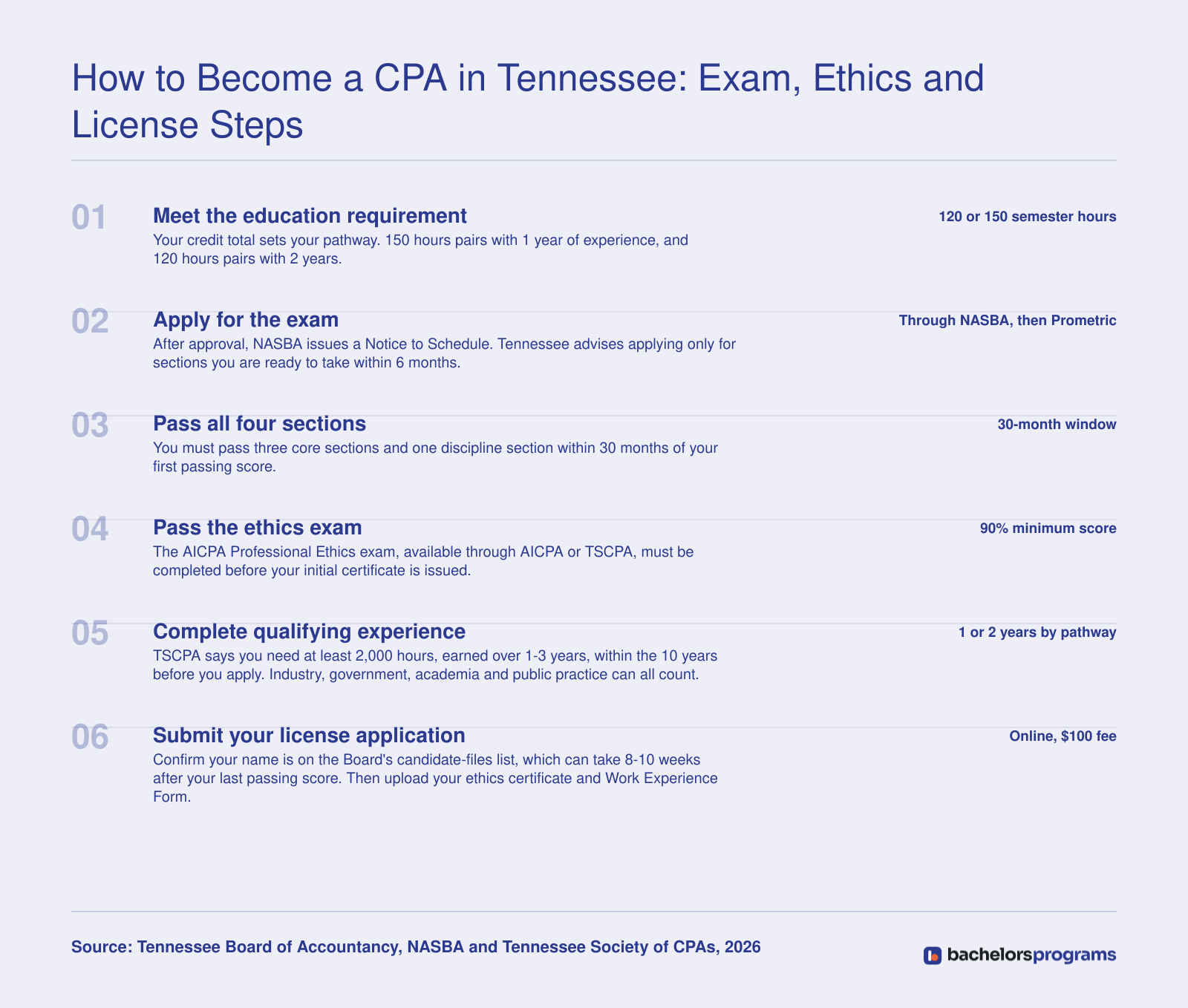
How to Become a CPA in Tennessee: Exam, Ethics and License Steps
Tennessee CPA licensure follows a fixed order, and some steps carry deadlines that can cost you credit if you miss them. The Tennessee Board of Accountancy recognizes two pathways for 2026: 150 semester hours plus 1 year of experience, or 120 semester hours plus 2 years.
CPA Exam Pass Rates by Tennessee Accounting School
School-level CPA pass rate reporting has been in flux: NASBA paused candidate performance data during the CPA Evolution overhaul, then released a 2025 edition in August 2026 that includes university statistics.1
What the 2025 Numbers Show
Tennessee's overall first-time pass rate was 64.8% in 2025, against a national first-time rate of 60.2%.1 Among Tennessee programs with at least 20 test-takers, Belmont University posted the strongest first-time rate at 73.5%, more than 13 points above the national figure and nearly 7 points higher than its 2024 result.1 Comparable 2025 first-time rates for the other Tennessee universities here are not established in the published results, so be careful with any single-school comparison.
Reading the 2024 Data
Trevecca Nazarene University reported a 77.8% rate for 2024, ranking first among Tennessee institutions in the 2024 NASBA report, when the statewide average was 45.8%.2 Trevecca does not label that figure as first-time only, so it does not line up neatly against 2025 first-time rates.
How to Weigh a Pass Rate
Ask how many candidates sit behind the number: a cohort of eight can swing 20 points on one exam. Check whether the rate covers first-time candidates or all attempts, pass rates reflect incoming student strength as much as teaching.
Look for a school's own published figures on its accounting department page, and use NASBA reports and the AICPA's scoring pages for national and state context.
Questions to Ask Yourself
Will this school's pathway get you to 150 credit hours for Tennessee CPA licensure?
Do you need to stay in Tennessee for in-state tuition and HOPE, or are you open to online study?
Does a Nashville or Memphis employer network matter more to you than a lower net price?
Compare Accounting programs on the data that matters
Explore more Business & Management majors or browse every field of study.
All Business & Management programs Browse every field of study