Best Accounting Schools in Utah
Compare 10 accredited Accounting programs in Utah, with net price after aid, graduation rates, earnings and debt from IPEDS and the U.S. College Scorecard.

A four-year accounting degree in Utah can mean a seat in a Provo or Salt Lake City classroom with on-campus recruiting, or a competency-based online program finished around a full-time job. Both lead to the same common credential: a Bachelor of Science (B.S.) in Accounting.
The pay case is solid. The Bureau of Labor Statistics put the national median wage for accountants and auditors at $83,680 in May 2025, and Brigham Young University graduates report median earnings of $96,632 four years out.
The constraint is licensure. A bachelor's degree in accounting typically runs 120 credits, while Utah requires 150 semester hours for CPA licensure, so the extra 30 hours need a plan before you enroll.
Key Points
- Brigham Young University graduates earn a median $96,632 four years out.
- Utah's CPA license requires 150 credit hours, beyond a standard bachelor's.
- Nationally, BLS projects 5% growth for accountants from 2025 to 2035.
Best Accounting Schools in Utah: Our Ranked List of Bachelor's Programs
Utah's accounting bachelor's programs run from large research universities with formal recruiting pipelines to competency-based online degrees built around a full-time job. Each card below shows where the school sits, how the program is delivered, what it costs, and how the program itself is put together. Use them side by side to compare cost and completion before narrowing your own list.
Brigham Young University
#1Provo, UT · $15,000 – $20,000/yr (est.)
Best for: Accounting majors seeking campus recruiting pipelines
BYU's Marriott accounting program runs a structured curriculum with published course flowcharts, and it pairs that structure with an unusually deep networking setup: the Accounting Society, Beta Alpha Psi and Women of the School of Accountancy, plus on-campus internships and field studies. Career support extends to placement profiles, CareerLaunch and Handshake. A dedicated advisement center handles academic planning, and financial aid is available to eligible students.
- Structured curriculum mapped through published course flowcharts
- Accounting Society and Beta Alpha Psi student organizations
- Women of the School of Accountancy group on campus
- On-campus internships and field studies available
- Career placement profiles, CareerLaunch and Handshake tools
- Dedicated advisement center for academic planning
- Financial aid available to eligible students
Western Governors University
#2Salt Lake City, UT · ~$13,000/yr (est.)
Best for: Working adults needing self-paced online terms
WGU is the fully online option on this list, and it works differently from the rest: competency-based courses, 12 start dates a year, and flat tuition charged per six-month term rather than per credit. Students who already hold an associate degree can have up to 10 of the 40 required courses waived. The accounting program dates to 2002, sits in a business school recognized by ACBSP, and is designed as the first step toward CPA certification.
- Competency-based, asynchronous online coursework
- 40 courses total; an associate degree may waive 10
- 12 start dates per year
- Flat tuition charged per six-month term, not per credit
- 2.0 cumulative GPA required; no ACT or SAT needed
- 62% of graduates finish within 24 months
- Designed as the first step toward CPA certification
- Military benefits and scholarships accepted
University of Utah
#3Salt Lake City, UT · $10,000 – $31,000/yr (est.)
Best for: Future CPAs planning a fifth-year master's
The University of Utah offers accounting as a Bachelor of Arts or Bachelor of Science, with coursework in accounting information systems, auditing, financial reporting, tax, and cost and managerial accounting. Its School of Accounting holds AACSB accreditation and keeps ties with the American Accounting Association, the AICPA and the Utah Association of Certified Public Accountants. An approved combined bachelor's and Master of Accounting pathway lets students plan the fifth year early.
- Offered as a Bachelor of Arts or Bachelor of Science
- Coursework in accounting information systems and auditing
- Financial reporting, tax, and cost and managerial accounting
- Prepares students for entry-level roles outside public accounting
- Learning outcomes include ethics and global business context
- Emphasis on clear writing, speaking and group work
- School of Accounting holds AACSB accreditation
Southern Utah University
#4Cedar City, UT · $7,000 – $21,000/yr (est.)
SUU awards the accounting degree as a BA or a BS and runs it at both the Cedar City campus and its online campus, which means students can move between formats. The 120-credit degree requires 40 upper-division credits and 30 credits earned through SUU, and a combined bachelor's and master's route lets CPA-track students finish both degrees in five years rather than six.
- 120 total credits; 40 upper-division; 30 earned at SUU
- Bachelor of Arts track requires 16 foreign language credits
- Bachelor of Science track requires 12 math or science credits
- Taught at the Cedar City campus and the online campus
- 2.5 GPA required across accounting and business courses
- Business school admission needed before most 3000/4000 courses
- Coursework includes accounting analytics and advanced Excel
Utah State University
#5Logan, UT · $9,000 – $25,000/yr (est.)
USU's Jon M. Huntsman School of Business teaches accounting through its School of Accountancy as a BS or a BA, with the BA adding foreign language proficiency. Students can pair the major with finance as a dual degree, and the program runs at the Logan campus and at statewide campuses. Advisors build semester-by-semester plans, and professional career coaches are available alongside them.
- BS or BA through the School of Accountancy
- BA requires proficiency in one or more foreign languages
- Dual accounting and finance major available
- Offered at the Logan campus and statewide campuses
- Advisor builds a semester-by-semester plan
- Professional career coaches available to students
- Huntsman School admission requirements apply
Utah Valley University
#6Orem, UT · $5,000 – $10,000/yr (est.)
UVU's Woodbury School of Business offers a 120-credit Bachelor of Science in Accounting with four concentration options: internal audit, management accounting, tax, and public accounting or graduate school preparation. Students must complete ACC 2110 with at least a C- to matriculate, and graduation requires a 2.5 GPA in business courses. UVU is also a partner in Intuit's Accounting Futures Program, which added AI-oriented accounting judgment coursework, QuickBooks certification preparation and industry advisors.
- 120 credits: 30 general education and 90 discipline core
- Four concentrations, including internal audit and tax
- ACC 2110 with a C- or better required to matriculate
- 2.5 GPA required in Woodbury School of Business courses
- 40 upper-division credit hours required to graduate
- Internship elective worth 3 credits
- Two Writing Enriched courses required
- 30 business credit hours must be taken at UVU
Westminster University
#7Salt Lake City, UT · ~$27,000/yr (est.)
Westminster is a small private university where accounting sits under business and math, and the four-year major is taught in small classes with individualized faculty attention. Students complete general education through Honors or WCore, so the degree carries a liberal arts shape alongside the business core. It fits students who want a seminar-style setting instead of a large lecture hall.
- Four-year undergraduate accounting major
- Small class sizes with individualized faculty attention
- General education through Honors or WCore
- Grouped under business and math interests
Ensign College
#8Salt Lake City, UT · ~$11,000/yr (est.)
Ensign College is a small Salt Lake City institution that teaches accounting at three levels: a 15-credit certificate, an associate degree, and a Bachelor of Applied Science in Business Management with an accounting emphasis. The bachelor's takes six semesters on the three-year track or eight on the four-year track, and coursework adds business analytics, robotic process automation, Excel, Tableau, Alteryx and QuickBooks. Instructors are working professionals, and the degree prepares students for the CMA or Enrolled Agent exams.
- Bachelor's track runs six semesters on the three-year plan
- Or eight semesters on the four-year plan
- Adds business analytics and robotic process automation
- Training in Excel, Tableau, Alteryx and QuickBooks
- Prepares students for CMA or Enrolled Agent exams
- Instructors are working professionals
- Two concentration options
Utah Tech University
#9Saint George, UT · $16,000/yr (est. net price)
Utah Tech's accounting BS is built around applied work rather than theory alone: students prepare financial statements, reconcile bank accounts, complete individual and entity tax returns, and perform staff-level audit tasks. Four suggested elective tracks cover public accounting, managerial accounting, audit and forensic accounting, and tax. Upper-division options include forensic accounting, governmental and nonprofit accounting, and sustainability accounting.
- 120 credits over four years; 2.0 GPA minimum
- Four tracks: public, managerial, audit and forensic, tax
- 40 upper-division credits, 30 of them in residence
- Students prepare financial statements and tax returns
- Practice bank reconciliations and staff-level audit tasks
- Electives in forensic and governmental accounting
- Also offers sustainability accounting coursework
Weber State University
#10Ogden, UT · ~$10,000/yr (est.)
Weber State's Goddard School of Business & Economics holds AACSB accreditation, and its BS in Accounting is grounded in financial and managerial accounting, auditing, cost accounting and taxation. Classes are small, faculty keep strong local connections, and the school runs faculty-led study abroad in Asia, South America and Europe. Graduates can continue into Weber's Master of Accounting or Master of Taxation.
- AACSB-accredited Goddard School of Business & Economics
- Coursework in financial and managerial accounting, auditing, tax
- Small class sizes with personalized faculty attention
- Faculty maintain strong local industry connections
- Faculty-led study abroad in Asia, South America and Europe
- Feeds into Weber's Master of Accounting or Master of Taxation
Cost & outcomes by school
Federal data for the highest-earning Accounting programs, independent of the ranking above. Earnings are this field's bachelor's graduates four years after completing where the Scorecard reports them, else the school's undergraduate median.
| School | Net price / yr | Grad rate | Earnings | Debt | Grads/yr | Format |
|---|---|---|---|---|---|---|
| Brigham Young University UT | $15,564 | 81% | $96,632 | $9,127 | 16 | Campus |
| University of Utah UT | $16,200 | 65% | $94,253 | $20,643 | 154 | Campus |
| Utah State University UT | $14,936 | 59% | $87,050 | $11,000 | 115 | Campus |
| Westminster University UT | $27,094 | 64% | $85,664 | $22,250 | 8 | Campus |
| Weber State University UT | $10,258 | 46% | $85,554 | $15,317 | — | Campus |
| Utah Valley University UT | $6,376 | 45% | $81,706 | $15,471 | 180 | Campus |
| Southern Utah University UT | $10,462 | 61% | $78,586 | $10,550 | 91 | Hybrid |
| Western Governors University UT | $12,548 | 46% | $75,767 | $15,915 | 1,772 | Online |
| Utah Tech University UT | $16,039 | 38% | $74,398 | $11,500 | 48 | Campus |
| Ensign College UT | $10,824 | 43% | $50,630 | — | 27 | Campus |
Sources: U.S. Department of Education. Net price, graduation rate, earnings and debt: College Scorecard (earnings and debt for this field's bachelor's graduates where reported, else school-wide); graduates: IPEDS. A dash means no figure is reported.
Cost, debt & payoff
Median earnings of this field's bachelor's graduates (4 yrs after completing, else the school's undergraduate median) vs. their median federal loan debt · U.S. College Scorecard
Across these programs the median graduate earns about $83,630 and finishes with roughly $15,317 in debt — a ratio that clears a common rule of thumb (keep debt below first-year salary). Net price and debt vary widely school to school, so check the per-school figures in the table above before you shortlist.
How We Ranked Utah's Bachelor's Degree in Accounting Programs
College rankings have shifted away from reputation surveys toward federal outcome data, and this list follows that trend.
What drives the order
- Graduate outcomes: Median earnings for accounting graduates, reported to the U.S. Department of Education and measured one year and later after completion.
- Net price: What students actually pay after grants and scholarships, not the sticker tuition figure.
- Graduation rate: The share of full-time students who finish, which signals how well a school supports students through four years.
- Program completions: How many accounting bachelor's degrees a school awards, a rough measure of how established the department is.
What these numbers can and cannot tell you
Two of those inputs deserve a caveat. Graduation rate and net price are reported for the institution as a whole, not for the accounting department specifically, so a school with a strong accounting program can still carry a campus-wide completion figure that drags on its position. Earnings are medians, meaning half of graduates earned more and half earned less. A median tells you nothing about the spread, and small graduating classes produce noisier figures than large ones.
Scope and independence
Only bachelor's degree programs at Utah institutions are eligible, in any format: campus, hybrid or fully online. Schools cannot pay for placement or for a higher position, and bachelorsprograms.com accepts no compensation for inclusion.
Most Affordable Accounting Schools in Utah
Average net price, the amount students actually pay after grants and scholarships, is the clearest measure of cost, so the table below orders Utah's most affordable bachelor's in accounting programs by that figure, using 2024 federal IPEDS and College Scorecard data. Utah Valley University is the least expensive at $6,376 a year after aid, about $6,200 less than the $12,548 net price at Western Governors University, the highest in this group. Ensign College has the lowest sticker tuition at $4,004 but a higher net price, so compare tuition and net price together before you decide.
| School | City | Format | In-State Tuition and Fees | Average Net Price After Aid | Median Debt at Program Completion |
|---|---|---|---|---|---|
| Utah Valley University | Orem | Campus | $6,507 | $6,376 | $15,471 |
| Weber State University | Ogden | Campus | $6,557 | $10,258 | $15,317 |
| Southern Utah University | Cedar City | Hybrid | $6,962 | $10,462 | $10,550 |
| Ensign College | Salt Lake City | Campus | $4,004 | $10,824 | N/A |
| Western Governors University | Salt Lake City | Online | $8,658 | $12,548 | $15,915 |
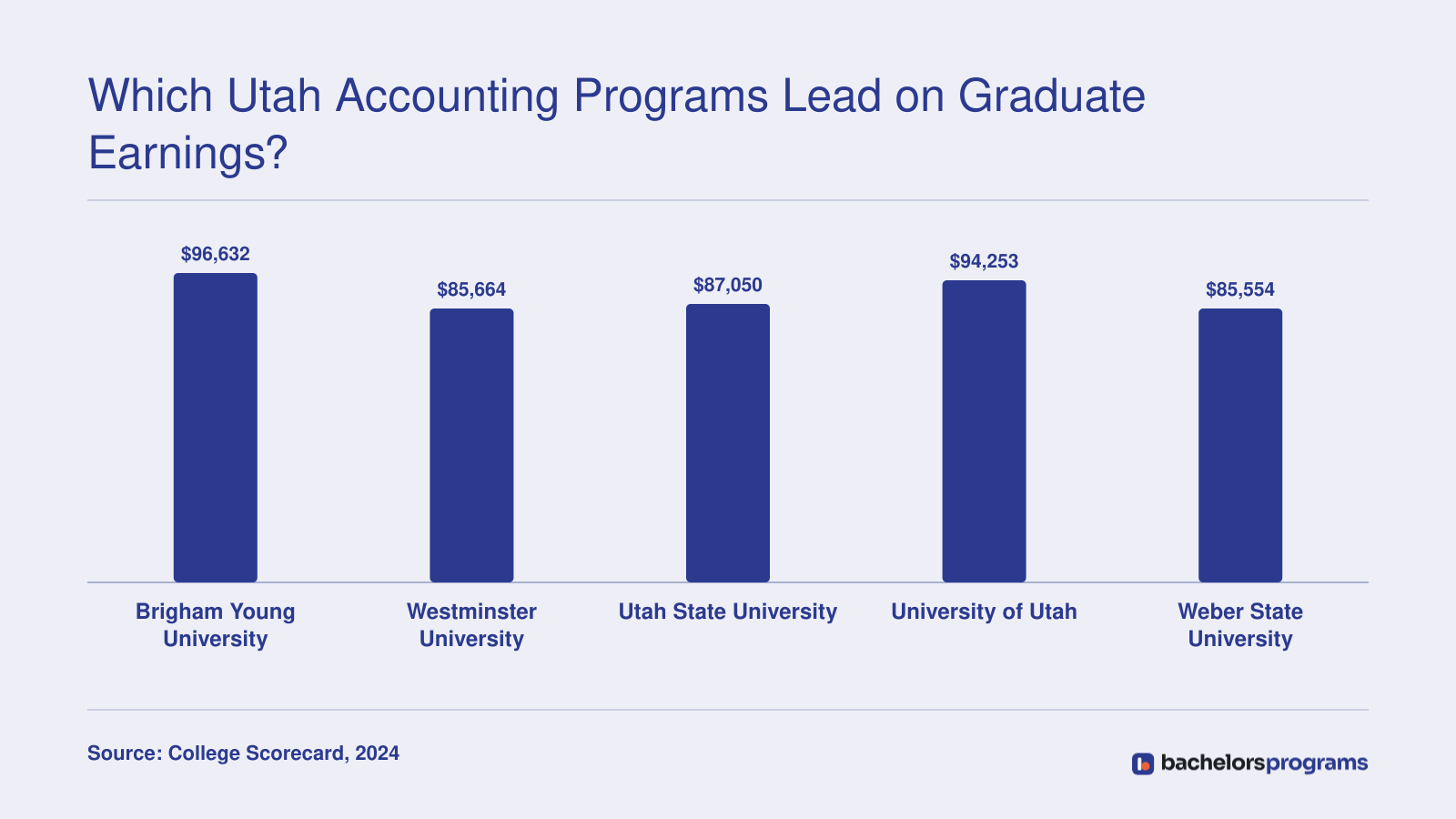
Which Utah Accounting Programs Lead on Graduate Earnings?
Among the top-earning bachelor's in accounting programs in Utah, Brigham Young University graduates report median earnings of $96,632 four years after finishing, with University of Utah close behind at $94,253. Utah State University ($87,050), Westminster University ($85,664) and Weber State University ($85,554) fall within about $1,500 of each other at the same four-year mark. These figures cover accounting graduates only, not every graduate of each school. Read them alongside the affordability table above: Weber State pairs pay near Westminster's with an average net price of $10,258 a year.
Online and Hybrid Bachelor's in Accounting Options at Utah Schools
Utah Valley University lists its Accounting B.S. as on-campus only, not offered online. Its Online-Plus format, which is mostly online with some livestream courses at set meeting times, applies to the accounting certificate, A.S. and minor. Students can start there and move to campus for the bachelor's. UVU also requires at least 30 business-course credits completed through UVU itself.
Delivery Format by School
- Western Governors University: Listed as online. The program is asynchronous, with rolling starts and tuition charged per term rather than per credit.
- Southern Utah University: Listed as hybrid, and the program page mentions a fully online option. At least 30 credits must be completed at SUU. Confirm the current online pathway with the school.
- Utah State University and Weber State University: Listed as campus-based. USU also offers statewide campuses. Neither school's online options could be confirmed here, so check with their accounting departments for any online or in-person requirements.
- BYU, University of Utah, Westminster University, Ensign College and Utah Tech University: Listed as campus programs.
Who Online Study Suits
- Working adults: Asynchronous formats such as WGU's let you study around a job instead of fixed class times.
- Rural Utah students: Online or hybrid courses cut the drive to Provo, Logan or Salt Lake City, though you should confirm which courses can be taken remotely.
- Transfer students: An online associate-level start, such as UVU's Online-Plus A.S., can lead into a campus bachelor's, so check which credits transfer.
Tuition can differ for online students, and some schools bill them separately from on-campus rates. Compare both rates before you commit.
Admissions for a Bachelor's Degree in Accounting in Utah: GPA, Test Policy and Transfer Credit
Getting into a Utah university is the easy part; the accounting major is where the real standards apply. Most published GPA thresholds apply to the business or accounting program, not to the school itself.
GPA and Test Policy
The University of Utah reviews transfer applicants holistically and sets no minimum GPA.1 It reports that 75% of recent transfer admits had an unweighted high-school GPA of 3.1 or higher.1 SAT/ACT scores are optional for most first-year applicants, but required for homeschooled applicants, those from unaccredited high schools, and GED/HiSET earners.2 Its admission rate is about 86%.
BYU is more selective, with an admission rate near 68%. Transfer applicants with fewer than 24 graded college credits must check whether a test score is required.4 No universal minimum score is stated.
Western Governors University requires no ACT or SAT and lists a 2.0 GPA minimum. Utah Tech and Utah Valley University also list 2.0, and Utah Valley adds a 2.5 GPA in business courses. Southern Utah University lists 2.5. Utah State directs accounting majors to Huntsman School admission requirements. I found no published policy for Weber State University, Westminster University or Ensign College.
Professional-Program Steps
Southern Utah requires business school admission before upper-level courses, and prerequisites come first at both Southern Utah and Utah Valley. Utah State's Huntsman requirements apply after general admission. The University of Utah and BYU publish no separate accounting GPA threshold in the sources I reviewed.
Transfer Credit
The University of Utah sets no limit on credits brought in for admission, but only some apply to the degree.1 A maximum of 6 transfer credits can count toward the accounting major core and electives. BYU evaluates course by course, expects a C- or better for equivalency, and does not accept vocational credit.3 Several schools require residency: 30 credits at Southern Utah, 30 business credits at Utah Valley, and 30 upper-division credits at Utah Tech.
Practical Tips
- Finish prerequisite courses early so you can apply to the business program on schedule.
- If you start at a Utah community college, confirm with your target school's advisor which courses count toward the accounting major before you enroll.
- Check residency rules before transferring, since they cap how much credit you can bring.
Cost of an Accounting Degree in Utah: Tuition, Net Price and State Aid
Published tuition tells only part of what an accounting degree costs in Utah; at many schools the average net price runs higher still. Treat the figures below as the latest federal reporting, not confirmed 2026-2027 rates, and check each school's bursar page before budgeting.
Tuition Versus Net Price
Net price is the average cost after grants and scholarships, and it includes housing, food and books, which is why it can exceed tuition. At Utah Valley University, in-state tuition is about $6,507 and net price is about $6,376. Weber State University lists about $6,557 in tuition and $10,258 net. Brigham Young University charges about $6,688 in tuition, with a net price near $15,564. At the University of Utah, tuition runs about $9,620 against a net price of $16,200.
Out-of-state costs are far higher at the public schools. The University of Utah's nonresident tuition is about $30,860, and Utah State University's is about $24,802. Utah Valley University's is about $18,489. Westminster University is the priciest here, at about $43,528 in tuition and a net price near $27,094.
Net price is an institution-wide average, so your own cost depends on income, housing and the aid you qualify for.
Utah State Aid
The Utah Opportunity Scholarship is for students at eligible Utah institutions.1 You apply in your senior year of high school.1 It covers tuition and fees and nothing else; total state aid, including waivers, cannot exceed that amount.2 The Board of Higher Education sets the maximum each year, so confirm the current amount with the Utah System of Higher Education.1
The New Century Scholarship is worth up to $5,000.3 It requires an associate degree finished by June 15 of your high school completion year, or an approved math and science curriculum, with at least a 3.0 GPA.3 It lasts the shortest of two years of full-time enrollment, 60 credit hours, or until you meet bachelor's requirements.3 You cannot hold both scholarships.4 Private institutions qualify only for holders who applied by October 1, 2019.3
Pell and Federal Aid
Pell recipients make up a large share of students at several of these schools, roughly 74% at Utah Valley University and about 80% at Ensign College. File the FAFSA even if you expect little aid; many institutional awards depend on it.
Related Articles
Accounting Careers in Utah: Job Outlook, Pay and Top Employers
The Bureau of Labor Statistics put the national median wage for accountants and auditors at $83,680 a year ($40.23 an hour) in May 2025. Employment is projected to grow 5% from 2025 to 2035, adding about 79,400 jobs, with roughly 115,300 openings a year on average.
Utah Pay and Outlook
Utah Department of Workforce Services lists a statewide median of $36.11 an hour, or about $75,109 at 2,080 hours a year. Projected job growth is 3.04%, with about 1,810 openings a year. The state lists a bachelor's degree as the entry requirement and a license as required. Most openings come from workers leaving the occupation rather than new positions, and the state expects CPAs to have the best prospects. Competition is stiffer at prestigious accounting and business firms.
These are occupational wages for everyone working as an accountant or auditor, including experienced professionals. They are not the graduate earnings shown in the earnings comparison above, which track recent alumni of specific programs. Treat the two as separate yardsticks.
Who Hires in Utah
- Accounting firms: FORVIS and Evans & Associates in Salt Lake City, and Sadler Gibb, ProvenCFO and The Accounting Guys in Provo, range from large national practices to small local ones.
- Corporate finance teams: Finance and insurance employers had a national median of $93,290, and management of companies and enterprises $91,940.
- Government: Federal-level accounting roles had a national median of $83,350.
This is a sample, not a full employer list. Recruiting typically runs through internships, often taken junior year, and many firms hire for full-time roles from those pools. Campus career offices and accounting student organizations usually host the recruiting events, so start early.
CPA Licensure in Utah: The 150-Credit Requirement and How a Bachelor's Fits
A bachelor's degree in accounting alone does not qualify you for a CPA license in Utah. The Utah Division of Professional Licensing (DOPL) sets the rules, and the education requirement goes beyond a standard four-year degree.1
What DOPL Requires
Applicants need a bachelor's degree from a college or university approved by the Utah Board of Accountancy. They also need 150 semester hours (225 quarter hours) of collegiate education with a concentration in accounting, auditing and business.2 The exact split between accounting and business credits is set in Utah administrative rules, so confirm it with DOPL before you plan your course schedule.
Beyond education, licensure involves several other steps:
- Exam: Pass every section of the Uniform CPA Examination, with applications submitted online through NASBA.3
- Ethics and law: Score at least 90% on the AICPA Professional Ethics Exam and pass the Utah Laws and Rules Examination.
- Experience: Complete 2,000 hours of accounting experience (about one year) under a licensed CPA1. Each supervisor submits a verification form for each employment period.
Closing the Gap From 120 to 150
Most bachelor's programs total about 120 credits, which leaves roughly 30 to cover. Utah students typically get there in one of three ways:
- Taking additional accounting and business courses after the bachelor's degree
- Enrolling in a combined or integrated program that builds the extra credits into a longer track
- Completing a master's degree
Exam eligibility is separate from licensure: Utah allows candidates to sit for the CPA Exam at 120 semester hours, including 24 accounting and 24 business hours, with the remaining credits completed before licensure.1 Ask DOPL directly before you build your timeline around early testing.
Choosing a School With Licensure in Mind
Use this checklist when comparing the schools ranked here:
- Does the school's accounting curriculum meet Utah's accounting and business credit rules?
- Is the school approved by the Utah Board of Accountancy?
- Does it offer a path to 150 hours, such as an extended program or post-bachelor's coursework?
- How much will the extra credits cost beyond the four-year price?
- Does the program help with internships or supervised experience?
Frequently Asked Questions About Utah Accounting Schools
These answers cover the questions prospective students ask most about a bachelor's degree in accounting in Utah. For school-by-school detail, see the ranked list and the cost, admissions and licensure sections on this page.
What is the best accounting school in Utah?
Which Utah colleges are AACSB accredited for accounting?
What is the cheapest accounting school in Utah?
Can you get a bachelor's degree in accounting online in Utah?
Do you need 150 credit hours to become a CPA in Utah?
Compare Accounting programs on the data that matters
Explore more Business & Management majors or browse every field of study.
All Business & Management programs Browse every field of study