Best Construction Management Schools in Wisconsin
Compare 6 accredited Construction Management programs in Wisconsin, with net price after aid, graduation rates, earnings and debt from IPEDS and the U.S. College Scorecard.

Wisconsin does not license construction managers, so the degree and the accreditor behind it carry most of the weight with employers.
A bachelor's degree in construction management, usually the Bachelor of Science (B.S.) in Construction Management, is the standard route into project management, estimating, and field leadership. Published in-state tuition runs from $8,644 at UW-Platteville to $50,480 at Milwaukee School of Engineering, though aid narrows that gap.
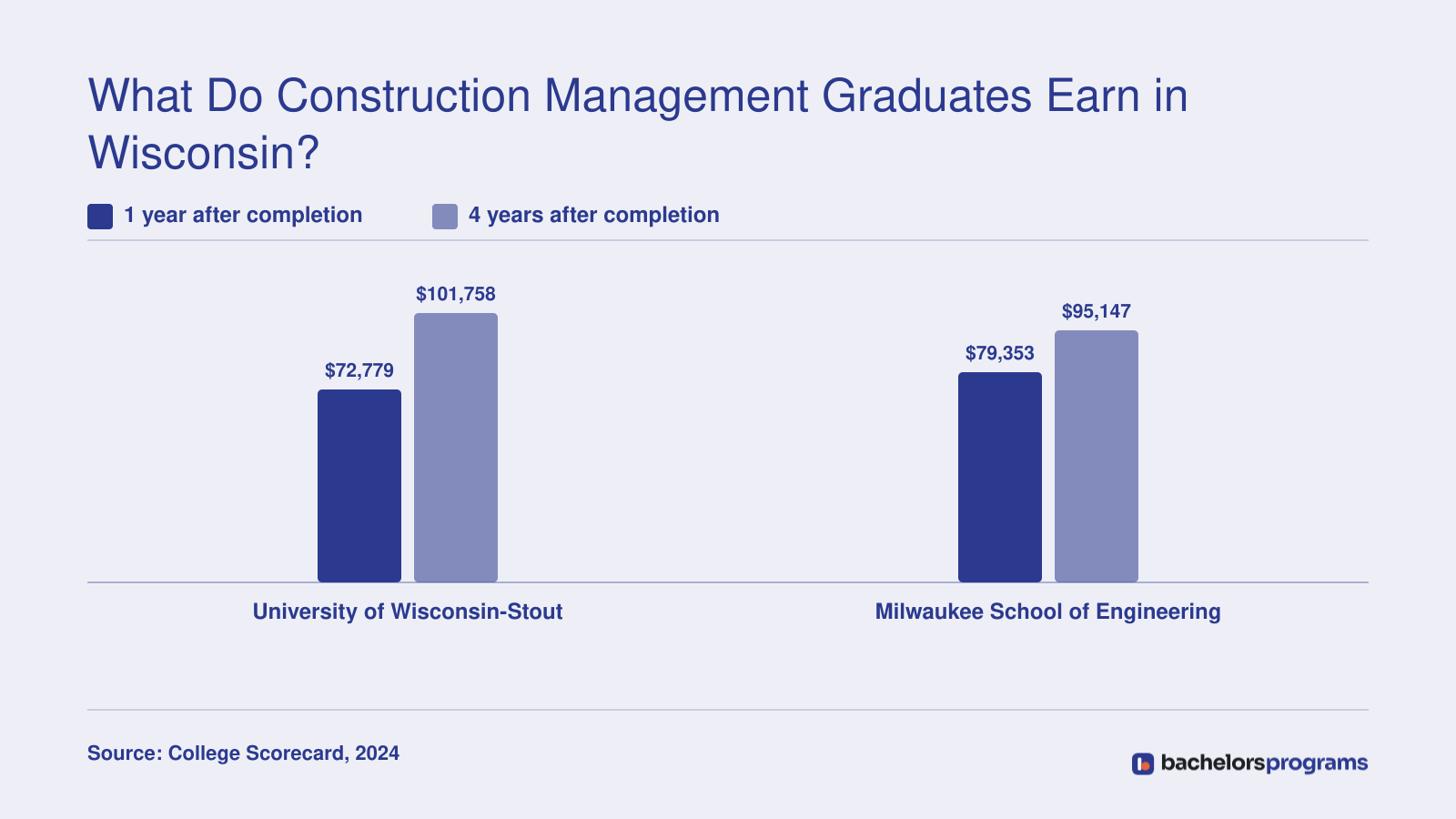
Early pay rewards the credential: UW-Stout and MSOE graduates post median earnings above $72,000 one year out. The harder call is accreditation, since ACCE, ABET, and ATMAE signal different things to Wisconsin contractors.
Key Points
- UW-Stout and MSOE graduates earn median pay above $72,000 one year out.
- BLS reports a $114,990 national median wage for construction managers.
- Wisconsin requires no general construction manager license or state exam.
Best Construction Management Schools in Wisconsin: Ranked List
Six Wisconsin schools award a bachelor's degree in construction management, and they fall into three rough types: engineering-school programs, polytechnic programs, and business-leaning programs built for working adults. Each entry notes who the program suits best. Net prices are average net price after aid and graduation rates are institution-wide, not program-specific.
Milwaukee School of Engineering
#1Milwaukee, WI · ~$22,000/yr (est.)
Best for: Engineering-minded students targeting commercial projects
Milwaukee School of Engineering sits in downtown Milwaukee and delivers its construction management bachelor's degree on campus with a nonresidential, engineering-heavy bent. ABET accreditation, building information modeling coursework, and a 100% placement rate reported by the program point to a technical, project-delivery focus. Schools offering this program have an institution-wide graduation rate of about 67%, and the average net price after aid is roughly $22,500. Graduates who reported earnings four years after finishing had a median above $95,000.
- ABET accredited construction management program
- Program reports a 100% job placement rate for recent graduates
- Coursework in estimating, scheduling, project management and BIM
- Blends business, engineering, communication and science courses
- Focus on nonresidential building construction
- One of three programs in the CAECM department
University of Wisconsin-Platteville
#2Platteville, WI · $9,000 – $18,000/yr (est.)
Best for: Transfer students arriving from Wisconsin technical colleges
UW-Platteville pairs a 120-credit construction management major with unusually deep Wisconsin industry ties: transfer agreements with Madison College and the state technical college system, a WisDOT construction safety training partnership, and labs supported by firms including Miron and Findorff. Schools offering this program have an institution-wide graduation rate of about 56%, and the average net price after aid is near $16,000, the lowest on this list.
- 120 credit hours, including at least 42 at the 3000 level
- Required internship plus a construction capstone
- Accelerated Bachelor's to Master's pathway available
- Transfer agreement with Madison College for construction management
- Approved Wisconsin technical college associate degrees transfer in
- Designated Mid-America OSHA Education Center training site
- Construction safety training partnership with WisDOT
- 18 elective credits required
University of Wisconsin-Stout
#3Menomonie, WI · $17,000/yr (est. net price)
Best for: Hands-on learners who want required field experience
UW-Stout in Menomonie runs an ACCE-accredited construction management bachelor's degree that balances technical and engineering coursework with the business, management and marketing side of the industry. Classes average about 30 students, and a required cooperative education or field experience puts students on a job site before graduation. Schools offering this program have an institution-wide graduation rate of about 55%, and the average net price after aid is roughly $17,500. Graduates who reported earnings four years after finishing had a median near $101,800.
- ACCE accredited since 1994
- Program reports 100% of graduates employed or in continuing education
- Required cooperative education or field experience
- Courses average about 30 students
- Upper-level work in estimating, scheduling, cost control and safety
- Member of the Associated Schools of Construction
- Sigma Lambda Chi honor society chapter on campus
Concordia University-Wisconsin
#4Mequon, WI · ~$36,000/yr (est.)
Concordia University Wisconsin in Mequon offers an accelerated construction and trades management bachelor's degree built for working adults, with asynchronous online and virtual synchronous classes that fit around a full-time job. Up to 84 transfer credits are accepted, and the degree can be completed in as little as two years depending on what transfers in. Schools offering this program have an institution-wide graduation rate of about 68%, and the average net price after aid is roughly $36,200, the highest on this list.
- IACBE accredited, 120 credit hours, 2.0 GPA minimum
- Up to 84 transfer credits accepted
- Finish in as little as two years with transfer credit
- Classes online, asynchronous and virtual synchronous
- Built for working adults in construction and the trades
- Coursework in cost estimating, scheduling, codes and field inspection
- Options to study LEAN or Six Sigma
- Military benefits and employer tuition reimbursement supported
University of Wisconsin-Madison
#5Madison, WI · ~$17,000/yr (est.)
At UW-Madison, construction management is a named option inside the ABET-accredited civil engineering bachelor's degree, so students graduate as civil engineers with a construction focus. The 128-credit plan adds legal aspects of engineering, integrated estimating and scheduling, and BIM to a structural design core, plus business electives and an optional co-op. Schools offering this program have an institution-wide graduation rate of about 90%, and the average net price after aid is roughly $17,400. It suits students who want the strongest engineering credential and can handle a civil engineering math and science load.
- ABET accredited civil engineering degree with a construction option
- 128 total credit hours
- Capstone design project required
- Cooperative Education Program available
- Courses in legal aspects of engineering and integrated estimating and scheduling
- Building information modeling coursework
- Business electives in accounting, finance and management
Marian University
#6Fond Du Lac, WI · $20,000 – $25,000/yr (est.)
Marian University in Fond du Lac shaped its construction management bachelor's degree with input from construction companies that wanted stronger project managers, and the 120-credit path covers residential, commercial and civil work. Three one-credit internships supply supervised field experience, and a comprehensive exit exam serves as a readiness check before graduation. Schools offering this program have an institution-wide graduation rate of about 44%, and the average net price after aid is roughly $21,900.
- 120 credit hours with a 2.0 GPA minimum
- Three one-credit internships required
- Comprehensive exit exam before graduation
- Curriculum shaped with input from construction companies
- Faculty with industry backgrounds
- Covers estimating, scheduling, plan reading and sustainable building
- Prepares for residential, commercial and civil projects
Cost & outcomes by school
Federal data for the highest-earning Construction Management programs, independent of the ranking above. Earnings are this field's bachelor's graduates four years after completing where the Scorecard reports them, else the school's undergraduate median.
| School | Net price / yr | Grad rate | Earnings | Debt | Grads/yr | Format |
|---|---|---|---|---|---|---|
| University of Wisconsin-Stout WI | $17,490 | 55% | $101,758 | $20,175 | 65 | Campus |
| Milwaukee School of Engineering WI | $22,453 | 67% | $95,147 | $27,000 | 23 | Campus |
| University of Wisconsin-Madison WI | $17,354 | 90% | $73,792 | $20,484 | — | Campus |
| University of Wisconsin-Platteville WI | $16,032 | 56% | $61,760 | $21,977 | 82 | Campus |
| Concordia University-Wisconsin WI | $36,201 | 68% | $56,075 | $25,750 | 1 | Campus |
| Marian University WI | $21,937 | 44% | $53,501 | $25,000 | — | Campus |
Sources: U.S. Department of Education. Net price, graduation rate, earnings and debt: College Scorecard (earnings and debt for this field's bachelor's graduates where reported, else school-wide); graduates: IPEDS. A dash means no figure is reported.
Cost, debt & payoff
Median earnings of this field's bachelor's graduates (4 yrs after completing, else the school's undergraduate median) vs. their median federal loan debt · U.S. College Scorecard
Across these programs the median graduate earns about $67,776 and finishes with roughly $23,489 in debt — a ratio that clears a common rule of thumb (keep debt below first-year salary). Net price and debt vary widely school to school, so check the per-school figures in the table above before you shortlist.
How We Ranked Wisconsin Bachelor's Degree Programs in Construction Management
Two construction management programs can publish the same tuition number and leave graduates in very different financial positions. One may report solid early earnings and modest debt; another may look affordable on paper and cost far more once aid and time to completion are counted. That gap is why the schools ranked here are compared on outcomes and cost together, not on reputation alone.
What Goes Into the Comparison
Each program is checked against a consistent set of measures: earnings and debt figures reported through the federal College Scorecard, the net price students actually pay after grants and scholarships, how many students complete the program, and whether the program or its parent institution holds accreditation recognized in the field. Net price is an average across students who receive aid, not a quote for any one person, so treat it as a starting point for a financial aid conversation.
Graduation rates and net price are measured across the whole institution; earnings and debt are program-level figures and appear only where a school publishes them.
What the List Covers
The list covers bachelor's programs in Wisconsin, campus-based and online, including options for students who live outside the state but want a Wisconsin degree. Positions reflect the data snapshot used at the time of writing rather than a final judgment on teaching quality, and a school lower on the list may still be the right fit for your goals, schedule, and budget.
Accreditation: ACCE, ABET, and ATMAE Compared for Wisconsin Programs
Accreditation is an outside review confirming that a degree program meets professional standards for curriculum, faculty, and student outcomes. Three accreditors matter for construction programs in Wisconsin, and each covers different ground.
What Each Accreditor Covers
ACCE, the American Council for Construction Education, accredits programs built specifically around construction education. ABET accredits college programs in engineering, applied science, and technology. Its engineering commission reviews civil engineering degrees1, while its applied and natural science commission reviews programs such as construction management. ATMAE, the Association of Technology, Management, and Applied Engineering, reviews technology and management programs with an emphasis on applied, industry-ready skills.
Standalone Degree or Civil Engineering Option
A standalone B.S. in construction management centers on estimating, scheduling, contracts, project controls, and field operations, with lighter design and advanced math. A construction option inside civil engineering leans on structures, soils, and design, then layers construction courses on top. The ABET-accredited engineering route is the usual first step toward a Professional Engineer (PE) license. Standalone management degrees generally are not built around that path.
Accreditation by Program
- UW-Stout: standalone B.S. in Construction Management, accredited by ACCE.
- UW-Platteville: standalone B.S. in Construction Management, accredited by ATMAE.
- MSOE: standalone B.S. in Construction Management, accredited by ABET's applied and natural science commission.
- UW-Madison: Construction Engineering and Management option within an ABET-accredited B.S. in Civil Engineering.
- Concordia University-Wisconsin (Construction and Trades Management): accreditation could not be verified.
- Marian University (B.S. in Construction Management): accreditation could not be verified.
What It Means for You
Many construction firms recruit from accredited programs because graduates arrive with a known baseline of skills. Accreditation also matters for the Certified Construction Manager (CCM) credential from the Construction Management Association of America, since a degree from a recognized program is generally easiest to document when you apply. Confirm current eligibility rules with the association. For any program marked unverified, ask the school's admissions office directly which accreditor, if any, reviews it.
Online and Hybrid Bachelor's Options at Wisconsin Schools
Working adults want flexibility, but construction management is hands-on, and most Wisconsin programs on this list are built around a campus. Every program page we verified lists campus delivery, so confirm any online claim directly with the school.
What the program pages show
- Campus only: Milwaukee School of Engineering, Marian University, and UW-Madison (where construction is an option within the civil engineering bachelor's2) are listed as campus programs. UW-Stout lists its B.S. in Construction Management under on-campus programs, and its online offerings do not include construction management.1
- UW-Platteville: The construction management major is listed as a campus program. The university's online bachelor's is in Management1, a different degree, so do not assume the two are interchangeable.
- Closest to flexible: Concordia University-Wisconsin's Construction and Trades Management program is described as an accelerated format for working adults, with online asynchronous and virtual synchronous classes and up to 84 transfer credits accepted. Ask the school which courses, if any, require a campus visit before you count on finishing remotely.
- Technical college transfer: None of the program pages we reviewed describe a dedicated pathway. If you hold a technical college associate degree, ask each admissions office how those credits would apply.
Why fully online study is limited
Labs, estimating software work, and required internships, co-ops, or field experience keep most of these degrees tied to Wisconsin campuses and job sites.
Questions to Ask Yourself
Do you want a standalone construction management degree, or a civil engineering degree with a construction focus that points toward PE licensure?
Are you drawn to residential and light commercial work, or to large commercial, industrial and heavy civil projects?
Can you commit to full-time study and summer internships, or do you need a hybrid or part-time format?
Are you starting with a technical college associate degree that you hope to transfer?
Admission Requirements, Test Policies, and Transfer Credit
Each Wisconsin school sets its own admission rules for construction management, and the requirements posted on a program page can change from one year to the next. The only rules that count are the ones the school publishes for the term you are entering, so verify every item yourself.
A Repeatable Search Method
- Search the school's own site for "[school name] construction management admission requirements" instead of a general web search. Program pages and admissions pages often say different things.
- Open both the first-year and the transfer page, then compare four items side by side: minimum GPA, ACT or SAT policy, application deadlines, and required high school coursework.
- Record whether test scores are required, optional, or not considered at all. Where a school does not publish a first-year test policy, ask admissions to confirm in writing.
UW-Stout shows why prerequisites matter. Its program page recommends high school math and science, plus English, communications, business, and general education, because the degree itself requires calculus and physics.
Sources Worth Cross-Checking
- Official admissions and registrar pages for each school
- System-wide transfer credit resources for the UW campuses
- BLS.gov for career and education context
- Professional associations such as AGC of Wisconsin and ABC Wisconsin for industry and scholarship information
Treat Transfer Credit as a Verification Task
Ask the registrar or a construction management advisor for a written credit evaluation before you enroll, with course names and credit values listed. Confirm any articulation agreement in writing; UW-Stout, for example, expects students transferring under an agreement to complete the entire sending program and still meet both the university's admission requirements and the program's own admission requirements. A short email that names each course and its equivalent is worth more than a verbal assurance at orientation.
Paying for It: Wisconsin Grants and Construction Scholarships
State grants depend on your finances and where you enroll. Industry scholarships depend on your career focus. Most Wisconsin students pursue both, and the two work together.
Wisconsin Grant and Wisconsin Higher Education Grant
Both programs are need-based and limited to Wisconsin residents in undergraduate programs at UW, technical college, or tribal institutions.1 That covers UW-Platteville, UW-Stout, and UW-Madison here. Students at Milwaukee School of Engineering, Concordia University-Wisconsin, and Marian University should ask each financial aid office which state aid applies to private nonprofit colleges. Eligibility lasts up to 10 semesters, and students who already hold a bachelor's degree are excluded from undergraduate state aid.
- Wisconsin Grant: For 2026-27, a Universities of Wisconsin recommendation proposed a $3,700 maximum and a $1,000 minimum.2 That is a recommendation, not a confirmed statewide schedule. Awards are prorated by credits: 100% at 12 credits, 75% at 9 to 11, 50% at 6 to 8, and 25% at 5 or fewer.3
- Wisconsin Higher Education Grant: Requires at least half-time enrollment.4 Awards run from $250 per year, with a ceiling of $3,000 per year.5
To apply, file the FAFSA. The Wisconsin Higher Educational Aids Board (HEAB) uses it to determine need.
Construction Industry Scholarships
Contractor associations, trade groups, and industry foundations often fund construction management students. Eligibility and amounts vary by sponsor and year, and none are guaranteed. Ask your program's department office which regional scholarships its students have won, then confirm deadlines and award sizes directly with each sponsor.
Stacking Aid
File the FAFSA early, then tell your school's aid office about every outside award you win. Some schools adjust institutional aid when outside awards arrive, so ask how they handle it before you accept.
Amounts above come from HEAB program instructions, board reports, and its 2026 memorandum. They change each year, so verify current figures with HEAB and your school.
Related Articles
Construction Management Careers and Licensure in Wisconsin
National pay figures are easy to find, but Wisconsin pay can differ from the national picture, so check local data before you plan around a salary. BLS reports a national median annual wage of $114,990 for construction managers in May 2025, across about 380,360 jobs.1 Treat that as a reference point, not a Wisconsin promise.
Verify Wisconsin Wages
Search the BLS Occupational Employment and Wage Statistics tool for SOC 11-9021. Filter for Wisconsin, then for metro areas such as Milwaukee-Waukesha-West Allis, Madison, Green Bay, or Appleton. Cross-check what you find against Wisconsin Department of Workforce Development and Job Center wage data. BLS release timing and metro-area coverage vary, so some areas may show older or limited figures. One older BLS snapshot for South Central Wisconsin's nonmetropolitan area (May 2021) listed 370 construction managers earning an average annual wage of $100,540. Treat that as dated.
Certification Through CMAA
BLS notes that certification is not required for construction managers but can demonstrate knowledge and experience.2 The Construction Management Association of America (CMAA) website is the place to confirm current Certified Construction Manager (CCM) eligibility, exam, and renewal requirements. Then compare that guidance with what Wisconsin employers ask for in job postings and with the career-services pages at schools like UW-Stout, UW-Platteville, and MSOE, rather than relying on a static summary.
OSHA 10-Hour and 30-Hour Training
OSHA.gov lists current 10-hour and 30-hour outreach training options and authorized trainers. These are training credentials, not licenses, and no source we reviewed shows a universal requirement for every construction manager. Employers, project owners, contracts, and public agencies may still require a card, so confirm the rules for each site or job.
Wisconsin Licensure
Wisconsin does not appear to have a statewide general construction manager license. BLS says licensing for this occupation varies by state2, so check the Wisconsin Department of Safety and Professional Services (DSPS) and your local municipality for contractor or trade credentials that may apply to specific work. Before assuming a license is required, confirm with DSPS, professional associations, and the program pages of the schools you are considering.
What Do Construction Management Graduates Earn in Wisconsin?
Construction management graduates of UW-Stout and Milwaukee School of Engineering post median earnings above $72,000 one year after finishing, rising past $95,000 by year four, per College Scorecard program data; program-level earnings are not yet published for the other schools here. UW-Stout graduates' median program debt of $20,175, roughly $214 a month on a 10-year plan, equals about one-fifth of their median pay four years after completion.
Wisconsin Construction Manager Licensure at a Glance
Compare Construction Management programs on the data that matters
Explore more Business & Management majors or browse every field of study.
All Business & Management programs Browse every field of study