Best Business Degree Programs in Wisconsin
Compare 82 accredited Business programs in Wisconsin at 38 colleges, with net price after aid, graduation rates, earnings and debt from IPEDS and the U.S. College Scorecard.

Two Wisconsin business graduates can hold the same credential and leave with very different numbers: UW-Madison's business majors post a median $92,203 five years after finishing, against median debt near $20,000. At regional UW campuses, average net price after aid runs closer to $12,000 to $14,000 a year.
Flagship, regional public, private college, or an online finish. Each route answers a different constraint, and that constraint is usually money or schedule rather than the diploma itself.
Every figure here is federal or school-reported. Accreditation and admissions selectivity separate the rest.
Key Points
- UW-Madison's business school ranks #15 nationally in 2026-27 U.S. News.
- UW-Parkside posts the lowest average net price here: $11,772 a year.
- Marquette business graduates earn a median $80,728 five years after finishing.
Best Business Bachelor's Schools in Wisconsin: Our Top 10
Ten Wisconsin bachelor's programs made this list, spanning the flagship in Madison, private universities in Milwaukee and Waukesha, and regional public campuses from Eau Claire to Whitewater. Some are built for traditional four-year students, others for transfer students and working adults finishing a degree around a job. Each entry reports the school-wide graduation rate so you can weigh completion odds alongside the program details.
University of Wisconsin-Madison
#1Madison, WI · ~$17,000/yr (est.)
Best for: Wisconsin residents targeting a flagship business school
Wisconsin's flagship carries the widest business menu in the state: a four-year residential BBA in management on the Madison campus and a separate online management track designed for transfer students who already hold at least 12 college credits. The residential version pairs a core in accounting, finance, marketing, and operations with case competitions and consulting projects, and assigns each student an academic and career coach. Roughly 90% of students graduate, a school-wide figure.
- Online BBA in management built for transfer students
- Requires at least 12 prior college credits to apply
- 120 credits total, including 30 residency credits
- 12 major credits in management coursework
- Coursework in human resources, negotiations, and team leadership
- Part-time enrollment available
- Academic advising support throughout the program
- Admissions handled through UW-Madison Online
- Four-year campus program starting in fall
- 120 total credit hours
- 3.0 GPA minimum plus prerequisite courses
- Assigned academic and career coaches
- Case competitions and consulting projects for experiential learning
- Core covers accounting, finance, marketing, and operations
Marquette University
#2Milwaukee, WI · ~$31,000/yr (est.)
Best for: Milwaukee-bound students wanting employer connections
This private Jesuit university in Milwaukee awards its BS in Business Administration through the College of Business Administration, structured as 30 credits of core curriculum, 55 of business core, and 27 major credits (33 for accounting majors). A 2026 employer partnership program gives Wisconsin companies recruiting access, career-fair visibility, and student consulting projects in return. About 83% of students graduate, a school-wide figure.
- 124 total credit hours
- 30 credits in the Marquette Core Curriculum
- 55 credits in the business core
- 27 major credits, or 33 for accounting majors
- 2.000 GPA required overall; 2.500 for accounting majors
- At least one international business elective required
- Up to three business majors allowed
- 45 credits must be completed at Marquette
University of Wisconsin-Eau Claire
#3Eau Claire, WI · ~$17,000/yr (est.)
Best for: Budget-focused students exploring many business majors
Eau Claire awards business administration as a Bachelor of Business Administration inside a College of Business that also runs BBA majors in accounting, finance, marketing, information systems, health care administration, and supply chain management, so adding a second major stays inside one college. The degree is built for students who want a broad management foundation rather than a single narrow specialty. About 64% of students graduate, a school-wide figure.
- Awarded as a Bachelor of Business Administration
- Housed in the College of Business
- Shares the college with BBA majors in accounting, finance, and marketing
- Also offered alongside professional sales and supply chain majors
Herzing University-Kenosha
#4Kenosha, WI · ~$23,000/yr (est.)
Herzing's Kenosha campus anchors a career-focused business management degree delivered online and aimed squarely at working adults, with credit for prior learning, military benefits, and a waived enrollment fee built into the offer. Classes are small with one-on-one instructor attention, and the curriculum leans practical: marketing, international business, organizational leadership, and data analytics. About 72% of students graduate, a school-wide figure.
- IACBE-accredited business program
- Fully online BS in Business Management
- Credit for prior learning accepted
- Military benefits and scholarships available
- Waived enrollment fee
- One-on-one instructor attention in small classes
- Concentration in business administration
- Coursework in data analytics, international business, and leadership
Carroll University
#5Waukesha, WI · $15,000 – $20,000/yr (est.)
Carroll's Sullivan School of Business and Technology runs an undergraduate business administration major organized around four assurance-of-learning goals: global awareness, critical analysis, strategic planning, and effective communication. Students can typically stack a second Sullivan School major, though the school bars some combinations, such as pairing business administration with accounting, analytics, finance, or marketing. About 71% of students graduate, a school-wide figure.
- Major in the Sullivan School of Business and Technology
- Four assurance-of-learning goals, including global awareness
- Students can typically add a second Sullivan School major
- Some combinations are barred, such as pairing with accounting
Maranatha Baptist University
#6Watertown, WI · ~$26,000/yr (est.)
A small Baptist university in Watertown where the BS in Business layers a 24-credit Bible studies core on top of 42 business credits and an explicit servant-leadership focus. The 128-credit degree leaves 37 open elective credits, which is enough room to add a second major or a dual degree. About 64% of students graduate, a school-wide figure.
- 128 credits minimum to graduate
- 42 credits in the business major
- 24-credit Bible studies core
- 25 credits of liberal arts core
- 37 open elective credits, leaving room for a dual degree
- Emphasis on servant leadership
- Taught from a Christian perspective
University of Wisconsin-Milwaukee
#7Milwaukee, WI · $10,000 – $22,000/yr (est.)
Milwaukee's public research university lets business students choose between a broad general business BBA and named tracks in marketing and accounting, all inside the Lubar College. A dedicated career services center, an internship job board, and accelerated master's options give students a route from coursework into Milwaukee employers. About 49% of students graduate, a school-wide figure and the lowest among the public universities here.
- 120 total credits required
- 24 credits in the General Business major
- 29 business core credits
- 2.5 GPA for guaranteed advancement into the major
- 2.25 overall GPA needed to graduate
- Last 30 credits must be taken at UWM
- Competency-area electives in finance, marketing, and entrepreneurship
- 120 total credit hours
- Marketing internship opportunity
- Accelerated master's degree option
- Dedicated career services center
- Double major option available
- Prerequisite courses required
- Prepares for CPA licensure
- 120 total credit hours
- Accelerated graduate program available
- Internship job board and career planning course
- Careers in public accounting and industry
University of Wisconsin-Whitewater
#8Whitewater, WI · $10,000 – $15,000/yr (est.)
Whitewater's College of Business and Economics is the largest AACSB-accredited business school in Wisconsin and reports a 96% job placement rate for its general business graduates. The BBA comes in campus and fully online versions, both with a customizable curriculum drawn from five topic areas, plus a safety and risk management concentration on the campus side. About 59% of students graduate, a school-wide figure.
- AACSB-accredited College of Business and Economics
- 96% job placement rate reported for graduates
- Customizable curriculum drawn from five topic areas
- Over 50 study abroad destinations
- First-year learning communities for business majors
- More than $2.5 million in scholarships awarded annually
- Tracks: Safety and Risk Management
- Fully online, no campus visits required
- $425 per credit
- 120 total credit hours
- Textbook rental included in tuition
- Taught entirely by professional instructors
University of Wisconsin-River Falls
#9River Falls, WI · $10,000 – $15,000/yr (est.)
River Falls runs its business administration degree through an AACSB-accredited School of Business and Economics that leans on high-impact practices, including living and learning communities for business majors. The curriculum covers business law, marketing, managerial finance, operations, organizational behavior, and strategic management, with a stated emphasis on written and verbal communication and team leadership. About 57% of students graduate, a school-wide figure.
- AACSB-accredited School of Business and Economics
- Coursework in business law, marketing, finance, and strategic management
- Emphasis on written and verbal communication
- High-impact practice opportunities
- Living and learning communities available
- Includes operations management and organizational behavior
Viterbo University
#10La Crosse, WI · ~$21,000/yr (est.)
Viterbo's BBA in Business Administration requires 70 credits of business coursework inside a 120-credit degree, including 40 upper-division credits and a comprehensive capstone. The College of Business, Leadership, and Ethics embeds a Servant Leadership certificate in the business core, so ethics and law run alongside finance, marketing, and management rather than as an add-on. About 68% of students graduate, a school-wide figure.
- 70 credits of business coursework
- 120 total college-level credits, including 40 upper-division
- 2.5 GPA required in major courses
- Capstone course MGMT-492 required
- Servant Leadership Embedded Certificate built into the core
- Transfers must complete 15 business credits at Viterbo
Cost & outcomes by school
Federal data for the highest-earning Business programs, independent of the ranking above. Earnings are this field's bachelor's graduates four years after completing where the Scorecard reports them, else the school's undergraduate median.
| School | Net price / yr | Grad rate | Earnings | Debt | Grads/yr | Format |
|---|---|---|---|---|---|---|
| Milwaukee School of Engineering WI | $22,453 | 67% | $89,070 | $27,000 | 1,114 | Campus |
| Marquette University WI | $31,487 | 83% | $78,257 | $23,940 | 4,044 | Campus |
| University of Wisconsin-Madison WI | $17,354 | 90% | $73,792 | $20,484 | 24,058 | Online |
| University of Wisconsin-Platteville WI | $16,032 | 56% | $61,760 | $21,977 | 2,434 | Hybrid |
| University of Wisconsin-La Crosse WI | $16,210 | 71% | $60,378 | $22,500 | 4,204 | Campus |
| Edgewood University WI | $26,113 | 60% | $59,728 | $24,424 | 724 | Campus |
| University of Wisconsin-Eau Claire WI | $16,550 | 64% | $58,561 | $20,909 | 4,168 | Campus |
| Saint Norbert College WI | $26,172 | 71% | $58,363 | $26,731 | 1,144 | Campus |
| University of Wisconsin-Stout WI | $17,490 | 55% | $58,084 | $23,000 | 2,526 | Campus |
| Carroll University WI | $15,193 | 71% | $58,009 | $27,000 | 1,172 | Campus |
| Carthage College WI | $26,565 | 64% | $56,950 | $26,000 | 1,340 | Campus |
| Concordia University-Wisconsin WI | $36,201 | 68% | $56,075 | $25,750 | 1,174 | Campus |
Sources: U.S. Department of Education. Net price, graduation rate, earnings and debt: College Scorecard (earnings and debt for this field's bachelor's graduates where reported, else school-wide); graduates: IPEDS. A dash means no figure is reported.
Cost, debt & payoff
Median earnings of this field's bachelor's graduates (4 yrs after completing, else the school's undergraduate median) vs. their median federal loan debt · U.S. College Scorecard
Across these programs the median graduate earns about $54,664 and finishes with roughly $23,000 in debt — a ratio that clears a common rule of thumb (keep debt below first-year salary). Net price and debt vary widely school to school, so check the per-school figures in the table above before you shortlist.
Most Affordable Business Bachelor's Schools in Wisconsin
Public UW campuses hold every spot in this affordability comparison, and each lands between about $11,800 and $14,200 a year in average net price after grants and scholarships. UW-Parkside in Kenosha comes in lowest at $11,772, through its online, competency-based Flexible Option. UW-River Falls and UW-Whitewater, which also appear in our main ranking, follow at roughly $14,000. Figures come from the U.S. Department of Education's IPEDS and College Scorecard data (2024).
| School | City | Avg. Annual Net Price | In-State Tuition and Fees | Program Format |
|---|---|---|---|---|
| University of Wisconsin-Parkside | Kenosha | $11,772 | $8,270 | Online (Flexible Option) |
| University of Wisconsin-Superior | Superior | $12,220 | $8,812 | Campus |
| University of Wisconsin-Green Bay | Green Bay | $13,369 | $8,700 | Campus and online |
| University of Wisconsin-River Falls | River Falls | $14,054 | $9,008 | Campus |
| University of Wisconsin-Whitewater | Whitewater | $14,158 | $8,616 | Campus |
Does UW–Madison Have the Best Business School in Wisconsin?
For academic reputation and selectivity, yes: the Wisconsin School of Business at UW, Madison leads the state. It ranks #15 overall and #8 among public universities in the 2026-27 U.S. News undergraduate business rankings, up from #19. Poets&Quants for Undergrads places it #21 in 2026.1 Older ranking figures from other publishers no longer apply.
How Admission Works
The School publishes no single overall acceptance rate. Its figures for current UW students, excluding direct transfers, are 45% for all applicants, 48% for first-year applicants and 35% for second-year applicants. Admitted GPAs average about 3.80 to 3.87. Poets&Quants reports 15.7% for the latest incoming class1, but it may not use the same definition, so do not compare the two numbers.
Entry is both direct and delayed. High-school applicants can select business on the UW, Madison application for direct admission. Others start as pre-business and apply within their first four semesters, with a 3.0 GPA minimum that does not guarantee a spot. Of the 1,111 new undergraduates in Fall 2026, 709 were direct admits and 402 came through pre-business.
Who Should Look Elsewhere
Madison is not the default for everyone. Cost-conscious students, commuters and online learners have strong options among the schools ranked here, including other University of Wisconsin campuses such as UW-Parkside, whose Business Administration program has a Flexible Option format. A school close to home, or one built for working adults, can serve you better than a reach school.
Which Wisconsin Schools Carry AACSB Accreditation
AACSB business accreditation is held by only some Wisconsin schools, and the AACSB International accredited-schools directory confirms it for the University of Wisconsin campuses below. Business accreditation covers a school's whole business program, while accounting accreditation is a separate, additional review that the directory lists for UW-Madison, UW-Milwaukee, and UW-Whitewater. Employers and graduate programs widely treat AACSB as a quality benchmark, so it is worth checking before you commit, especially if you plan to pursue an MBA or a specialized master's later.
| School | City | AACSB Business Accreditation | AACSB Accounting Accreditation |
|---|---|---|---|
| University of Wisconsin-Madison | Madison | Yes | Yes |
| University of Wisconsin-Milwaukee | Milwaukee | Yes | Yes |
| University of Wisconsin-Whitewater | Whitewater | Yes | Yes |
| University of Wisconsin-Eau Claire | Eau Claire | Yes | N/A |
| University of Wisconsin-Oshkosh | Oshkosh | Yes | N/A |
| University of Wisconsin-Stevens Point | Stevens Point | Yes | N/A |
| University of Wisconsin-River Falls | River Falls | Yes | N/A |
| University of Wisconsin-Parkside | Kenosha | Yes | Not listed |
Highest-Earning Business Bachelor's Programs in Wisconsin: Pay vs. Debt
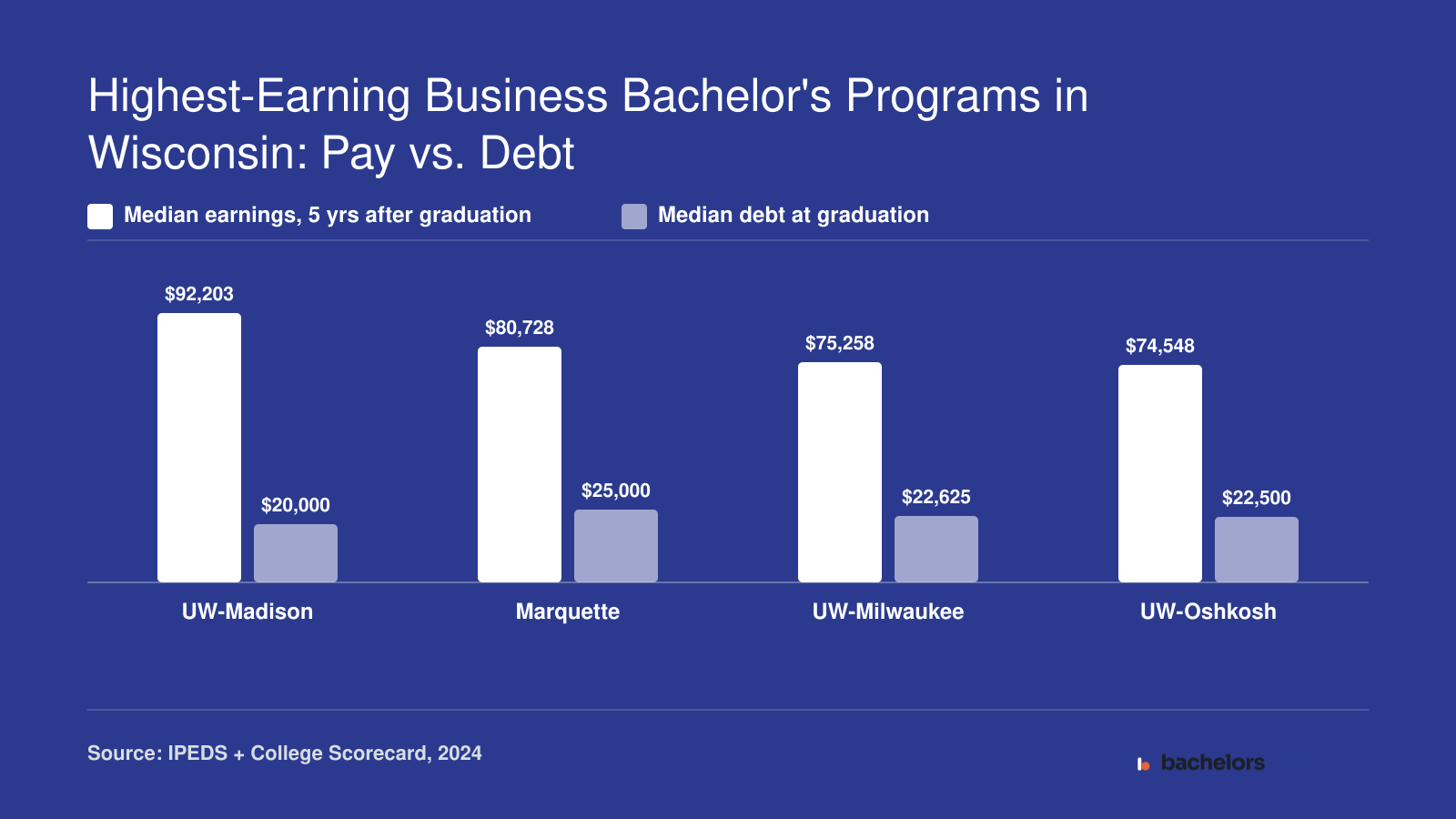
These figures track business administration graduates specifically, not each university as a whole. UW-Madison's business graduates earn a median $92,203 five years after finishing, against median debt of $20,000. Marquette ($80,728 vs. $25,000), UW-Milwaukee ($75,258 vs. $22,625) and UW-Oshkosh, in our directory ($74,548 vs. $22,500), follow. At each school shown, median debt sits below one-third of a single year's pay five years out, which points to manageable loan repayment for a typical graduate.
Online and Hybrid Business Bachelor's Options at Wisconsin Schools
Wisconsin's business schools are mostly built around the classroom. A student who needs to finish a bachelor's online has fewer choices than the state's long list of business programs suggests; most online routes are built for transfers and working adults, not first-time freshmen.
Fully Online Business Bachelor's Programs
- UW-Madison: The online BBA in Management runs through UW-Madison Online and is aimed at transfer students, who need at least 12 transfer credits; 30 residency credits still apply.
- Herzing University-Kenosha: Business management is taught online, with credit for prior learning, military benefits and scholarships listed among its features.
UW-Parkside's business administration major is offered through the Flexible Option, a self-paced, competency-based format for students who want to move faster through material they already know.
Hybrid and Campus Options
UW-Whitewater's general business BBA is offered on campus and online, so students can mix formats. Marquette, UW-Eau Claire, Carroll, Maranatha Baptist, UW-Milwaukee, UW-River Falls and Viterbo list their business administration bachelor's as campus programs.
Online study best suits working adults, transfers with credits left to finish, and out-of-state students who want a Wisconsin school without relocating.
What a Business Bachelor's Costs in Wisconsin: Tuition and Net Price
The same Wisconsin business credential can run under $10,000 a year in tuition or more than $45,000, depending on residency and sector.
Public Sticker Prices
UW-Madison charges residents $12,416 in tuition and segregated fees for 2026-27 and nonresidents $45,932, after a 2% resident and 4% nonresident increase.1 UW-Whitewater publishes $9,235 for residents and $19,336 for nonresidents, while its own viewbook shows a slightly different pair ($8,984 and $19,085)2, so treat any single total as an accounting choice. Whitewater also lists $11,470 for Minnesota residents and $14,905 under its Return to Wisconsin program. UW-Platteville sits at $8,851 and $18,660.
What Families Actually Pay
Sticker price is not net price. At Marquette, tuition runs $51,170 while average net price after aid is about $31,487; at Saint Norbert, $45,580 against roughly $26,172. Those are institution-wide undergraduate averages, not business-major figures, and federal net price data can lag current published rates by a year or two.
Adding Housing and Online Options
Whitewater's resident budget reaches $17,683 once housing ($5,030) and meals ($3,418) are added. Online changes the math: UW-Platteville's online Business B.S. costs $473 per credit including fees, and UW-Madison Online charges $500 per credit regardless of residency. Run each school's net price calculator before comparing offers.
Wisconsin Grants and Scholarships That Lower the Bill
Private colleges carry higher sticker prices, but Wisconsin's state aid is also larger for students who attend them, so compare net cost rather than list price.
State Grants
All of the programs below require Wisconsin residency, a diploma or GED, undergraduate status, enrollment at a Wisconsin nonprofit school, and demonstrated need on the FAFSA.1
- Wisconsin Grant: The state's main need-based award, paid for up to 10 semesters. Full-time students at UW campuses can receive up to $3,700 a year, and those at private nonprofit colleges up to $4,850 (at a Student Aid Index of $8,000 or less).2 Awards are prorated for part-time enrollment.
- Talent Incentive Program: For first-time freshmen with significant need, though your school must nominate you. Initial awards run $1,000 to $1,800 for the year, and continuing students can receive up to $1,800.3
Tuition Promise and School Aid
The Wisconsin Tuition Promise covers up to four years of tuition and fees at 12 public UW universities (UW-Madison is excluded) for families earning under $62,000.4 Eligible students are considered automatically through the federal aid application. Most of the private schools here also award institutional scholarships, which can stack on top of state grants.
Where to Apply
File the FAFSA first, since it triggers state and school aid alike. Then check award rules and current amounts on the Wisconsin Higher Educational Aids Board website.
Business Careers in Wisconsin: Pay, Employers, and the CPA Exception
What do business graduates actually earn in Wisconsin, and which employers hire them? Those answers change every year, so learn where to look instead of trusting a number copied from an article.
Check Wisconsin wages at the source
The Bureau of Labor Statistics publishes state-level wage and employment estimates through its Occupational Employment and Wage Statistics program. Go to BLS.gov, open the Wisconsin state profile, and pull the occupations that match your major: accountants and auditors, financial analysts, management analysts, market research analysts, and human resources specialists. Note the data edition and release date on the page, since each new release replaces the last.
Find real employers, not list-article guesses
Instead of relying on unverified "top employer" roundups, work the sources that are current:
- School career services: Most business programs post placement reports, employer partners, and alumni outcomes.
- Company career pages: Search directly for Wisconsin locations and entry-level finance, accounting, analytics, or HR openings.
- LinkedIn alumni tools: Filter graduates of a specific Wisconsin school by employer and job title.
- Professional associations: State and national groups for accountants, human resources professionals, and financial analysts run job boards and student chapters.
The CPA exception
Accounting is the one business path with a state license attached. In Wisconsin, CPA requirements are set by the Department of Safety and Professional Services and the Accounting Examining Board, covering education credits, the exam, and supervised experience. Confirm the current rules on the official state site before you choose a program, because credit-hour requirements have shifted in recent years.
Related Articles
Where Our Wisconsin Business School Rankings Come From
These rankings rest on federal education data and on what each school publishes about its own business program. The federal sources are the College Scorecard and IPEDS, the Education Department's annual survey of colleges. Admissions policies, online options, and program details come from the schools' own pages.
What the Measures Mean
- Net price: What a student pays after grants and scholarships, before loans.
- Graduation rate: The share of a school's students who finish a bachelor's degree within six years.
- Program earnings and debt: Median pay and borrowing for graduates of a specific field of study.
- Accreditation: Whether the business program holds AACSB status.
Limits to Keep in Mind
Graduation rate and net price describe the whole institution, not the business major alone. A school's figure may differ from what a business student sees. The Scorecard also lags, so earnings and debt reflect graduates from several years back. Treat them as a guide, not a forecast.
How AACSB Was Verified
AACSB is the best-known accreditor of business schools, and it reviews faculty quality, curriculum, and student outcomes. We checked each school's status against AACSB's public list of accredited institutions and the school's own business pages.
Compare Business programs on the data that matters
Explore more Business & Management majors or browse every field of study.
All Business & Management programs Browse every field of study