Best Computer Science Schools in Wisconsin
Compare 43 accredited Computer Science programs in Wisconsin at 26 colleges, with net price after aid, graduation rates, earnings and debt from IPEDS and the U.S. College Scorecard.
A bachelor's degree in computer science in Wisconsin is a four-year, roughly 120-credit program, and the math sequence matters more than the name on the diploma. Schools award it as a Bachelor of Science (B.S.) or a Bachelor of Arts (B.A.) in Computer Science.
Marquette University leads this ranking, followed by Carroll University and Lawrence University; the ordering weighs cost and outcomes rather than reputation. Published tuition and net price after grants vary by campus and delivery format, and admission to the major is often a second gate behind university admission.
Milwaukee and Madison employers recruit across these campuses; what separates graduates is the systems they can build.
Key Points
- Marquette University ranks first, ahead of Carroll University and Lawrence University.
- University of Wisconsin-Milwaukee Flex offers a fully online applied computing degree.
- Most posted admit rates describe the whole university, not the major.
Best Computer Science Schools in Wisconsin: Our Top 10 Ranked
Marquette University holds the top spot among Wisconsin bachelor's programs in computer science, with Carroll University and Lawrence University close behind. The order favors schools where students finish on time, pay less after aid, and offer a substantive computer science curriculum, so a low sticker price alone will not lift a school up the list. The ten entries below cover public and private campuses across the state, from large Milwaukee universities to small liberal arts colleges.
Marquette University
#1Milwaukee, WI · ~$31,000/yr (est.)
Best for: Milwaukee students wanting co-op experience
A Jesuit university in Milwaukee and a founding partner of the Northwestern Mutual Data Science Institute, which ties students to regional employers and funded research in AI and data science. The B.S. in Computer Science pairs core work in algorithms and software development with electives in artificial intelligence, data mining, and cybersecurity, and adds co-op placements plus an accelerated five-year B.S./M.S. route. School-wide, roughly 83 percent of students graduate and about 81 percent of applicants are admitted.
- Bachelor of Science in Computer Science, delivered on campus in Milwaukee
- Core coursework in algorithms, data structures, and software development
- Advanced courses in artificial intelligence, data mining, and cybersecurity
- Lab components plus a required senior design project
- Co-op work opportunities with Milwaukee-area employers
- Accelerated five-year B.S./M.S. option
- Electives in programming languages, compilers, and data science
- Ethics in computing and web development also covered
Carroll University
#2Waukesha, WI · $15,000 – $20,000/yr (est.)
Best for: Small-campus liberal arts programmers
A private liberal arts university in Waukesha where computer science sits inside a broad general education core rather than a narrow technical track. Majors choose from four concentrations, work on equipment reserved for computer science and IT students, and get hands-on time with Oracle and Microsoft SQL Server. A Video Game Studies minor is a common pairing for students aiming at game development.
- Four concentration options within the computer science major
- Lab equipment reserved exclusively for computer science and IT majors
- Access to Microsoft, Mac, and Unix/Linux platforms
- Oracle and Microsoft SQL Server database experience
- Internships built into the liberal arts-based curriculum
- Video Game Studies minor available to computer science majors
- Covers multiple programming paradigms and software engineering
- Prepares students for graduate study as well as industry roles
Lawrence University
#3Appleton, WI · ~$23,000/yr (est.)
Best for: Theory-focused computing students eyeing research
A small liberal arts college in Appleton offering a B.A. in Computer Science built around theory as much as code. Classes stay small, faculty offices sit directly across from the classrooms, and GPU-accelerated resources support machine learning coursework and student research. A senior seminar has every graduate present original work to faculty.
- Bachelor of Arts in Computer Science at the Appleton campus
- Electives in artificial intelligence, machine learning, and graphics
- GPU-accelerated computing resources for machine learning research
- Senior seminar where students present work to faculty
- Small class sizes with close faculty attention
- Also offers a minor in computer science
Milwaukee School of Engineering
#4Milwaukee, WI · ~$22,000/yr (est.)
A Milwaukee engineering school where the ABET-accredited computer science degree leans applied: applied mathematics, algorithms, artificial intelligence, and substantial lab work. MSOE is a Northwestern Mutual Data Science Institute partner, and that collaboration is expected to open shared research and computing resources to students. Guaranteed transfer agreements with several Wisconsin technical colleges create a defined path in for two-year graduates. School-wide, about 67 percent of students graduate and roughly 59 percent of applicants are admitted.
- ABET-accredited Bachelor of Science in Computer Science
- Applied mathematics, algorithms, and artificial intelligence coursework
- Hands-on learning with advanced computing resources
- Faculty expertise in AI and machine learning applications
- Guaranteed transfer agreements with several Wisconsin technical colleges
- Northwestern Mutual Data Science Institute partner
- Shared research and computing resources through the institute
University of Wisconsin-Whitewater
#5Whitewater, WI · $10,000 – $15,000/yr (est.)
A public UW campus in Whitewater whose computer science department lets students specialize early. Emphases in artificial intelligence and game development sit alongside an applied computing track aimed at business and management applications. Internship credit, programming contests, cyber defense competitions, and tutoring support sit on top of in-state tuition of roughly $8,600 a year, among the lowest on this list.
- Emphases in artificial intelligence, game development, and applied computing
- Programming in Java and C++ with software engineering and database courses
- Internship credit available for majors
- Programming contests and cyber defense competitions
- Research opportunities and tutoring services for majors
- Scholarships available to computer science students
University of Wisconsin-Platteville
#6Platteville, WI · $9,000 – $18,000/yr (est.)
A public UW campus in Platteville whose computer science major is unusually customizable, with six emphases including AI, game development, big data, networking, and a CS+Business route that adds management, accounting, and economics. The 57-credit core is demanding, requiring at least a C- in every major course. Two project courses give the degree a working portfolio at the end.
- Six emphases, including artificial intelligence, game development, and big data
- CS+Business emphasis adds management, accounting, and economics
- 57-credit major core
- Two-course project sequence required of all majors
- C- or better required in every major course
- Non-emphasis route requires 12 elective credits, 9 at the upper level
Saint Norbert College
#7De Pere, WI · $26,000/yr (est. net price)
A private Catholic college in De Pere with small classes and a computer science major that pairs a traditional core with applied options. Students can add a game development concentration or a business information systems concentration, and everyone finishes with a senior capstone. Coursework extends through machine organization, operating systems, networks, and programming languages.
- Bachelor of Science in Computer Science with major and minor options
- Tracks: game development and business information systems
- Coursework in programming, data structures, algorithms, and software engineering
- Senior capstone required
- Machine organization, operating systems, and networks offered
- Calculus required alongside the computer science core
University of Wisconsin-Milwaukee
#8Milwaukee, WI · $10,000 – $22,000/yr (est.)
A large public research university in Milwaukee with an ABET-accredited computer science B.S. and a founding seat in the Northwestern Mutual Data Science Institute, which has directed funded research and student scholar awards to the campus. The 120-credit degree requires a capstone and a laptop from sophomore year, and qualified students can accelerate into a master's. School-wide graduation runs near 49 percent, a reminder that this is a big, access-focused campus with strong employer ties.
- ABET-accredited, 120-credit Bachelor of Science
- Laptop required starting sophomore year
- Capstone project required
- Accelerated master's option for qualified students
- Transfer GPA considered for transfer applicants
- Coursework in networking, operating systems, and software engineering
- Founding partner of the Northwestern Mutual Data Science Institute
University of Wisconsin-Green Bay
#9Green Bay, WI · $13,000/yr (est. net price)
A public UW campus in Green Bay that has built its computer science degree around three routes: artificial intelligence, cybersecurity, and a reduced-credit fundamentals track. Classes are small, community internships are built in, and transfer students arriving from Wisconsin technical colleges get generous credit. The campus also emphasizes compact degree paths, including a 100-credit bachelor's model.
- Emphasis areas in artificial intelligence and cybersecurity
- Reduced-credit fundamentals track available
- Small class sizes with community internships
- Generous transfer credit policy with Wisconsin technical colleges
- Graduate pathways in data science and cybersecurity
- Compact 100-credit bachelor's model on campus
Wisconsin Lutheran College
#10Milwaukee, WI · $20,000 – $25,000/yr (est.)
A private Lutheran college in Milwaukee with a computer science major that stays small and hands-on. Students can shape the degree with an artificial intelligence or software engineering concentration, and they get round-the-clock access to a makerspace and Windows and Linux labs. At 33 major credits plus 12 collateral credits it is one of the leaner majors here, capped by a final project and a 2.50 major GPA to graduate.
- 33 major credits plus 12 collateral credits
- Concentrations in artificial intelligence and software engineering
- C or better in CSC 231 required to declare the major
- 2.50 GPA in the major required to graduate
- 24/7 makerspace and computer lab access
- Capstone experience required
- Hands-on work with C++, Python, robotics, and web development
Cost & outcomes by school
Federal data for the highest-earning Computer Science programs, independent of the ranking above. Earnings are this field's bachelor's graduates four years after completing where the Scorecard reports them, else the school's undergraduate median.
| School | Net price / yr | Grad rate | Earnings | Debt | Grads/yr | Format |
|---|---|---|---|---|---|---|
| Saint Norbert College WI | $26,172 | 71% | $96,237 | $25,932 | 9 | Campus |
| University of Wisconsin-Milwaukee WI | $15,014 | 49% | $92,342 | $27,000 | 104 | Campus |
| University of Wisconsin-Parkside WI | $11,772 | 40% | $89,495 | $24,250 | — | Campus |
| Milwaukee School of Engineering WI | $22,453 | 67% | $89,070 | $27,000 | 46 | Campus |
| Rasmussen University-Wisconsin WI | — | 57% | $84,899 | $28,113 | — | Online |
| Carroll University WI | $15,193 | 71% | $79,438 | $27,000 | 10 | Campus |
| Marquette University WI | $31,487 | 83% | $78,257 | $23,940 | — | Campus |
| Concordia University-Wisconsin WI | $36,201 | 68% | $75,487 | $25,750 | 5 | Campus |
| University of Wisconsin-Madison WI | $17,354 | 90% | $73,792 | $20,484 | — | Campus |
| University of Wisconsin-Green Bay WI | $13,369 | 48% | $69,304 | $19,200 | 31 | Campus |
| University of Wisconsin-Platteville WI | $16,032 | 56% | $61,760 | $21,977 | 2 | Campus |
| University of Wisconsin-Eau Claire WI | $16,550 | 64% | $58,561 | $20,909 | — | Campus |
Sources: U.S. Department of Education. Net price, graduation rate, earnings and debt: College Scorecard (earnings and debt for this field's bachelor's graduates where reported, else school-wide); graduates: IPEDS. A dash means no figure is reported.
Cost, debt & payoff
Median earnings of this field's bachelor's graduates (4 yrs after completing, else the school's undergraduate median) vs. their median federal loan debt · U.S. College Scorecard
Across these programs the median graduate earns about $55,961 and finishes with roughly $24,250 in debt — a ratio that clears a common rule of thumb (keep debt below first-year salary). Net price and debt vary widely school to school, so check the per-school figures in the table above before you shortlist.
How to Choose a Bachelor's Degree in Computer Science in Wisconsin
A bachelor's degree in computer science teaches you how software and computing systems work, from algorithms to operating systems. Wisconsin schools award it as a B.S. or a B.A., and a few checks will narrow the field quickly.
B.S. vs. B.A.
A B.S. leans heavier on math and science and suits students aiming at systems, engineering, or research-oriented work. A B.A. leaves more room for a minor or second field, which fits students who want to pair computing with business, design, or the sciences. UW-Madison offers both, so you can compare the two tracks within one school.
Common Emphases
Program pages often highlight software engineering, cybersecurity, AI and data, or applied computing. UW-Whitewater, for example, lists an Applied Computing version alongside its standard Computer Science major. Read the course list, not just the label.
ABET vs. Regional Accreditation
These are two different checks. Regional accreditation covers a whole institution. ABET accredits individual programs, and its Computing Accreditation Commission reviews computing programs at the associate, bachelor's, and master's levels.2 For computer science, ABET's 2025-2026 criteria require at least 40 semester credit hours covering algorithms and complexity, theory, programming languages, software development, computer architecture, networking, operating systems, and parallel and distributed computing.3
ABET's 2026 accredited program search lists bachelor's computing programs at Marquette University, UW-Eau Claire, UW-Madison, and UW-Milwaukee.1 For Milwaukee School of Engineering, UW-Platteville, and UW-La Crosse, that search did not confirm a computer science listing, so ask those schools directly.1 Accreditation changes, so run your own check: open ABET's accredited program search, filter to Computing, bachelor's level, United States, and look up the school.
A Simple Decision Rule
- First: confirm ABET status for the exact program.
- Second: match the emphasis and B.S. or B.A. structure to the career you want.
- Third: compare cost and net price among the programs that pass the first two checks.
Questions to Ask Yourself
Do you want a large research university or smaller classes with applied, project-based work?
Do you need a fully online degree, or can you relocate to a Wisconsin campus?
Does your target employer or graduate path expect an ABET-accredited program?
Online and Hybrid Bachelor's in Computer Science Options at Wisconsin Schools
Can you earn a bachelor's degree in computer science fully online from a Wisconsin school? Yes. UW-Superior delivers its Bachelor of Science in Computer Science online, and the University of Wisconsin also runs a fully online applied computing degree.1 Before comparing, separate a fully online degree, one with no campus visits at all, from a campus program that lets you take a few courses online.
The UW Applied Computing Collaboration
The University of Wisconsin offers a Bachelor of Science in Applied Computing, 100% online, through a collaboration of five UW campuses.4 They include UW-Milwaukee, UW-Oshkosh, UW-Platteville, UW-River Falls, and UW-Stevens Point. You choose a home campus. That campus handles admission, evaluates your prior coursework, and awards the degree, so your diploma and transcript match those of on-campus students.
The program blends IT, computer science, and business across 21 required courses and 61 credits.2 It is degree completion, built for students who arrive with an associate degree or roughly 45 to 60 transferable credits. The published minimum GPA for that pathway is 2.0.2
Transfer and Credit Pathways
Transfer Wisconsin can estimate how UW and technical college credits move over, but your home campus makes the official call and may credit courses differently than another campus would.3 Applicants with fewer than 60 credits may be considered for provisional admission.3 I found no confirmed reduced-credit pathway beyond that.
Campus Programs With Online Elements
Every ranked program in our data is listed as campus-based. UW-Whitewater mentions online options alongside in-person study, but the format is not confirmed as fully online. UW-Milwaukee Flex lists Applied Computing in our directory.
What to Verify
- Awarding institution: Confirm which campus issues your degree.
- In-person requirements: Ask whether any visits, labs, or proctored exams apply.
- Accreditation: Check institutional accreditation and whether the specific program holds any programmatic accreditation. I could not confirm the latter.
Admissions Requirements for Wisconsin Computer Science Bachelor's Programs
The admit rate on a Wisconsin computer science program's page usually belongs to the whole university, not the major. Understand that gap before you build a college list. A bachelor's degree in computer science often sits behind a second gate: declaring the major after you are already enrolled.
Selective and Open-Access Campuses
At one end, MSOE admits about 59 percent of applicants, Lawrence about 64 percent, Carroll about 67 percent and Marquette about 81 percent. At the other, UW-Milwaukee, UW-Green Bay and UW-Platteville all admit roughly 89 to 91 percent, with UW-Whitewater and Saint Norbert near 86 percent and Wisconsin Lutheran about 78 percent. Treat the high-admit campuses as safeties for admission, not automatically for the major, and treat the selective end as a match or reach even with strong grades. UW-Madison publishes only a school-wide acceptance rate, so plan around the major declaration step below rather than a separate CS rate.
Tests and GPA
UW-Madison is test-optional for Fall 2026, and Universities of Wisconsin campuses are test-optional from Spring 2026 through Summer 2028.1 UW-Milwaukee does not require ACT or SAT scores and waives them altogether for applicants 21 or older or those with 12 or more transferable credits. Neither UW-Madison nor UW-Milwaukee publishes a fixed first-year GPA cutoff for Fall 2026; both describe a review of coursework, grades and rigor.
Transfer Credit Rules
UW-Madison wants 24 transferable semester hours earned after high school and does not count AP, A-Level, IB or CLEP credit toward that total.2 It accepts up to 72 credits, and its Guaranteed Transfer path asks for a 3.0 cumulative GPA plus a 2.0 in your prior term.3 UW-Platteville sets 12 transferable credits for Spring 2026 entry.4 UW-Milwaukee's published admissions page does not state a transfer credit maximum, so get that answer in writing from admissions.
Declaring the Major
At UW-Madison, computer sciences declaration for students starting Summer 2026 or later requires COMP SCI 300 and MATH 222, a BC or better in one introductory programming course, and a 2.250 GPA in eligible coursework. Staying in the major requires a 2.000.
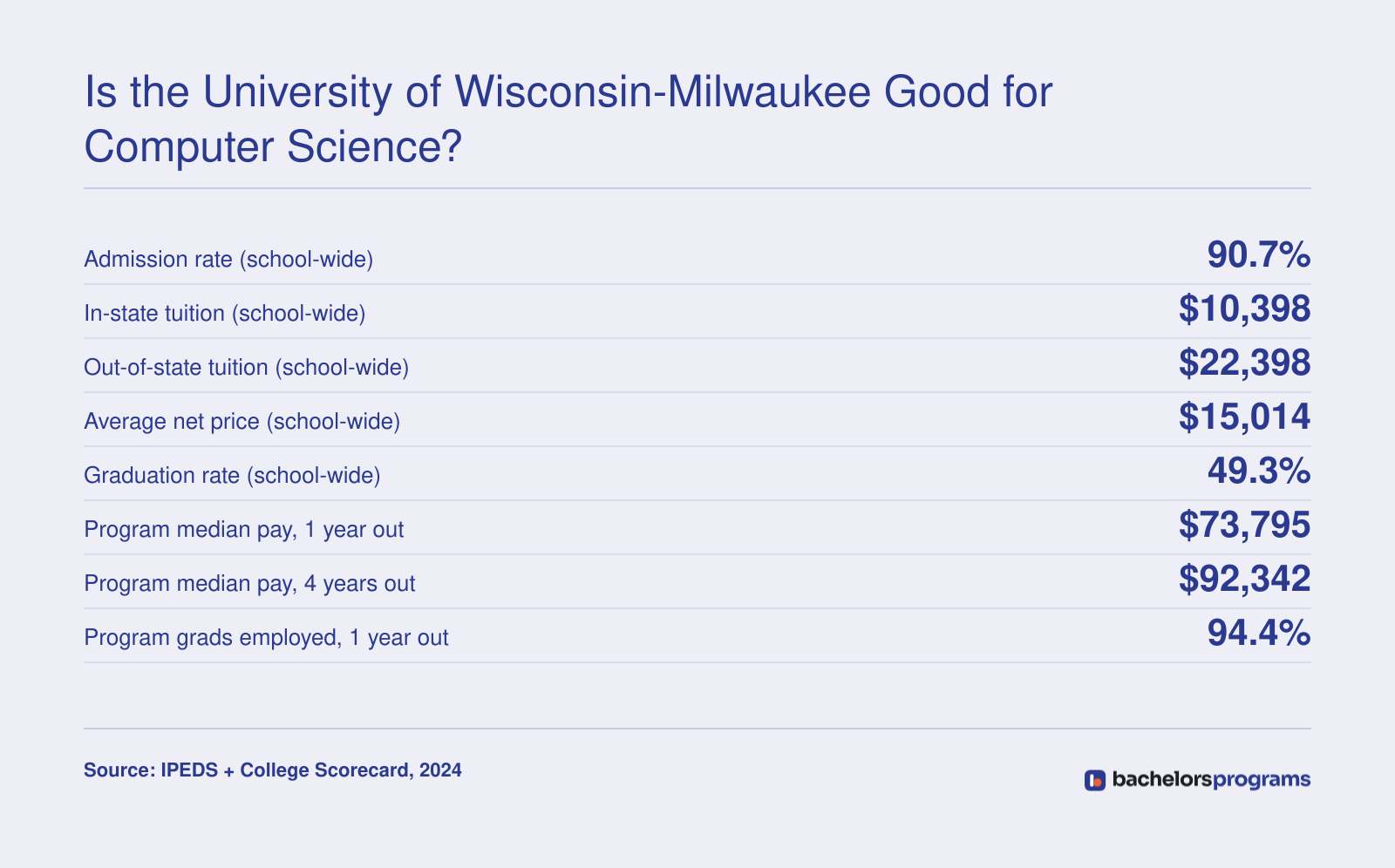
Is the University of Wisconsin-Milwaukee Good for Computer Science?
The University of Wisconsin-Milwaukee pairs an ABET-accredited Computer Science, BS with public tuition and well-documented graduate outcomes. School-wide figures describe the whole university. Program-level figures track computer science bachelor's graduates only, measured one and four years after finishing.
Related Articles
Cost of a Computer Science Degree in Wisconsin: Tuition, Net Price, and Aid
The cost of a computer science degree in Wisconsin is what you pay for tuition and fees over four years, minus the grants and scholarships you receive. Sticker price is the published rate. Net price is what remains after aid, and it is the number that should drive your decision.
In-State vs. Out-of-State Tuition
Public campuses charge Wisconsin residents far less. The latest figures I can confirm are 2024-2025 tuition for a full-time undergraduate4; they exclude mandatory fees, so expect a higher bill, and expect it to have changed since.
- UW-Eau Claire: $7,931 in-state, $17,517 nonresident.1
- UW-Milwaukee: $8,772 in-state, $20,772 nonresident.2
Minnesota residents may qualify for a separate reciprocity rate.3 At UW-Eau Claire it was $8,692 and at UW-Milwaukee $12,958, lower than nonresident but above resident. Current eligibility, participating campuses, and rules should be confirmed directly with the school. Some other nonresidents may qualify for Return to Wisconsin, a 25% waiver of nonresident tuition when requirements are met.3
Public vs. Private Schools
Private schools such as Marquette, Carroll, and Milwaukee School of Engineering post much higher sticker prices than UW campuses. They also tend to discount that price with institutional scholarships, so the gap between sticker and net price is usually wider at private colleges. A public campus often still costs less after aid, but compare each school individually rather than assuming.
Wisconsin Aid Programs
The Wisconsin Grant is need-based aid that generally does not have to be repaid, and you apply for it by filing the FAFSA. Award amounts and eligibility rules change, so check the current figures with each school's financial aid office. UW-Madison also runs the Wisconsin Tuition Promise for qualifying in-state students. I could not confirm its current income limits or what it covers, so verify those on the university's aid pages. Campus merit scholarships are separate, and many schools consider you for them automatically when you apply.
A Practical Tip
Run each school's net price calculator using the same household income, assets, and residency details. Matching inputs is the only way to compare results fairly, and you should note whether each estimate includes fees, housing, and books.
Cheapest Wisconsin Bachelor's in Computer Science Programs After Aid
This table sorts Wisconsin computer science schools by average annual net price, the cost after grants and scholarships, using 2024 IPEDS and College Scorecard data from the U.S. Department of Education. Net price, tuition and graduation rate are institution-wide figures for all undergraduates, not computer science students alone, so treat them as approximate. Median debt is shown only where federal data reports it for the school's computer science bachelor's graduates. The lowest net prices come with lower overall graduation rates: UW-Parkside and UW-Superior graduate about 40 to 42 percent of students, compared with roughly 57 to 59 percent at UW-River Falls and UW-Whitewater.
| School | City | In-State Tuition and Fees | Average Net Price After Aid | Graduation Rate (Institution-Wide) | Median Debt, Computer Science Graduates |
|---|---|---|---|---|---|
| University of Wisconsin-Parkside | Kenosha | $8,270 | $11,772 | 40% | $24,250 |
| University of Wisconsin-Superior | Superior | $8,812 | $12,220 | 42% | N/A |
| University of Wisconsin-Green Bay | Green Bay | $8,700 | $13,369 | 48% | $19,200 |
| University of Wisconsin-River Falls | River Falls | $9,008 | $14,054 | 57% | N/A |
| University of Wisconsin-Whitewater | Whitewater | $8,616 | $14,158 | 59% | N/A |
Wisconsin Computer Science Degree FAQs
These answers cover the questions Wisconsin students ask most often about a bachelor's degree in computer science. Details such as tuition, prerequisites and accreditation vary by school, so confirm them on each program's own page before you apply.
Is UW-Madison good for computer science?
Can you get a bachelor's degree in computer science online in Wisconsin?
Do you need a license to work in computer science in Wisconsin?
Does it matter if a computer science program is ABET-accredited?
Compare Computer Science programs on the data that matters
Explore more Computers & IT majors or browse every field of study.
All Computers & IT programs Browse every field of study