Best Finance Schools in Arkansas
Compare 17 accredited Finance programs in Arkansas at 14 colleges, with net price after aid, graduation rates, earnings and debt from IPEDS and the U.S. College Scorecard.

A bachelor's degree in finance in Arkansas can cost as little as $7,334 a year in in-state tuition and fees, or several thousand dollars more at a flagship or private campus, so the school you pick shapes both your debt and your first job. Most programs here award a Bachelor of Science (B.S.) in Finance or a business degree with a finance concentration, taught on campus, with a narrower set of online options.
The ranking weighs cost, graduation rates and College Scorecard outcome data. The practical tension is accreditation and employer reach against price: Arkansas banks and corporations recruit heavily from a handful of campuses, but graduates of regional schools also land local roles.
Key Points
- University of Arkansas offers five finance concentrations in a 120-credit plan.
- University of Arkansas-Fort Smith has the lowest net price: $10,574 yearly.
- AACSB lists Arkansas State, Arkansas Tech and Central Arkansas business schools.
Best Bachelor's Degree in Finance Programs in Arkansas: Our Top 10
The University of Arkansas is our pick for the strongest bachelor's degree in finance in the state, pairing five finance concentrations with a 120-credit, eight-semester plan and internships inside the Fayetteville financial community. The ten schools below are the state's leading bachelor's-level finance options for 2026, spanning large public campuses, private Christian colleges and a fully online completion route. Each entry notes what the school does well, which programs you can actually enroll in, and who tends to fit there.
University of Arkansas
#1Fayetteville, AR · ~$18,000/yr (est.)
Best for: Students wanting multiple finance concentrations
The University of Arkansas in Fayetteville runs its finance program through the Sam M. Walton College of Business, where undergraduates earn a Bachelor of Science in Business Administration in Finance and pick from five concentrations, including banking, financial analytics and real estate. The department leans on problem-based casework and internships in the local financial community rather than lecture-only coursework. The university also awards the New Arkansan Non-Resident Tuition Award to eligible out-of-state students, which narrows the gap between resident and nonresident tuition.
- Banking track covers commercial banking and credit analysis
- Advanced Commercial Banking among the specialized courses
- 8-semester degree plan totaling 120 credit hours
- Internships in the financial community
- Arkansas Bankers Association Chair in Banking
- Electives from accounting, economics or information systems
- Quantitative methods emphasized throughout the track
- 120 total credit hours across eight semesters
- Study abroad opportunities in finance
- Internships in the financial community
- One of five concentration options in the major
- This concentration can be completed fully online
- Students help manage the Rebsamen Trust
- Internships in the financial community
- Real-world business activities built into coursework
- Prepares for diverse finance careers
John Brown University
#2Siloam Springs, AR · $20,000 – $25,000/yr (est.)
Best for: Christian students wanting faith-integrated business study
John Brown University is a private Christian campus in Siloam Springs, and its finance major sits inside the Soderquist College of Business as one of ten business majors. Students build skills in financial management, financial planning and portfolio analysis, with group projects and networking work folded into the classroom experience. Faculty bring banking, lending and financial services backgrounds to a curriculum that integrates faith with business practice.
- Financial management, planning and portfolio analysis
- Prepares students for industry certifications
- Group projects and networking opportunities
- Professors with banking and lending experience
- One of 10 business majors in the Soderquist College of Business
- Faith-integrated approach to business education
Arkansas State University
#3Jonesboro, AR · $8,000 – $15,000/yr (est.)
Best for: Students targeting bank management careers
Arkansas State University in Jonesboro delivers its finance degree through the Neil Griffin College of Business, a school holding AACSB International accreditation. Finance majors choose among financial management, financial services or banking emphases, and the banking track puts students into financial analysis, trading and client account work. Freshmen enter with a 3.0 GPA standard, transfers with a 2.0, and the university offers an application fee waiver request and concurrent-credit partnerships with Arkansas high schools.
- Three emphases: financial management, financial services, banking
- AACSB International accreditation
- 120 total credit hours
- 3.0 GPA for freshmen, 2.0 for transfer applicants
- $30 application fee with a waiver request form
- ACT or SAT score required for admission
- Coursework in stocks, trading and investing
Harding University
#4Searcy, AR · ~$22,000/yr (est.)
Harding University in Searcy awards a Bachelor of Business Administration in Finance, combining a common business core with specialized work in investments, commercial banking, real estate, risk analysis and international finance. The 128-credit degree includes a required course in Christian business ethics and a 41-hour liberal arts foundation. An accelerated BBA/MBA route lets strong students apply up to 12 hours of graduate credit toward both degrees, and a finance internship supplies hands-on experience.
- 128 total credit hours
- 44-hour business core plus 27 hours of finance coursework
- Accelerated BBA/MBA option using up to 12 graduate credits
- Finance internship opportunity available
- Required course in Christian business ethics
- Six hours of upper-level business electives
- Strong math recommended for business analysis
University of Central Arkansas
#5Conway, AR · $15,000 – $20,000/yr (est.)
The University of Central Arkansas in Conway offers its Bachelor of Business Administration in Finance entirely online, built as a completion program for students who hold an associate degree from an Arkansas community college partner or have finished the lower-division core. Coursework points toward financial planning, investment banking, portfolio management and real estate, with an emphasis on problem-solving, communication and teamwork. Admission requires a 2.0 GPA, and the university connects eligible transfers with scholarship support.
- Online completion program for community college transfers
- 2.0 GPA minimum for admission
- Designed for associate degree holders from Arkansas partner colleges
- Coursework spans financial planning, investments and real estate
- Emphasizes problem-solving, communication and teamwork
- Scholarships available for eligible students
Ouachita Baptist University
#6Arkadelphia, AR · $20,000 – $25,000/yr (est.)
Ouachita Baptist University in Arkadelphia houses finance in the Hickingbotham School of Business, which holds AACSB accreditation as one of a small group of private undergraduate-only business schools worldwide. Students manage more than $1.3 million of university endowment, train on a Bloomberg Terminal and prepare for the Securities Industry Essentials exam, with a student team meeting weekly. Business students also take annual all-expenses-paid trips to major metro firms and the Federal Reserve.
- AACSB accredited, one of nine private undergraduate-only business schools
- Students manage $1.3 million of university endowment
- Bloomberg Terminal training available
- Prepares students for the Securities Industry Essentials exam
- All-expenses-paid trips to metro firms and the Federal Reserve
- Coursework in corporate financial management and investments
- Partnership with Securities Training Corporation
Arkansas Tech University
#7Russellville, AR · $10,000 – $15,000/yr (est.)
Arkansas Tech University in Russellville maps finance onto an eight-semester plan so students finish in four academic years, with coursework in investments, risk management and money and banking. Every finance student joins a student-managed investment fund, and electives stack into credentials in entrepreneurship, business data analytics or Microsoft applications. An accelerated BSBA-to-MBA option lets students apply aid to dual credit, and alumni work at Edward Jones, Arvest Bank, Bank OZK, ArcBest and Walmart.
- Eight-semester degree map for four-year completion
- Every finance student joins a student-managed investment fund
- New York Wall Street Experience
- Stackable certificates in analytics, entrepreneurship or Microsoft applications
- Accelerated BSBA-to-MBA (AB2M) option
- Coursework in investments, risk management, money and banking
- Prepares for CFP certification
University of the Ozarks
#8Clarksville, AR · ~$17,000/yr (est.)
The University of the Ozarks in Clarksville offers a Bachelor of Science in Finance that builds on accounting and economics foundations before moving into financial analysis and decision-making. Courses such as Introduction to Investments and Risk Management lead to a Portfolio Management capstone that closes out the major. Graduates head into commercial banking, investment banking, financial planning, insurance, real estate and venture capital, and the small campus keeps quantitative work applied rather than abstract.
- Portfolio Management serves as the capstone
- Accounting and economics foundations
- Courses include Introduction to Investments and Risk Management
- Prepares students for commercial banking, investment banking and venture capital
- Quantitative data problem solving across the curriculum
- Financial planning and budgeting coursework
University of Arkansas-Fort Smith
#9Fort Smith, AR · ~$11,000/yr (est.)
The University of Arkansas-Fort Smith awards a BBA in Finance with concentrations in corporate finance and investments, built on a 120-credit curriculum that pairs core business disciplines with investments, advanced financial management, money and banking, and international finance. Qualified freshmen get a guaranteed eight-semester completion path, and the program requires financial literacy and business computing competencies before graduation. Small class settings and dedicated advising keep the four-year plan on track, and applicable transfer credits are guaranteed.
- 120 total credit hours over eight semesters
- 2.3 GPA minimum
- Financial literacy competency required
- Business computing competency required
- Accounting electives strongly recommended
- Guaranteed transfer of applicable credits
- 40 upper-level hours required
- At least 40 upper-level credit hours
- 2.3 GPA minimum
- Accounting electives strongly recommended
- Eight-semester, 120-credit degree structure
- Business computing competency required
- Financial literacy competency required
University of Arkansas at Little Rock
#10Little Rock, AR · $17,000/yr (est. net price)
The University of Arkansas at Little Rock offers a Bachelor of Business Administration in Finance with a general finance emphasis, set at 120 minimum credit hours with 45 upper-level hours and 30 hours in residence. At least half of the major requirements and half of the College of Business courses must be completed at UA Little Rock. The university's Corporate Partnership Program gives employees of participating Arkansas employers a 10% tuition scholarship, a per-credit textbook benefit and a waived application fee, and its partnership with the Arkansas Department of Finance and Administration extends the same support to state employees.
- 120 minimum credit hours
- 45 upper-level hours at the 3000-4000 level
- 30 hours must be in residence
- Half of major requirements completed at UA Little Rock
- Half of College of Business courses completed at UA Little Rock
- University Core adds 35 hours
Cost & outcomes by school
Federal data for the highest-earning Finance programs, independent of the ranking above. Earnings are this field's bachelor's graduates four years after completing where the Scorecard reports them, else the school's undergraduate median.
| School | Net price / yr | Grad rate | Earnings | Debt | Grads/yr | Format |
|---|---|---|---|---|---|---|
| University of Arkansas AR | $18,209 | 71% | $87,717 | $21,500 | 458 | Campus |
| Ouachita Baptist University AR | $22,409 | 61% | $77,583 | $21,320 | 39 | Campus |
| University of Arkansas at Little Rock AR | $17,248 | 42% | $71,526 | $15,076 | 17 | Campus |
| Harding University AR | $22,130 | 69% | $71,203 | $27,250 | 17 | Campus |
| Arkansas State University AR | $12,366 | 55% | $68,408 | $20,790 | 37 | Campus |
| University of Central Arkansas AR | $16,511 | 54% | $58,941 | $16,896 | 53 | Online |
| John Brown University AR | $20,397 | 72% | $53,907 | $21,250 | 7 | Campus |
| University of the Ozarks AR | $17,360 | 52% | $44,384 | $20,875 | 6 | Campus |
| Lyon College AR | $19,616 | 47% | $44,232 | $21,500 | 2 | Campus |
| Southern Arkansas University AR | $14,027 | 49% | $42,386 | $18,750 | — | Campus |
| Arkansas Tech University AR | $12,970 | 49% | $41,766 | $21,000 | 17 | Campus |
| University of Arkansas-Fort Smith AR | $10,574 | 38% | $41,102 | $18,250 | — | Campus |
Sources: U.S. Department of Education. Net price, graduation rate, earnings and debt: College Scorecard (earnings and debt for this field's bachelor's graduates where reported, else school-wide); graduates: IPEDS. A dash means no figure is reported.
Cost, debt & payoff
Median earnings of this field's bachelor's graduates (4 yrs after completing, else the school's undergraduate median) vs. their median federal loan debt · U.S. College Scorecard
Across these programs the median graduate earns about $53,907 and finishes with roughly $21,000 in debt — a ratio that clears a common rule of thumb (keep debt below first-year salary). Net price and debt vary widely school to school, so check the per-school figures in the table above before you shortlist.
Cheapest Bachelor's in Finance Programs in Arkansas
University of Arkansas-Fort Smith is the cheapest college for a finance degree in Arkansas in our data, with in-state tuition and fees of $7,334 and an average net price of $10,574 after grants and scholarships. Net price is a school-wide average for aided students drawn from 2024 IPEDS and College Scorecard figures, so your own cost may be higher or lower. The low-cost options differ more in graduation rate than in format: every program here is campus-based. Arkansas State University costs about $750 more per year in tuition than Fort Smith but posts the highest graduation rate in the table, 55.4 percent, and carries AACSB accreditation. Arkansas Tech University, Southern Arkansas University and University of Arkansas at Monticello all graduate between 48 and 49 percent of students.
| School (City) | Finance Program | In-State Tuition & Fees | Average Net Price After Aid | Graduation Rate | Format |
|---|---|---|---|---|---|
| University of Arkansas-Fort Smith (Fort Smith) | BBA-Finance | $7,334 | $10,574 | 37.9% | Campus |
| Arkansas State University (Jonesboro) | Bachelor of Science in Finance with an Emphasis on Banking | $8,090 | $12,366 | 55.4% | Campus |
| Arkansas Tech University (Russellville) | Finance | $8,674 | $12,970 | 48.6% | Campus |
| Southern Arkansas University (Magnolia) | Financial Analysis | $9,960 | $14,027 | 48.8% | Campus |
| University of Arkansas at Monticello (Monticello) | Business Administration, B.B.A. (Finance emphasis) | $9,292 | $14,287 | 48.6% | Campus |
Online and Hybrid Finance Bachelor's Options at Arkansas Schools
You can complete a finance bachelor's degree online in Arkansas, but the fully online options are fewer than the state's campus lineup suggests. At most Arkansas schools the finance major is built as a campus program, with online study limited to general education or business core courses rather than the full major.
Where the full major can be finished online
The clearest fully online route is the University of Arkansas in Fayetteville, whose Finance B.S.B.A. includes an online pathway in the Financial Management/Investment concentration. That concentration is a 120-credit, eight-semester program, and it is the one finance track at the university designed to be completed entirely at a distance. If you want a different concentration, expect to be on the Fayetteville campus for at least part of the degree.
The University of Central Arkansas is the other Arkansas school whose finance degree is publicly described as an online completion program, aimed at students who transfer in community college credit. Most other finance programs in the state are campus-based, so the finance coursework itself generally happens in person.
What online study costs
The University of Arkansas bills online students per credit rather than at a flat rate, and it charges online students in-state tuition regardless of where they live. For fall 2026 the per-credit tuition is $376.09, plus several per-credit fees: a library fee, a network and data systems fee, an off-campus fee and an online facilities fee. Even one on-campus course adds that course's on-campus and college fees, so mixing formats costs more.
Practical checks before you enroll
- Proctoring and labs: confirm whether exams are proctored remotely and whether any finance courses require on-campus sessions.
- Transfer credit: online completion tracks are usually built for students arriving with an associate degree, so ask how many credits must be earned in residence.
- Residency rules: a school's online tuition rule may apply only to students admitted to a fully online program, not to campus students taking online classes.
Admission Requirements for Arkansas Finance Bachelor's Programs
Some Arkansas finance programs admit you directly into the business school, while others ask you to clear a GPA or test threshold after you enroll. The difference matters more than a single acceptance rate.
Prospective students often ask whether the University of Arkansas's business college has its own acceptance rate. It does not. Students apply to the University of Arkansas, and the institution-wide acceptance rate is about 74%. Once admitted, students who want a business major are automatically admitted to the business college and can begin business classes in their first semester. No second application is required.
GPA and Test Policy
The University of Arkansas does not publish a general freshman ACT or SAT requirement, and the business college does not add one for standard admission. Transfer applicants with fewer than 24 transferable hours may qualify with either a 3.75 cumulative college GPA or an ACT/SAT of 28/1310 plus a 3.85 high school GPA. Those same numbers appear for the business college's honors program, but they are not the ordinary admission bar.
Once enrolled, business students must meet progression standards: a 2.50 overall GPA and a 2.50 GPA across the 37-credit pre-business core, with a C or better in each pre-business course. Other ranked schools publish different thresholds. Arkansas State University lists a 3.0 GPA minimum and requires an ACT or SAT. The University of Arkansas-Fort Smith lists a 2.3 GPA minimum. The University of Central Arkansas lists a 2.0 GPA minimum for its online finance completion program. For the remaining schools on this list, no first-year GPA or test policy is published on the finance program page, so confirm directly with each admissions office.
Transfer Credit Rules
At the University of Arkansas, transfer courses generally must carry a C or better to count toward the business degree. Transfer students in the business college also need a 2.50 cumulative GPA in both pre-business and overall college work. Transfer-credit limits, residency rules and course-by-course equivalencies are not fully published for every Arkansas finance program, so ask each school for a transfer evaluation before you commit.
A Quick Selectivity Check
To compare selectivity quickly, look at each school's overall admission rate. Arkansas Tech University admits about 96% of applicants, while the University of Arkansas at Little Rock admits about 59%. Those figures describe the whole institution, not the finance program, so use them as a starting point rather than a final answer.
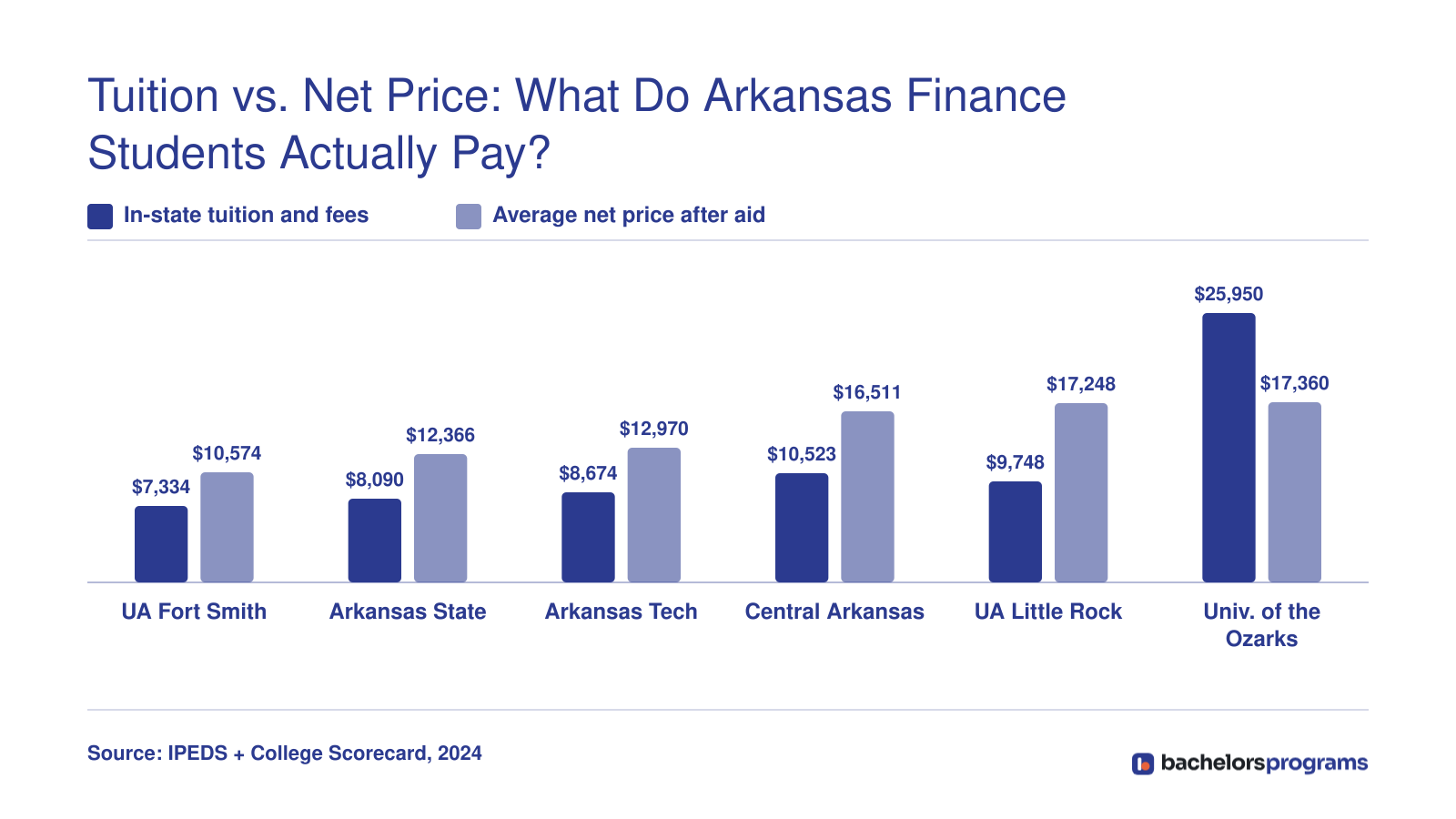
Tuition vs. Net Price: What Do Arkansas Finance Students Actually Pay?
Published in-state tuition and fees are only a starting point. Net price is the average yearly cost for students who receive aid, after grants and scholarships. It also counts housing, books and other expenses, so at public universities such as University of Arkansas-Fort Smith, Arkansas State University and Arkansas Tech University it runs several thousand dollars above tuition. At private University of the Ozarks, aid pulls net price to $17,360, about $8,590 below its $25,950 sticker price. Treat every net price as an average estimate. Your own cost depends on your aid package, so run each school's net price calculator before comparing offers.
Cost of a Finance Degree in Arkansas: Tuition, Net Price and State Aid
What does a bachelor's degree in finance in Arkansas actually cost after financial aid?
Two numbers matter, and they differ by thousands of dollars a year: the published tuition rate and the net price a student pays once grants and scholarships are applied.
In-State vs. Out-of-State Tuition
Public universities in Arkansas charge residents far less than nonresidents. At the University of Arkansas, tuition is $10,104 for Arkansas residents and $29,966 for everyone else. UA Little Rock charges $9,748 in-state and $22,158 out-of-state, Arkansas State $8,090 and $14,522, and UA Fort Smith $7,334 and $12,182. Private options such as University of the Ozarks publish one rate, $25,950, regardless of residency.
Net price tells a different story. After aid, it lands near $10,574 at UA Fort Smith, $12,366 at Arkansas State, $12,970 at Arkansas Tech, $17,360 at University of the Ozarks and $18,209 at the University of Arkansas.
Arkansas Academic Challenge Scholarship
The state's main bachelor's award is the Arkansas Academic Challenge Scholarship, administered by the Arkansas Division of Higher Education. The deadline is July 1.1 For 2025-26, awards run from $2,000 to $5,000 a year, capped at $15,000 across four years.2 Applicants must be Arkansas residents, generally for 12 months before enrolling, and meet a GPA and test-score pathway.3 Recipients take 12 credits their first fall and 15 each semester after, complete 27 credits the first year and 30 thereafter, keep a 2.5 GPA1, and may renew up to 120 credits.
Other State Aid and the FAFSA
The Arkansas Future Grant, with July 1 and January 10 deadlines, is built around certificate and associate programs in high-demand fields.4 ADHE's overview lists a $3,800 award at four-year institutions, but the detailed program page limits eligibility to associate and certificate study, so confirm before counting on it.5 The Governor's Scholars Program awards up to $5,000 a year, $20,000 total.6 File the FAFSA first, since most state and campus aid requires it.7
A Practical Tip for Lowering Net Price
Apply to several Arkansas schools, then compare financial aid offers side by side rather than sticker prices, and ask each business school about departmental scholarships. Carrying 15 credits keeps you on pace for the Academic Challenge credit requirements and for finishing in four years.
Related Articles
AACSB Accreditation and CFP Pathways at Arkansas Finance Schools
Accreditation is one of the first things finance recruiters and graduate admissions offices check on a résumé. In Arkansas, the AACSB directory lists the University of Arkansas1, University of Central Arkansas2, Arkansas State University3, Arkansas Tech University4, Southern Arkansas University5, the University of Arkansas at Little Rock6 and Ouachita Baptist University as AACSB-accredited business schools offering a bachelor's-level finance program. Each is listed with a banking component.
Why AACSB Matters
AACSB accreditation applies to a school's business college, not to an individual major. It signals that the faculty, curriculum and student outcomes have passed an outside review. That is useful in two ways.
- Employers: Banks, corporate finance teams and wealth management firms often use accreditation as shorthand for a baseline of quality when they recruit from a school they do not know well.
- Graduate plans: If you may pursue an MBA or a specialized finance credential later, a degree from an accredited business school is easier for admissions committees to evaluate.
The directory does not give accreditation effective dates, and it does not say whether each finance major is separately reviewed. Treat it as confirmation of the business school, and ask the department about anything more specific.
CFP Board Registration
A bachelor's in finance can be a first step toward the Certified Financial Planner designation, but only if the coursework meets the CFP Board's education requirement. Registered programs satisfy it automatically. Others may need a separate certificate. The directory results behind this page do not confirm which Arkansas schools hold registered status, so the CFP Board's registered-programs directory is the place to check before you enroll. Also ask each department whether its personal financial planning courses count toward the education requirement.
Other ranked schools without AACSB listing, John Brown University, Harding University, the University of the Ozarks, the University of Arkansas-Fort Smith, Lyon College and the University of Arkansas at Monticello, may still offer sound finance coursework. Their accreditation is simply different, so compare it directly with the schools above.
What Financial Analysts Earn in Arkansas
Financial and investment analyst roles are a common destination for graduates with a bachelor's degree in finance.
Finance Careers in Arkansas and Where Graduates Work
A finance bachelor's degree leads into several Arkansas sectors, and the state's employer base is more varied than many applicants expect.
Where Graduates Work
Banking is the anchor. Bank OZK, Arvest Bank, Simmons Bank, First Security Bank, Southern Bancorp and Encore Bank all hire for lending, credit analysis and branch management. Stephens Inc. in Little Rock is a notable name in investments. Corporate finance roles appear at large employers such as Tyson Foods, while insurance and real estate firms round out the mix. State government also employs finance and investment analysts, with FY2026 ranges of $58,700 to $86,876 for those two titles.2 The list is not complete or ranked; use it to begin your own search.
What the Jobs Pay
The most recent BLS state estimates available for Arkansas date to May 20231:
- Financial and investment analysts: 1,310 jobs, with a mean annual wage of $84,690.1
- Personal financial advisors: 1,910 jobs, with a mean annual wage of $113,780.1
- Loan officers: 3,020 jobs, with a mean annual wage of $80,920.1
These are averages across all experience levels, so entry-level pay will usually start lower. Advisor pay in particular often depends on client base and commissions.
Licensing in Arkansas
Finance is generally not a state-licensed profession, so you do not need an Arkansas license simply to hold a finance degree or work as an analyst. Roles in securities sales or advising are different. They may require FINRA licenses, typically the Series 7 for selling securities and the Series 66 for advisory work, which generally builds on a passing Series 7 and works alongside state registration. Employers typically sponsor these exams, so you rarely pay for them yourself, though requirements vary by role.
A Practical Tip
Treat internships as part of your degree plan. Arkansas finance hiring runs heavily on regional relationships, and schools such as the University of Arkansas, the University of Central Arkansas and Arkansas State University have employer networks you can tap through career offices and faculty. Ask each school which banks and firms recruit on campus and where recent graduates landed, then apply for a summer internship before your senior year.
Compare Finance programs on the data that matters
Explore more Business & Management majors or browse every field of study.
All Business & Management programs Browse every field of study