Best Computer Science Schools in Arkansas
Compare 15 accredited Computer Science programs in Arkansas at 11 colleges, with net price after aid, graduation rates, earnings and debt from IPEDS and the U.S. College Scorecard.

Arkansas schools award the undergraduate computer science degree as a Bachelor of Science (B.S.) or a Bachelor of Arts (B.A.) in Computer Science. Program-level earnings data shows medians near $75,000 one year after graduation, while the lowest average net price among these schools runs about $10,574 a year.
Every school covered is based in Arkansas, and both campus and online formats are included, alongside the ranked list, the most affordable colleges, graduate earnings, admissions, cost, and careers.
That combination is the real decision point. Tuition across Arkansas campuses varies far more sharply than early-career pay does, so what you borrow matters more than where the salary lands.
Key Points
- University of Arkansas ranks first, with an ABET-accredited computer science B.S.
- University of Arkansas-Fort Smith posts the lowest average net price, $10,574 yearly.
- University of Arkansas graduates earn a $95,642 median four years after completion.
Best Schools for a Bachelor's Degree in Computer Science in Arkansas
The University of Arkansas in Fayetteville is the strongest overall pick for a bachelor's degree in computer science in Arkansas, pairing an ABET-accredited B.S. with the research reach of the state's flagship campus. Below it, small private colleges compete on class size and on tracks such as artificial intelligence, cybersecurity and game development, while regional public universities keep the price of a commuter degree within reach. Each card covers the credential awarded, whether the program shows up in ABET's computing directory, and the details worth knowing before you apply.
University of Arkansas
#1Fayetteville, AR · ~$18,000/yr (est.)
Best for: In-state students wanting a research campus
The state's flagship campus awards a 122-credit B.S. in Computer Science on an eight-semester plan, with core work in programming, algorithms, software engineering and networks, capped by a capstone sequence. The B.S. is accredited by ABET's Computing Accreditation Commission, and the university is a founding member of a regional consortium that shares leadership-class computing infrastructure across more than a dozen universities. Arkansas residents pay far less than out-of-state students, and some nonresidents qualify for in-state classification. Schools offering this program have graduation rates of about 71% institution-wide, not a program-specific rate.
- 122 credit units required for the degree
- Eight-semester degree plan published in the catalog
- Core coursework in programming, algorithms and software engineering
- Computer networks and database management included
- Capstone project courses close out the sequence
- High school calculus and chemistry prerequisites for admission
- 4000-level computer science electives
- Not every course is offered each semester
John Brown University
#2Siloam Springs, AR · $20,000 – $25,000/yr (est.)
Best for: Faith-driven learners seeking small classes
John Brown University is a private Christian college in Siloam Springs that awards computer science as either a B.A. or a B.S., with hands-on labs in the Balzer Technology Center. Students choose from several emphases, and a 4+1 pathway lets them finish a bachelor's and a cybersecurity master's in five years. The program does not appear in ABET's 2026 Computing Accreditation Commission search for computer science. Schools offering this program have graduation rates of about 72% institution-wide.
- B.A. and B.S. tracks both available
- Hands-on labs in the Balzer Technology Center
- 4+1 option finishes a bachelor's and a cybersecurity master's in five years
- Multiple emphases let students tailor the major
- Courses in object-oriented programming and data structures
- Also covers database design and software engineering
- Computer Science Advisory Board links students to industry
- Accelerated master's option delivered online
Harding University
#3Searcy, AR · ~$22,000/yr (est.)
Best for: Students targeting AI and game development
Harding University, a private Christian university in Searcy, offers computer science as both a B.S. and a B.A., and the B.S. runs 120 credit hours with a heavier mathematics spine. Coursework reaches machine learning and game development, and students can compete on a programming team that travels to regional and international contests, while cybersecurity and data science partnerships add applied options. The program does not appear in ABET's 2026 Computing Accreditation Commission search. Schools offering this program have graduation rates of about 69% institution-wide.
- 120 total credit hours across four years
- Computer science core plus a strong mathematics sequence
- Machine learning and game development courses
- Competitive programming team open to students
- Team competes in regional and international contests
- Cybersecurity partnership option
- Data science partnership option
- Prepares students for software engineering and systems analysis
- Liberal arts route through the computer science major
- Software development focus
- Artificial intelligence coursework included
- Prepares students for graduate study
- Traditional campus delivery in Searcy
Hendrix College
#4Conway, AR · ~$24,000/yr (est.)
Hendrix College is a small liberal arts college in Conway where computer science classes run 10 to 20 students and a two-course Python and Java sequence comes before advanced topics. Coursework reaches database systems, mobile app development, artificial intelligence and algorithms, and every major finishes a senior capstone. Three full-time faculty keep advising personal, and the department runs programming contests, conference travel and a guest speaker series. The program does not appear in ABET's 2026 Computing Accreditation Commission search, and schools offering this program have graduation rates of about 72% institution-wide.
- Two-course programming sequence in Python and Java
- Small classes of 10 to 20 students
- Semester-long project built into advanced courses
- Senior capstone required
- Advanced work in database systems, mobile app development and AI
- Three full-time faculty in the department
- Programming contests, conference travel and guest speakers
- Mathematics courses required alongside computer science
Ouachita Baptist University
#5Arkadelphia, AR · $20,000 – $25,000/yr (est.)
Ouachita Baptist University in Arkadelphia awards computer science as either a B.S. or a B.A., letting students choose between a technical path and a broader liberal arts one. The Department of Mathematics and Computer Sciences also offers a separate cybersecurity major, so computing students sit in a department with more than one route into the field. The program is not listed in ABET's 2026 Computing Accreditation Commission search. Schools offering this program have graduation rates of about 61% institution-wide.
- B.S. and B.A. paths both offered
- Separate cybersecurity major in the same department
- Housed in the Department of Mathematics and Computer Sciences
- Course catalog and degree summary sheets published online
- Goals and objectives for the major listed publicly
University of Arkansas-Fort Smith
#6Fort Smith, AR · ~$11,000/yr (est.)
The University of Arkansas at Fort Smith awards a 120-credit B.S. in Computer Science with three 9-hour concentrations: general, artificial intelligence and data science, and cybersecurity. The curriculum spans software engineering, machine learning, big data, cloud applications and applied cryptography, so students can aim the degree at a specific slice of the job market rather than a broad middle. Learning outcomes stress problem solving, team collaboration and professional communication. The program does not appear in ABET's 2026 Computing Accreditation Commission search, and schools offering this program have graduation rates of about 38% institution-wide.
- 120 credit hours, on-campus format
- 9-hour general concentration module
- Java programming and web systems coursework
- Database systems and cloud applications covered
- 9-hour concentration module in AI and data science
- Covers big data, deep learning and data analytics
- Natural language processing coursework
- Machine learning content within the concentration
- 9-hour cybersecurity concentration module
- Applied cryptography course
- Computer forensics and cyber operations courses
- Cyber crimes coursework
Lyon College
#7Batesville, AR · ~$20,000/yr (est.)
Lyon College in Batesville treats computer science as a liberal arts discipline, awarding a B.A. in Computer Science alongside combined B.S. degrees in computer science and artificial intelligence and in computer science and cybersecurity, plus a B.A. in computer science and game development. Small classes and project work replace large lecture halls, and a computer science minor is available for students majoring in something else. The program does not appear in ABET's 2026 Computing Accreditation Commission search. Schools offering this program have graduation rates of about 47% institution-wide.
- B.A. in Computer Science offered
- B.S. in Computer Science and Artificial Intelligence
- B.S. in Computer Science and Cybersecurity
- B.A. in Computer Science and Game Development
- Computer science minor available for other majors
Philander Smith University
#8Little Rock, AR · ~$14,000/yr (est.)
Philander Smith University, a historically Black university in Little Rock, awards a B.S. in Computer Science with a concentration in health information technology and a second option in cybersecurity. Students can also pursue a 3/2 dual-degree engineering pathway through an articulation agreement with the University of Arkansas in Fayetteville. The program sits in the Department of Applied Mathematics and Computer Science, and faculty contacts are published for prospective students. It does not appear in ABET's 2026 Computing Accreditation Commission search, and schools offering this program have graduation rates of about 30% institution-wide.
- Concentration in Health Information Technology
- Cybersecurity available as a second concentration
- 3/2 dual-degree engineering pathway with the University of Arkansas
- Housed in the Department of Applied Mathematics and Computer Science
- Faculty contacts listed for prospective students
Arkansas Tech University
#9Russellville, AR · $10,000 – $15,000/yr (est.)
Arkansas Tech University in Russellville awards a 120-credit B.S. in Computer Science with a capstone, and the university's program page states the degree is accredited by ABET's Computing Accreditation Commission. Computing students complete senior projects with Arkansas organizations including the City of Russellville, the Russellville Housing Authority, the Arkansas Advanced Energy Association, local nonprofits and public-safety agencies, working on resource-navigation sites, educational platforms and sustainability tracking. That applied, local-partner focus stands out for a public university of this size. Schools offering this program have graduation rates of about 49% institution-wide.
- 120 total credit hours
- ABET Computing Accreditation Commission accreditation listed
- Capstone project courses in the final year
- Programming, data structures and algorithm design coursework
- Database design, networking and introduction to cybersecurity
- Senior projects with the City of Russellville and regional partners
- Discrete mathematics and calculus required
- Program housed in Corley Hall
Southern Arkansas University
#10Magnolia, AR · $10,000 – $15,000/yr (est.)
Southern Arkansas University in Magnolia awards a B.S. in Computer Science built around an upper-level sequence that runs from semester five through semester eight. Juniors and seniors take computer networking, network security, operating systems, data modeling, programming languages and compilers, theory of computation and software engineering, and two senior project courses close the degree. It is a direct, project-capped route for students who want a public university option in south Arkansas. The program does not appear in ABET's 2026 Computing Accreditation Commission search, and schools offering this program have graduation rates of about 49% institution-wide.
- Upper-level sequence spans semesters five through eight
- Computer networking and network security courses
- Operating systems and data modeling coursework
- Programming languages and compilers
- Theory of computation and software engineering
- Two senior project courses required
- Upper-level computer science or mathematics electives
Cost & outcomes by school
Federal data for the highest-earning Computer Science programs, independent of the ranking above. Earnings are this field's bachelor's graduates four years after completing where the Scorecard reports them, else the school's undergraduate median.
| School | Net price / yr | Grad rate | Earnings | Debt | Grads/yr | Format |
|---|---|---|---|---|---|---|
| University of Arkansas AR | $18,209 | 71% | $95,642 | $20,726 | 133 | Campus |
| Harding University AR | $22,130 | 69% | $92,014 | $24,149 | 32 | Campus |
| Hendrix College AR | $24,149 | 72% | $60,376 | $26,688 | 22 | Campus |
| John Brown University AR | $20,397 | 72% | $53,907 | $21,250 | 19 | Campus |
| Ouachita Baptist University AR | $22,409 | 61% | $51,673 | $21,050 | 6 | Campus |
| University of Arkansas at Little Rock AR | $17,248 | 42% | $45,265 | $22,000 | — | Campus |
| Lyon College AR | $19,616 | 47% | $44,232 | $21,500 | 4 | Campus |
| Southern Arkansas University AR | $14,027 | 49% | $42,386 | $18,750 | — | Campus |
| Arkansas Tech University AR | $12,970 | 49% | $41,766 | $21,000 | — | Campus |
| University of Arkansas-Fort Smith AR | $10,574 | 38% | $41,102 | $18,250 | 23 | Campus |
| Philander Smith University AR | $14,224 | 30% | $38,427 | $24,736 | 4 | Campus |
Sources: U.S. Department of Education. Net price, graduation rate, earnings and debt: College Scorecard (earnings and debt for this field's bachelor's graduates where reported, else school-wide); graduates: IPEDS. A dash means no figure is reported.
Cost, debt & payoff
Median earnings of this field's bachelor's graduates (4 yrs after completing, else the school's undergraduate median) vs. their median federal loan debt · U.S. College Scorecard
Across these programs the median graduate earns about $45,265 and finishes with roughly $21,250 in debt — a ratio that clears a common rule of thumb (keep debt below first-year salary). Net price and debt vary widely school to school, so check the per-school figures in the table above before you shortlist.
How We Ranked Arkansas Computer Science Schools
The cheapest school is not always the best-paying one, so this ranking weighs several measures at once rather than leaning on a single number.
What the Ranking Draws On
The ranking uses College Scorecard, the U.S. Department of Education's public dataset, at both the program level and the institution level. Only bachelor's programs at Arkansas-based schools are included, in campus and online formats alike. Each school's computer science program is judged on the following:
- Net price: What students pay on average after grants and scholarships, not the published sticker price.
- Graduation rate: The share of students who finish their degree at the school.
- Program earnings: Median pay for computer science graduates, where the program publishes it.
- Program debt: Typical federal loan debt for graduates of the program, where published.
Where the Data Falls Short
Some of these figures describe the whole school, not the computer science major. Graduation rate and net price are institution-wide averages, so a student in this major may see a different result than the school-wide number suggests. Smaller programs often have no published earnings or debt figures, because the federal data is withheld when too few graduates are counted. Those programs are not penalized for it. They are judged on the measures that do exist, and gaps are flagged where they matter.
Use the ranking as a starting point. Pair it with a campus visit, a look at the curriculum, and a conversation with the department.
How This Differs From Reader Polls
Many lists of top schools rest on reader votes or reputation surveys that nobody can check. This one is built on published federal figures you can look up yourself.
How Much Do Computer Science Graduates Earn at Arkansas Schools?
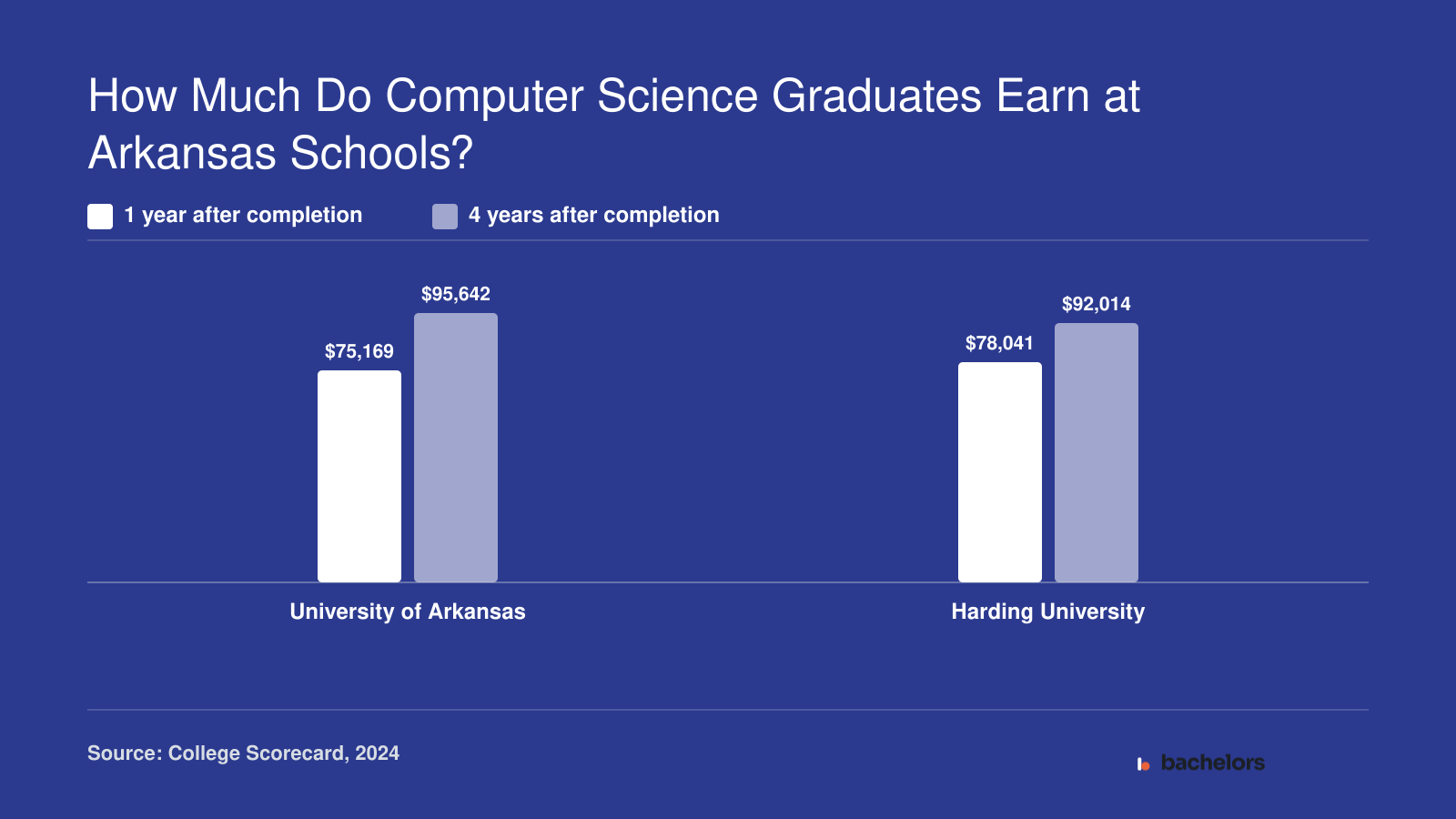
Computer science bachelor's graduates in Arkansas earn program-level medians of $75,169-$78,041 one year after completion, based on College Scorecard data for the University of Arkansas and Harding University. Four years after completion, the University of Arkansas median rises to $95,642 and Harding's to $92,014, and Harding's five-year median reaches $97,126. Hendrix College, John Brown University and Ouachita Baptist University graduate computer science classes too small for Scorecard to report program earnings, so the chart compares only the two schools with reportable figures.
Online and Hybrid Bachelor's Computer Science Options at Arkansas Schools
An online or hybrid bachelor's degree in computer science is a four-year B.S. or B.A. delivered mostly or entirely over the internet, with little or no required time on campus. For the Arkansas schools covered here, the answer to "can I finish this degree online?" is not a clear yes. The verified program pages for these schools describe campus-based delivery, so treat every school as campus-first until its admissions or department office confirms otherwise in writing.
Campus-based programs and their formats
- University of Arkansas (Fayetteville): The Bachelor of Science in Computer Science is a campus-based, eight-semester plan of study.3 The plan of study mentions no online or hybrid option.
- University of Arkansas-Fort Smith: The Bachelor of Science in Computer Science is an on-campus, 120-credit-hour program. Students choose from General, AI/Data Science, and Cybersecurity concentrations.
- Harding University: The B.S. is campus-based, with cybersecurity and data science partnership options.
- John Brown University, Ouachita Baptist University, and Lyon College: Each offers B.A. and B.S. paths, all listed as campus programs. Lyon's variants pair computer science with AI, cybersecurity, or game development.
- Hendrix College, Philander Smith University, Arkansas Tech University, and Southern Arkansas University: All four list on-campus computer science majors.
The University of Arkansas at Little Rock offers a 120-credit-hour Bachelor of Science in Computer Science.1 The sources we reviewed do not show it can be completed fully online, and they do not describe a hybrid format. Ask the department directly before you plan around remote study.
Check ABET before you enroll online
ABET accreditation matters to many employers and to some graduate programs. The University of Arkansas at Little Rock's B.S. is accredited by the Computing Accreditation Commission of ABET,2 and Arkansas Tech's program page also notes ABET accreditation. If any school offers you an online or hybrid version, ask whether that version sits under the same ABET-accredited program as the campus degree. Institutional accreditation, such as the regional or national kind that covers an entire university, is not the same thing as ABET accreditation of the computer science program.
Before applying, confirm the delivery format, any online concentrations, and any degree-completion pathway for transfer students on each school's current catalog page.
Related Articles
Cost of a Computer Science Degree in Arkansas: Tuition and Net Price
In Arkansas, the sticker price of a computer science bachelor's degree and what families actually pay are two different numbers, and the gap is widest at the schools that look most expensive up front.
What the published rates look like
For 2026-27, in-state tuition and mandatory fees at the state's public universities cluster tightly. Arkansas Tech lists roughly $10,489 for a resident undergraduate carrying 15 hours per semester at Russellville, or about $264.99 per credit hour.1 The University of Arkansas estimates about $10,916 for a typical resident taking 30 credit hours across the year ($8,336 in tuition plus $2,580 in fees).2 UA Little Rock's average resident figure runs about $10,185 for fall and spring combined.3 These rates rest on different credit-hour assumptions, so treat them as a band rather than a line-by-line comparison.
Net price tells a different story
Average net price, meaning what students pay after grants and scholarships, reorders things. UA Fort Smith comes in lowest at roughly $10,574, followed by Arkansas Tech near $12,970 and Southern Arkansas around $14,027. The private colleges publish far higher sticker figures, Ouachita Baptist at $34,500 and John Brown at $31,756, yet their net prices land near $22,409 and $20,397 after institutional aid. Harding discounts from $26,262 down to about $22,130. The private discount is deep, but it rarely closes the gap entirely.
Debt and the fine print
Median graduate debt is remarkably consistent across the state: about $18,250 at UA Fort Smith, $21,000 at Arkansas Tech, $21,500 at the University of Arkansas and Lyon, and $26,500 at Harding. Four things worth holding onto:
- Regional public universities are the cheapest in-state path, both before and after aid.
- The average spans a full class, so it is not a quote for you. Your award depends on income, test scores and merit criteria.
- Out-of-state rates jump sharply because non-residents do not benefit from state appropriations: the University of Arkansas charges $29,966 versus $10,104 in-state.
- A private college's published price tells you very little until you see the award letter.
Common Questions About Computer Science Degrees in Arkansas
These answers draw on the school pages and rankings covered above. Program details can change, so confirm specifics with each school before you apply.
What is the best college for computer science in Arkansas?
Which Arkansas colleges have ABET-accredited computer science programs?
Can I transfer from an Arkansas community college into a bachelor's computer science program?
Do I need a license to work in computer science in Arkansas?
Compare Computer Science programs on the data that matters
Explore more Computers & IT majors or browse every field of study.
All Computers & IT programs Browse every field of study