Best Finance Schools in California
Compare 55 accredited Finance programs in California at 52 colleges, with net price after aid, graduation rates, earnings and debt from IPEDS and the U.S. College Scorecard.

A finance bachelor's degree in California forces a choice between public affordability and private-school connections. The common credential is the Bachelor of Science (B.S.) in Finance, though many schools award it as a business administration degree with a finance concentration. Cal State campuses cost far less than Southern California's private universities, which tend to offer smaller classes and stronger employer pipelines in Los Angeles and San Diego.
Every program listed is a bachelor's program at a California school, delivered on campus or online.
Most finance majors still graduate into a regional job market anchored by banking, wealth management and technology.
Key Points
- California State University-Los Angeles posts the lowest net price: $3,967.
- San Jose State finance graduates earn a $98,041 median five years out.
- USC admits about 9.8% of applicants; California State University-San Bernardino, 93.7%.
Best Finance Schools in California: Top 10 Bachelor's Programs Ranked
California's strongest undergraduate finance programs are not all found in the same kind of school. The ten below range from a UC campus in the Inland Empire to private business schools in Los Angeles and San Diego, and each pairs a business core with a finance specialization. The entries note what the finance coursework actually covers, what hands-on investing experience is available, and which students each program fits.
University of California-Riverside
#1Riverside, CA · ~$14,000/yr (est.)
Best for: Inland Empire students wanting a UC degree
UC Riverside's Bachelor of Science in Business Administration carries a finance concentration built on financial management, investments, and risk, with electives that reach into options, futures, and portfolio management. The coursework leans quantitative and points toward corporate finance, investment management, and financial engineering roles. Undergraduates practice investment analysis through the Hylander Financial Group and connect with the CFA Society of Los Angeles. It gives Inland Empire students a research-university route into finance without leaving the region.
- Concentration requires five focused finance courses
- Covers corporate governance, mergers and acquisitions, risk
- Electives include options, futures, and portfolio management
- Wide course selection within the concentration
- Hylander Financial Group for hands-on investment practice
- Ties to the CFA Society of Los Angeles
University of Southern California
#2Los Angeles, CA · ~$33,000/yr (est.)
Best for: CFA-track students targeting investment banking
USC's Marshall School of Business offers the finance emphasis inside its Bachelor of Science in Business Administration, blending a rigorous business core with finance, economics, and computer modeling. Marshall is a CFA Institute Program Partner, with coursework intended to cover much of the knowledge tested in the CFA program, and the university also runs joint degrees in accounting and finance and in real estate finance and development. The emphasis requires at least 12 upper-division finance units and is open to Marshall and Leventhal undergraduates who have completed the prerequisite. It carries the most established finance recruiting network of any school on this list.
- At least 12 upper-division units in finance and business economics
- Blends finance, economics, and computer modeling
- Requires sophomore standing before declaring
- Prior credit for the finance fundamentals course required
- Open to current Marshall and Leventhal undergraduates
- Only one emphasis may be earned
San Jose State University
#3San Jose, CA · ~$14,000/yr (est.)
Best for: Bay Area commuters seeking affordable coursework
San Jose State's finance concentration sits inside its Bachelor of Science in Business Administration and covers corporate finance, investment analysis, and the operation of U.S. and global money and capital markets. Students take required coursework in financial institutions and financial management and can add electives in real estate finance, entrepreneurial finance, and international business finance. A published four-year roadmap and a C-or-better standard in major courses keep progress predictable. Its Silicon Valley location puts banks, corporations, and investment firms within commuting distance.
- 120 total credit hours with a published four-year roadmap
- Concentration requires 18 units of finance coursework
- Required courses in financial institutions and investment analysis
- Electives: real estate finance, entrepreneurial finance, international finance
- Grade of C or better required in major courses
University of San Diego
#4San Diego, CA · $30,000/yr (est. net price)
The Knauss School of Business at the University of San Diego awards a Bachelor of Business Administration with finance as one of six majors, pairing a broad business foundation with finance specialization. The business school setting and a student-faculty ratio of 13 to 1 keep classes small and advising close. Students choose finance as a full major rather than an add-on concentration, and graduates move into banking, asset management, and corporate finance roles with support from a deep Southern California alumni base.
- Finance is one of six majors in the BBA
- Housed in the Knauss School of Business
- Main campus program in San Diego
- Broad business core plus a finance specialization
California State University-San Bernardino
#5San Bernardino, CA · $4,600/yr (est. net price)
Cal State San Bernardino offers a finance concentration inside its Bachelor of Arts in Administration, covering financial institutions, capital markets, investment analysis, and international finance. A capstone ties the coursework together, and electives open into student-managed investment funds, real estate finance, or retirement planning. The program emphasizes communication, problem solving with technology, and ethical reasoning in a global context. It is one of the lowest-priced routes to a finance degree on this list, which matters for students paying their own way.
- Finance concentration inside a 120-unit administration major
- Covers international finance, financial theory, and case studies
- Capstone required
- Electives include student-managed investment funds and retirement planning
- 17 concentration options across the administration major
- Builds communication, technology, and ethical reasoning skills
California State University-Northridge
#6Northridge, CA · ~$7,000/yr (est.)
CSUN's Bachelor of Science in Business Administration offers three finance tracks: Financial Analysis, Financial Planning, and Risk Management and Insurance. Coursework runs from corporate and quantitative finance to fixed income, financial modeling, business valuation, and futures and options, with a required capstone. A standout is the Student Portfolio Management class, where a small group of students runs a real stock portfolio. The planning track is aimed at students heading into personal financial planning careers.
- Coursework in fixed income, futures and options, quantitative finance
- Student Portfolio Management class runs a real stock portfolio
- Honors section of the advanced finance course available
- Capstone required; 120 total credit hours
- C or higher in the introductory finance course required
- Prepares for personal financial planner careers
- Electives in investment analysis and financial modeling
- Honors portfolio management class open to planning students
- Prepares for careers in risk management and insurance
- One of three finance concentration options in the major
Biola University
#7La Mirada, CA · $30,000 – $35,000/yr (est.)
Biola's Bachelor of Science in Business Administration includes a finance concentration with two tracks, Corporate Finance and Financial Planning. The Financial Planning track meets the education requirements for the CFP credential, and coursework covers corporate finance, investments, and organizational leadership alongside financial modeling and spreadsheet analysis. Students can manage real money through the Student Investment Fund and join the Biola Financial Planning Association. It is a smaller, faith-based private option in Los Angeles County for students who want a tight-knit business program.
- Two tracks: Corporate Finance and Financial Planning
- Financial Planning track meets CFP education requirements
- Coursework in corporate finance, investments, organizational leadership
- Student Investment Fund manages a real portfolio
- Biola Financial Planning Association for networking
- Builds financial modeling and spreadsheet analysis skills
Loyola Marymount University
#8Los Angeles, CA · ~$48,000/yr (est.)
Loyola Marymount's finance major grounds students in capital markets and the analytical tools used in corporate finance, banking, and investments, with an emphasis on applied financial modeling. The Finance Learning Lab houses twelve Bloomberg Terminals, and students can earn the Bloomberg Market Concepts certification at no cost while running the Student Investment Fund. A four-year activity plan maps internships, networking, and career preparation from the first year onward. Graduates are recruited into investment banking, asset management, corporate treasury, and financial analysis.
- Foundation in capital markets and applied financial modeling
- Twelve Bloomberg Terminals in the Finance Learning Lab
- Free Bloomberg Market Concepts certification
- Student Investment Fund for security analysis and valuation
- Four-year activity plan maps internships and networking
California Lutheran University
#9Thousand Oaks, CA · ~$30,000/yr (est.)
California Lutheran University's School of Management awards a Bachelor of Science in Business Administration with a finance emphasis that generally requires 12 credits of approved electives. Core coursework spans accounting, economics, statistics, business communications, and the legal environment, with internships encouraged throughout. Students work with the Steven Dorfman Center for Innovation and Entrepreneurship and the Center for Economic Research and Forecasting, and eligible seniors can begin graduate coursework through a 4+1 MBA path. It suits students who want a small-university business program in Ventura County.
- Finance emphasis generally requires 12 credits of electives
- Five emphasis options within the business administration degree
- Core includes accounting, economics, statistics, business communications
- Internships encouraged in the business world
- Steven Dorfman Center for Innovation and Entrepreneurship
- Center for Economic Research and Forecasting
- Eligible seniors may start graduate courses via 4+1 MBA
University of La Verne
#10La Verne, CA · $20,000 – $25,000/yr (est.)
The University of La Verne offers a Bachelor of Arts in Business Administration with a business finance concentration built on Managerial Finance plus two electives chosen from investments, financial institutions, international finance, or money and banking. At 12 semester hours inside a 52-hour major, the concentration pairs easily with a second concentration or an accelerated finish. Core coursework covers accounting, marketing, management information systems, leadership, and a business seminar. Up to 15 units of graduate work can count toward both a bachelor's and a master's degree.
- 52 semester hours total: prerequisites, core, electives
- Finance concentration is 12 semester hours
- Built on Managerial Finance plus two electives
- Electives: investments, financial institutions, international finance, money and banking
- Up to 15 graduate units may count toward both degrees
- Seven concentration options in the major
Cost & outcomes by school
Federal data for the highest-earning Finance programs, independent of the ranking above. Earnings are this field's bachelor's graduates four years after completing where the Scorecard reports them, else the school's undergraduate median.
| School | Net price / yr | Grad rate | Earnings | Debt | Grads/yr | Format |
|---|---|---|---|---|---|---|
| Santa Clara University CA | $50,062 | 88% | $118,737 | $14,490 | 226 | Campus |
| Loyola Marymount University CA | $48,381 | 79% | $109,303 | $19,500 | 156 | Campus |
| Menlo College CA | $31,100 | 54% | $103,918 | $23,250 | 33 | Campus |
| University of San Francisco CA | $41,431 | 70% | $103,605 | $24,394 | 58 | Campus |
| West Coast University-Anaheim-Orange County CA | $32,879 | 60% | $102,672 | $32,946 | — | Online |
| University of San Diego CA | $30,365 | 84% | $93,099 | $23,094 | 239 | Campus |
| University of Southern California CA | $32,740 | 92% | $92,498 | $18,000 | — | Campus |
| California Polytechnic State University-San Luis Obispo CA | $16,665 | 86% | $90,768 | $18,500 | — | Campus |
| San Diego State University CA | $15,364 | 76% | $88,136 | $15,000 | — | Campus |
| Dominican University of California CA | $35,333 | 78% | $84,713 | $27,000 | — | Campus |
| Pepperdine University CA | $58,098 | 83% | $82,939 | $23,510 | 40 | Campus |
| University of California-Davis CA | $14,741 | 86% | $80,838 | $13,000 | — | Campus |
Sources: U.S. Department of Education. Net price, graduation rate, earnings and debt: College Scorecard (earnings and debt for this field's bachelor's graduates where reported, else school-wide); graduates: IPEDS. A dash means no figure is reported.
Cost, debt & payoff
Median earnings of this field's bachelor's graduates (4 yrs after completing, else the school's undergraduate median) vs. their median federal loan debt · U.S. College Scorecard
Across these programs the median graduate earns about $69,391 and finishes with roughly $17,750 in debt — a ratio that clears a common rule of thumb (keep debt below first-year salary). Net price and debt vary widely school to school, so check the per-school figures in the table above before you shortlist.
Most Affordable Bachelor's in Finance Schools in California
These California public universities offer a bachelor's degree in finance at the lowest average net price, which is what students pay after grants and scholarships. California State University-Los Angeles has the lowest net price at $3,967, and California State University-San Bernardino, which also appears in our main ranking, follows at $4,564. The remaining schools are in our directory; all figures come from 2024 IPEDS and College Scorecard data from the U.S. Department of Education, and earnings and debt reflect all graduates of each school, not finance majors alone.
| School | City | Finance Program | In-State Tuition & Fees | Average Net Price | Graduation Rate | Median Earnings (10 Yrs After Entry) | Median Graduate Debt |
|---|---|---|---|---|---|---|---|
| California State University-Los Angeles | Los Angeles | Business Administration, B.S.: Option in Finance | $7,160 | $3,967 | 53% | $59,211 | $13,000 |
| California State University-San Bernardino | San Bernardino | Bachelor of Arts in Administration (Finance concentration) | $8,093 | $4,564 | 55% | $59,977 | $14,715 |
| California State University-Stanislaus | Turlock | Business Administration (Finance concentration) | $8,246 | $6,067 | 53% | $63,188 | $13,540 |
| California State University-Fullerton | Fullerton | Business Administration, Finance Concentration | $7,470 | $6,555 | 70% | $62,951 | $13,750 |
| California State University-Fresno | Fresno | Business Administration, Finance Option | $7,350 | $7,000 | 57% | $61,244 | $14,505 |
Bachelor's in Finance Programs With the Highest Graduate Earnings in California
San Jose State University stands out on value: its graduates reach a median of $98,041 at the five-year mark on in-state tuition and fees of $8,410, a fraction of what the private schools charge. Menlo College's earnings figure is measured four years after graduation, so read it alongside the five-year figures with that difference in mind.
| School | Location | Type | Median Graduate Earnings | Years After Graduation | Median Earnings 1 Year After Graduation | In-State Tuition and Fees | Median Program Debt |
|---|---|---|---|---|---|---|---|
| Loyola Marymount University | Los Angeles | Private | $116,165 | 5 | $70,542 | $62,357 | $19,500 |
| University of San Diego | San Diego | Private | $107,544 | 5 | $64,819 | $59,486 | $23,094 |
| University of San Francisco | San Francisco | Private | $107,184 | 5 | $64,972 | $60,492 | $24,394 |
| Menlo College | Atherton | Private | $103,918 | 4 | $69,684 | $53,630 | $23,250 |
| San Jose State University | San Jose | Public | $98,041 | 5 | N/A | $8,410 | N/A |
Related Articles
Online and Hybrid Bachelor's in Finance Options at California Schools
Campus study is still the default for finance in California, and online choices are narrow. Among the highest-ranked schools, only University of La Verne lists both campus and online formats. UC Riverside, USC, San Jose State, University of San Diego, Cal State San Bernardino, CSUN, Biola, Loyola Marymount and Cal Lutheran all list campus delivery.
Where online and blended formats show up
California State University-East Bay lists its B.S. in Business Administration, Finance option as blended and online, with the main campus in Hayward. La Verne's finance concentration sits inside a Business Administration (BA) degree and includes 12 semester hours of finance coursework. Neither is a degree titled simply "B.S. in Finance." The finance track is part of a broader business major, the structure most California schools use. Sacramento State follows the same model, with a 21-unit Finance concentration inside a 66-unit major and 120 total units for 2026-2027. Its catalog does not establish an online or hybrid format.
What to verify before you apply
- In-person requirements: East Bay's program information does not say whether classes meet on campus or how often. Ask the department directly.
- Tuition: The research did not confirm whether online students at these schools pay different rates than campus students. Request the online per-unit rate in writing.
- Degree title: Confirm the finance option appears on your transcript and diploma, not only a general business degree.
- Who it suits: Working adults, transfer students and anyone outside commuting range gain the most from blended formats. Students who want a student-managed investment fund, Bloomberg terminals or on-campus recruiting should weigh how much of that an online track includes.
Third-party lists sometimes name additional online finance programs. Treat those as leads and verify format and requirements on the school's own program page.
Admission Requirements for California Finance Schools: CSU, UC and Private
USC admitted about 9.8% of applicants in the latest data, while California State University-San Bernardino admitted about 93.7%. That range shows how differently the three tracks admit students.
How Selectivity Differs by Track
- CSU: California State University-Northridge (about 93.5%) and San Jose State University (about 84.6%) admit most applicants. A 2.00 GPA is the system-wide floor, but popular campuses and majors often require much more.1
- UC: University of California-Riverside admits about 76.4%. UC admission is holistic, so coursework rigor and GPA matter more than a single cutoff.
- Private nonprofit: The range is wide. Loyola Marymount University admits about 45.1% and the University of San Diego about 52.4%, while California Lutheran University (about 75.7%), Biola University (about 74.4%) and the University of La Verne (about 71.2%) are more open.
GPA, Test Policy and Impaction
Finance and business are often impacted at CSU and UC campuses: more qualified applicants apply than there are seats, so the bar sits above the minimum. Confirm on each campus's admissions page whether that status applies to its finance program; it could not be verified school by school.
For testing, the CSU and UC systems have not used SAT or ACT scores in admission decisions in recent cycles, but confirm the current policy before you apply. Private schools set their own rules, and test-optional policies are common. Several schools do not publish a firm GPA minimum for first-year applicants, so treat any figure you find elsewhere as a typical profile rather than a guarantee.
Transfer Credit and Major Entry
CSU campuses generally want junior-level transfers with 60 semester units (90 quarter units), a cumulative GPA of at least 2.0 and completed English composition, critical thinking, oral communication and quantitative reasoning courses.2 Campuses that are highly impacted typically admit transfers with higher GPAs. The Associate Degree for Transfer can be reported on a CSU application, but it does not by itself guarantee a spot in finance.3 Use the ASSIST database to check how community college courses map to each campus.
Major-entry rules vary by school. At California State University-Northridge, transfer grades below C are not accepted for finance courses, and upper-division finance work requires a C or higher in FIN 303. At USC, the finance emphasis is open to current business undergraduates with sophomore standing and prior credit for BUAD 306.
Practical Tip: First-Year vs. Transfer
First-year applicants should plan around the CSU and UC application window, which typically runs October 1 through November 30.4 Transfer students should finish the lower-division business and math courses before applying and keep their GPA as high as possible, since the major itself may be the harder gate.
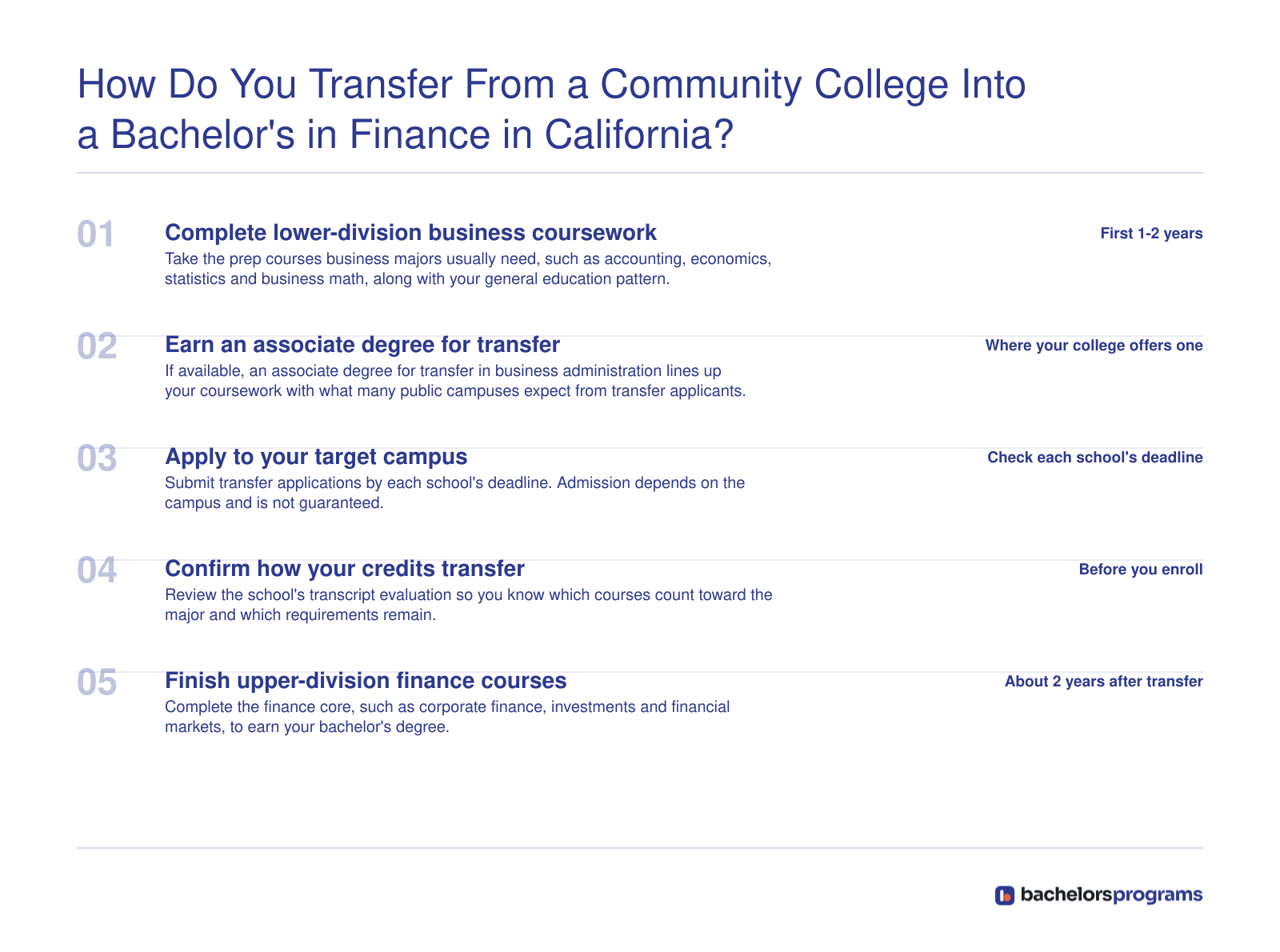
How Do You Transfer From a Community College Into a Bachelor's in Finance in California?
Many finance students in California start at a community college and transfer to finish the bachelor's. The order below follows a typical route, but each campus sets its own transfer rules, so confirm the details with your target school's admissions office.
How Much a Bachelor's Degree in Finance Costs in California: CSU vs. UC vs. Private
At California State University, a 2026-27 undergraduate enrolled in more than 6 units per term pays $6,838 in systemwide tuition1, and the average campus mandatory fee adds $2,194, for an average combined $9,032.2 That total is the clearest starting point for costing a CSU finance degree, but it is an average, not a flat systemwide charge.
The CSU Rate Card
CSU tuition depends on unit load. Students taking 6 or fewer units per term pay $3,962 in systemwide tuition. Mandatory fees differ from campus to campus, so two CSU finance programs can carry different total costs even though the tuition line looks the same. Budget from the campus's own cost-of-attendance page, not from the systemwide average alone.
Out-of-State and Nonresident Students
A nonresident undergraduate pays systemwide tuition plus $471 per semester unit.1 For a typical full-time load of 30 semester units, the nonresident surcharge is $14,130, and systemwide plus nonresident tuition reaches $20,968 before campus mandatory fees.3 Nonresident tuition waivers may apply in some cases, so ask the campus directly before assuming the full surcharge.
UC and Private Universities
UC campuses and private California universities publish their own cost-of-attendance figures, which combine tuition, campus fees, housing, books, and personal expenses. Private universities generally do not use the public-system in-state and out-of-state split. Compare the net price after grants and scholarships, not the sticker price, because aid can change the out-of-pocket difference between a public and private finance degree.
What to Compare
Put four numbers side by side for each finance program: tuition, mandatory campus fees, housing and food, and the net price after gift aid. The first two are published on official cost pages; the last two turn a headline tuition rate into a realistic annual budget.
California Financial Aid for Finance Majors: Cal Grant, Middle Class Scholarship and More
Sticker tuition is the published price; net price is what students actually pay after federal, state and campus grants. Net price figures are campus or sector averages, not a quote for any one student; your own offer will depend on income, assets, residency and when you file.
Cal Grant, the Middle Class Scholarship and campus aid
- Cal Grant A: For 2026, the maximum is $5,742 for eligible undergraduates at a CSU campus and $12,570 at a UC campus.1 Eligibility turns on income, assets, GPA and academic progress, and you must file the FAFSA or the California Dream Act Application (CADAA).1
- Cal Grant B: Same application, aimed at students with the highest need; residency or AB 540 status, income, asset, GPA and progress rules all apply.2
- Middle Class Scholarship: Pays 10% to 40% of mandatory systemwide tuition and fees at a UC, CSU or community college bachelor's program.3 You need California residency, or AB 540 eligibility, and for 2025-26 the family income ceiling ran up to $234,000.4 Awards vary with cost of attendance and state funding, so no fixed dollar amount is promised.
Deadlines and one takeaway
March 2 is the standard Cal Grant deadline, and the California Student Aid Commission has used an early April date in some recent cycles.5 Dates can shift, so confirm the current one before you file.
Aid narrows the gap between public and private sticker prices. Where net price is reported for the CSU campuses in our ranking, it runs from $4,564 at California State University-San Bernardino to $7,021 at California State University-Northridge, and roughly 86% to 87% of students at those two campuses receive Pell Grants.
Finance Careers in California After a Bachelor's Degree
A bachelor's degree in finance leads to a handful of well-defined career paths in California, and the strongest pay is in advising and analysis.
Main Career Paths
- Corporate finance: Budgeting, forecasting and financial analysis inside companies of every size.
- Financial planning and advising: Helping individuals manage investments, retirement and taxes.
- Investment and banking: Research, portfolio support and client service roles at banks and investment firms.
- Lending: Evaluating and approving consumer, mortgage and commercial loans.
- Risk management: Measuring credit, market and operational risk for lenders, insurers and corporations.
Wages and Outlook
Personal financial advisors in California earned a mean annual wage of $143,240 in May 2023, with about 32,100 employed statewide, according to Bureau of Labor Statistics (BLS) state data.1 Nationally, BLS reports 2025 median annual wages of $103,570 for financial analysts2, $105,070 for personal financial advisors3 and $76,690 for loan officers.4
National projections for 2025 to 2035 favor analysts: BLS expects financial analyst employment to grow 7 percent (about 32,000 jobs)2, while personal financial advisors and loan officers are each projected to grow 1 percent.3 These are national figures, so California demand may differ.
The graduate earnings table earlier on this page measures something different. It tracks pay for graduates of specific programs, while BLS figures cover everyone in an occupation, including workers with decades of experience. Use the program figures to compare schools and the occupational wages to gauge long-term potential.
Credentials and California Licensing
Two professional credentials matter most. The Chartered Financial Analyst (CFA) charter suits graduates headed into investment analysis or portfolio management; it involves passing a series of exams and building qualifying work experience, so most candidates start during their first years on the job. The Certified Financial Planner (CFP) certification fits those pursuing advising and generally requires a bachelor's degree, planning coursework, an exam and professional experience. Requirements change, so confirm current rules before enrolling.
Some roles also carry state licensing. Investment adviser representatives in California generally must pass a qualifying exam and register with the California Department of Financial Protection and Innovation (DFPI). Mortgage loan originators working for state-licensed lenders typically need a license obtained through the Nationwide Multistate Licensing System (NMLS) and overseen by the DFPI. Check the DFPI's current requirements before applying, since education, testing and renewal rules can change.
Compare Finance programs on the data that matters
Explore more Business & Management majors or browse every field of study.
All Business & Management programs Browse every field of study