Best Computer Science Schools in California
Compare 79 accredited Computer Science programs in California at 59 colleges, with net price after aid, graduation rates, earnings and debt from IPEDS and the U.S. College Scorecard.

California's tech employers hire computer science graduates in volume, and the state's schools range from highly selective private institutions to public campuses with admit rates above 90 percent. That spread makes the bachelor's degree in computer science a question of fit, not just prestige. Schools award it as a Bachelor of Science or a Bachelor of Arts in Computer Science, and the B.S. is far more common.
It ranks undergraduate programs, not the graduate research rankings that dominate search results, which reward faculty output over what a first-degree student experiences.
The real tension is access against cost: Stanford admits about 4 percent of applicants, while Cal State Fullerton admits about 91 percent.
Key Points
- The cheapest options here are CSU campuses, under $7,100 net price yearly.
- A 3.0 GPA meets UC eligibility but rarely wins CS admission.
- California State University-Monterey Bay offers a fully online computer science bachelor's.
Best Computer Science Schools in California: Our Top 10 Bachelor's Programs
What separates the top of this list from the rest is the depth of upper-division coursework and how close the campus sits to California's technology employers. The first three also give students a way to specialize early, through subplans, research, or a defined transfer pathway. Every school below awards a Bachelor of Science in Computer Science, and each entry notes how selective it is and what students pay after aid.
Stanford University
#1Stanford, CA · $10,000 – $15,000/yr (est.)
Best for: Research-focused students targeting AI subplans
A private research university in Stanford, it is the most selective campus on this list, admitting roughly 4% of applicants. Schools offering this program have graduation rates of 92%, and net price after aid averages near $13,800. The computer science B.S. leans on heavy math, science, and engineering fundamentals, then closes with a senior project.
- 93 units in the major, 180 university units overall
- At least 26 units of math, 11 of science, 10 of engineering fundamentals
- 3-unit senior project capstone required
- Honors track requires a 3.6 GPA and an honors thesis
- Subplans: AI, Computational Biology, Computer Engineering, HCI, Systems, Theory, Visual Computing
- Individually Designed subplan available for self-directed students
University of California-Los Angeles
#2Los Angeles, CA · $13,000/yr (est. net price)
Best for: Los Angeles applicants wanting a large public campus
A public research university in Los Angeles, it admits about 9% of applicants. Schools offering this program have graduation rates of 93%, and net price after aid runs near $12,500 for California residents. The B.S. builds a broad foundation across computing, with room to shape the upper division around your goals.
- Offered as a standing major in the UCLA catalog
- Rigorous foundation across the core areas of computing
- Built around analytical and problem-solving skills
- Prepares graduates for technology careers and graduate study
University of California-San Diego
#3La Jolla, CA · $10,000 – $15,000/yr (est.)
Best for: Transfer students needing a structured multi-year plan
A public university in La Jolla, it admits roughly 27% of applicants. Schools offering this program have graduation rates of 86%, with net price after aid near $12,500 for California residents. Computer science is the department's largest undergraduate major, and transfer students get a tailored multi-year plan.
- Department's largest undergraduate major
- Lower-division work in math, programming methodology and computer organization
- Electives span Systems, Theory/Abstraction and Applications of Computing
- Cross-disciplinary electives in cognitive science, ECE, linguistics and math
- Graduate-level courses can count toward the major
- CSE Honors Program for high-achieving students
California Institute of Technology
#4Pasadena, CA · ~$16,000/yr (est.)
A small private institute in Pasadena, it admits about 3% of applicants and graduates 94% of students, the highest rate on this list, with net price after aid near $16,100. Classes are tiny, faculty mentorship is built in, and undergraduate research is part of the culture rather than an extra.
- Six concentration options, including AI and machine learning, and robotics
- Thesis or capstone project required
- No prior programming experience required
- SURF summer research fellowships open to undergraduates
- Small classes with close faculty mentorship
- Computer science minor can be added to another major
University of California-Santa Barbara
#5Santa Barbara, CA · $15,000 – $20,000/yr (est.)
A public university in Santa Barbara, it admits about 33% of applicants. Schools offering this program have graduation rates of 83%, and net price after aid averages near $16,100 for California residents. The B.S. pairs a theory-heavy core with a two-quarter senior capstone presented at the department's annual Summit.
- Two-quarter senior capstone presented at the department's annual Summit
- Electives in machine learning, networking, security and human-computer interaction
- Student organizations include ACM and Women in Software and Hardware
- Degree also opens paths in business, law and medicine
- Research opportunities across many computing fields
Pomona College
#6Claremont, CA · ~$19,000/yr (est.)
A private liberal arts college in Claremont, it admits about 7% of applicants and graduates 93% of students, with net price after aid near $19,300. Computer science is one of its most in-demand majors, and students can reach upper-division courses across The Claremont Colleges consortium.
- CSCI 51 must be taken within the first three semesters to guarantee a seat
- CSCI 50 can be skipped with prior programming experience
- High-demand major with fixed seats allocated by class year
- Upper-division courses reserve seats for Claremont Colleges students
- Major and minor both available to undergraduates
- Tracks: Artificial Intelligence, Cybersecurity
- Undergraduate research opportunities in the department
California Polytechnic State University-San Luis Obispo
#7San Luis Obispo, CA · ~$17,000/yr (est.)
A public polytechnic in San Luis Obispo, it admits about 31% of applicants. Schools offering this program have graduation rates of 86%, and net price after aid averages near $16,700 for California residents. The computer science B.S. is project-heavy from the first year and ends in a senior project done solo or on a team.
- ABET accredited by the Computing Accreditation Commission
- 120 total units, including a senior project
- Project work in multiple programming languages and on different systems
- Six concentrations, including AI, cybersecurity and game development
- 2.0 GPA minimum for the major
- General Curriculum option for students who have not picked a concentration
California State University-Fullerton
#8Fullerton, CA · $7,000 – $20,000/yr (est.)
A public university in Fullerton, it admits about 91% of applicants and graduates 70% of students, with net price after aid near $6,600, the lowest on this list. The 120-unit B.S. keeps general education requirements lean for computer science majors and ends in a required capstone.
- ABET accredited, 120 units total
- Required senior capstone project
- Placement exams can waive introductory courses
- General education exceptions tailored to computer science majors
- Electives in web development, game design, data science and cybersecurity
- Coursework includes ethics and software engineering
California State University-Long Beach
#9Long Beach, CA · $7,000 – $20,000/yr (est.)
A public university in Long Beach, it admits about 46% of applicants. Schools offering this program have graduation rates of 69%, and net price after aid averages near $10,400 for California residents. Its ABET-accredited B.S. builds computer security into the core rather than treating it as an optional elective.
- ABET accredited under the computer science program criteria
- Core covers algorithms, database systems, operating systems and security
- Electives in networking, AI, user interface design and graphics
- Advising through the Engineering Student Success Center, split by last name
- Department cites close ties with local industry
University of California-Santa Cruz
#10Santa Cruz, CA · $15,000 – $20,000/yr (est.)
A public university in Santa Cruz, it admits about 66% of applicants and graduates 75% of students, with net price after aid near $17,900. The B.S. is compact, built around roughly 22 courses, and offers a capstone or senior thesis exit for students aiming at graduate study.
- 22 courses minimum, or 23 without the test-out option
- Major qualification needs three CSE courses plus calculus at a 3.0 GPA
- At most one unsuccessful attempt at a major course
- Capstone course or senior thesis fulfills the exit requirement
- Honors at a 3.5 GPA; highest honors at 3.8
- Transfer applicants need five specified courses at a 3.0 combined GPA
- Published four-year first-year plan and two-year transfer plan
Cost & outcomes by school
Federal data for the highest-earning Computer Science programs, independent of the ranking above. Earnings are this field's bachelor's graduates four years after completing where the Scorecard reports them, else the school's undergraduate median.
| School | Net price / yr | Grad rate | Earnings | Debt | Grads/yr | Format |
|---|---|---|---|---|---|---|
| Pomona College CA | $19,285 | 93% | $217,051 | $11,782 | 77 | Campus |
| Stanford University CA | $13,807 | 92% | $214,907 | $10,399 | 446 | Campus |
| University of California-Berkeley CA | $13,481 | 93% | $204,379 | $13,750 | 1,029 | Campus |
| California Institute of Technology CA | $16,075 | 94% | $200,511 | — | 88 | Campus |
| Harvey Mudd College CA | $35,924 | 92% | $198,257 | $22,949 | 54 | Campus |
| University of Southern California CA | $32,740 | 92% | $192,897 | $19,625 | 378 | Campus |
| University of California-San Diego CA | $12,470 | 86% | $159,487 | $16,166 | 429 | Campus |
| California Polytechnic State University-San Luis Obispo CA | $16,665 | 86% | $154,784 | $19,500 | 283 | Campus |
| University of San Francisco CA | $41,431 | 70% | $150,341 | $20,250 | 87 | Campus |
| University of San Diego CA | $30,365 | 84% | $149,847 | $19,500 | 52 | Campus |
| University of California-Santa Barbara CA | $16,109 | 83% | $149,190 | $13,500 | 229 | Campus |
| University of the Pacific CA | $25,447 | 69% | $147,511 | $23,000 | 62 | Campus |
Sources: U.S. Department of Education. Net price, graduation rate, earnings and debt: College Scorecard (earnings and debt for this field's bachelor's graduates where reported, else school-wide); graduates: IPEDS. A dash means no figure is reported.
Cost, debt & payoff
Median earnings of this field's bachelor's graduates (4 yrs after completing, else the school's undergraduate median) vs. their median federal loan debt · U.S. College Scorecard
Across these programs the median graduate earns about $87,460 and finishes with roughly $18,480 in debt — a ratio that clears a common rule of thumb (keep debt below first-year salary). Net price and debt vary widely school to school, so check the per-school figures in the table above before you shortlist.
How We Ranked California Bachelor's Degree in Computer Science Programs
What the List Measures
This ranking looks only at bachelor's programs in computer science, both campus and online, at schools based in California. Because the view is undergraduate, the ranking does not borrow from the graduate research rankings that get quoted whenever computer science comes up. Each program is measured against federal College Scorecard outcomes, earnings after graduation, completion rates, plus published net price after aid and admission selectivity. That mix keeps the focus on what a student actually pays and what graduates actually do.
Where ABET Fits
ABET's Computing Accreditation Commission accredits programs, not whole institutions, and it reviews computing programs at the associate, bachelor's, and master's levels.1 For a bachelor's degree in computer science, that accreditation tells employers and graduate admissions offices that the curriculum has been reviewed against a recognized standard. It is not a licensing requirement, because computer science has no state license in California.
What the Accreditation Check Showed
In the 2026 ABET program search, computing listings appear for UCLA, Cal Poly San Luis Obispo, Cal Poly Pomona, CSU Fresno, CSU Fullerton, CSU Long Beach, and CSU Los Angeles.3 The same search returns no computer science listing for Stanford, Caltech, UC San Diego, UC Santa Barbara, or UC Santa Cruz. That absence does not mean a program is unaccredited: the search can file a program under a different computing title, and the extract behind this list shows institution names without program titles. Confirm each program's own entry in ABET's search before you apply.2
Cheapest Computer Science Bachelor's Degrees in California
Each of the lowest-cost options below is a public California State University campus with an average net price under $7,100 a year for students who receive aid, based on 2024 U.S. Department of Education data from IPEDS and the College Scorecard. Net price is an average for aided students within each school's sector (in-state students at public campuses), so your own cost will rise or fall with your family income and aid package. Cal State Fullerton also appears in our main ranking, the other schools are in our directory, and the debt column shows median borrowing by computer science bachelor's graduates at each school.
| School | Sector | Avg. Net Price After Aid (per year) | In-State Tuition and Fees | Graduation Rate (institution-wide) | Format | Median Debt, CS Bachelor's Graduates |
|---|---|---|---|---|---|---|
| California State University-Los Angeles | Public | $3,967 | $7,160 | 53% | On campus | $14,429 |
| California State University-San Bernardino | Public | $4,564 | $8,093 | 55% | On campus | $16,906 |
| California State University-Stanislaus | Public | $6,067 | $8,246 | 53% | On campus | $12,655 |
| California State University-Fullerton | Public | $6,555 | $7,470 | 70% | On campus | $13,750 |
| California State University-Fresno | Public | $7,000 | $7,350 | 57% | On campus | $18,480 |
Online and Hybrid Computer Science Bachelor's Options at California Schools
Can you earn a fully online degree-completion program from a California-based school? Yes, though the choices are narrower than for on-campus study, and most are built for students who already have college credit.
Fully Online: California State University-Monterey Bay
The B.S. in Computer Science from California State University-Monterey Bay (based in Seaside) is a fully online degree-completion program designed to take about 24 months. It suits transfer-ready working professionals and students who prefer online learning, so it is not a path for first-year freshmen.
No on-campus meetings are required. Each course does begin with a required synchronous Zoom orientation on the Saturday before classes start, so plan for that weekend commitment each term.
The program pages do not state whether this online degree is ABET-accredited, and we could not confirm it. Ask the department directly if accreditation matters for your goals.
Hybrid Delivery: California State University-East Bay
One 2026 guide describes an online or hybrid B.S. in Computer Science at California State University-East Bay, in Hayward. That guide is not an official university page. Confirm the format, any in-person requirements, and ABET status with the department before you count on it.
Other Campuses and Degree Completion
At least one other California State University campus has opened applications for a fully online computer science completion program, with a first cohort starting in Fall 2026.1 It targets students with roughly 60 or more transferable units or an associate degree.
Accreditation Is Easier to Verify On Campus
California Polytechnic State University-San Luis Obispo lists ABET accreditation for its on-campus computer science degree. Its pages do not describe an online or hybrid version. If you need both ABET accreditation and online delivery, verify each directly with the school.
Computer Science Admissions in California: GPA, Test Policy, and Transfer Credit
A 3.0 GPA clears the University of California's eligibility floor. It does not make a computer science applicant competitive at most UC campuses, and that gap between the minimum and the real bar is where application plans usually go wrong.
GPA: The Floor Is Not the Bar
UC publishes systemwide minimums for first-year applicants: at least 3.0 for California residents and 3.4 for nonresidents, calculated from A-G coursework.1 Those numbers are eligibility thresholds, not the typical GPA of an admitted computer science student. CSU campuses and the private universities on this list set their own expectations. Where a school publishes no CS-specific GPA or test policy, treat its general first-year profile as the closest guide and ask an admissions counselor directly rather than assuming.
Test Policy: UC Is Test-Free
UC is test-free for undergraduate admission in 2026, meaning SAT and ACT scores are not considered.2 CSU and private campuses set their own policies, and those can change from one cycle to the next, so confirm the current rule on each admissions page before you pay for a retake.
Impacted Majors and Switching Into CS
Computer science is capped at many UC and CSU campuses, which affects applicants twice. Admission is more competitive than the campus average, and switching into CS after you enroll is usually a separate, competitive process built on your grades in prerequisite courses. Ask the department for its published change-of-major criteria before you accept an offer in another major.
Transfer: TAG, ADT, and the Courses That Count
- UC TAG: six campuses participate2, but eligible majors vary, so CS is not guaranteed to be TAG-eligible everywhere. You may submit a TAG for one campus only.3 You need 30 UC-transferable semester units by the September 30, 2026 deadline, 60 before you transfer, UC-E and UC-M completed, and a GPA between 2.7 and 3.6 depending on campus, major, and college.4 Apply through the UC Transfer Admission Planner.
- ADT: a Computer Science Associate Degree for Transfer overlaps heavily with the UC pathway, but UC also expects multivariable calculus, linear algebra, and differential equations.5
- Prep courses: intro programming, data structures, computer organization or assembly, a year of single-variable calculus, discrete math, and a year of calculus-based physics with labs. The sequence can run two to four terms, so start early and use ASSIST to confirm how your courses articulate.
Questions to Ask Yourself
Would you be comfortable applying to an impacted computer science major knowing you may be placed in an alternate major?
Could you start at a community college and use an ADT or TAG to transfer?
Do you need an ABET-accredited program, or is the flexibility of an online format worth more to you?
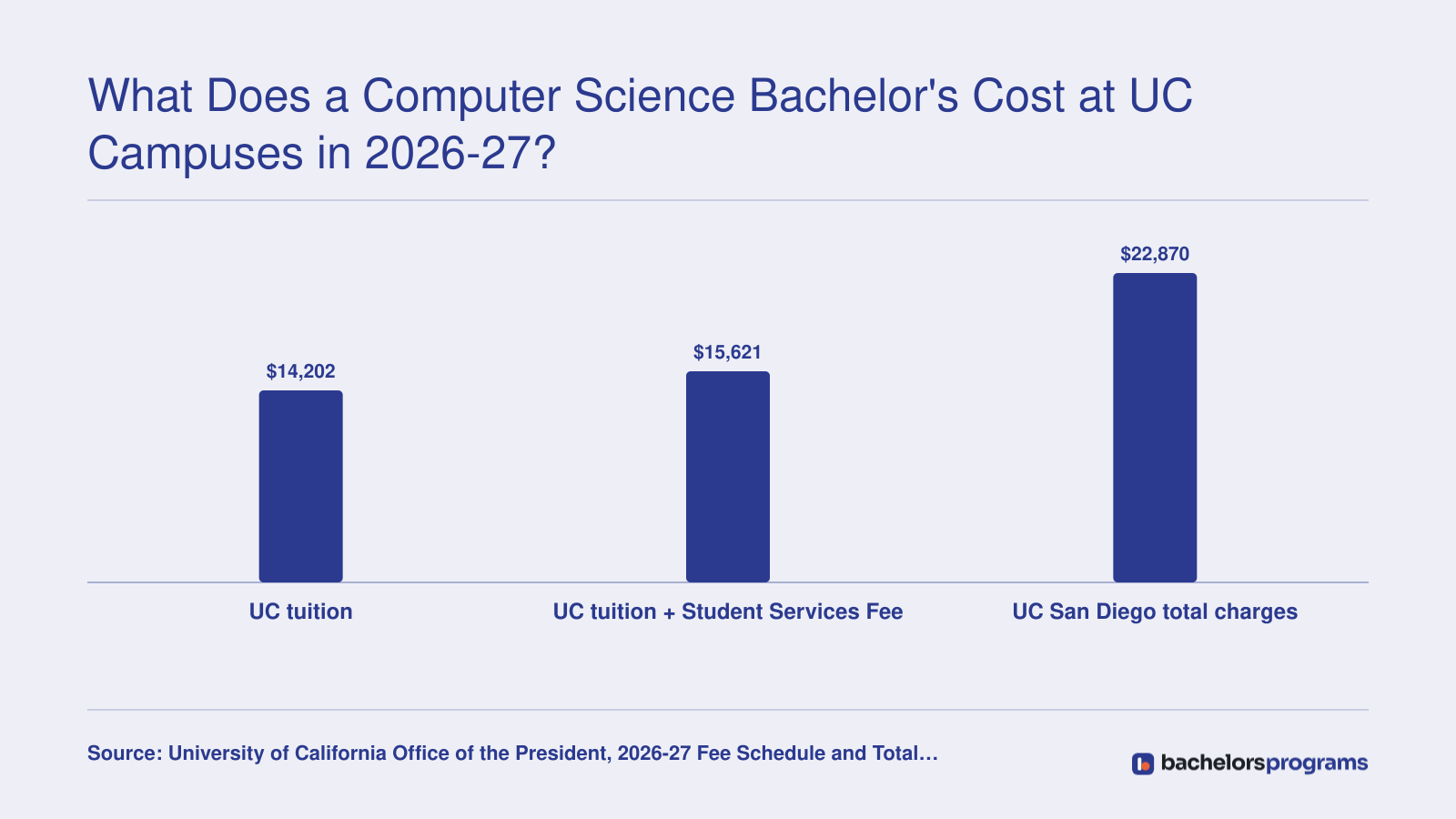
What Does a Computer Science Bachelor's Cost at UC Campuses in 2027?
For California residents entering in 2026-27, University of California tuition is $14,202, and the $1,419 Student Services Fee brings mandatory systemwide charges to $15,621. Campus-based fees push the total higher. UC San Diego lists $22,870 before health insurance. UC holds these charges flat for up to six years for each entering cohort. All figures are sticker prices before financial aid, and the net price figures elsewhere on this page are averages. CSU campuses and private schools such as Stanford University and the University of San Diego set their own rates, so check each school's tuition page.
Related Articles
California Software Developer Pay at a Glance
Software development is one of the most common paths for computer science graduates. California pays well above the national rate for this work.
Common Questions About Computer Science Bachelor's Programs in California
These answers cover accreditation, pay, degree type, transfer and licensing for a bachelor's degree in computer science in California. Details vary by campus, so confirm specifics on each school's own program page.
Are California computer science programs ABET accredited?
How much do computer science graduates make in California?
Should I choose a B.S. or a B.A. in computer science?
Can I transfer from a community college into a California CS bachelor's program?
Do you need a license to work as a software developer in California?
Compare Computer Science programs on the data that matters
Explore more Computers & IT majors or browse every field of study.
All Computers & IT programs Browse every field of study