Best Finance Schools in Maine
Compare 6 accredited Finance programs in Maine at 5 colleges, with net price after aid, graduation rates, earnings and debt from IPEDS and the U.S. College Scorecard.

A bachelor's degree in finance in Maine starts with a price gap: the state's two AACSB-accredited public business schools charge in-state tuition of roughly $11,000 to $13,000 a year, while private options post sticker prices three to four times higher.
Most students earn the Bachelor of Science (B.S.) in Finance, though at some Maine schools the credential arrives as a B.S.B.A. or a business administration major with a finance concentration, and at least one can be finished fully online through a Maine-based institution. Accreditation, admissions, net price, and career outcomes all shift that calculus.
Hiring in Portland's banking, insurance, and wealth management firms leans on regional programs, so the internship pipeline often outweighs national name recognition.
Key Points
- University of Maine and University of Southern Maine hold AACSB accreditation.
- In-state tuition starts at $11,284 at the University of Southern Maine.
- University of Maine finance graduates earn a $75,004 median four years out.
Best Finance Schools in Maine: Ranked Bachelor's Programs
Maine offers a small, focused set of bachelor's programs in finance, and the strongest of them share a few traits: an accredited business school, required internships or capstones, and clear routes into banking, insurance, and investment work. The five schools below are ranked for students who want a finance degree in Maine, whether they enroll on a traditional campus or in a blended format.
University of Maine
#1Orono, ME · $18,000/yr (est. net price)
Best for: In-state students wanting a research campus
Maine's flagship public research university, in Orono, houses its finance program inside an AACSB-accredited business school. Students pair a broad business core with specialized work in valuation, derivatives, fixed income, and investment strategy, then finish with a capstone. A 120-credit, 2.0-GPA structure keeps the path clear, and concentrations let students tilt the degree toward international business, information systems, or entrepreneurship.
- AACSB-accredited business school
- 120 credits with a required capstone experience
- Concentrations in international business, information systems, or entrepreneurship
- Minimum 2.0 GPA; C- or better in business core courses
- Coursework in valuation, derivatives, fixed income, and investment strategy
- Three one-credit professional skills courses
- Upper-level finance courses offered once a year
Saint Joseph's College of Maine
#2Standish, ME · $25,000 – $30,000/yr (est.)
Best for: Bank employees using employer tuition partnerships
A small Catholic college in Standish, Saint Joseph's builds its finance major around ethics and long-term sustainability rather than short-term returns, asking students to weigh employees, customers, communities, and stockholders together. The 120-credit degree mixes investments, money and banking, financial statement analysis, and global finance with a senior business seminar. Rolling admission and multiple start dates each year suit working professionals, and a separate banking pathway offers reduced tuition to employees of participating financial institutions.
- 120 credits; 3.0 GPA required for the major
- Emphasizes ethical, sustainable finance for all stakeholders
- Coursework in investments, money and banking, and global finance
- Senior business seminar plus finance electives
- Rolling admissions with multiple start dates each year
- Employer-partnered banking pathway with reduced tuition
Thomas College
#3Waterville, ME · $19,000/yr (est. net price)
Best for: Hands-on learners wanting internship-heavy business training
Thomas College in Waterville has taught business for a century, and its finance major leans practical: internships, leadership development, and one-on-one mentoring through the Harold Alfond Institute for Business Innovation. Students can complete a 121-credit degree in three years and choose between the standard finance track and a financial analyst concentration sequenced around CFA exam material. It is a small, career-focused campus with a deep alumni network in Maine banking, insurance, and financial services.
- 121 credits; optional three-year completion track
- Coursework in business finance, investment management, and financial statement analysis
- Personal financial planning and money, banking, and financial markets courses
- Internships and mentorship through the Alfond Institute
- Innovation challenges and leadership development programs
- Financial analyst concentration within the finance major
- Coursework sequenced to prepare for the CFA exam
- Internships built into the concentration
- One-on-one student mentoring and business club membership
University of Southern Maine
#4Portland, ME · $11,000 – $28,000/yr (est.)
The University of Southern Maine sits in Portland, the state's financial and insurance hub, which makes internships logistically easier for finance majors. Its AACSB-accredited business school offers the finance major in person and in blended formats, with coursework spanning banking, insurance, investment, and corporate and public finance. Students can shape electives toward CFP exam preparation, and an accelerated pathway into the MaineMBA is available for those eyeing graduate study.
- AACSB-accredited; offered in person and in blended formats
- Curriculum can be tailored toward CFP exam preparation
- Internships with one of 200 partner organizations
- Test-optional admission; no entrance exam required
- Accelerated pathway to the MaineMBA
- Typical completion time of four years
University of New England
#5Biddeford, ME · $38,000/yr (est. net price)
The University of New England, in Biddeford, takes a trading-floor approach: finance students train on Bloomberg Terminals, run simulated trades, and enter trading competitions. The curriculum covers financial markets, investments, fixed income securities, and international finance, with room for entrepreneurial finance and data analysis. A semester abroad in Morocco and the option to add a concentration, minor, or double major give the degree flexibility.
- Training on Bloomberg Terminals with certification preparation
- Coursework in financial markets, fixed income securities, and international finance
- Simulated stock trading and trading competitions
- Entrepreneurial finance and data analysis coursework
- Semester abroad option in Morocco
- Flexibility to add a concentration, minor, or double major
Cost & outcomes by school
Federal data for the highest-earning Finance programs, independent of the ranking above. Earnings are this field's bachelor's graduates four years after completing where the Scorecard reports them, else the school's undergraduate median.
| School | Net price / yr | Grad rate | Earnings | Debt | Grads/yr | Format |
|---|---|---|---|---|---|---|
| University of Maine ME | $17,510 | 55% | $75,004 | $23,425 | 82 | Campus |
| University of Southern Maine ME | $13,596 | 40% | $73,068 | $16,000 | 29 | Hybrid |
| Saint Joseph's College of Maine ME | $27,555 | 66% | $59,045 | $27,000 | 9 | Campus |
| University of New England ME | $38,107 | 68% | $55,921 | $25,250 | — | Campus |
| Thomas College ME | $18,885 | 54% | $44,991 | $24,250 | 11 | Campus |
Sources: U.S. Department of Education. Net price, graduation rate, earnings and debt: College Scorecard (earnings and debt for this field's bachelor's graduates where reported, else school-wide); graduates: IPEDS. A dash means no figure is reported.
Cost, debt & payoff
Median earnings of this field's bachelor's graduates (4 yrs after completing, else the school's undergraduate median) vs. their median federal loan debt · U.S. College Scorecard
Across these programs the median graduate earns about $57,483 and finishes with roughly $24,250 in debt — a ratio that clears a common rule of thumb (keep debt below first-year salary). Net price and debt vary widely school to school, so check the per-school figures in the table above before you shortlist.
How We Ranked Maine's Bachelor's Degree in Finance Programs
What the Ranking Weighs
Four factors drive the order: net price after financial aid, earnings and debt for graduates of the specific finance program, the school's graduation rate, and the number of students who complete the degree. Earnings and debt come from the federal College Scorecard. Completions show how established a program is and how many students it carries through to graduation.
What the Numbers Can't Tell You
Graduation rate and net price are institution-wide averages. They describe the whole school, not finance majors alone, so your own cost and timeline may differ. Program-level earnings are measured after completion for past graduates. They show what has happened, not a promise of what any individual will earn, and real results shift with internships, location, and the job market.
So, What Is the Best Finance School in Maine?
On this ranking, the University of Maine in Orono comes out first. Its Business Administration in Finance program suits students who want a large public university, a full residential campus, and a broad business curriculum in one place. It is a strong fit if you plan to start as a first-year student and stay on campus.
The best choice still depends on your situation. If you prefer a smaller campus, compare Saint Joseph's College of Maine and Thomas College. If you want a Portland setting, look at the University of Southern Maine. The University of New England offers a Bachelor of Science in Finance for students drawn to its Biddeford campus.
Which Maine Finance Schools Are AACSB-Accredited?
AACSB International lists the University of Maine's Maine Business School in Orono and the University of Southern Maine's School of Business in Portland and Gorham as accredited business schools,1 and both had that business accreditation extended in 2025.2 If you want the most widely recognized business credential behind your bachelor's degree in finance, start with these two schools.
Maine's AACSB-Accredited Finance Programs
- University of Maine (Orono): Offers Business Administration with a finance focus through the Maine Business School, the state's flagship public business program.
- University of Southern Maine (Portland/Gorham): Offers a Business Administration degree with a Finance major through its School of Business, convenient for students in the Portland area.
AACSB lists both as Business Administration degrees with finance coursework, including banking, rather than as a standalone finance degree. Your diploma will read Business Administration, with finance as the area of study.
What About Saint Joseph's, Thomas, and UNE?
Saint Joseph's College of Maine, Thomas College, and the University of New England all offer finance bachelor's programs, but none of the three appeared in the AACSB directory.1 That alone does not make their programs weaker. Colleges in New England generally hold institutional accreditation through the New England Commission of Higher Education (NECHE), and some business programs nationwide pursue a different business accreditor, such as ACBSP. Before you apply, confirm each school's current institutional and business accreditation directly on its website or with admissions, since accreditation status can change.
Why AACSB Status Matters
AACSB accreditation signals that a business school has gone through outside review of its faculty qualifications, curriculum, and learning outcomes, and that it is re-evaluated on a regular cycle. Some employers, particularly larger firms that recruit nationally, treat it as a quality marker. It is not required to sit for professional exams like the CFA, though, so weigh it alongside cost, location, and program format rather than treating it as the only filter.
Online and Hybrid Bachelor's in Finance Options at Maine Schools
Online study is now a mainstream choice in Maine business education, but the fully online route to a finance credential still comes with conditions.
Campus and Blended Formats
University of Maine runs its B.S.B.A. in Finance in person at Orono, a 120-credit program with no hybrid or online delivery advertised. University of Southern Maine takes a blend: the finance major is offered in blended and in-person formats, so part of the coursework can happen online without a full remote commitment. Thomas College lists its Finance BS as a campus program in Waterville. University of New England keeps its B.S. in Finance at the Biddeford campus, roughly 120 credits, built around Bloomberg Terminals and internships that require being there.1
The Fully Online Route
Saint Joseph's College of Maine offers the state's fully online option, delivered asynchronously with no campus residency. It is a B.S.B.A. in Banking rather than a general finance degree, and applicants must currently be employed by a banking institution. The partnership pathway accepts up to 90 credits of professional banking diplomas and certificates toward the 120-credit total.
Certification Alignment
USM is a CFP Board Registered Financial Planning Program, and its required coursework satisfies the CFP exam's education requirement, with a certificate issued for the Board. No program page here advertises a CFA-aligned curriculum.
Who Each Format Suits
Working adults already inside a bank should look first at Saint Joseph's, where credit for banking coursework shortens the path to a degree. Transfer students holding 60 or more credits benefit from that generous cap as well. Out-of-state students and anyone balancing a job should weigh USM's blended format, which keeps some flexibility without giving up campus access. Students targeting investment or corporate finance roles get the most from UMaine, UNE, or Thomas, where internships and trading tools are on campus.
Related Articles
Cost of a Bachelor's Degree in Finance in Maine: Tuition, Net Price, and State Aid
Published in-state tuition and fees run $11,284 at the University of Southern Maine and $13,326 at the University of Maine, while the private options post sticker prices of $31,824 at Thomas College, $44,210 at the University of New England, and $44,420 at Saint Joseph's College of Maine. The University of Maine System projects an average total in-state cost of $24,069 for fiscal 2027, but that figure bundles tuition, fees, room, and board rather than tuition alone.1
What students actually pay
Net price, the average yearly cost after grants and scholarships are applied, is reported institution-wide rather than by major, so treat it as a campus average, not a finance-specific quote. On that basis, USM averages about $13,596 and UMaine about $17,510. Private discounting narrows the gap sharply: Thomas College averages roughly $18,885 and Saint Joseph's about $27,555, both well under sticker. UNE averages around $38,107. A realistic planning range for a bachelor's degree in finance in Maine is therefore roughly $13,500 to $38,000 per year before loans, with the public campuses anchoring the low end.
Maine State Grant and other state aid
The Finance Authority of Maine administers the Maine State Grant, worth $2,500 for full-time students and $1,250 for those enrolled at least half time in 2026-27.2 Eligibility turns on filing the FAFSA by the mid-November deadline, a Student Aid Index at or below 10,000, at least half-time enrollment in a first undergraduate credential, and one year of Maine residency established for reasons other than education.2 Awards are capped at ten full-time-equivalent semesters and generally must be used at a Maine school, with the NEBHE Tuition Break program as the main exception.3
One way to trim the bill
Maine's community college tuition waiver covers students who finished high school within the past two years and maintain Maine residency for twelve months, for up to two years or 150% of stated program length.4 Completing general education requirements under that waiver and then transferring into a finance major at UMaine, USM, or Thomas College can remove a meaningful share of the four-year bill. Confirm course equivalencies with the receiving school before you enroll.
What Do Maine Finance Graduates Earn After Finishing Their Degree?
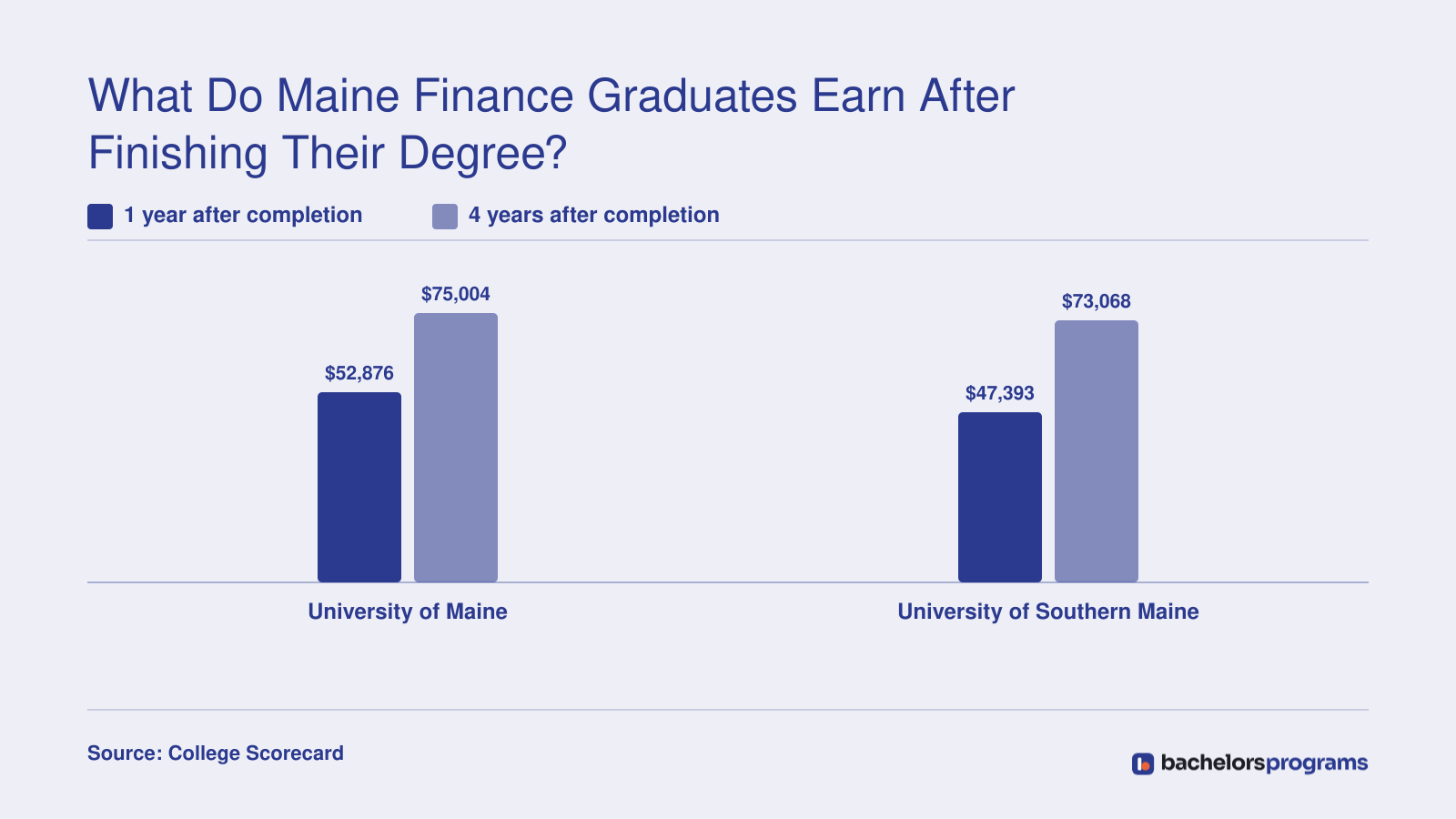
Federal program-level data shows finance bachelor's graduates of the University of Maine and the University of Southern Maine earning medians of $52,876 and $47,393 one year after completion, rising to $75,004 and $73,068 four years out. At four years, the gap between the highest and lowest figures is just $1,936. The difference in borrowing is wider: median debt is $23,425 at the University of Maine and $16,000 at the University of Southern Maine.
Finance Careers and Starting Salaries in Maine
The wage figures below come from U.S. Bureau of Labor Statistics occupational estimates. The two Portland-South Portland rows are older May 2022 metro figures, and the May 2025 rows are the latest BLS medians available for these roles, so treat them as broad benchmarks rather than a direct comparison. Medians reflect workers at all experience levels, so new graduates with a bachelor's degree in finance should expect starting pay below these figures, and percentile ranges were not available in the data reviewed.
| Occupation | Median Annual Wage | 10th Percentile | 90th Percentile | Maine Employment |
|---|---|---|---|---|
| Personal Financial Advisors (Portland-South Portland metro, May 2022) | $140,730 | N/A | N/A | 300 (Portland-South Portland metro) |
| Loan Officers (Portland-South Portland metro, May 2022) | $107,350 | N/A | N/A | 550 (Portland-South Portland metro) |
| Financial and Investment Analysts (BLS, May 2025) | $103,570 | N/A | N/A | N/A |
| Personal Financial Advisors (BLS, May 2025) | $105,070 | N/A | N/A | N/A |
| Loan Officers (BLS, May 2025) | $76,690 | N/A | N/A | N/A |
CFA, CFP, and Maine Licensing for Finance Roles
CFP Board lets candidates sit for the CFP Exam before finishing a bachelor's degree,2 but the degree is a condition of initial certification. It can be completed before the exam or within 5 years after passing, and the official transcript is due in that same window.1 The degree can be in any discipline, so a finance degree from any school here fits, provided the institution holds accreditation recognized by the U.S. Department of Education.1
What CFP Adds to Your Degree
The degree is only one piece. CFP candidates also complete Registered Program coursework, including a financial plan development capstone,2 plus an experience requirement, ethics review, and background check. CFP Board's Accelerated Path does not waive any of these.4 Its competency standards are changing between Q2 2026 and Q4 2027,3 though the bachelor's requirement remains, so check the current rules before you plan.
Maine Licensing by Career Track
Roles that sell securities or advise on investments generally involve registration through the Maine Office of Securities. Mortgage loan originators are licensed through the Maine Bureau of Consumer Credit Protection. Exams, fees, and background standards change, so confirm them on those agencies' pages rather than relying on a summary.
Which Credential Fits, and When to Start
- Financial planning: Pursue CFP. Start the education coursework during your junior or senior year.
- Investment analysis and portfolio work: Look at the CFA charter, which is separate from CFP. Verify its current enrollment and experience rules with the organization that administers it.
- Brokerage or advisory sales: Expect state registration once an employer sponsors you.
- Mortgage lending: Expect state licensing before you originate loans.
Choosing the Right Bachelor's in Finance for Your Goals
Finance work in Maine has shifted toward roles that pair quantitative analysis with client-facing advice, so the right bachelor's degree in finance is the one built around the work you want to do. At the schools ranked here, that distinction lives in the curriculum: one program leans on portfolio management and market analysis, another on Bloomberg terminal certification, another on internships across partner organizations.
Match the Program to the Work
- Investment and analysis: University of Maine holds AACSB International accreditation and offers three concentration options across a 120-credit curriculum covering markets, business financing, and portfolio management. University of New England adds Bloomberg Technology Certification and simulated stock trading.
- Corporate finance: University of Southern Maine pairs the major with internships at 200 partner organizations; Thomas College offers a three-year completion option with leadership development built in.
- Banking: Southern Maine and Thomas both frame the degree around banking, insurance, and financial services careers.
- Financial planning: Southern Maine says the program prepares students for the CFP certification exam, and Saint Joseph's builds its B.S.B.A. around ethical, sustainable finance.
Best Overall and Best Value
University of Maine is the best overall pick, with AACSB accreditation, four-year median earnings of $75,004, and the broadest set of concentrations. University of Southern Maine is the best value: a $13,596 net price, AACSB accreditation, and four-year median earnings of $73,068.
Your Next Step
Before you compare tuition, run each school's net price calculator with your own income figures. Then ask admissions at the programs you are seriously considering for a written transfer credit evaluation of courses you have already completed.
Maine Finance Degree FAQs
These answers summarize the most common questions about earning a bachelor's degree in finance in Maine. Each one points back to the fuller section of this page.
What is the best finance school in Maine?
Which Maine colleges offer a bachelor's degree in finance?
Are there online finance degrees in Maine?
What is the starting salary for finance majors in Maine?
Which Maine finance programs are AACSB accredited?
Compare Finance programs on the data that matters
Explore more Business & Management majors or browse every field of study.
All Business & Management programs Browse every field of study