Best Cybersecurity Schools in Maryland
Compare 12 accredited Cybersecurity programs in Maryland at 9 colleges, with net price after aid, graduation rates, earnings and debt from IPEDS and the U.S. College Scorecard.

Fort Meade, home to the NSA and U.S. Cyber Command, gives Maryland a hiring market that few states can match for a bachelor's degree in cybersecurity. Defense contractors cluster along the Baltimore-Washington corridor, and many recruit from nearby campuses.
The standard title is the Bachelor of Science (B.S.) in Cybersecurity, though several Maryland schools teach the same material under other names: computer science with a cyber focus, or secure computing and information assurance. Annual net price after aid runs from $9,977 at Coppin State University to $26,505 at Stevenson University, so cost varies as much as program titles do.
Most federal and contractor roles require a security clearance, which an employer typically sponsors after hiring. The degree gets you in the door; the clearance and certifications decide how far you go.
Key Points
- Coppin State posts the lowest net price after aid: $9,977.
- Towson and UMGC both carry NSA Center of Academic Excellence status.
- Students can complete a cybersecurity bachelor's online through UMGC's Cybersecurity Technology program.
Best Bachelor's Degree in Cybersecurity Programs in Maryland
Nine Maryland universities offer a bachelor's degree in cybersecurity, and the order below balances completion and price against the strength of each program. Coppin State University carries the lowest net price after aid at $9,977, while Towson University posts the highest published program earnings at $71,484 four years after completion. Each card notes the price, the university's overall graduation rate, how the program is delivered, and what the school does best.
Towson University
#1Towson, MD · ~$17,000/yr (est.)
Best for: Students targeting federal cyber internships
Towson has held NSA Center of Academic Excellence in Cyber Defense designation since 2002 and Cyber Operations recognition since 2012, and its ABET-accredited B.S. in Computer Science with a Cyber Operations track pairs security theory with labs, exercises and internship placements in government and industry. Students can also pursue an accelerated bachelor's to master's path and join the Cyber Defense Club and competition team. Net price after aid is $17,413 and the university's overall graduation rate is 69%. Graduates of this program report median earnings of $71,484 four years after completion, the highest published figure in this list.
- ABET-accredited degree with a Cyber Operations track
- NSA Center of Academic Excellence in Cyber Operations since 2012
- Cyber defense designation held since 2002
- Labs, exercises and hands-on security applications
- Internships with government agencies and IT firms
- Cyber Defense Club and cybersecurity competition team
- Accelerated B.S./M.S. in Computer Science option
- Three concentration options within the computer science major
Salisbury University
#2Salisbury, MD · ~$18,000/yr (est.)
Best for: Eastern Shore students who prefer campus learning
Salisbury runs cybersecurity as a focus inside its Computer Science B.S., so students build a traditional computing foundation and then take three required electives on network design, cryptography and countermeasures. The program is campus-based, requires grades of C or better in prerequisites, and asks transfer students to complete at least 12 upper-level computer science credits at Salisbury. Net price after aid is $17,743 and the university's overall graduation rate is 68%. The department points to alumni working at Google, Microsoft, NASA, NSA, Lockheed Martin and Booz Allen Hamilton.
- 120 credit hours including general education requirements
- Minimum 2.0 GPA and 30 upper-level credits to graduate
- 30 of the last 37 credits must be taken at Salisbury
- Suggested four-year plan published in the catalog
- Graduates work at Google, Microsoft, NASA, NSA and Lockheed Martin
- Three required focus electives on network security topics
- Covers network design and performance, cryptography and countermeasures
- Grades of C or better required in prerequisite courses
- Transfer students complete at least 12 upper-level CS credits at SU
- Prepares for network engineer, security analyst and cybersecurity engineer roles
University of Maryland Global Campus
#3Adelphi, MD · $22,000/yr (est. net price)
Best for: Working adults needing fully online flexibility
UMGC is the online arm of the University System of Maryland and the most flexible option here, offering fully online and hybrid delivery and a bachelor's degree in cybersecurity technology that accepts up to 90 credits for prior learning, work experience and industry certifications. Coursework covers AI, data science, automation and ethical hacking, and maps to the CCNA, A+, Network+, Security+ and CISSP exams. Net price after aid is $22,063 and the university's overall graduation rate is 33%; graduates of the program report median earnings of $62,022 four years after completion. The cyber competition team finished first in 10 competitions in 2026.
- Fully online and hybrid course options
- Up to 90 credits for prior learning, work experience and certifications
- Prepares for CCNA, A+, Network+, Security+ and CISSP exams
- NSA-designated cyber defense education center
- Cyber competition team took first place in 10 events in 2026
- Military benefits and employer tuition reimbursement accepted
- Interest-free monthly payment plan available
- Reduced tuition for eligible servicemembers and families
Stevenson University
#4Owings Mills, MD · ~$27,000/yr (est.)
Stevenson's B.S. in Cybersecurity and Digital Forensics is built around investigation as much as defense, with courses in intrusion testing and advanced digital forensics and internship placements with agencies including the FBI and NSA. It holds National Center of Digital Forensics Academic Excellence designation, issues certificates carrying DoD training credit, and offers a bachelor's to master's option. Net price after aid is $26,505, the highest in this list, against a university-wide graduation rate of 68%. The College of Southern Maryland lists Stevenson as a formal transfer destination.
- Courses include Cybersecurity Fundamentals, Intrusion Testing and Advanced Digital Forensics
- National Center of Digital Forensics Academic Excellence designation
- NSA Center of Academic Excellence designation
- Internship placements with the FBI and NSA
- Certificates carry DoD training credit
- Bachelor's to master's option for accelerated completion
- Minor in cybersecurity available
Capitol Technology University
#5Laurel, MD · ~$22,000/yr (est.)
Capitol Technology University sits in Laurel near the Fort Meade and Washington corridor, and its ABET-accredited B.S. in Cybersecurity carries NSA Center of Academic Excellence in Cyber Defense designation. The 120-credit curriculum covers cryptography, risk management, digital forensics and penetration testing, and students train in a student-run security operations center while preparing for Security+, CEH and CISSP. Net price after aid is $22,102 and the university's overall graduation rate is 43%. Full-time and part-time enrollment are both offered, the application fee is $0, and the program has been named an SC Media Best Cybersecurity Program.
- ABET-accredited and NSA CAE-CDE designated
- 120 credit hours with full-time or part-time enrollment
- $0 application fee
- Student-run security operations center for hands-on training
- Prepares students for CompTIA Security+, CEH and CISSP
- Cyber competition team and internships with local employers
- Coursework in cryptography, risk management, forensics and penetration testing
- Named an SC Media Best Cybersecurity Program
University of Baltimore
#6Baltimore, MD · $10,000 – $24,000/yr (est.)
The University of Baltimore delivers cybersecurity as a Cyber Security Concentration inside its B.S. in Applied Information Technology, a 24-credit concentration that adds network security, applied cryptography, information assurance, web and database security and digital forensics on top of a 120-credit degree. Classes meet in the evening with full-time and part-time enrollment, which suits students already working in IT. Net price after aid is $13,868, the second lowest here, and the university's overall graduation rate is 38%. The program is STEM-designated and offers an accelerated bachelor's to master's path.
- 120 credit hours total; the concentration requires 24 credits
- General track option requires 18 credits instead
- Evening classes with full-time or part-time enrollment
- STEM-designated program
- Accelerated bachelor's to master's option
- Concentration covers applied cryptography, network security and digital forensics
- IT certification encouraged but not required
- Alumni advisory board informs the curriculum
Frostburg State University
#7Frostburg, MD · $10,000 – $26,000/yr (est.)
Frostburg's B.S. in Secure Computing and Information Assurance leans on hands-on practice, including access to the US Cyber Range for real-world simulations and capture-the-flag competitions. Coursework spans defensive programming, security policy analysis and Security+ preparation, and the department maintains transfer pathways from partner community colleges. Net price after aid is $16,715 and the university's overall graduation rate is 50%.
- Access to the US Cyber Range for real-world simulations
- Coursework in defensive programming and security policy analysis
- Prepares students for CompTIA Security+ certification
- Capture-the-flag competitions and hands-on training labs
- Transfer pathways from partner community colleges
- CSIT student showcase for project work
Bowie State University
#8Bowie, MD · ~$19,000/yr (est.)
Bowie State, a historically Black university in Prince George's County, offers cybersecurity two ways: a cybersecurity focus inside the Computer Science major and a cybersecurity concentration inside Computer Technology. Both are campus-based and cover network security, data protection and threat analysis with core computing requirements underneath. Net price after aid is $19,298 and the university's overall graduation rate is 38%. Bowie State participates in Maryland's Cyber Warrior Diversity Program and is named in the state's proposed artificial-intelligence partnership.
- Cybersecurity focus inside the computer science major
- Core computer science requirements plus cybersecurity electives
- Covers network security, data protection and threat analysis
- Housed in the Department of Computer Science
- Cybersecurity concentration within the Computer Technology program
- Traditional campus-based format
- Offered through the College of Arts and Sciences
- Cybersecurity specialization available
Coppin State University
#9Baltimore, MD · $5,000 – $10,000/yr (est.)
Coppin State offers a B.S. in Cybersecurity Engineering that leans toward building resilient systems, with a distinctive emphasis on medical cyber-physical systems alongside network security and secure software development. The four-year plan runs from introduction to engineering through digital electronics to a senior advanced design project. Net price after aid is $9,977, the lowest in this list, against a university-wide graduation rate of 26%. Coppin is a historically Black university and a participant in Maryland's Cyber Warrior Diversity Program.
- Four-year degree plan spanning engineering and security coursework
- Emphasis on medical cyber-physical systems
- Focus on designing cyber resilient systems
- Courses in network security and secure software development
- Senior advanced design project capstone
- Includes mathematics, digital electronics and introduction to engineering
- Test scores may be optional for admission
Cost & outcomes by school
Federal data for the highest-earning Cybersecurity programs, independent of the ranking above. Earnings are this field's bachelor's graduates four years after completing where the Scorecard reports them, else the school's undergraduate median.
| School | Net price / yr | Grad rate | Earnings | Debt | Grads/yr | Format |
|---|---|---|---|---|---|---|
| Capitol Technology University MD | $22,102 | 43% | $85,035 | $20,264 | — | Campus |
| Towson University MD | $17,413 | 70% | $71,484 | $18,718 | — | Campus |
| Stevenson University MD | $26,505 | 69% | $62,079 | $26,000 | — | Online |
| University of Maryland Global Campus MD | $22,063 | 33% | $62,022 | $25,391 | 368 | Hybrid |
| Salisbury University MD | $17,743 | 68% | $61,515 | $21,000 | — | Campus |
| University of Baltimore MD | $13,868 | 38% | $61,335 | $23,250 | 22 | Campus |
| Frostburg State University MD | $16,715 | 50% | $55,493 | $21,105 | — | Campus |
| Bowie State University MD | $19,298 | 38% | $54,537 | $22,985 | — | Campus |
| Coppin State University MD | $9,977 | 26% | $46,490 | $25,000 | — | Campus |
Sources: U.S. Department of Education. Net price, graduation rate, earnings and debt: College Scorecard (earnings and debt for this field's bachelor's graduates where reported, else school-wide); graduates: IPEDS. A dash means no figure is reported.
Cost, debt & payoff
Median earnings of this field's bachelor's graduates (4 yrs after completing, else the school's undergraduate median) vs. their median federal loan debt · U.S. College Scorecard
Across these programs the median graduate earns about $61,515 and finishes with roughly $22,045 in debt — a ratio that clears a common rule of thumb (keep debt below first-year salary). Net price and debt vary widely school to school, so check the per-school figures in the table above before you shortlist.
Most Affordable Bachelor's Degree in Cybersecurity Programs in Maryland
These public universities offer the lowest average net price among the schools ranked here, based on 2024 federal data from IPEDS and the College Scorecard. Net price is what students pay per year after grants and scholarships, so it is a better guide to your real cost than the published tuition. Coppin State University comes in under $10,000 a year, and every option below is a campus-based program.
| School | City | Program | Average Net Price (per year) | In-State Tuition and Fees | Format |
|---|---|---|---|---|---|
| Coppin State University | Baltimore | Bachelor of Science in Cybersecurity Engineering | $9,977 | $7,100 | Campus |
| University of Baltimore | Baltimore | Applied Information Technology (B.S.), Cyber Security Concentration | $13,868 | $9,992 | Campus |
| Frostburg State University | Frostburg | Secure Computing and Information Assurance (B.S.) | $16,715 | $10,220 | Campus |
| Towson University | Towson | B.S. in Computer Science, Cyber Operations Track | $17,413 | $11,728 | Campus |
| Salisbury University | Salisbury | Computer Science, B.S., Computer Network and Cyber Security Focus | $17,743 | $11,084 | Campus |
What Went Into This Ranking: Outcomes, Price, and Format
A school's brochure tells you what it hopes you'll notice. Federal data tells you what graduates actually experienced. The rankings here lean on the second kind of evidence, drawn from federal IPEDS and College Scorecard data.
What the Rankings Draw On
Five inputs shape the comparisons: median earnings for program graduates, the number of students completing each program, net price, typical student debt, and whether the program runs on campus, online, or both. Only Maryland-based schools with a bachelor's degree in cybersecurity are included, along with closely related majors such as computer science with a cyber track or information assurance. Both campus and online delivery count.
Read the Numbers With These Limits in Mind
Three caveats matter when you compare rows:
- Net price: This figure is an average for the school's sector, not a quote for one program or one student. Your own aid package will differ.
- Graduation rate: This figure covers the whole institution, not the cybersecurity program by itself.
- Earnings windows: Some rows report pay one year after completion, others two or four years. A higher figure in a later window is not automatically a better outcome.
Use the rankings to build a shortlist. Then check each school's program page, its financial aid estimator, and its admissions office for the details a federal dataset cannot capture.
Which Maryland Schools Are NSA-Designated Centers of Academic Excellence?
The National Security Agency and the Department of Homeland Security name colleges as National Centers of Academic Excellence when their cybersecurity curriculum meets federal standards. Among the schools ranked here, Towson University and University of Maryland Global Campus appear in the 2014 NSA/DHS designation announcement in the Cyber Defense (CAE-CD) category. That announcement does not list a current expiry year, so confirm each school's status on the official NCAE-C list before you apply.
| School | CAE Designation Held | Designation Type (CAE-CD / CAE-CO / CAE-R) | Notes |
|---|---|---|---|
| Towson University | National Center of Academic Excellence in Information Assurance/Cyber Defense | CAE-CD | Listed as a four-year Maryland institution in the 2014 NSA/DHS designation announcement. No current expiry year is given in that record. Towson's bachelor's path in this field is the B.S. in Computer Science with a Cyber Operations Track. |
| University of Maryland Global Campus | National Center of Academic Excellence in Information Assurance/Cyber Defense | CAE-CD | Listed under its former name, University of Maryland University College, as a four-year Maryland institution in the 2014 NSA/DHS designation announcement. No current expiry year is given in that record. Its bachelor's offering is the Cybersecurity Technology program. |
Online and Hybrid Cybersecurity Bachelor's Options at Maryland Schools
Flexibility and face-to-face instruction rarely come in the same package, and that tradeoff should decide which format you choose. Yes, you can earn a cybersecurity bachelor's degree entirely online from a Maryland-based school: University of Maryland Global Campus (UMGC).
Online, Hybrid, and Campus Formats
UMGC offers Cybersecurity Technology, Cyber Operations, and Cybersecurity Management and Policy, each a 120-credit degree with all courses available online. Select hybrid courses are also offered. Courses run year-round, and UMGC's listed 2026 tuition is $337 per credit in-state, $499 out-of-state, and $250 for military students, with other fees possible.
The hybrid option is UMGC Shady Grove in Rockville. It offers hybrid classes for bachelor's students along with UMGC's full student services. Check the term schedule to see which cybersecurity classes meet in person, since a complete degree at that location is not confirmed.
The other programs here, at Towson, Salisbury, Capitol Technology, Baltimore, Frostburg, Bowie State, and Coppin State, are listed as campus-based. Confirm Stevenson's format with its admissions office before you plan around it.
2+2 Transfer Routes and ARTSYS
A 2+2 route means about two years of lower-division coursework at a Maryland community college, then two years at a four-year school. ARTSYS is Maryland's statewide transfer tool, and you can use it to see how community college courses apply at a public university. The agreements differ by school pair, as do the grades or GPA they require, so verify each one before you enroll.
UMGC may accept up to 90 transfer credits toward its 120-credit cybersecurity degrees. That is a ceiling, not a guarantee, and an associate degree does not automatically meet every requirement. Frostburg also highlights transfer pathways and community college partnerships.
Who Fits Which Format
- Fully online: Working adults, military students, and anyone carrying a transfer-credit stockpile gain the most from UMGC's schedule.
- Hybrid: Students near Rockville who want occasional in-person classes and campus support without a full-time commute.
- Campus: Recent high school graduates who want labs, competition teams, and internship networking in person.
Maryland Grants and Scholarships That Cut the Bill
Maryland's aid for cybersecurity students falls into two groups: need-based grants that follow your family income, and targeted scholarships that reward a specific academic or service commitment. Which track you qualify for determines how much of the bill is actually covered.
Need-Based: The Guaranteed Access Grant
The state's largest need-based award covers up to 100% of adjusted need or $18,000 for 2026-27, whichever is lower, with a $100 annual floor. You must be a Maryland resident under 26 at your first award, start college within six years of high school or a GED, and have family income at or below 130% of the federal poverty guidelines. Enroll full-time (12 or more credits a semester) and file by March 1, 2026, through the FAFSA or, if you are undocumented, the MHEC One-App. Renewal requires 24 completed credits.
Targeted: Cybersecurity Public Service Scholarship
This one is designed for cybersecurity majors. You need a 3.0 GPA, at least 25% of your credits finished, and graduation within three years, studying full- or part-time in an approved cybersecurity program at a Maryland public or private nonprofit institution. Awards in 2026 ranged from $1 to $13,689, set by the Maryland Higher Education Commission. The deadline is July 1, and full-time recipients can renew for two additional years. Federal Cyber Corps Scholarships for Service recipients are excluded.
Transfer and Early-Start Programs
The 2+2 Transfer Scholarship pays $2,000 a year to STEM transfers and $1,000 to others for up to three years; applicants need a 2.5 GPA and must move full-time from a Maryland community college into a four-year program. Apply by October 15, 2026. Next Generation Scholars is not a student award: it funds nonprofits serving grades 7 through 12 in select counties, with $5.45 million in program funding for FY2027 and a July 16, 2026 deadline for organizations.
Amounts and eligibility shift yearly, so confirm the current figures with the Maryland Higher Education Commission before you count on them.
Stacking State Aid
File the FAFSA as soon as it opens, complete the One-App in MDCAPS, then ask each school's financial aid office how an outside award interacts with the rest of your package.
Related Articles
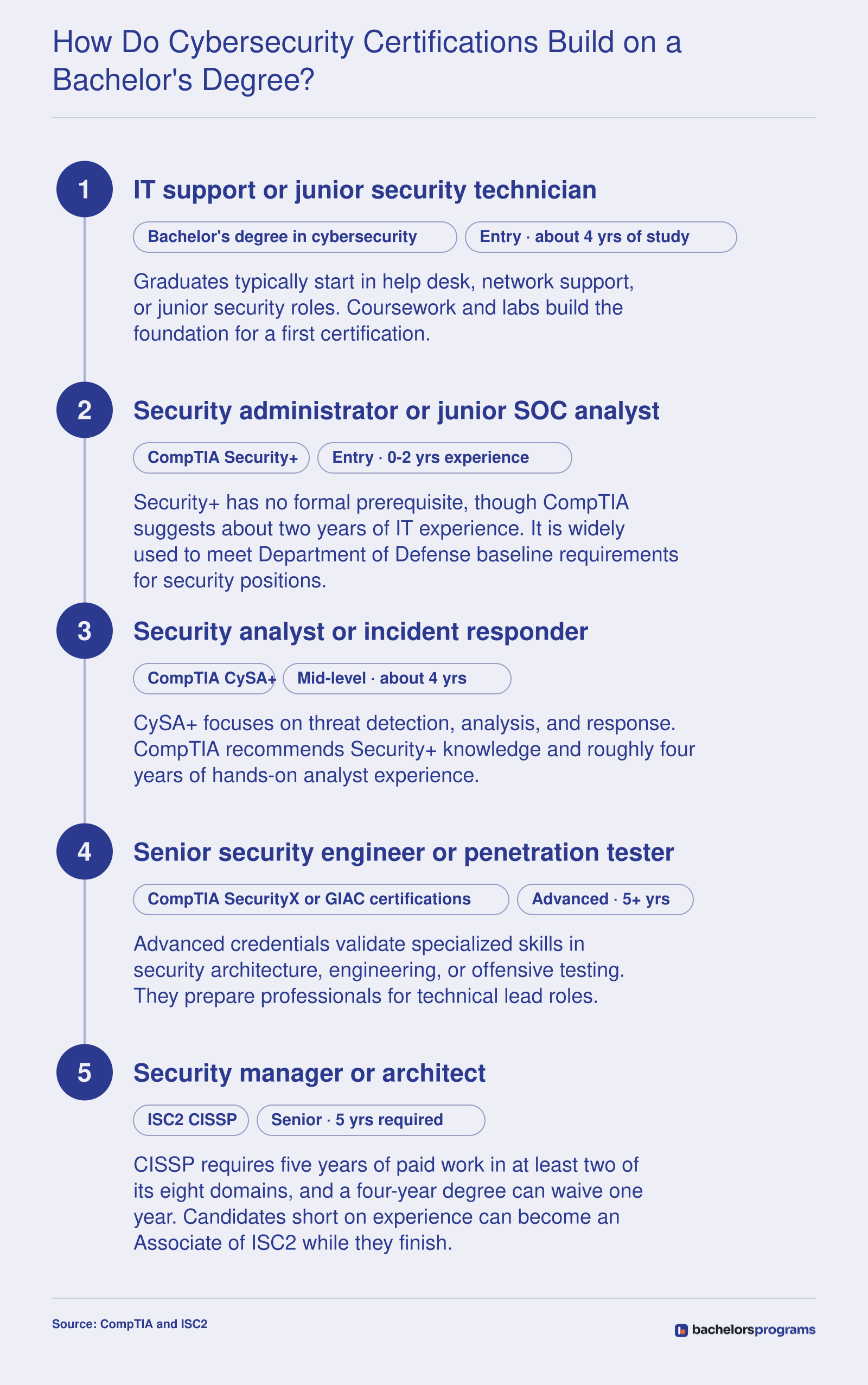
How Do Cybersecurity Certifications Build on a Bachelor's Degree?
A bachelor's degree in cybersecurity opens the door, but most security careers advance through a recognized sequence of industry certifications. Each step below pairs a credential with the role it typically supports and the experience its certifying body recommends or requires.
Quick Answers for Prospective Maryland Cybersecurity Students
These answers draw on the school pages and federal job announcement information covered in this article. Policies vary by school and employer, so confirm details with the admissions office or the specific job posting.
Do you need an IT background to apply to a cybersecurity bachelor's program?
Do you need a degree from an NSA-designated school to work for a Maryland federal agency or contractor?
Which Maryland schools offer cybersecurity-focused bachelor's degrees?
Compare Cybersecurity programs on the data that matters
Explore more Computers & IT majors or browse every field of study.
All Computers & IT programs Browse every field of study