Best Finance Schools in New York
Compare 69 accredited Finance programs in New York at 63 colleges, with net price after aid, graduation rates, earnings and debt from IPEDS and the U.S. College Scorecard.

A bachelor's degree in finance in New York, most often awarded as the Bachelor of Science (B.S.) in Finance, trains students to value securities, analyze credit, and manage corporate capital. Price is the first fork in the road: average net price after grants and scholarships runs from roughly $3,033 at CUNY Baruch College to about $49,965 at Yeshiva University.
These programs at New York-based schools, campus and online alike, differ on cost, admissions and what graduates earn. Pay depends on the campus as much as on the major: early-career median earnings among these schools differ by tens of thousands of dollars.
Key Points
- NYU admits about 9.2% of applicants, and Stern publishes no minimum GPA.
- CUNY's Baruch and Brooklyn College offer finance near the industry at modest cost.
- At New York's best-known schools, the finance major remains largely campus-based.
Best Schools for a Bachelor's Degree in Finance in New York
New York splits into two broad camps for finance study: CUNY campuses in Manhattan and Brooklyn that put students next to the industry at a modest price, and private universities from Syracuse to Rochester that pair the major with trading rooms, managed portfolios, and required internships. Every school below awards a bachelor's degree in finance, or a finance concentration inside a business degree, and each entry reflects program facts the schools publish.
CUNY Bernard M Baruch College
#1New York, NY · $7,000 – $15,000/yr (est.)
Best for: Manhattan students wanting finance-industry access
Baruch College is the City University of New York's business-focused campus in Manhattan, and its Zicklin School of Business produces one of the largest cohorts of finance graduates in the state each year. The curriculum is quantitative and aligned with the CFA candidate body of knowledge, built on a core in corporate finance and investment analysis. Qualified seniors can earn credit through an internship, and a combined bachelor's and master's path is available for students aiming at graduate study. For finance industry exposure without leaving the city, it is the most direct route in the CUNY system.
- Eight finance courses, with five electives and at least three at the 4000 level
- CFA Institute University Affiliation Program aligns courses with the CFA body of knowledge
- Qualified seniors can earn academic credit through an internship
- 2.0 GPA in major courses required to graduate
- Combined BBA and MS path available for students planning graduate study
- Advanced math, statistics, and econometrics recommended for grad school
- Prepares students for banking, investments, insurance, and corporate finance
Binghamton University
#2Vestal, NY · $20,000 – $25,000/yr (est.)
Best for: Quantitatively minded upstate business majors
Binghamton University is a SUNY research campus in Vestal, and its School of Management offers finance as a concentration inside the Bachelor of Science in Business Administration. The program leans analytical, with quantitative methods, problem solving, and advanced Excel built into five required finance courses and four electives. Students declare after earning a B- or better in FIN 311 and must hold a 2.7 GPA in concentration courses to graduate. It suits students who want a rigorous, structured finance track at a public university price.
- Finance concentration inside the BS in Business Administration
- Five finance courses plus four electives
- B- or better in FIN 311 required to declare the concentration
- 2.7 GPA in concentration courses required at graduation
- Emphasis on analytical, quantitative, and advanced Excel skills
- Study abroad courses count toward the concentration GPA
- Coursework includes financial regulation and risk management
Niagara University
#3Niagara University, NY · ~$17,000/yr (est.)
Best for: Small-cohort learners wanting applied finance
Niagara University is a private Catholic institution in Western New York, and its Holzschuh College of Business Administration runs a Bachelor of Science in Finance with small classes and a 10-to-1 student-faculty ratio. Coursework spans corporate finance, investments, international financial management, and financial statement analysis, backed by accounting, economics, and business strategy. Four business electives let students add cooperative education or MBA-level courses, and Excel modeling and business analytics run through the major. The result is an applied, generalist finance degree in a close-knit setting.
- Four business electives from six business disciplines
- Cooperative education or MBA-level courses can fill elective slots
- Covers corporate finance, investments, and international financial management
- Financial statement analysis and advanced Excel modeling emphasized
- Business analytics coursework supports analytical finance roles
- Offered through the Holzschuh College of Business Administration
CUNY Brooklyn College
#4Brooklyn, NY · under $5,000/yr (est.)
Brooklyn College is a CUNY campus in Brooklyn, and its Murray Koppelman School of Business gives finance majors hands-on access to Wall Street tools without a Manhattan commute. The B.B.A. includes Bloomberg terminal work and a student-managed hedge fund run alongside investment professionals, and the program holds CFA Institute University Affiliation status. Qualified students can take graduate finance courses that also count toward an accelerated M.S. in Finance. The Magner Career Center connects students to internships and employers across the city.
- Bloomberg terminal access built into the finance curriculum
- Student-managed hedge fund run with experienced investment professionals
- CFA Institute University Affiliation Program member
- Up to four graduate courses count toward the accelerated M.S. in Finance
- 59 to 61 credits across the business core and finance requirements
- 2.5 GPA minimum, with no thesis or capstone required
- Magner Career Center links students to JPMorgan, Goldman Sachs, Deloitte
New York University
#5New York, NY · ~$37,000/yr (est.)
New York University's Stern School of Business sits in Greenwich Village, close to the firms that recruit heavily from it. Finance is a core undergraduate discipline at Stern, with coursework in credit analysis, valuation, and financial decision-making, plus lectures and informal talks by senior business executives. The location gives students direct access to banks, consulting firms, insurers, and corporate finance departments for internships and recruiting. Admission is highly selective, and the program is built for students who want the full New York industry experience.
- Finance major within NYU Stern's Undergraduate College
- Coursework in credit analysis, valuation, and financial decision-making
- Prepares for investment banking, consulting, insurance, and corporate finance
- Senior business executives give lectures and informal talks
- Manhattan location puts financial markets within reach
Touro University
#6New York, NY · $30,000/yr (est. net price)
Touro University is a private institution with its main campus in Manhattan and a career-oriented outlook. Its Bachelor of Science in Finance covers how financial management works inside business firms, banks, government agencies, and personal portfolios. The program is designed as a launch point into entry-level roles at commercial and investment banks, brokerage houses, real estate firms, and regulatory offices. It is a practical fit for students who want a broad finance foundation in New York City without a large research university setting.
- Covers financial management in firms, institutions, government, and personal portfolios
- Prepares for entry-level roles at commercial and investment banks
- Coursework applies to brokerage houses, real estate, and regulatory offices
- Emphasis on how financial systems work across sectors
Syracuse University
#7Syracuse, NY · $35,000 – $40,000/yr (est.)
Syracuse University is a private research university in Central New York, and its Martin J. Whitman School of Management awards a 122-credit Bachelor of Science in Finance. The degree pairs core work in financial management and investments with electives such as financial modeling, derivatives, and fixed income, plus a senior capstone. An internship after junior standing and a 50-hour community service project are graduation requirements, and many students meet the global diversity requirement through study abroad. It is a structured, career-oriented program for students aiming at Wall Street or corporate finance.
- 122-credit degree with a senior capstone
- Internship required after junior standing
- 50-hour community service project required for graduation
- Nine credits of finance electives, including financial modeling and derivatives
- Study abroad can satisfy the global diversity requirement
- Coursework in security valuation and portfolio construction
- Housed in the Martin J. Whitman School of Management
Le Moyne College
#8Syracuse, NY · ~$22,000/yr (est.)
Le Moyne College is a private Jesuit institution in Syracuse, and its Madden College of Business and Economics runs a hands-on finance major. Students choose a concentration in corporate finance or investment management, manage a real investment portfolio, and work in the Errico Family Trading Center and the BNY Mellon Innovation Lab. Coursework is built to prepare students for CFA Level I and II, and alumni work at firms including BNY Mellon, Goldman Sachs, and JPMorgan. Small classes keep the applied work closely supervised.
- Concentrations in corporate finance and investment management
- Students manage a real investment portfolio
- Errico Family Trading Center and BNY Mellon Innovation Lab
- Coursework prepares students for CFA Level I and II
- Alumni work at BNY Mellon, Goldman Sachs, and JPMorgan
St. John Fisher University
#9Rochester, NY · ~$29,000/yr (est.)
St. John Fisher University is a private campus in Rochester, and its School of Business offers finance with tracks in corporate finance and financial planning. Students work across personal, corporate, and global finance, manage a real portfolio through the Investment Club, and take a globalization course alongside the business core. More than two thirds of School of Business students convert internships into job offers, and graduates land at firms such as Morgan Stanley, M&T Bank, and Xerox. A 4+1 MBA lets high achievers add a master's degree in one extra year.
- Tracks in corporate finance and financial planning
- Investment Club manages a real portfolio
- 67% of business students convert internships into job offers
- 4+1 MBA option and MBA Early Assurance for first-years
- 12:1 student-to-faculty ratio, with typical classes of 20 to 25
- Employers include M&T Bank, Morgan Stanley, and Xerox
- Globalization course supplements the business core
Yeshiva University
#10New York, NY · ~$50,000/yr (est.)
Yeshiva University is a private university in Manhattan, and its Sy Syms School of Business awards a B.S. in Finance at the Wilf Campus. The major requires 27 credits of business and finance coursework covering asset management, banking, venture capital, mergers and acquisitions, and management consulting. Graduates move into portfolio management, investment and commercial banking, insurance, brokerage, and real estate. Students also draw on an alumni network of more than 70,000.
- 27 credits of business and finance coursework
- Covers asset management, banking, venture capital, and mergers and acquisitions
- Also covers management consulting and financial management
- More than 70,000 alumni in the YU network
- Based at the Wilf Campus in Manhattan
- Finance minor available within the Sy Syms School
Cost & outcomes by school
Federal data for the highest-earning Finance programs, independent of the ranking above. Earnings are this field's bachelor's graduates four years after completing where the Scorecard reports them, else the school's undergraduate median.
| School | Net price / yr | Grad rate | Earnings | Debt | Grads/yr | Format |
|---|---|---|---|---|---|---|
| Fordham University NY | $44,338 | 82% | $141,860 | $26,870 | — | Campus |
| Syracuse University NY | $38,793 | 84% | $120,274 | $27,000 | 197 | Campus |
| Binghamton University NY | $21,620 | 82% | $115,013 | $15,363 | 132 | Campus |
| Cornell University NY | $28,690 | 95% | $104,043 | $14,000 | — | Campus |
| Rensselaer Polytechnic Institute NY | $36,228 | 84% | $102,051 | $23,750 | — | Campus |
| Manhattan University NY | $27,256 | 64% | $100,376 | $26,323 | 35 | Campus |
| St. John's University-New York NY | $29,999 | 66% | $98,970 | $26,000 | 128 | Campus |
| Adelphi University NY | $30,783 | 67% | $97,175 | $25,000 | 24 | Campus |
| CUNY Queens College NY | $4,195 | 53% | $94,526 | $10,298 | 56 | Campus |
| St Bonaventure University NY | $27,074 | 67% | $92,426 | $24,375 | 41 | Campus |
| Pace University NY | $30,892 | 60% | $92,271 | $25,000 | 86 | Campus |
| Clarkson University NY | $30,305 | 75% | $89,696 | $26,000 | — | Campus |
Sources: U.S. Department of Education. Net price, graduation rate, earnings and debt: College Scorecard (earnings and debt for this field's bachelor's graduates where reported, else school-wide); graduates: IPEDS. A dash means no figure is reported.
Cost, debt & payoff
Median earnings of this field's bachelor's graduates (4 yrs after completing, else the school's undergraduate median) vs. their median federal loan debt · U.S. College Scorecard
Across these programs the median graduate earns about $70,455 and finishes with roughly $23,250 in debt — a ratio that clears a common rule of thumb (keep debt below first-year salary). Net price and debt vary widely school to school, so check the per-school figures in the table above before you shortlist.
Most Affordable Bachelor's in Finance Programs in New York
The finance programs below have the lowest average net price among the New York schools in our data. Net price is the average amount students paid after grants and scholarships, based on 2024 IPEDS and College Scorecard figures from the U.S. Department of Education. Your own cost will depend on your aid package. Every school here is a public CUNY or SUNY campus, and Baruch and Brooklyn College keep average net price near $3,000 a year.
| School | Location | Public or Private | Average Net Price After Aid | In-State Tuition and Fees | Format | Median Earnings 1 Year After Graduation (Finance) |
|---|---|---|---|---|---|---|
| CUNY Bernard M Baruch College (BBA in Finance) | New York, NY | Public | $3,033 | $7,464 | Campus | $54,991 |
| CUNY Brooklyn College (Finance, B.B.A.) | Brooklyn, NY | Public | $3,103 | $7,452 | Campus | $37,867 |
| CUNY York College (Finance) | Jamaica, NY | Public | $4,456 | $7,358 | Campus | N/A |
| SUNY Old Westbury (Finance, B.S.) | Old Westbury, NY | Public | $11,282 | $8,422 | Campus | $46,941 |
| SUNY College of Technology at Canton (Finance) | Canton, NY | Public | $15,268 | $8,742 | Online | $42,110 |
Online and Hybrid Bachelor's in Finance Options at New York Schools
[[LINK:1|Online business degrees]] are now common across New York's public university system, but the finance major at the state's best-known schools is still largely a campus-based credential. If you plan to keep working while you study, format matters as much as school choice.
## Fully Online: SUNY Canton
SUNY College of Technology at Canton is the clearest New York-based option for distance learners. The SUNY program search lists its Bachelor of Business Administration in Finance as 100% online, with 121 credits required.[[CITE:1]] That listing does not describe term length, accelerated sessions or part-time pacing.[[CITE:1]] Ask admissions how many courses per term a working student can realistically carry.
## Campus Programs Among the Ranked Schools
The finance majors ranked here are on-campus programs. That includes CUNY Bernard M Baruch College, CUNY Brooklyn College, Binghamton University, Syracuse University, Le Moyne College and Yeshiva University. Several of their signature features depend on being on site, such as Brooklyn College's Bloomberg terminal work and Le Moyne's Errico Family Trading Center. These schools do not advertise a fully online version of the finance major. If remote coursework is a priority, confirm availability with each school directly.
## Hybrid, Accelerated and Part-Time Scheduling
New York University's School of Professional Studies says many of its bachelor's programs can be completed fully online or in a hybrid format. It offers full- and part-time options and a seven-week course schedule. Transfer students who bring in the maximum 80 credits can finish in as little as two years. That description covers the school's programs broadly, not finance specifically, so verify whether a finance pathway fits it.
St. John's University-New York lists its 120-credit finance B.S. at its Queens and Manhattan locations. Adelphi University offers its finance B.S. in Garden City.[[CITE:2]] Neither program page publishes details on accelerated terms or part-time scheduling.
Admissions: GPA, Test Policy, and Transfer Credit for Finance Majors
NYU admits about 9.2% of applicants, the most selective rate among the schools here, and its Stern School of Business publishes no minimum GPA for first-year applicants.1 Stern reviews high school or college records, recommendations, essays, and activities as a whole.
Selectivity and GPA
Admit rates vary widely:
- Most selective: NYU (9.2%), Binghamton (38.6%), Syracuse (45.9%), Baruch (47.5%).
- Mid-range: Yeshiva (55.6%), Brooklyn College (58.4%), Touro (60.8%), St. John Fisher (66.4%).
- Most open: Le Moyne (83.0%), Niagara (87.4%).
Most of these schools do not publish a minimum GPA for admission. Some program pages do cite GPA thresholds for the major: 2.0 at Baruch, 2.5 at Brooklyn College, and 2.7 at Binghamton. Treat those as program-level benchmarks, not guarantees of admission. At NYU Stern, enrolled students need a 2.0 cumulative GPA and at least 12 units each semester to stay in good standing.5
Test Policy
NYU is test-optional through the 2027-2028 application cycle.2 Applicants who submit scores may send only one form: the SAT, ACT, IB Diploma, three IB Higher-Level scores, or three AP scores.2 The other schools here did not state a test policy in the material we reviewed, so confirm it on each school's page before applying.
Transfer Credit and Internal Routes
NYU Stern spells out its transfer rules:
- External transfers: Fall entry only, for first-year or sophomore students.6 Applicants must complete or be completing microeconomics, statistics and regression, and financial accounting, none of them pass/fail.
- Credit limits: Up to 64 credits can transfer, generally with a C or higher.3 Finance, marketing, and statistics courses may first count as electives until you pass a Stern proficiency exam.4
- Internal NYU transfers: Apply by March 1 for fall entry after completing 32 credits at your original NYU school.1 No minimum GPA is published.1
We did not find published CUNY or SUNY articulation details for the other schools, so ask a transfer advisor at your community college and your target school which courses count toward the finance major.
Related Articles
Cost of a Finance Degree in New York: Tuition, Net Price, and State Aid
New York's public colleges remain the state's clearest route to a low-debt finance degree, but what students actually pay matters more than the sticker price.
Published Tuition vs. Net Price
SUNY's average in-state tuition is $7,070 for 2026-27.4 CUNY's finance schools land close to that: Baruch College lists $7,464 in-state and Brooklyn College $7,452. After aid, the average net price falls to about $3,033 at Baruch and $3,103 at Brooklyn. Binghamton University lists $10,567 in-state, with an average net price of $21,620.
Private schools start far higher but discount heavily. NYU lists $62,796 and averages $37,050 after aid. Syracuse University lists $65,528 and averages $38,793. Niagara University lists $39,345 and averages $17,248. Net price varies by family income, so treat these as averages, not quotes.
Tuition Assistance Program (TAP)
TAP awards for 2026-27 run from $1,000 to $5,665 and can cover up to 100% of tuition.1 Eligibility depends on New York net taxable income, dependency status, and the school.2
- Income ceilings: $125,000 for dependent undergraduates and independent students with dependents; $60,000 for independent married students without dependents; $30,000 for independent single students without dependents.2
- Enrollment: a degree program at an approved New York college, 12 applicable credits per semester (generally 30 per year), good standing, and at least $200 in tuition.2
- Limits: students who already hold a bachelor's degree are not eligible.
The 2026-27 TAP deadline is June 30, 2027.1
Excelsior Scholarship
Excelsior covers remaining tuition at SUNY and CUNY for households with federal adjusted gross income up to $125,000.3 Students must be New York residents for 12 continuous months, attend full-time (30 credits a year), and stay on track to finish a bachelor's degree in four years, or five in a program that normally takes five.7 Recipients agree to live in New York, and work here if employed, for the length of the award.3
The maximum is tied to the SUNY average tuition of $7,070, though CUNY's aid page cites up to $5,500.5 Confirm the figure with your campus. The scholarship is reduced by any TAP award, and the two together can cover full tuition. The 2026-27 new-applicant window has closed, so plan for the next cycle.6
What to Do Next
File the FAFSA and the TAP application, then run each school's net price calculator before comparing offers.
Sticker Price vs. Net Price at New York's Top Finance Schools
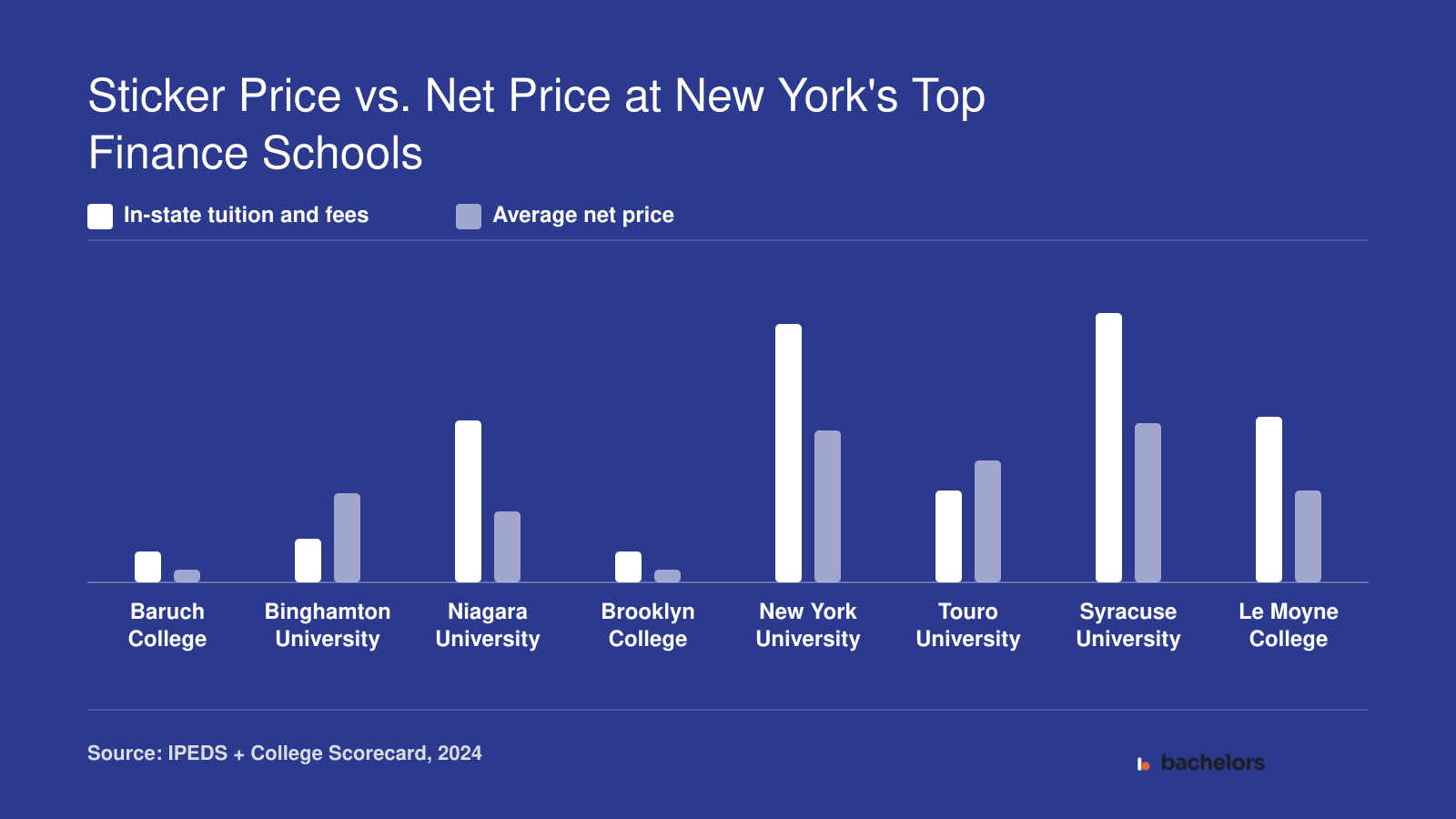
Sticker price is the published tuition and fees. Net price is the average yearly cost of attendance (tuition, housing, food, books and fees) minus grants and scholarships. At private schools, aid closes much of the gap: net price runs about $26,700 below tuition at Syracuse University and about $25,700 below at New York University. At Baruch College and Brooklyn College, students pay roughly $3,000 to $3,100 a year after aid. At Binghamton University and Touro University, net price is higher than tuition because it includes living costs, not tuition alone.
AACSB Accreditation, CFA Alignment, and Bloomberg Labs: What to Look for in a Program
An AACSB-accredited business school with a CFA-aligned curriculum and a live trading room is a different product from a finance degree with none of those signals. Those differences rarely appear in a brochure headline, so know which marks are verified and which are marketing.
AACSB accreditation is the floor
AACSB's accredited school directory confirms business accreditation for several of the schools on this page, including Baruch College's Zicklin School of Business, Binghamton University, NYU's Stern School of Business, and Brooklyn College's Murray Koppelman School of Business4. Fordham University's Gabelli School of Business and Ithaca College's School of Business also appear in the directory. Listing years are not uniform: Binghamton's entry shows 2025-263, while other entries simply carry accredited status. For employers screening resumes and for graduate admissions committees, AACSB is the recognized signal that a business school has been peer-reviewed on faculty qualifications, curriculum, and student learning outcomes. It is a baseline rather than a tiebreaker on its own.
CFA alignment and student-managed money
Baruch's Zicklin program lists the affiliation among its features and notes preparation for CFA exams. Le Moyne College's finance program advertises preparation for CFA Level I and II.
Hands-on investing is the other differentiator. Brooklyn College lists Bloomberg terminal experience and a student-managed hedge fund. Le Moyne cites its Errico Family Trading Center and real portfolio management. St. John Fisher University's Investment Club manages a portfolio.
What the directory cannot tell you
AACSB's pages confirm accreditation status and school details, but they do not record CFA affiliation, terminal labs, or fund structure. Those claims come from the schools themselves. Ask how many terminals undergraduates can access, whether the fund uses real money or a simulation, and whether the CFA-aligned track is open to every finance major.
Finance Careers in New York: Salaries, Employers, and FINRA Registration
A finance career in New York usually takes one of three forms: analyzing investments, advising individuals on their finances, or managing budgets and capital inside a company. Pay depends heavily on which path you choose and where in the state you work.
What Finance Majors Earn in New York
Federal wage data tracks experienced workers in an occupation, not new graduates, so expect entry-level pay to start below these figures:
- National benchmark: The Bureau of Labor Statistics reports May 2025 median wages of $102,740 for financial and investment analysts1 and $105,070 for personal financial advisors2.
- New York State: Personal financial advisors earned a median of $166,400 in May 20253. BLS wage surveys generally leave out self-employed workers, so independent advisors may not be reflected.
- New York City metro: In May 2023, mean wages reached $146,450 for analysts and $213,810 for advisors.4 These are averages, which top earners pull upward.
- Upstate: May 2025 advisor medians were $101,150 in Rochester and $103,650 in Buffalo, close to the national level.3
NYC vs. Upstate Employers
New York City concentrates investment banks, asset managers, trading firms, and fintech companies. Students at Baruch, NYU, Fordham, and other city schools can more easily fit internships around classes. Upstate, the work leans toward insurers, regional banks, credit unions, and corporate finance departments at large employers. Students at Canisius, Niagara, RIT, or St. John Fisher can build strong résumés too, but they often need to plan earlier and travel for recruiting. Wherever you study, one or two internships before graduation is the most dependable route to a first offer.
Licensing and FINRA Registration
Most finance jobs, including corporate finance and many analyst roles, require no state license. Roles that involve buying or selling securities for clients are different. The Series 7 exam covers general securities representative work and must be taken with sponsorship from a FINRA member firm, so employers typically sponsor new hires. The Series 63 covers state securities law and is commonly paired with it. Exact requirements depend on the role, so confirm them with any prospective employer.
Common Questions About Finance Degrees in New York
Treat these questions as a checklist, not a data summary. Rankings, requirements and pay figures change, so verify each answer directly with the school or agency before you rely on it.
What is the best business school for undergraduates in NYC?
Is CUNY Bernard M Baruch College good for finance?
What GPA do you need to get into a finance program in New York?
How much do finance majors make in New York?
Are there online bachelor's degrees in finance from New York schools?
Compare Finance programs on the data that matters
Explore more Business & Management majors or browse every field of study.
All Business & Management programs Browse every field of study