Best Accounting Schools in New York
Compare 87 accredited Accounting programs in New York at 76 colleges, with net price after aid, graduation rates, earnings and debt from IPEDS and the U.S. College Scorecard.

New York's route to a CPA license is shifting, which makes the choice of undergraduate program matter more than it used to. A bachelor's degree in accounting, most often a Bachelor of Science (B.S.) in Accounting, is the entry credential, but the state's 150-credit expectation means the school you pick shapes how and when you qualify.
Each program in the ranked top 10 is compared on affordability, earnings, online options, admissions, cost and CPA licensure. Rankings blend net price, graduation rate, and program outcomes from federal data.
Public CUNY and SUNY campuses cost far less than private ones, yet the licensing requirements are identical at every school.
Key Points
- Baruch College ranks first, backed by its Zicklin School of Business.
- Hunter College's in-state net price is lowest here, at $2,984 a year.
- Baruch accountancy graduates finish with a median $11,000 in federal loans.
Top 10 Bachelor's Degree in Accounting Programs in New York
Baruch College claims the top spot for accounting in New York, pairing a Zicklin School of Business degree with a Manhattan location that keeps students close to the city's accounting and finance employers. The rest of the list splits between SUNY campuses, from Farmingdale and Stony Brook to Geneseo, and private options such as NYU, so readers weighing cost against reach can see both paths side by side. Every entry is a bachelor's degree in accounting at a New York school, offered on campus, online, or both.
CUNY Bernard M Baruch College
#1New York, NY · $7,000 – $15,000/yr (est.)
Best for: Urban students targeting public accounting careers
Baruch College is a public CUNY campus in Manhattan, and its Zicklin School of Business houses the accounting program. Students move into Zicklin through three routes, including an early-entry option after four pre-business courses, and the school publishes a term-by-term path toward the 150-credit CPA designation. Its location puts internships with New York accounting and finance employers within a subway ride.
- 124 total credits: 42 Pathways, 21 pre-business, 27 business base, 24 major
- 2.0 GPA required to graduate; 2.5 GPA in four core accounting courses
- Three admission paths into Zicklin, including early entry at a 2.25 average
- Major covers Financial Accounting I-III, Cost Accounting, Federal Income Taxation, Auditing
- CPA guidance addresses the 150-credit designation and the national exam
- 57 liberal arts credits and a liberal arts minor required
Farmingdale State College
#2Farmingdale, NY · $11,000/yr (est. net price)
Best for: Long Island commuters wanting business flexibility
Farmingdale State College is a SUNY College of Technology on Long Island, and accounting sits inside its business management degree rather than as a standalone major. The program is deliberately flexible, with students building an individualized set of electives alongside a faculty advisor. A commuter-friendly campus and a broad business core suit students who want an accounting focus without leaving Long Island.
- Accounting concentration inside the BS in Business Management
- 124 to 125 total credits
- Choose from six concentration options in the business major
- Individualized elective plan built with a faculty advisor
- Core covers financial and managerial accounting, corporate finance, marketing
- Prepares for roles in accounting and finance, financial services, and global business
Stony Brook University
#3Stony Brook, NY · ~$19,000/yr (est.)
Best for: Honors-track students adding research depth
Stony Brook University is a SUNY research campus on Long Island's North Shore, and accounting is a full Bachelor of Science major in the College of Business. The curriculum leans analytical, requiring business analytics, finance, and operations work alongside financial reporting and auditing. Qualified freshmen and transfers enter the major directly on their application, and the Business Honors Program adds a thesis capstone.
- 3.2 GPA required for students not admitted to the major at entry
- Qualified freshmen and transfers enter directly by marking the major
- Core: Intermediate Accounting I and II, Federal Income Taxation I, External Auditing
- Business analytics, finance, and operations coursework required
- C or better needed in ACC and BUS courses, ECO 110, ECO 111, MAT 122
- Business Honors Program requires 3.5 GPA and a thesis capstone; apply by Oct 15
CUNY Hunter College
#4New York, NY · ~$3,000/yr (est.)
Hunter College is a CUNY campus on Manhattan's Upper East Side where accounting is housed in the Department of Economics rather than a business school. That structure pulls economics into the degree and leaves room for up to 13 non-professional credits outside the major. Internships in government, private firms, and nonprofits can count for credit, and departmental honors is open to high achievers.
- Offered by the Department of Economics, blending accounting with economics
- At least 30 accounting credits and 30 professional studies credits
- Up to 13 non-professional credits can count toward the degree
- Internships in government, private firms, and nonprofits earn pass/no pass credit
- Departmental honors option with a faculty-supervised project
CUNY Brooklyn College
#5Brooklyn, NY · under $5,000/yr (est.)
Brooklyn College is a CUNY campus in Midwood with a large business school and an accounting degree built on a broad business core. The college is candid about licensure: this shorter B.B.A. does not supply every course New York's 150-credit CPA rule requires, and students are pointed to a 150-credit public accounting degree or a master's to close the gap. The Magner Career Center connects majors with Deloitte, KPMG, and PwC.
- 120 credits: 46 to 50 in a business core, 19 in an accounting core
- Two tracks: Auditing and Assurance (15 credits) and General Accounting (9 credits)
- Grade of C or better in every accounting course; no course taken more than three times
- Writing-intensive course required for the major
- The B.B.A. alone does not supply all courses for New York CPA licensure
- College also offers a 150-credit public accounting degree and an M.S. in accounting
- Magner Career Center connects students with Deloitte, KPMG and PwC
University at Buffalo
#6Buffalo, NY · $20,000 – $25,000/yr (est.)
The University at Buffalo is a major SUNY research university, and accounting is a credit-heavy major inside the School of Management. Students take 85 credits in the field against 120 for the degree, with a 3.0 GPA and prerequisite coursework needed to enter the major. Many continue into the school's Master of Science in Accounting to reach the 150 credits New York licensure requires.
- 85 credits in the major within a 120-credit degree
- 3.0 GPA plus prerequisite courses required for admission to the major
- 60 earned credit hours needed before applying to the major
- Coursework includes intermediate financial accounting, auditing, federal income taxes
- Data analytics and management information systems built into the curriculum
- The BS alone does not qualify for the CPA exam; many students add the M.S.
- School of Management honors program available; no third attempt at major courses
New York University
#7New York, NY · ~$37,000/yr (est.)
NYU is a private university in lower Manhattan, and accounting is a concentration inside the Stern School of Business BS in Business rather than a separate degree. Students complete at least 12 upper-level accounting credits plus three advanced electives, with options such as sustainability accounting and financial analytics. Stern's recruiting ties to the city's financial industry are the main draw, and a combined BS/MS path covers CPA coursework.
- Accounting is a concentration inside Stern's BS in Business
- At least 12 upper-level accounting credits required
- Three advanced accounting electives, including sustainability accounting and analytics
- Coursework in managerial accounting and financial statement analysis
- BS/MS dual degree option covers the coursework for CPA eligibility
State University of New York at New Paltz
#8New Paltz, NY · ~$19,000/yr (est.)
SUNY New Paltz is a mid-sized public campus in the Hudson Valley whose business school treats accounting as an applied, practice-oriented major. Students build analytical, technical, and reporting skills through classroom work and extracurricular activities, and graduates land staff accountant, budget analyst, forensic accountant, and tax roles. The school also offers an MBA in Public Accountancy for students who need the full 150 hours.
- Builds analytical, technical, and applied accounting skills
- Big Four firms including EY, PwC, Deloitte and KPMG hire graduates
- Prepares for CPA, CMA, CIA and CFE certifications
- Graduates work as staff accountants, budget analysts, forensic and tax accountants
- MBA in Public Accountancy meets New York's 150-semester-hour requirement
CUNY Lehman College
#9Bronx, NY · $3,100/yr (est. net price)
Lehman College is a CUNY campus in the Bronx that has built out online delivery across several business degrees. Accounting is available as both a Bachelor of Science and a Bachelor of Arts, and major courses can be taken entirely online or in person. That flexibility is the point: the college positions the program for working adults and career changers fitting coursework around a job.
- Major courses delivered 100% online or on campus
- Business-field degree with a full accounting foundation
- College markets the online route as flexible and affordable
- Master of Science in Accounting available for students continuing on
- Award is a Bachelor of Arts rather than a B.S.
- Major courses available online or in person
- Business-field undergraduate degree with accounting coursework
- Designed as a flexible, affordable route into the field
SUNY College at Geneseo
#10Geneseo, NY · $15,000 – $20,000/yr (est.)
SUNY Geneseo is a selective public liberal arts campus in the Finger Lakes region, and accounting there pairs a full business major with a liberal arts foundation. New York State registers the program to qualify graduates for the Uniform CPA exam, and a one-year master's option supplies the remaining 150-hour credits. Career support is unusually structured for a public campus, with an in-house coach, an annual internship fair, and recruiting trips to New York City.
- Registered by New York State to qualify graduates for the Uniform CPA exam
- One-year M.S. in Accounting option supplies the remaining 150 credit hours
- Case analyses, decision projects, and independent research built into courses
- Annual internship and job fair plus New York City trips to major firms
- In-house career coach and alumni networks in New York City and Western New York
- Faculty include PhDs and practicing CPAs
Cost & outcomes by school
Federal data for the highest-earning Accounting programs, independent of the ranking above. Earnings are this field's bachelor's graduates four years after completing where the Scorecard reports them, else the school's undergraduate median.
| School | Net price / yr | Grad rate | Earnings | Debt | Grads/yr | Format |
|---|---|---|---|---|---|---|
| Fordham University NY | $44,338 | 82% | $117,024 | $23,000 | 118 | Campus |
| Syracuse University NY | $38,793 | 84% | $112,682 | $27,000 | 77 | Campus |
| Binghamton University NY | $21,620 | 82% | $106,323 | $17,500 | 164 | Campus |
| Marist University NY | $41,544 | 80% | $106,313 | $22,946 | 30 | Campus |
| Ithaca College NY | $33,926 | 76% | $102,626 | $25,000 | 16 | Campus |
| Rensselaer Polytechnic Institute NY | $36,228 | 84% | $102,051 | $23,750 | — | Campus |
| Adelphi University NY | $30,783 | 67% | $100,895 | $21,500 | 22 | Campus |
| Pace University NY | $30,892 | 60% | $100,797 | $25,291 | 56 | Campus |
| Touro University NY | $29,627 | 72% | $99,047 | $11,000 | 51 | Campus |
| University at Albany NY | $17,167 | 62% | $98,010 | $22,186 | 135 | Campus |
| Molloy University NY | $24,347 | 70% | $92,683 | $26,546 | 17 | Campus |
| Hofstra University NY | $34,176 | 69% | $92,530 | $22,750 | 38 | Campus |
Sources: U.S. Department of Education. Net price, graduation rate, earnings and debt: College Scorecard (earnings and debt for this field's bachelor's graduates where reported, else school-wide); graduates: IPEDS. A dash means no figure is reported.
Cost, debt & payoff
Median earnings of this field's bachelor's graduates (4 yrs after completing, else the school's undergraduate median) vs. their median federal loan debt · U.S. College Scorecard
Across these programs the median graduate earns about $72,587 and finishes with roughly $23,000 in debt — a ratio that clears a common rule of thumb (keep debt below first-year salary). Net price and debt vary widely school to school, so check the per-school figures in the table above before you shortlist.
Most Affordable Accounting Bachelor's Programs in New York
CUNY senior colleges fill every slot among the lowest-cost accounting bachelor's programs ranked here. All are public, and average net prices run just over $3,000 a year. For in-state students, CUNY Hunter College posts the lowest net price at $2,984. CUNY Bernard M Baruch College costs only about $50 more a year and has a 72% graduation rate, the strongest in this group. Net price is a federal average for students who receive grants and scholarships (IPEDS and College Scorecard, 2024), not a personal quote, so check each school's net price calculator. Even so, these averages sit well under half of each school's roughly $7,400 in-state sticker price.
| School | City | Sector | Program | Format | In-State Tuition and Fees | Out-of-State Tuition and Fees | Average Net Price After Aid | Graduation Rate |
|---|---|---|---|---|---|---|---|---|
| CUNY Hunter College | New York | Public | B.S. in Accounting | Campus | $7,382 | $15,332 | $2,984 | 57% |
| CUNY Bernard M Baruch College | New York | Public | Accountancy BBA | Campus | $7,464 | $15,414 | $3,033 | 72% |
| CUNY Brooklyn College | Brooklyn | Public | Accounting, B.B.A. | Campus | $7,452 | $15,402 | $3,103 | 54% |
| CUNY Lehman College | Bronx | Public | Bachelor of Science in Accounting | Online or campus | $7,410 | $15,360 | $3,148 | 51% |
Online and Hybrid Bachelor's in Accounting Options at New York Schools
An online or hybrid bachelor's in accounting teaches the same material as a classroom program (financial reporting, auditing, taxation, business law), but delivers some or all of it through a course site instead of a lecture hall. "Hybrid" means part of the work happens online and part happens in a classroom on a set schedule.
Which ranked programs are online
You can complete a bachelor's degree in accounting online at a New York school. Among the programs ranked here, CUNY Lehman College in the Bronx is the one built for online study: its Bachelor of Science in Accounting lets students take major courses fully online or in person, so the format can be entirely remote or a blend, depending on how you register. Lehman also offers a Bachelor of Arts in Accounting at 120 credits, but the college does not publish a delivery format for that version, so ask the department directly before assuming it can be done remotely. The other ranked programs are classroom-based, with coursework completed on campus.
Asynchronous versus hybrid
The distinction that matters most is scheduling. A fully asynchronous course has no fixed meeting time: you watch lectures and submit work on your own clock, within weekly deadlines. A hybrid course still expects you somewhere physical, whether that is a weekly seminar, a proctored exam, or a periodic residency. Confirm which applies before you commit, because a single required on-campus course can decide whether a program works for you.
Who each format fits
- Working adults: Asynchronous online study protects a full-time job and evening study hours.
- Transfer students: Online delivery makes it easier to finish a degree started elsewhere without relocating.
- Career changers: Hybrid formats offer face-to-face faculty access while you learn an unfamiliar field.
Related Articles
Admissions for Accounting Bachelor's Programs in New York: GPA, Test Policy and Transfer Credit
What GPA do you need to get into an accounting bachelor's program in New York, and do you still have to submit SAT or ACT scores? It depends on whether you apply to the university or to the major. Many schools admit you on general criteria, then set a higher bar for accounting.
GPA expectations by school
- CUNY Baruch College: The Accountancy BBA lists a 2.0 GPA minimum, plus a 2.5 GPA in accounting courses. Its admission rate is about 48%.
- Stony Brook University: The accounting program lists a 3.2 GPA minimum. About 49% of applicants are admitted.
- University at Buffalo: The major lists a 3.0 GPA minimum and 60 earned credit hours. About 74% of applicants are admitted.
- CUNY Brooklyn College: Strong freshman candidates typically have an 81% high school average, which is a benchmark and not a universal cutoff.3 Accounting majors need a C or better in every accounting course and get no more than three attempts at any one course.4 About 58% of applicants are admitted.
- CUNY Lehman College: It sets no GPA to apply, and the program follows CUNY general admission. About 57% of applicants are admitted.
- New York University: Its School of Professional Studies sets no minimum GPA and reviews applications holistically.1 Across the university, only about 9% of applicants are admitted.
For CUNY Hunter College, Farmingdale State College, SUNY New Paltz and SUNY Geneseo, no GPA minimum for the accounting major appears on the admissions pages. Their admission rates run from about 54% to 67%, so confirm requirements with each admissions office.
Test policy and transfer credit
NYU's School of Professional Studies does not require SAT or ACT scores.2 Brooklyn College points to SAT, ACT or Regents results as evidence of readiness. Lehman does not state a test requirement. For the other ranked schools, no test policy appeared in the pages reviewed.
NYU's School of Professional Studies is the clearest on transfers. It accepts up to 80 transfer credits and may guarantee admission to associate-degree holders with a 3.0 GPA, or to active-duty and veteran service members with 60 college credits.1 Brooklyn College evaluates transfers on prior accredited coursework. Lehman publishes no transfer maximum, minimum grade or residency rule.
Takeaways
- Test scores matter least at NYU's School of Professional Studies, which does not require them.
- Transfer students should compare NYU's published 80-credit limit with Buffalo's 60-credit requirement for its major, which suggests students enter at the junior level.
- Stony Brook (3.2) and Buffalo (3.0) set the highest published GPA bars. Baruch's 2.5 applies to accounting courses once you are in the major.
Cost of an Accounting Degree in New York: Tuition, Net Price and State Aid
The cost of a bachelor's degree in accounting in New York has two layers: the published tuition and the net price a family pays after grants. Those numbers can differ by tens of thousands of dollars a year, and the state aid you qualify for depends on income, enrollment status and where you live.
Published Tuition vs. Net Price
At the University at Buffalo, a ranked public option, in-state tuition is $10,936 and out-of-state tuition is $31,536; the published average net price after aid is $20,995. New York University, a ranked private option, publishes tuition of $62,796, with an average net price of $37,050. The private sticker price is roughly six times the public in-state figure, but the net-price gap narrows to about $16,000.
TAP and Excelsior
New York's Tuition Assistance Program (TAP) awards $1,000 to $5,665 a year for 2026-27.1 Dependent undergraduates qualify with combined income up to $125,000, as do independent students with tax dependents; independent students who are married with no dependents are capped at $60,000, and single independent students at $30,000.1 TAP requires 12 months of New York residency. Full-time recipients need 12 credits a term and 30 a year, and TAP generally runs up to four years.
The Excelsior Scholarship covers remaining tuition at SUNY or CUNY for families with federal adjusted gross income up to $125,000.2 It is last-dollar aid: Pell, TAP and other grants apply to tuition first, and Excelsior fills the balance up to SUNY resident tuition. It excludes room, board, fees, books and transportation, requires full-time enrollment and 30 credits a year, and converts to a loan if you leave New York before the award period ends. The 2026-27 application deadline was August 31, 2026.2 At participating private colleges, the Enhanced Tuition Award adds up to $6,000 a year.3
NYC vs. Upstate, and a Stacking Tip
Cost differences within New York often come down to housing. CUNY campuses in New York City draw many students who commute from home, while upstate SUNY campuses typically add room and meal plans to the bill. State grants apply to tuition, not housing, so a commuter budget can look very different from a residential one.
One practical move: file the FAFSA and the New York State TAP application each year, then ask each financial aid office for a written package that shows Pell, TAP, Excelsior and institutional grants as separate lines. That lets you see which awards are tuition-only and whether outside scholarships will reduce your institutional aid.
Which New York Accounting Bachelor's Programs Leave Graduates With the Least Debt?
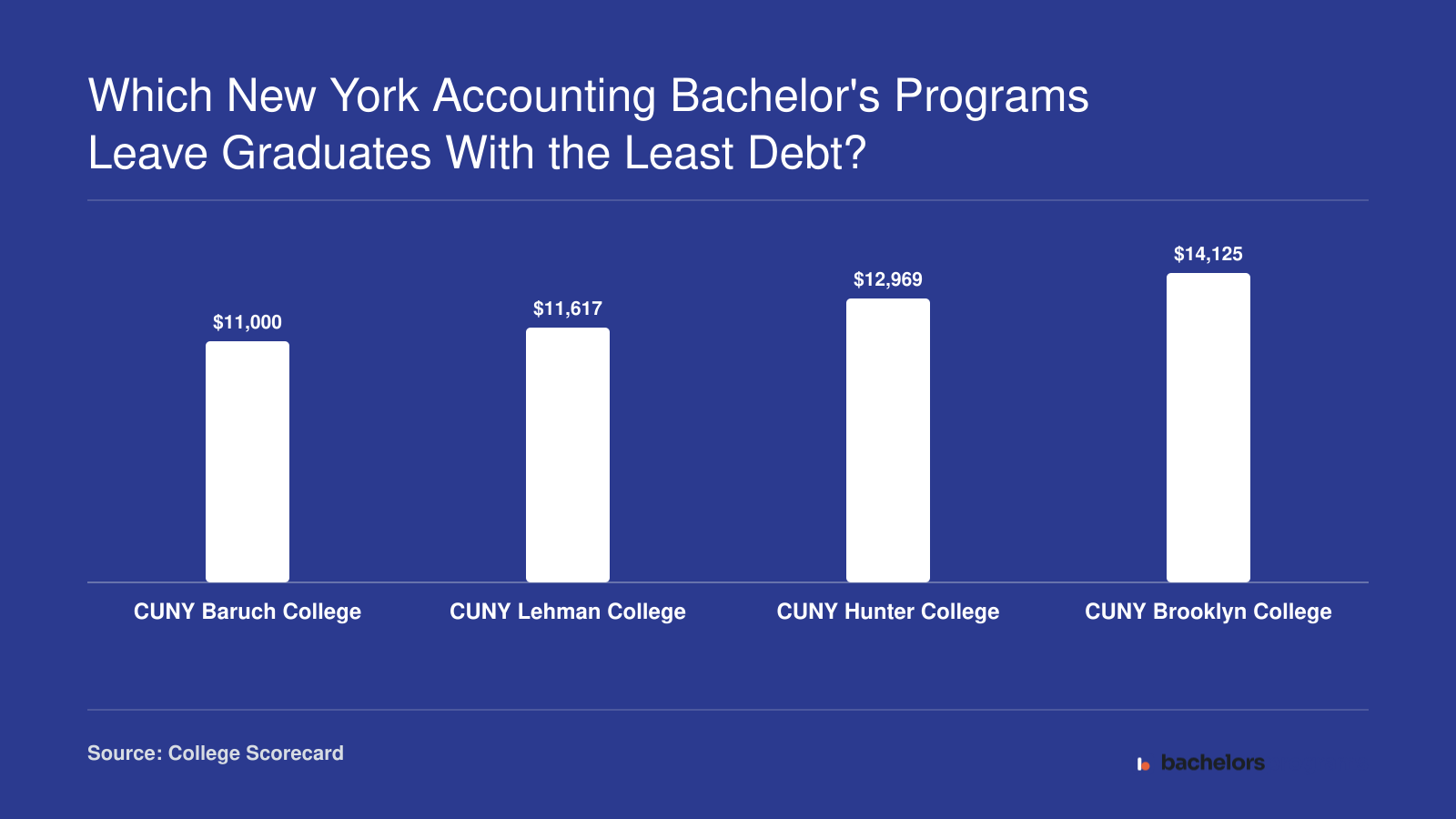
Among the schools ranked here, CUNY accounting programs post the lowest program-level median federal debt at completion, according to College Scorecard data. Baruch College's Accountancy BBA graduates finish with a median of $11,000 in federal loans, followed by Lehman College ($11,617), Hunter College ($12,969) and Brooklyn College ($14,125). Weigh these figures alongside net price and earnings: Baruch pairs its low debt with an average net price of $3,033 and median first-year earnings of $54,281 for accounting graduates.
New York CPA Education Requirements: The 150-Credit Rule and 2027 Changes
The credit count gets the attention, but the deciding factor in New York is which pathway you file under and when. The same bachelor's degree in accounting can lead to a license through more than one route between now and 2027, and the calendar matters as much as the transcript.
Sitting for the exam is not the same as getting licensed
Before November 21, 2026, New York allowed candidates to sit for the Uniform CPA Examination at 120 semester hours2, but licensure still required 150 hours plus a year of acceptable experience.1 The 120-to-sit rule was never a 120-credit license.
What changes, and when
- Effective November 21, 2026: a new 120-semester-hour licensure pathway opens. It requires a qualifying accountancy or equivalent degree, the applicable curriculum, the exam, and at least two years of acceptable experience.1 For programs registered on or after that date, the regulations specify at least 27 professional accounting hours and 30 general business hours.3
- Effective August 1, 2027: the revised 150-hour pathway (150E) applies. It keeps 150 hours, 33 accounting hours and one year of experience but adds at least 18 upper-level hours and at least one course in each of five content areas, plus general business coursework.4 An accounting bachelor's must contain 24 accounting hours.5
- The phase-out: the traditional 150-hour pathway ends August 1, 2027. The New York State Education Department Office of the Professions advises applicants to complete education, exam, and experience and submit by May 1, 2027, or requalify under another pathway.1
A 153-credit transcript clears the 150 minimum, but the state publishes no separate 153-credit pathway, and extra credits do not replace required subject-area coursework.
What this means for picking a program
Ask whether the accounting major is registered as licensure-qualifying, how its required courses map to the content areas above, and whether the department offers 150-credit planning or pathway advising. A transcripted accounting internship can count for up to six hours of coursework, but it cannot double as experience.5 Confirm the details with the Office of the Professions before you enroll.
New York CPA Licensure at a Glance
Accounting Careers and Pay in New York: NYC vs. Upstate
Choosing between a downstate and an upstate accounting career is partly a paycheck question and partly a cost-of-living one. The same bachelor's degree in accounting leads to a median wage roughly $25,000 higher in the New York metro than in Rochester, but rent and commuting costs rise along with it.
The statewide picture
New York employed 119,150 accountants and auditors as of May 2023, per Bureau of Labor Statistics data,1 and the statewide median annual wage reached $102,640 in 2025.2 Half of the state's accountants earn between $79,760 and $134,820, and the top tenth clears $171,030.2 Nationally, BLS projects 5% growth from 2025 to 2035, about 79,400 added jobs, which it rates as faster than average.3
Metro by metro
- New York-Newark-Jersey City: $105,650 median
- Albany-Schenectady-Troy: $84,660 median
- Buffalo-Cheektowaga: $82,120 median
- Rochester: $80,890 median
The New York figure covers the broader metro area, which reaches into New Jersey and Pennsylvania, so it is not a New York State-only number.
Where graduates land first
Four entry paths absorb most new graduates: public accounting firms doing audit and tax work, corporate accounting departments, government finance offices at the city, state and county level, and nonprofit finance teams. Starting salaries generally sit toward the lower end of the statewide range, and they climb as CPAs gain experience and licensure.
Compare Accounting programs on the data that matters
Explore more Business & Management majors or browse every field of study.
All Business & Management programs Browse every field of study