Best Business Degree Programs in New York
Compare 204 accredited Business programs in New York at 108 colleges, with net price after aid, graduation rates, earnings and debt from IPEDS and the U.S. College Scorecard.

New York offers business bachelor's degrees at nearly every price point, from SUNY and CUNY campuses to Ivy-adjacent private schools, and the spread in cost and outcomes is wide. Large urban campuses such as New York University sit alongside regional publics like SUNY Oneonta and CUNY Lehman College, plus online degree-completion tracks run by New York schools.
Cost and earnings pull apart: the cheapest option and the best-paid graduates rarely come from the same campus, so the lowest-cost programs and the highest-earning ones get separate lists. AACSB status, admissions rules, aid and pay each get a plain answer.
Employers in New York hire from all of these schools, but the brand carries more weight in Manhattan finance than it does upstate.
Key Points
- New York University admits roughly 9 percent of its applicants.
- Public CUNY and SUNY campuses offer the lowest net prices after aid.
- New York CPA licensure requires 150 semester hours, more than a bachelor's.
Best Bachelor's in Business Schools in New York: Our Top 10
New York's strongest business bachelor's programs tend to share three traits: a net price after aid that families can actually cover, a record of getting students to the finish line, and graduates who earn well within a few years of leaving. The ten schools below deliver that combination across the state, from Buffalo and Albany to Manhattan and Brooklyn. Each entry carries the city, the formats offered, in-state tuition, average net price after aid, and the school-wide graduation rate; read net price as an approximate average across aided students, not a quote for your own bill.
University at Buffalo
#1Buffalo, NY · $20,000 – $25,000/yr (est.)
Best for: Cost-conscious students wanting a large research campus
Buffalo is the largest public option on this list, and its business school runs a four-year BS in Business Administration with a General Management concentration inside a 120-credit degree. The major asks for a 2.500 GPA across prerequisites and coursework, and the program publishes outcomes: graduates reported median earnings of $69,903 four years after finishing, with median debt of $18,697. For a student who wants a big research university without a private-college price, it is the most straightforward value in the state system.
- 120 total credit hours over four years
- 70 major-specific credits, including 36 core business credits
- General Management concentration
- Admission requires a 2.500 GPA in prerequisites and overall
- 60 credit hours of prerequisites before the major
- 9 concentration credits plus a strategic management course
- Honors track open at a 3.500 GPA
- Minimum 2.000 GPA required to stay in the major
United States Military Academy
#2West Point, NY
Best for: Future Army officers seeking a funded degree
West Point is the outlier here: a federal service academy where the management major sits inside a tightly structured leadership curriculum, and every graduate commissions as an Army officer. Admission is the most selective on this list by a wide margin, so the practical question is fit with military service rather than class profile. There is no tuition bill and no business-school sticker price to weigh, which puts it in a category of its own.
- Bachelor's-level management major
- Business administration and management, general field
- Course listings organized by graduating class year
New York University
#3New York, NY · ~$37,000/yr (est.)
Best for: Finance-focused students set on Manhattan internships
NYU Stern is the most national name on this list and the one with the deepest New York City footprint, running a STEM-eligible BS in Business from Washington Square with 12 concentrations and a required global experience. A student can spend the first year at NYU London before returning to Stern in Manhattan, and the Global Experience requirement pushes everyone outside the country at some point. The trade-off is cost, with tuition and average net price both far above the public options.
- STEM-eligible BS in Business from Stern
- 12 concentrations, from finance and real estate to business analytics
- Four required Social Impact Core courses
- Global Experience requirement for all students
- First year can be spent at NYU London
- 44 elective credits and hundreds of NYU minors
- Double major available
- Tracks in luxury marketing and advanced data analysis
University of Rochester
#4Rochester, NY · ~$29,000/yr (est.)
Rochester takes an unusual route: a BA in business that requires a second major in another field, so students pair business with economics, psychology, or a language rather than specializing narrowly. The major is compact, 12 courses plus calculus and statistics prerequisites that AP or IB credit can clear, and a new curriculum takes effect in fall 2026 for incoming first-years and transfers. It suits a student who wants a liberal arts education with business as one half of it.
- 12 courses total plus calculus and statistics prerequisites
- AP or IB credit can satisfy the pre-major requirements
- Nine core courses and three approved electives
- Second major required in another field
- Satisfies the social sciences division of the Rochester Curriculum
- Covers the upper-level writing requirement
- New curriculum takes effect in fall 2026
CUNY Lehman College
#5Bronx, NY · $3,100/yr (est. net price)
Lehman is the value story on this list: a Bronx CUNY campus where the BBA in Business Administration can be completed with major courses entirely online or in person, and where median earnings four years after graduation reach $62,496 against median debt of $10,963. The business school layers in the Small Business Internship Program, which places students in paid internships with Bronx small businesses, plus short skill-building courses in social media and data presentation. For a working student paying their own way, the arithmetic is hard to beat.
- BBA in Business Administration
- Major courses can be taken 100 percent online or in person
- Six undergraduate minors offered
- Small Business Internship Program places students with Bronx businesses
- 1- to 2-credit skill-building courses
- Upskilling in social media and data presentation
- Classroom, online, and experiential learning formats
Touro University
#6New York, NY · $30,000/yr (est. net price)
Touro runs its BS in Business Management and Administration out of a Times Square building, with five concentrations and evening, Sunday, and hybrid schedules built for working students. Graduates report median earnings of $60,290 four years out with median debt of $18,541, and an accelerated pathway lets strong students start graduate coursework early. The location does real work here: internships with creative agencies, corporate offices, and financial firms are part of the design.
- Bachelor of Science in Business Management and Administration
- Five concentrations: accounting, finance, management, marketing, information systems
- Online, campus, and hybrid course formats
- Evening and Sunday classes for working students
- Times Square campus near Midtown firms
- Internships at creative agencies, corporate offices, and financial firms
- Accelerated pathway into graduate coursework
Rensselaer Polytechnic Institute
#7Troy, NY · ~$36,000/yr (est.)
RPI's Lally School puts a management degree inside a technology-focused campus, and the outcomes reflect it: median earnings of $99,713 four years after graduation, the highest on this list, with median debt of $25,000. Students can concentrate in accounting, business analytics, entrepreneurship, finance, or marketing, and the curriculum leans on quantitative work, team projects, and co-op or international exchange. It is the pick for someone who wants business skills aimed at technical industries.
- Bachelor's in Management from the Lally School of Management
- Tracks: Accounting, Business Analytics
- Concentrations also include entrepreneurship, finance, and marketing
- Quantitative foundation in math and science
- Focus on technology, innovation, and analytics
- Team-based project learning across the core
- Cooperative education and international exchange options
- Accelerated management-law program
University at Albany
#8Albany, NY · ~$17,000/yr (est.)
Albany's Massry School of Business offers a BS in Business Administration with seven concentrations and a fully online option, and it is unusually explicit about outcomes: graduates report median earnings of $76,633 four years out, and the school says more than 80 percent of business students find work within five months. The co-op program places students 35 to 40 hours a week for four to five months at a minimum of $21 an hour, and the Financial Analyst Honors concentration meets CFP Board education requirements. Entry to the major requires a 3.0 GPA, which is a real filter.
- Seven concentrations, including finance, marketing, and financial planning
- Financial Planning concentration meets CFP Board education requirements
- Fully online option available
- Co-op pays at least $21 an hour, 35 to 40 hours a week
- Co-op runs four to five months
- Financial Analyst Honors concentration requires a 3.5 GPA
- 3.0 GPA required to enter the major
- Combined bachelor's and master's finishes in five years
SUNY Oneonta
#9Oneonta, NY · ~$19,000/yr (est.)
Oneonta is a smaller SUNY campus whose business program punches above its size on hands-on resources: twelve Bloomberg terminals, a student portfolio managed with the University Foundation, and an annual Fed Challenge team. Students choose from accounting, finance, marketing, or supply chain management, and every class is taught by full-time faculty rather than teaching assistants. The 4+1 arrangements with the MBA and M.S. programs let a student stay for a graduate degree without starting over.
- Four concentrations: accounting, finance, marketing, supply chain management
- All classes taught by full-time faculty, no teaching assistants
- Twelve Bloomberg terminals on site
- Bloomberg Market Concepts certification available
- Students help manage a portfolio with the University Foundation
- Annual Fed Challenge monetary policy competition
- Capstone course in strategic management
- 4+1 MBA and M.S. partnerships
St. Joseph's University-New York
#10Brooklyn, NY · ~$19,000/yr (est.)
St. Joseph's is a small private campus in Brooklyn where the business administration bachelor's is built around internships and a liberal arts base rather than a long list of concentrations. Graduates report median earnings of $63,693 four years out with median debt of $21,825, and dual degree options let students stack a second credential. It fits students who want a small, teaching-focused department inside New York City rather than a large business school.
- Bachelor's in Business Administration on the Brooklyn campus
- Internship opportunities built into the program
- Dual degree options available
- Business fundamentals combined with humanities and sciences
- Prepares students for consulting, banking, and management roles
Cost & outcomes by school
Federal data for the highest-earning Business programs, independent of the ranking above. Earnings are this field's bachelor's graduates four years after completing where the Scorecard reports them, else the school's undergraduate median.
| School | Net price / yr | Grad rate | Earnings | Debt | Grads/yr | Format |
|---|---|---|---|---|---|---|
| Cornell University NY | $28,690 | 95% | $104,043 | $14,000 | 9,222 | Campus |
| Columbia University in the City of New York NY | $21,590 | 96% | $102,491 | $21,500 | 5,836 | Campus |
| Rensselaer Polytechnic Institute NY | $36,228 | 84% | $102,051 | $23,750 | 2,532 | Campus |
| Clarkson University NY | $30,305 | 75% | $89,696 | $26,000 | 1,434 | Campus |
| Manhattan University NY | $27,256 | 64% | $86,316 | $26,000 | 1,798 | Campus |
| Fordham University NY | $44,338 | 82% | $85,569 | $24,300 | 5,856 | Campus |
| New York University NY | $37,050 | 88% | $82,509 | $20,500 | 16,368 | Campus |
| Binghamton University NY | $21,620 | 82% | $80,596 | $18,500 | 8,166 | Campus |
| Syracuse University NY | $38,793 | 84% | $79,164 | $26,000 | 8,858 | Campus |
| University of Rochester NY | $29,278 | 85% | $79,042 | $21,000 | 4,350 | Campus |
| Marist University NY | $41,544 | 80% | $77,819 | $25,000 | 2,612 | Campus |
| Molloy University NY | $24,347 | 70% | $77,789 | $27,000 | 1,442 | Campus |
Sources: U.S. Department of Education. Net price, graduation rate, earnings and debt: College Scorecard (earnings and debt for this field's bachelor's graduates where reported, else school-wide); graduates: IPEDS. A dash means no figure is reported.
Cost, debt & payoff
Median earnings of this field's bachelor's graduates (4 yrs after completing, else the school's undergraduate median) vs. their median federal loan debt · U.S. College Scorecard
Across these programs the median graduate earns about $59,453 and finishes with roughly $22,000 in debt — a ratio that clears a common rule of thumb (keep debt below first-year salary). Net price and debt vary widely school to school, so check the per-school figures in the table above before you shortlist.
The Five Lowest-Cost Business Bachelor's Programs in New York
Public CUNY and SUNY campuses dominate the low-cost end of business education in New York. The table below is sorted by average net price after grants and scholarships, using 2024 IPEDS and College Scorecard figures from the U.S. Department of Education. CUNY Lehman College, part of our top 10, has the lowest net price, while CUNY York College and SUNY College at Potsdam sit outside our main ranking but post comparable costs.
| School | City | Business Program | Format | In-State Tuition and Fees | Average Net Price | Graduation Rate | Median Earnings 4 Years After Graduation (Business Bachelor's) |
|---|---|---|---|---|---|---|---|
| CUNY Lehman College | Bronx | Business Administration (BBA) | Online or on campus | $7,410 | $3,148 | 51% | $55,567 |
| CUNY York College | Jamaica | Business Administration (BS) | Online or in person | $7,358 | $4,456 | 32% | $52,751 |
| College of Staten Island CUNY | Staten Island | Business | On campus | $7,490 | $5,579 | 34% | N/A |
| SUNY College at Potsdam | Potsdam | Business Administration (BS) | On campus | $8,768 | $13,624 | 45% | $55,709 |
| SUNY College of Technology at Alfred | Alfred | Business Administration | On campus | $8,892 | $15,016 | 55% | $55,892 |
Which New York Business Schools Hold AACSB Accreditation
AACSB, ACBSP and IACBE all accredit business programs, but they carry different weight with employers and graduate schools. AACSB is the most widely recognized business-specific accreditation. It signals that a school's faculty, curriculum and learning outcomes passed a demanding peer review, the first check to run on any business bachelor's.
Where the Ranked Schools Stand
- AACSB: New York University (Stern), University at Buffalo and University of Rochester (Simon).
- ACBSP: CUNY York College, which announced initial accreditation in 2026.
- IACBE: SUNY College of Technology at Alfred, listed under the name Alfred State.1
For West Point, CUNY Lehman, Touro, Rensselaer, University at Albany, SUNY Oneonta, St. Joseph's University-New York, College of Staten Island and SUNY Potsdam, the directory records reviewed here do not confirm a business accreditation. Look each one up in the AACSB directory and on its program page before you apply.
What ACBSP and IACBE Mean for You
These accreditors approve solid programs, often at teaching-focused schools. Transfer credit usually depends on the school's institutional accreditation and the receiving college's own policy, so confirm before you move. Some graduate business programs and recruiters give AACSB schools a closer look, so ask about their preferences.
The Quick Takeaway
AACSB matters most if you are aiming at finance, consulting, or a graduate business degree later. For management, operations or small-business roles, a strong ACBSP or IACBE program can serve you well, especially at a lower cost.
Related Articles
Earning a Business Bachelor's Online or Hybrid From a New York School
Online flexibility and campus access pull in opposite directions. The schedule that lets a working adult keep a job can also cut them off from the internships, recruiting events and alumni network that a New York campus puts within reach.
Which programs list an online option
Of the schools ranked here, three are set up for both formats. CUNY Lehman College lets students take major courses online or in person, and University at Albany lists a fully online option for its Business Administration BS. Touro University describes flexible online and campus options, hybrid course formats, and evening and Sunday classes. The rest, including Buffalo, NYU, Rochester, RPI, Oneonta and St. Joseph's, are campus programs.
Delivery and eligibility questions
Ask whether sessions are live or self-paced, whether any in-person residency is required, and whether the online track is a degree-completion route limited to students who transfer in with an associate degree or substantial credit. Residency requirements vary by program, so confirm any required in-person meeting or weekend session before committing to a format. A transfer-only completion track is a different product from a four-year online degree, and the answer changes who can apply.
Who each format suits
Online fits working adults, parents and transfer students who need to keep earning. Campus fits students who want New York City internships, career fairs and the day-to-day networking that a business degree rewards.
Business Bachelor's Admissions in New York: GPA, Test Policy and Transfer Credit
Applying to a highly selective private is a different project from applying to a broad-access public, and New York gives you both. New York University admits roughly 9 percent of applicants and the United States Military Academy about 12 percent, so those files are read for rigor, context and the full academic record. At the other end, University at Buffalo admits about 74 percent, University at Albany and SUNY Oneonta roughly 69 percent, and St. Joseph's University-New York around 72 percent, where a solid college-prep transcript puts you in realistic range. CUNY Lehman College, at about 57 percent, sits between the two.
GPA and testing
Few schools publish a hard freshman GPA floor, but the absence of one is not a low bar. What is published tends to govern entry into the business major itself: University at Buffalo requires a 2.500 GPA for admission to its Business Administration BS and a 2.000 to stay in good standing, while University at Albany lists a 3.0 minimum for its program. On testing, confirm the policy for your application year directly on the school's admissions page. NYU's bulletin documented an optional-test policy for 2024-2025, but that language does not automatically carry into the current cycle.1
Transfer credit
NYU Stern accepts a maximum of 64 transfer credits, takes transfers for fall entry only, limits them to first-year and sophomore standing, and requires letter grades (no pass/fail) in the specified courses. CUNY and SUNY campuses generally honor system articulation from community colleges, so an AA or AS often maps cleanly into junior standing.
International applicants
Expect TOEFL or IELTS scores, a course-by-course transcript evaluation and financial documentation for the I-20. Minimums vary by campus and some programs set none, so verify before you test.
Business Careers and Pay in New York City vs. Upstate Metros
Business pay in New York, the base salary employers report for roles such as management analyst, financial analyst and marketing specialist, shifts sharply between New York City and upstate metros. The most reliable comparison comes from pulling the federal numbers yourself.
How to Find Current Pay and Employment Data
- Step 1: Open the Occupational Employment and Wage Statistics (OEWS) pages on BLS.gov.
- Step 2: Search each occupation: management analysts (13-1111), financial and investment analysts (13-2051), and market research analysts and marketing specialists (13-1161).
- Step 3: Select New York-Newark-Jersey City, Albany, Buffalo, Rochester and Syracuse, then compare median annual wages and employment counts.
For reference, the May 2023 release put Albany-Schenectady-Troy management analysts at a median annual wage of $81,598 across 3,050 jobs1, and statewide financial and investment analysts at $143,330 across 49,220 jobs.2
Sources Worth Checking
- BLS OEWS: median wages and job counts by metro.
- NYS Department of Labor and CareerOneStop: local labor market context.
- College career centers: placement rates and starting salary ranges for business graduates.
- Professional associations in finance, marketing research and consulting: role descriptions and compensation surveys.
What to Look For
- Use the latest release year and read medians, not means.
- Confirm whether figures are annual or hourly, and how the metro is defined.
- Expect blanks where samples are too small, and never fill them with guesses.
- Treat wages as base pay, and weigh NYC figures against its higher cost of living.
Use these comparisons to target employers, anchor offer negotiations and press career centers for fresher local numbers.
New York CPA Licensure at a Glance
Questions to Ask Yourself
Does your target career actually require an AACSB-accredited degree?
Is New York City internship access worth the higher cost of living?
Are you planning for the 150 credits New York requires for CPA licensure?
Can you meet the conditions attached to Excelsior or TAP awards?
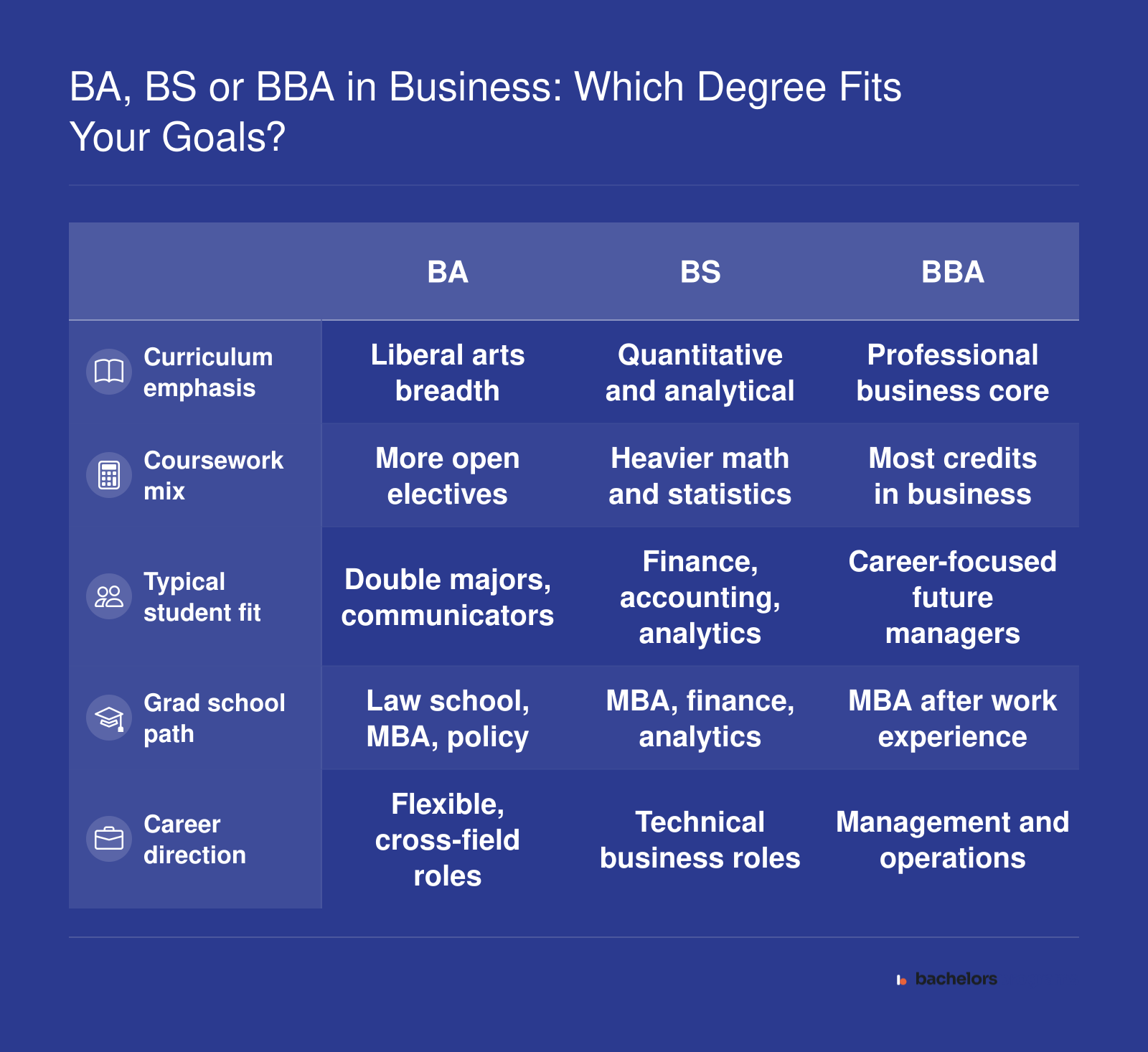
BA, BS or BBA in Business: Which Degree Fits Your Goals?
New York schools award business bachelor's degrees under several titles. The University of Rochester offers a BA business major, while the University at Buffalo and the University at Albany award a BS in business administration. Titles and requirements vary by school, so treat this comparison as a general guide and check each program's course list before you apply.
Business Degree Questions New Yorkers Ask Most
What is the best business school in New York for undergraduates?
How much do business administration graduates earn in New York?
Are these earnings figures a statewide salary for every graduate?
Compare Business programs on the data that matters
Explore more Business & Management majors or browse every field of study.
All Business & Management programs Browse every field of study