Best Finance Schools in Tennessee
Compare 36 accredited Finance programs in Tennessee at 28 colleges, with net price after aid, graduation rates, earnings and debt from IPEDS and the U.S. College Scorecard.

What is the best finance school in Tennessee for a bachelor's degree in finance? It depends on cost, accreditation and where you plan to work. Nashville and Memphis anchor the state's banking, insurance and corporate finance employers, and both cities hire from public universities and private colleges.
The usual credential is the Bachelor of Science (B.S.) in Finance, though some schools award a business degree with a finance major. Price varies widely: Austin Peay State University lists $9,006 a year in tuition and fees, while Christian Brothers University lists $38,420 before aid.
Sticker price rarely predicts outcomes. Net price and graduate earnings tell a clearer story, and AACSB accreditation still carries weight with recruiters.
Key Points
- Austin Peay State University charges $9,006 in yearly in-state tuition and fees.
- The University of Tennessee-Knoxville admits about 42% of applicants, the lowest rate here.
- Nationally, financial analysts earned a $102,740 median wage in May 2025.
Best Bachelor's in Finance Schools in Tennessee: Our Top 10
The ten programs below range from the state's flagship research university to small private colleges, and each one awards a bachelor's degree in finance from a Tennessee-based school. Six appear in the AACSB International directory; for the other four, accreditation status could not be confirmed from the sources used for this list, and we say so on the card rather than guess. Several of these schools put real money under student control through managed investment funds, which is worth weighing against cost and location.
The University of Tennessee-Knoxville
#1Knoxville, TN · ~$19,000/yr (est.)
Best for: Aspiring analysts wanting hands-on portfolio experience
The state's flagship campus runs the deepest finance program in Tennessee, built around a CFA-recognized curriculum, Bloomberg terminal training, and the Masters Investment Learning Center, where students manage real portfolios. Twelve collateral options let majors pair finance with business analytics, entrepreneurship, or supply chain management, and qualified students can apply to an accelerated five-year path toward a master's degree. The Haslam College of Business holds AACSB International accreditation.
- 120 to 124 credit hours with twelve collateral options
- CFA Recognized University with sponsorships for exam costs
- Bloomberg terminal training in the Masters Investment Learning Center
- Students manage real portfolios in Finance 495
- Coursework spans derivatives, fixed income, real estate and international finance
- Accelerated five-year bachelor's to master's pathway for qualified majors
- Student groups include the Tennessee Capital Markets Society
- International business concentration inside the finance major
- 2.5 GPA minimum for the track
- Same CFA-recognized curriculum as the base major
The University of the South
#2Sewanee, TN · ~$28,000/yr (est.)
Best for: Liberal arts students targeting investment banking
Sewanee pairs a small liberal arts setting with a finance major grounded in economics, corporate finance, investments, and security analysis, so the coursework reads more analytical than narrowly vocational. Electives reach into real estate finance, international finance, energy economics, and derivatives, and the program is designed to position graduates for the Level I CFA exam or for graduate study in finance, policy, or law. AACSB business accreditation status could not be confirmed from the sources used here.
- Core in economics, corporate finance, investments and security analysis
- Electives include real estate finance, international finance and derivatives
- Prepares students for the Level I CFA exam
- Hands-on work with real financial data
- Small liberal arts setting in Sewanee
Freed-Hardeman University
#3Henderson, TN · $22,000/yr (est. net price)
Best for: Faith-based learners interested in financial planning
A private Christian university in Henderson where upper-level finance classes stay small and faculty attention is one-on-one, and the business school is a CFA Institute University Affiliation Program member. Students choose between a general finance path and a financial planning track aimed at the CFP exam, and an investment club manages an actual stock portfolio. AACSB business accreditation status could not be confirmed from the sources used here.
- CFA Institute University Affiliation Program member
- Capstone required; small upper-level classes
- Investment club manages a real stock portfolio
- Coursework in risk management, financial markets and managerial finance
- Internships and case studies built into the major
- Financial planning track prepares students for the CFP exam
- Internships with financial planning practices
- Experience hours can be earned while enrolled
- Faculty include CFP professionals
- Monthly Student Financial Planning Association events
Tennessee Tech
#4Cookeville, TN · $10,000 – $15,000/yr (est.)
Tennessee Tech's finance major sits inside a Bachelor of Science in Business Administration and leans on accounting and economics to teach financial statement analysis, security valuation, and capital investment decisions. It is one of the more accessible public options on this list, and the curriculum feeds directly into banking, real estate, insurance, brokerage, and corporate treasury roles. AACSB business accreditation status could not be confirmed from the sources used here.
- Finance major inside the Bachelor of Science in Business Administration
- Analyze financial statements, value securities, select capital investments
- Combines accounting and economics coursework
- Paths into banking, real estate, insurance, brokerage and corporate finance
Lipscomb University
#5Nashville, TN · ~$25,000/yr (est.)
Lipscomb blends a sixteen-course business core with unusually hands-on investing work: students compete in the TVA Investment Challenge and use Bloomberg terminals in the Financial Markets Lab. A finance internship is required and study abroad options extend the degree beyond Nashville, with graduates moving into analyst, examiner, and personal advisor roles. The university's business programs hold AACSB International accreditation.
- Bloomberg terminals in the Financial Markets Lab
- Competes in the TVA Investment Challenge managing real portfolios
- Finance internship required for the major
- Sixteen required business core courses
- Study abroad options available
Middle Tennessee State University
#6Murfreesboro, TN · ~$13,000/yr (est.)
MTSU's Jones College of Business is one of the larger business schools in the region, and the finance B.B.A. lets students concentrate in corporate finance, investments, or financial institutions, with a separate real estate concentration. Twenty-seven semester hours of finance coursework plus a built-in business administration minor give the degree a broad base, and the university's low in-state tuition makes it one of the better values here. Business programs at MTSU hold AACSB International accreditation.
- 27 semester hours of finance courses
- Concentrations in corporate finance, investments, financial institutions
- Business administration minor included
- 2.0 GPA minimum for the major
- Real estate concentration inside the finance B.B.A.
- Careers in brokerage, property management and lending
- Faculty with real estate industry ties
- Internships and part-time work available
The University of Tennessee-Martin
#7Martin, TN · $11,000/yr (est. net price)
UT Martin runs a compact finance program inside the Bachelor of Science in Business Administration, with concentrations in commercial banking and investments and a student-managed stock portfolio at the center of the experience. Thirty credit hours of major coursework, internships, and professional conferences keep the degree practical, and this is among the lowest-priced public routes to a finance bachelor's in the state. Business programs at UT Martin hold AACSB International accreditation.
- Tracks: Commercial Banking, Investments
- 30 credit hours of major coursework
- Students manage an actual stock portfolio
- Internships and professional conferences
- C or better required in upper-division finance courses
- Combines finance with accounting and economics
Lee University
#8Cleveland, TN · ~$19,000/yr (est.)
Lee University's finance program on the Cleveland campus builds a business foundation in accounting, economics, management, and marketing before advanced work in valuation, portfolio management, and international finance. A required business ethics course and 80 clock hours of Christian service shape the program's character, and the 120-credit structure is standard for the field. AACSB business accreditation status could not be confirmed from the sources used here.
- 120 total credit hours
- Specialty area requires 65 credit hours
- Coursework in valuation, portfolio management and international finance
- Required business ethics course
- 80 clock hours of Christian service
- Christian worldview general education sequence
East Tennessee State University
#9Johnson City, TN · ~$16,000/yr (est.)
ETSU's finance B.B.A. pairs a 36-credit business core with a 15-credit finance core and a Financial Services concentration, and students can also choose corporate finance and investments, real estate, or general finance tracks. A senior business exam before the capstone and a rule that half of major requirements be earned at ETSU are worth planning around early. Business programs at ETSU hold AACSB International accreditation.
- 4 concentration options, including Financial Services
- 36-credit B.B.A. core plus 15-credit finance core
- 9-credit concentration and 12 credits of advisor-approved electives
- At least six elective credits must be FNCE courses
- Senior Business Exam required before the capstone
- 50 percent of major requirements must be earned at ETSU
- 2.0 GPA minimum; C or better in core courses
University of Memphis
#10Memphis, TN · $10,000 – $15,000/yr (est.)
The University of Memphis offers its finance B.B.A. on campus and fully online through UofM Global, with flexible tracks covering banking, analysis, planning, and corporate finance. The online route awards the same diploma, accepts transfer credit, and is built for working adults, while the campus program emphasizes capital budgeting and portfolio design. Business programs at Memphis hold AACSB International accreditation.
- 120 credit hours with flexible tracks in banking and analysis
- Coursework in capital budgeting, investment analysis and portfolio design
- Prepares students for analyst, loan officer and advisor roles
- Work in private industry, government or nonprofit sectors
- Fully online through UofM Global
- Same diploma as on-campus students
- 8 concentration options; Business Finance concentration listed
- Recognized by the CFA Institute and CFP Board
- Transfer credits accepted
- 24/7 tutoring and career advising
- 2.0 GPA minimum; prerequisite courses required
Cost & outcomes by school
Federal data for the highest-earning Finance programs, independent of the ranking above. Earnings are this field's bachelor's graduates four years after completing where the Scorecard reports them, else the school's undergraduate median.
| School | Net price / yr | Grad rate | Earnings | Debt | Grads/yr | Format |
|---|---|---|---|---|---|---|
| Belmont University TN | $33,147 | 71% | $124,270 | $20,500 | 27 | Campus |
| The University of Tennessee-Knoxville TN | $18,976 | 74% | $83,793 | $20,500 | 361 | Campus |
| Austin Peay State University TN | $9,735 | 40% | $71,567 | $20,547 | 39 | Campus |
| Middle Tennessee State University TN | $13,359 | 54% | $66,701 | $21,250 | 76 | Campus |
| Tennessee Tech TN | $14,246 | 58% | $66,535 | $16,087 | 31 | Campus |
| University of Memphis TN | $12,397 | 51% | $65,132 | $23,550 | 97 | Campus |
| The University of the South TN | $27,872 | 80% | $64,911 | $22,855 | 28 | Campus |
| The University of Tennessee-Martin TN | $10,701 | 53% | $64,840 | $20,251 | 42 | Campus |
| King University TN | $22,347 | 48% | $59,831 | $22,750 | — | Campus |
| East Tennessee State University TN | $15,983 | 53% | $58,232 | $17,739 | 58 | Campus |
| Christian Brothers University TN | $9,854 | 55% | $57,478 | $27,000 | 12 | Campus |
| Lipscomb University TN | $24,739 | 72% | $55,541 | $19,500 | 30 | Campus |
Sources: U.S. Department of Education. Net price, graduation rate, earnings and debt: College Scorecard (earnings and debt for this field's bachelor's graduates where reported, else school-wide); graduates: IPEDS. A dash means no figure is reported.
Cost, debt & payoff
Median earnings of this field's bachelor's graduates (4 yrs after completing, else the school's undergraduate median) vs. their median federal loan debt · U.S. College Scorecard
Across these programs the median graduate earns about $54,988 and finishes with roughly $21,250 in debt — a ratio that clears a common rule of thumb (keep debt below first-year salary). Net price and debt vary widely school to school, so check the per-school figures in the table above before you shortlist.
Cheapest Bachelor's in Finance Programs in Tennessee
If you want the cheapest college for a finance degree in Tennessee, compare net price, the average annual cost after grants and scholarships, rather than sticker tuition. Christian Brothers University lists $38,420 in tuition and fees but has an average net price of $9,854, close to public Austin Peay State University ($9,735) and UT Martin ($10,701), which is the lowest net price among the schools in our ranking. A lower net price does not always mean less borrowing: Le Moyne-Owen College and Lane College, two Memphis-area and Jackson HBCUs outside our ranked list, post low net prices but higher institution-wide median debt than the public options, while program-level median debt for finance graduates is $17,500 at Austin Peay and $20,500 at UT Martin, according to 2024 IPEDS and College Scorecard data.
| School | Sector | In-State Tuition and Fees | Average Net Price After Aid | Pell Grant Share | Median Graduate Debt (Institution-Wide) |
|---|---|---|---|---|---|
| Le Moyne-Owen College | Private nonprofit | $12,076 | $7,099 | 89% | $28,070 |
| Austin Peay State University | Public | $9,006 | $9,735 | 74% | $20,547 |
| Christian Brothers University | Private nonprofit | $38,420 | $9,854 | 66% | $27,000 |
| The University of Tennessee-Martin | Public | $10,560 | $10,701 | 68% | $21,024 |
| Lane College | Private nonprofit | $11,790 | $10,904 | 92% | $30,500 |
Highest-Earning Finance Bachelor's Graduates in Tennessee
How much do finance majors make in Tennessee after graduation? At every school below with debt figures, median debt at completion is less than one year of first-year pay, lowest relative to earnings at Austin Peay State University (36 percent) and highest at the University of Memphis (61 percent). These Scorecard medians cover small groups of completers and are not a promise of starting pay.
| School | Completers in Scorecard group | Median earnings 1 year after finishing | Median earnings 4 years after finishing | Median debt at completion | Debt as share of 1-year earnings |
|---|---|---|---|---|---|
| Belmont University | 21 | N/A | $124,270 | N/A | N/A |
| The University of Tennessee-Knoxville | 198 | $53,826 | $83,793 | $23,250 | 43% |
| Austin Peay State University | 25 | $48,264 | $71,567 | $17,500 | 36% |
| East Tennessee State University | 59 | $39,936 | $58,232 | $18,125 | 45% |
| University of Memphis | 102 | $44,395 | $65,132 | $27,000 | 61% |
Online and Hybrid Bachelor's in Finance Options at Tennessee Schools
Yes, you can earn a bachelor's degree in finance online in Tennessee, but expect a hybrid arrangement: at the schools ranked here the finance major itself is a campus program, so online study means stacking online general-education and elective credits around a campus-based major rather than taking the whole degree from home.
Which Schools Offer What
The University of Tennessee-Knoxville lists its B.S.B.A. in Finance as an on-campus program, and the finance majors at Tennessee Tech, Middle Tennessee State, UT Martin, East Tennessee State, the University of Memphis, Lipscomb, Freed-Hardeman, Lee and Sewanee are campus programs as well. Each of those pages describes a campus-based major, and none we reviewed advertises a fully online finance major or a residency term attached to one. Strayer University-Tennessee also offers a Bachelor of Business Administration in Finance.
What Online Credits Cost
Tennessee Tech publishes online undergraduate tuition for Fall 2026 through Spring 2027 at $383 per credit hour in state, capped at 12 credit hours, plus a $153 per credit hour online fee, for a stated $536 per credit hour total. Out-of-state and international rates are separate and some programs are excluded, so confirm that finance courses qualify before you build a schedule around the online rate.
Transfer Credits and the Tennessee Transfer Pathway
Tennessee community colleges offer an Associate of Science in Finance built on the Tennessee Transfer Pathway.1 Students who complete the pathway courses and the associate degree can enter a Tennessee public university as juniors, and the pathway guarantees admission everywhere except UT Knoxville, where competitive standards still apply.2 How each course lands inside the finance major depends on the receiving school's audit, equivalency and minimum-grade rules, so get a written credit evaluation before you enroll.
Who Should Choose Online
Working adults and transfer students who already hold an associate degree get the most from a hybrid schedule, because they can keep a job while clearing general-education requirements. If you want a trading lab, Bloomberg terminals and internship recruiting, stay on campus.
Admission Requirements for Tennessee Finance Bachelor's Programs
Getting into a bachelor's degree in finance in Tennessee usually happens in two stages: admission to the university, then meeting business-school standards before upper-level finance courses. For selectivity context, UT Knoxville admits about 42% of applicants, the lowest rate among the schools ranked here, while UT Martin admits about 88%.
- Minimum GPAMiddle Tennessee State and East Tennessee State list a 2.0 GPA minimum for the finance major. The University of Memphis requires a 2.00 overall GPA and a 2.25 GPA in listed lower-division business courses. UT Knoxville business students must keep a 2.5 cumulative GPA, though it publishes no separate first-year minimum for finance.
- ACT/SAT test policyTest policy is set at the university level, so confirm it with each school's undergraduate admissions office. The finance program pages we reviewed for UT Knoxville and Memphis do not state a test requirement.
- Direct admission vs. entry after prerequisitesUT Knoxville admits transfer students directly to its business college through competitive holistic review, then requires a C or better in tracking courses such as MATH 125, ACCT 200, ECON 211 and STAT 201. ETSU and Memphis require a C or better in core or major courses.
- Transfer credit and the Tennessee Transfer PathwayThe Tennessee Transfer Pathway is an advising tool that maps community college courses to major preparation at Tennessee public universities. UT Knoxville participates, but no finance-specific transfer guarantee is published. ETSU requires 50% of major coursework to be completed at ETSU.
- Application materialsUT Knoxville's transfer review weighs academics, extracurricular and leadership activity, and commitment to business, so plan to show all three. For other schools, follow each admissions page's current checklist.
Cost of a Finance Bachelor's Degree in Tennessee
Sticker Price vs. What Students Actually Pay
At Tennessee's public universities, in-state tuition and fees fall in a narrow band. Austin Peay State University lists $9,006 a year, Middle Tennessee State University $10,266, UT Martin $10,560, University of Memphis $10,728 and Tennessee Tech $11,376. Average net price after grants and scholarships runs from $9,735 at Austin Peay to $14,246 at Tennessee Tech. Net price can exceed tuition at public schools because it counts housing, food and books, not just the bill for classes.
Private schools often show the opposite pattern. Christian Brothers University lists $38,420 in tuition and fees, yet its average net price is $9,854, close to the public figures, because institutional aid covers much of the sticker price. Don't rule out a private school on tuition alone.
Net price is an average across students in each sector and income band. It is an estimate, not a quote. Run each school's net price calculator for your own number.
The Tennessee HOPE Scholarship
The HOPE Scholarship, run by the Tennessee Student Assistance Corporation (TSAC), is the state's main merit award for Tennessee residents attending eligible public and private colleges in the state. Entering freshmen generally qualify with a 3.0 high school GPA or a 21 on the ACT (or the SAT equivalent), plus a completed FAFSA. Award amounts vary by class standing and have changed in recent years, so confirm the current figure with TSAC before you build a budget. Keeping HOPE requires meeting college GPA benchmarks at set credit-hour checkpoints.
Community College Routes Into a Bachelor's
- Tennessee Promise: A last-dollar scholarship covering tuition and mandatory fees at a Tennessee community or technical college for students who apply as high school seniors. It includes mentoring and community service requirements.
- Tennessee Reconnect: A similar tuition-free path at community colleges for adults who have not yet earned an associate or bachelor's degree.
Both can lead to an associate degree that feeds directly into a finance bachelor's program at a four-year school.
Stack State Aid With a Transfer Pathway
Tennessee Transfer Pathways map community college courses that move as a block to the state's public universities and to participating private colleges. Completing a business pathway on Tennessee Promise, then transferring with HOPE, can cut the cost of your first two years sharply. Before you enroll, ask the finance department which courses count toward the major. Some schools cap transfer credit in the business core: UT Chattanooga, for example, requires half of business credits to be earned at UTC.
Related Articles
Finance Careers in Tennessee After a Bachelor's Degree
Financial and investment analysts earned a national median annual wage of $102,740 in May 20251, and personal financial advisors earned $105,0702, according to the Bureau of Labor Statistics. Those are national figures. The numbers that should shape your job search are the Tennessee and metro ones, and BLS publishes both.
Pull the state and metro tables yourself
Start at BLS.gov. The Occupational Outlook Handbook pages for Financial Analysts and Personal Financial Advisors explain what the work involves, and the Occupational Employment and Wage Statistics (OEWS) section publishes separate tables for Tennessee, Nashville, and Memphis. Search by occupation title or by code: 13-2051 for financial and investment analysts, 13-2052 for personal financial advisors. For scale, the statewide median across all occupations was $47,380 in May 2025.3
Read each estimate for what it actually measures
Check three things before you compare: the data year (the current release is May 2025, published in 2026), whether a number is a median annual wage, an employment count, or a location quotient, and whether a metro row is grouped with a broader occupation or withheld because the sample was too small. Smaller metros often publish a combined category instead of the exact title you searched.
Find out who is actually hiring
In Memphis, the Financial Activities sector reported 29,200 jobs in September 2026 on a preliminary basis, at average weekly earnings of $1,504.70, or $41.00 an hour.4 That is an industry average rather than an occupational salary, but it tells you the sector is large and well paid locally. To turn that into employer names, check Nashville and Memphis business journals, chamber of commerce directories, LinkedIn company searches, and employer career pages. Career services offices and employment outcome reports at the University of Tennessee-Knoxville, Middle Tennessee State, Belmont, and the University of Memphis are worth reading too.
Ask people, not just databases
The Financial Planning Association and the Tennessee Society of CPAs run local chapters and events where you can ask practitioners what they hire for. Alumni networks and campus career centers will often tell you directly which employers recruit in each city, what titles new graduates start in, and what salary range to expect.
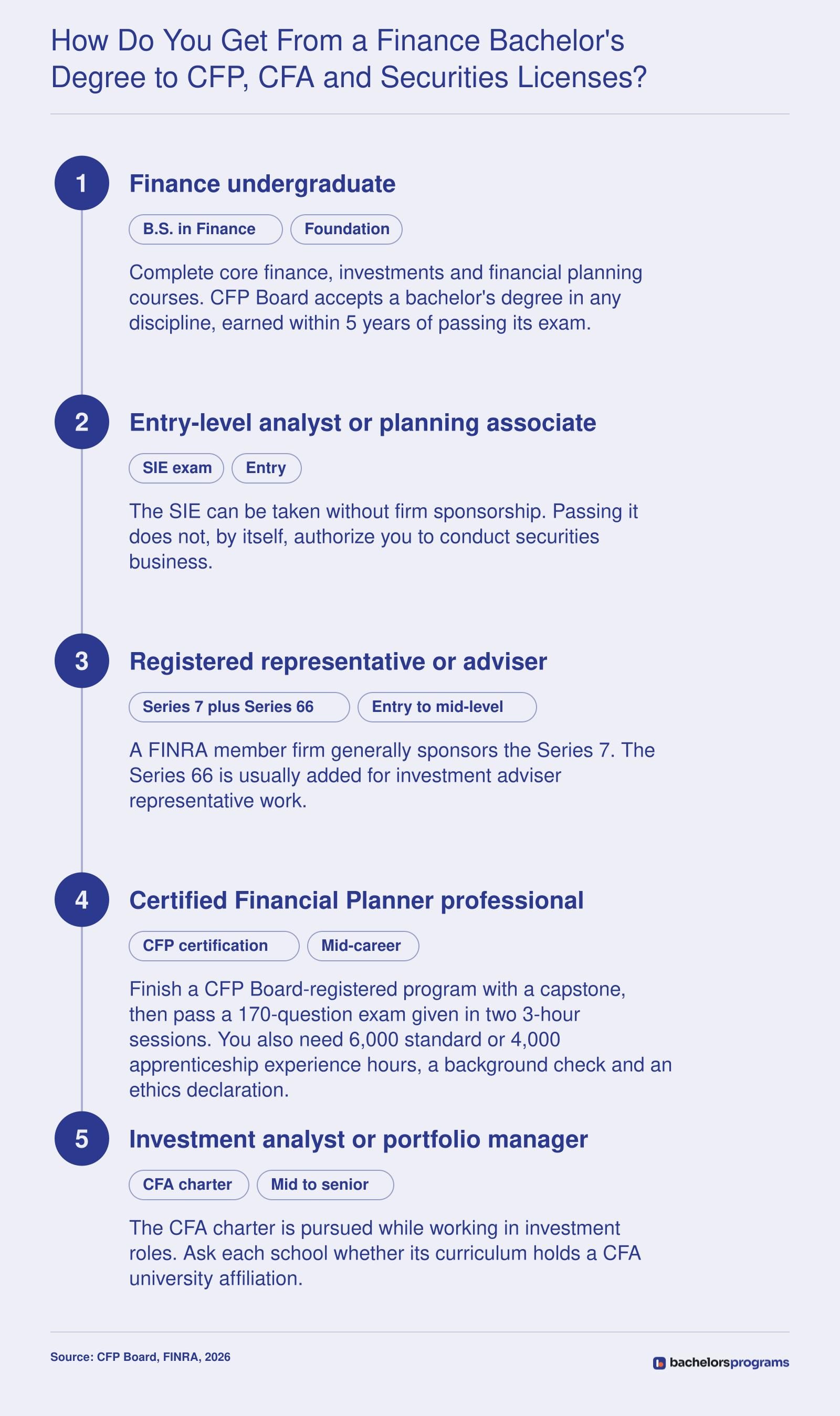
How Do You Get From a Finance Bachelor's Degree to CFP, CFA and Securities Licenses?
A bachelor's degree in finance is the starting point. Licenses and professional credentials are added in stages, often with employer support. Ask whether a program's business school holds AACSB accreditation, which employers and graduate programs widely recognize as a quality marker. If you are aiming for the CFP, check that your coursework appears in CFP Board's directory of registered programs. Freed-Hardeman University's Finance: Financial Planning track is a natural place to start that check.
How to Choose a Bachelor's in Finance Program in Tennessee
Pick your finance program by working through five filters in a fixed order, and let cost break ties only after the first four are settled.
Accreditation, Then Concentration
Start with accreditation, because it limits everything else. Treat AACSB status as a tiebreaker, not a requirement, for most students. It matters more if you are aiming at the CFA path or a graduate program later, since admissions committees and employers recognize it. Next, check the concentration. Freed-Hardeman offers a financial planning track, and East Tennessee State offers a financial services concentration. Those suit students headed toward advisory work better than a general finance major does.
Internships, Format and Cost
Look for internship pipelines and local employer ties. A program in Nashville or Memphis will usually put you closer to banks, health care finance and corporate headquarters than one in a small town. Ask each department where recent graduates interned. Then consider format, and only then cost. For budget-driven students, net price should carry more weight than prestige. Compare the programs against the cost tables above rather than relying on sticker tuition.
Match It to Your Situation
- First-time freshman: Prioritize AACSB status, a strong internship network and a campus that fits you. You have time to use all of it, so the extra investment can pay off.
- Community college transfer: Confirm which credits transfer before you apply, then favor in-state public schools with clear articulation paths. Net price matters most here.
- Working adult: Put format first. Strayer University-Tennessee and the hybrid arrangements described earlier fit a job schedule, so ask about evening classes, pacing and credit for work experience.
Use the ranking to build a shortlist, then use the cost tables to cut it. Whichever school you land on, confirm the concentration and the internship record directly with the department before you commit.
Finance Schools in Tennessee: Frequently Asked Questions
These answers cover the most common questions about earning a bachelor's degree in finance in Tennessee. Where the available data is limited, the answers say so and point you to what to confirm with each school.
What is the best finance school in Tennessee?
Which Tennessee colleges are AACSB accredited for finance?
How much do finance majors make in Tennessee after graduation?
Can you get a bachelor's degree in finance online in Tennessee?
What is the cheapest college for a finance degree in Tennessee?
Compare Finance programs on the data that matters
Explore more Business & Management majors or browse every field of study.
All Business & Management programs Browse every field of study