Best Computer Science Schools in Tennessee
Compare 39 accredited Computer Science programs in Tennessee at 26 colleges, with net price after aid, graduation rates, earnings and debt from IPEDS and the U.S. College Scorecard.

Tennessee schools award the computer science bachelor's as either a Bachelor of Science (B.S.) or a Bachelor of Arts (B.A.), and the price tags differ sharply. Published tuition and fees run from $10,560 in-state at the University of Tennessee-Martin to $67,498 at Vanderbilt University.
The schools here are Tennessee-based and include campus and online bachelor's programs. Compare them on ABET status, cost and Tennessee salaries.
Sticker price is a poor guide, though. After grants and scholarships, Vanderbilt's average net price is $15,846, against $10,701 at UT Martin.
Key Points
- Le Moyne-Owen College posts the lowest average net price, $7,099.
- Private tuition runs from $25,620 (Freed-Hardeman) to $57,110 (Rhodes College).
- Vanderbilt University graduates earn the highest median pay one year out.
Best Bachelor's in Computer Science Schools in Tennessee, Ranked
Tennessee's computer science departments run from a national research university in Nashville to regional publics with co-op and internship pipelines. The ten schools below all award a bachelor's degree in computer science or a closely named equivalent, and each entry notes what the degree actually requires: core hours, concentrations, capstone expectations, and the gates into upper-division work.
Vanderbilt University
#1Nashville, TN · ~$16,000/yr (est.)
Best for: Interdisciplinary students wanting a liberal arts CS path
Vanderbilt University is a private research university in Nashville and, with UT Knoxville, a founding member of the Southeast Regional Superintelligence Computing Consortium. Institutional research ties include a partnership with Chattanooga utility EPB on a planned quantum campus that would support up to 250 researchers, faculty, and graduate students.
- 25-hour computer science core plus 12 hours of depth at the 3000 level
- 3-hour computer science project and Computers and Ethics (CS 1151)
- 11 hours of math, including 8 in calculus and 3 in statistics
- 4 hours of science, at least one course with a lab
- 6 hours of computational electives; open electives support double majors
The University of Tennessee-Knoxville
#2Knoxville, TN · ~$19,000/yr (est.)
Best for: Research-minded students drawn to national-lab partnerships
The University of Tennessee, Knoxville is the state's flagship public campus and the anchor of a computing research network that includes Oak Ridge National Laboratory, Y-12, and TVA. The B.S. in Computer Science pairs a rigorous core with upper-division electives in machine learning, operating systems, networks, and cybersecurity. Students finish with a two-semester senior design sequence, and the department adds an honors concentration plus a five-year path to a master's degree.
- Two-semester senior design sequence required before graduation
- Honors concentration available for high-achieving students
- Five-year BS/MS pathway for students planning graduate study
- C or better required in core courses
- Competitive progression to upper-division coursework
- AP score of 3 earns COSC 101 credit; proficiency exam also accepted
- Upper-division electives in machine learning, networks, and cybersecurity
- uTrack monitoring plus faculty advising keeps students on schedule
Rhodes College
#3Memphis, TN · ~$29,000/yr (est.)
Best for: Small-college students wanting close faculty mentoring
Rhodes College is a small private liberal arts college in Memphis whose computer science curriculum is built to ACM undergraduate guidelines. Majors start at COMP 141 or COMP 142 depending on experience, so no prior programming background is required, and the department publishes sample four-year plans alongside tutoring hours and internship support. It suits students who want a residence-hall-scale department inside a broader liberal arts education.
- Curriculum aligns with ACM undergraduate guidelines
- Major and minor options with published sample four-year plans
- Starts at COMP 141 (Python) or COMP 142 for experienced coders
- No prior programming experience required
- AP Computer Science A credit accepted
- Upper-level electives require COMP 241 and COMP 251
- Internships, study abroad, and departmental tutoring hours available
Tennessee Tech
#4Cookeville, TN · $10,000 – $15,000/yr (est.)
Tennessee Tech is a public university in Cookeville whose computer science department sits inside engineering and organizes the major around three named concentrations. The Fast Track option lets juniors and seniors bank up to six graduate credits, and an Applied Industry Experience Track connects students with paid or credit-bearing internships, sponsored projects, and prototypes. Degree maps and a computer science minor make the program easy to plan around.
- Tracks: Information Assurance and Cybersecurity; Data Science and AI; High Performance Computing
- Core covers computer architecture, programming languages, algorithms, and AI
- Fast Track lets juniors and seniors earn up to 6 graduate credits
- Fast Track needs a 3.25 overall GPA and 3.5 GPA in CSC courses
- CSC 2400 with a B required for the Fast Track option
- Applied Industry Experience Track offers paid or credit-bearing internships
- Minor in computer science available alongside the major
- Degree maps provided for four-year planning
The University of the South
#5Sewanee, TN · ~$28,000/yr (est.)
The University of the South, known as Sewanee, is a small private liberal arts college on Tennessee's Cumberland Plateau. Its computer science major spans 48 semester hours, ends in a comprehensive examination, and requires nineteen credits from outside the discipline, so the degree is deliberately broad. A pre-engineering track lets students spend three years at Sewanee before transferring to an engineering school.
- 48-semester-hour major ending in a comprehensive examination
- Nineteen course credits must come from outside the discipline
- Pre-engineering track: three years at Sewanee, then an engineering school
- Covers multiple programming paradigms, systems, databases, and data structures
- Departmental honors through an independent research project
- Emphasis on technical writing and verbal communication
Freed-Hardeman University
#6Henderson, TN · $22,000/yr (est. net price)
Freed-Hardeman University is a private Christian university in Henderson, Tennessee. The B.S. in Computer Science runs a 39-hour core with a capstone and four concentrations, and 16 hours of Bible coursework sit alongside the liberal arts core. Published four-year plans through 2026-27 make the sequence easy to map before enrolling.
- Tracks: Artificial Intelligence; Business Intelligence; Information Systems; Software Development
- 39-hour computer science core with a capstone
- 22 to 24 hours of coursework in the chosen concentration
- 16 hours of Bible coursework in addition to the liberal arts core
- Four-year plans posted for 2024-25 through 2026-27
- Listed roles include data analyst, cybersecurity, and database administrator
Lipscomb University
#7Nashville, TN · ~$25,000/yr (est.)
Lipscomb University is a private university in Nashville, and its computer science degree is housed in the Raymond B. Jones College of Engineering. The 127-credit B.S. layers a 74-hour major over calculus, linear algebra, statistics, and two physics sequences with labs, then adds an internship and a senior seminar. Students also choose nine upper-level electives across computer science, software engineering, security, and IT.
- 127 credit hours: 38 general education, 74 in the major
- Coursework spans compilers, operating systems, graphics, and algorithms
- Calculus I and II, linear algebra, and mathematical statistics required
- General Physics I and II with labs required
- Software Studio I plus an internship and senior seminar
- 9 upper-level electives in CS, software engineering, security, or IT
Middle Tennessee State University
#8Murfreesboro, TN · ~$13,000/yr (est.)
Middle Tennessee State University is a large public university in Murfreesboro with a hands-on computing culture: an annual HackMT hackathon, a Handshake internship board, and a dedicated Career Development Center. The B.S. in Computer Science with a Business Applications concentration pairs software design with business fundamentals, and students can add minors in business administration or mathematics. The department points to employers including Google, Microsoft, Meta, HCA, Deloitte, and Schneider Electric.
- Business Applications concentration pairs computing with business fundamentals
- Minors in Business Administration or Mathematics can be added
- Prepares students for phone app, web, and enterprise software work
- Annual HackMT hackathon and Handshake internship board
- Career Development Center supports internship placement
The University of Tennessee-Martin
#9Martin, TN · $11,000/yr (est. net price)
The University of Tennessee at Martin is a regional public campus in northwest Tennessee with small classes and a 16-to-1 student-to-faculty ratio. The B.S. in Computer Science uses a 49-hour major core and three concentrations, and every student completes a senior design project. It is a practical, teaching-focused option for students who want a computing degree close to home.
- Tracks: Software and Systems; Data Science; Digital Hardware and Embedded Systems
- 49-hour major core with a required senior design project
- Digital Hardware track adds physics coursework
- Blends theory with hands-on practice
- Prepares students for business, education, government, and industry roles
University of Memphis
#10Memphis, TN · $10,000 – $15,000/yr (est.)
The University of Memphis is the city's public research university, and its computer science department enrolls more than 500 students across four concentration options. The B.S. in Computer Science pairs a computing core with a capstone that draws projects from community and industry partners. Coursework emphasizes communication, teamwork, ethics, and professional responsibility alongside software development.
- Four concentration options, including a general concentration
- Capstone draws projects from community and industry partners
- More than 500 students enrolled in the program
- Degree flowcharts and four-year plans published
- Coursework emphasizes ethics, communication, and teamwork
Cost & outcomes by school
Federal data for the highest-earning Computer Science programs, independent of the ranking above. Earnings are this field's bachelor's graduates four years after completing where the Scorecard reports them, else the school's undergraduate median.
| School | Net price / yr | Grad rate | Earnings | Debt | Grads/yr | Format |
|---|---|---|---|---|---|---|
| Vanderbilt University TN | $15,846 | 94% | $160,021 | $14,500 | 244 | Campus |
| The University of Tennessee-Knoxville TN | $18,976 | 74% | $106,312 | $17,066 | 127 | Campus |
| Middle Tennessee State University TN | $13,359 | 54% | $96,485 | $21,198 | 123 | Campus |
| Tennessee Tech TN | $14,246 | 58% | $90,521 | $17,855 | 152 | Campus |
| University of Memphis TN | $12,397 | 51% | $90,207 | $22,500 | 85 | Campus |
| The University of Tennessee-Chattanooga TN | $14,265 | 50% | $82,644 | $21,975 | 77 | Campus |
| The University of Tennessee-Martin TN | $10,701 | 53% | $79,403 | $21,024 | 10 | Campus |
| Rhodes College TN | $28,585 | 85% | $78,973 | $25,982 | 41 | Campus |
| Tennessee State University TN | $15,796 | 34% | $67,292 | $17,500 | 23 | Campus |
| The University of the South TN | $27,872 | 80% | $64,911 | $22,855 | 16 | Campus |
| Christian Brothers University TN | $9,854 | 55% | $57,478 | $27,000 | 12 | Campus |
| Lipscomb University TN | $24,739 | 72% | $55,541 | $19,500 | 7 | Campus |
Sources: U.S. Department of Education. Net price, graduation rate, earnings and debt: College Scorecard (earnings and debt for this field's bachelor's graduates where reported, else school-wide); graduates: IPEDS. A dash means no figure is reported.
Cost, debt & payoff
Median earnings of this field's bachelor's graduates (4 yrs after completing, else the school's undergraduate median) vs. their median federal loan debt · U.S. College Scorecard
Across these programs the median graduate earns about $53,990 and finishes with roughly $20,714 in debt — a ratio that clears a common rule of thumb (keep debt below first-year salary). Net price and debt vary widely school to school, so check the per-school figures in the table above before you shortlist.
Cheapest Bachelor's in Computer Science Programs in Tennessee
These Tennessee schools offer a bachelor's degree in computer science at the lowest average net price after grants and scholarships, according to 2024 IPEDS and College Scorecard data from the U.S. Department of Education. Le Moyne-Owen College leads at $7,099 per year. Net price is an average across students who receive aid at each school, not an exact quote, so your cost will depend on family income and the aid you are awarded. Christian Brothers University, for example, lists $38,420 in tuition and fees but averages $9,854 after aid. Graduation rates are institution-wide, not specific to computer science: schools offering this program have graduation rates ranging from 18% at Lane College to 55% at Christian Brothers University.
| School | City | Type | Average Net Price After Aid (per year) | Published In-State Tuition and Fees | Institution-Wide Graduation Rate |
|---|---|---|---|---|---|
| Le Moyne-Owen College | Memphis | Private nonprofit | $7,099 | $12,076 | 27% |
| Austin Peay State University | Clarksville | Public | $9,735 | $9,006 | 40% |
| Christian Brothers University | Memphis | Private nonprofit | $9,854 | $38,420 | 55% |
| The University of Tennessee-Martin | Martin | Public | $10,701 | $10,560 | 53% |
| Lane College | Jackson | Private nonprofit | $10,904 | $11,790 | 18% |
How We Ranked Tennessee Computer Science Schools
Where do the numbers behind this ranking come from, and what do they actually measure? Every figure here comes from two federal sources: the U.S. Department of Education's IPEDS and College Scorecard. Neither is a school's own marketing material.
Who Is Included
Only Tennessee schools with a bachelor's degree in computer science are included, whether you attend on campus or online through a Tennessee-based school. Graduate study and certificates are left out.
Inputs From the Computer Science Program
Some figures describe the major itself:
- Earnings: the median pay of graduates about one year after finishing.
- Debt: the median federal loan debt those graduates carry.
- Completions: how many students earn the degree each year, a rough sign of program size.
Inputs From the Whole Institution
Other figures describe the school as a whole, not the major:
- Graduation rate: the share of first-time students who finish within 150 percent of normal time.
- Net price: what students pay on average after grants and scholarships, not the sticker price.
A school's graduation rate reflects every major on campus, not just computer science, so treat it as context rather than a verdict on the program.
Read the Numbers as Estimates
Earnings and debt are medians. The graduation and net-price figures are averages. They describe past graduating classes and are not guarantees for yours. Small programs can swing from year to year, and your own aid package, concentration, and job search will shape your results. Use the figures to narrow your list, then confirm current costs and requirements on each school's own pages.
ABET Accreditation and Concentrations at Tennessee Schools
An ABET-accredited program and one without the seal can lead to the same job title, but they answer different questions about how the curriculum was reviewed.
What ABET adds
ABET accreditation is a program-level review, not a school-wide one. The Computing Accreditation Commission (CAC) accredits computing programs at the associate, bachelor's and master's levels1, so the degree level and program title matter when you check a listing. The seal gives graduate committees, federal hiring offices and some employers a shorthand for a curriculum that meets discipline standards, though it is not a guarantee of a better education or a job.
Which schools list ABET
UT Knoxville and Tennessee Tech appear in ABET's public search for computing. Confirm that the entry reads Computer Science and that the degree level is bachelor's, because the search also covers associate and master's programs. Memphis's program page states ABET accreditation, so check its exact program and commission on ABET's search. Vanderbilt, Rhodes, Sewanee, Freed-Hardeman, Lipscomb, Middle Tennessee State University and UT Martin show no ABET computing listing tied to computer science in the sources reviewed.
Concentrations to compare
Concentrations are where the programs diverge. Tennessee Tech offers Information Assurance and Cybersecurity, Data Science and Artificial Intelligence, and High Performance Computing. UT Martin offers Software and Systems, Data Science, and Digital Hardware and Embedded Systems. Middle Tennessee State University lists a Business Applications concentration. Lipscomb structures upper-level electives across computer science, software engineering, security and IT. Vanderbilt's Bachelor of Arts in Computer Science pairs a shorter CS core with interdisciplinary electives, Rhodes aligns its curriculum with ACM guidelines, and Sewanee offers a pre-engineering track.
A program with no ABET listing is not necessarily weaker. Small liberal arts programs and newer concentrations may skip the seal, and employers still hire on evidence of skill. Verify the program title and degree level on ABET's search, then ask the department which courses carry the concentration.
Related Articles
Questions to Ask Yourself
Is your GPA closer to a selective school's range or an open-admission school's range?
Are you starting at a community college and planning to transfer in credits?
Does your list include test-optional schools if your SAT/ACT scores are weak?
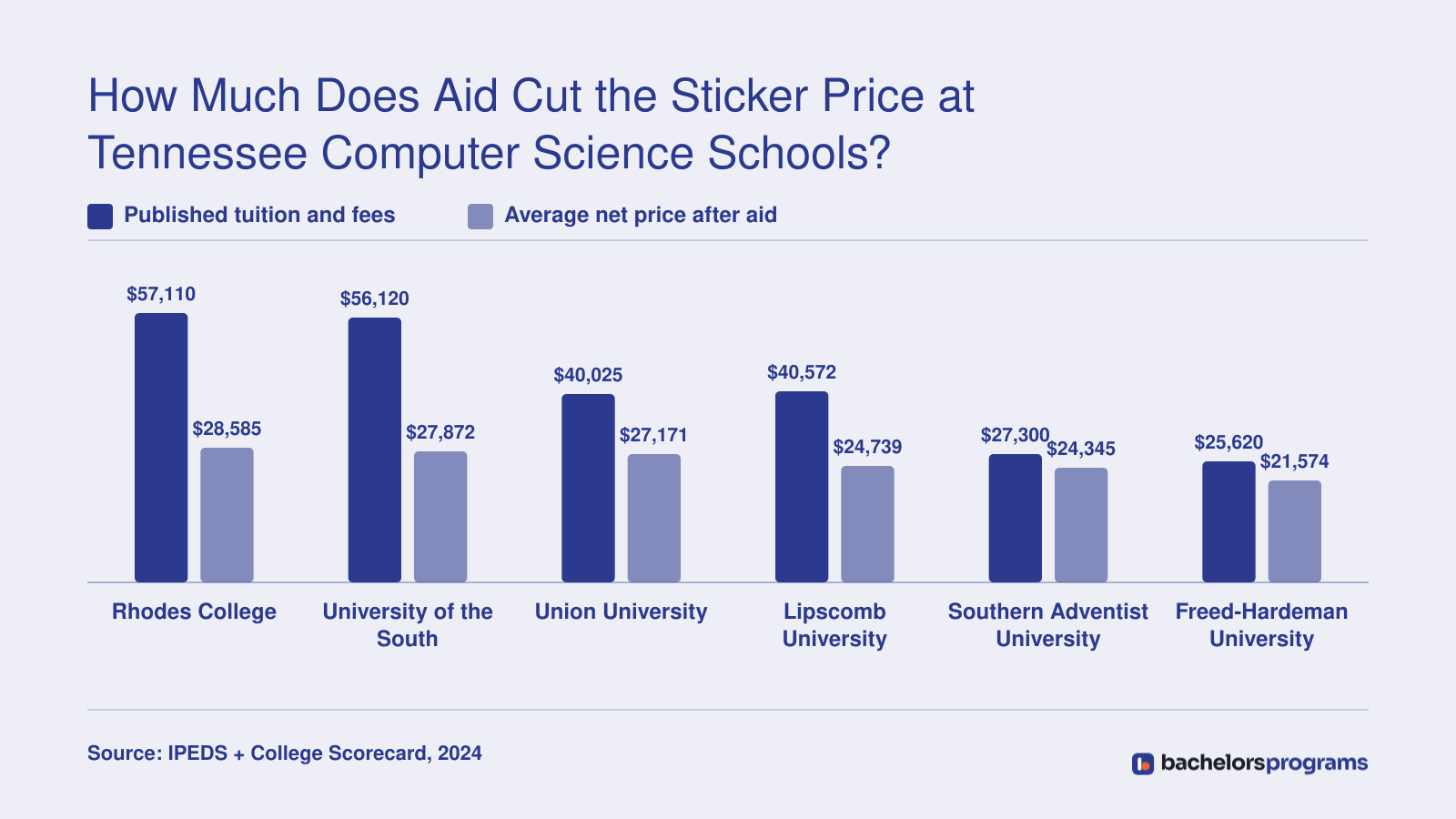
How Much Does Aid Cut the Sticker Price at Tennessee Computer Science Schools?
At these private Tennessee colleges, published tuition and fees run from $25,620 at Freed-Hardeman University to $57,110 at Rhodes College. The average net price after grants and scholarships falls in a much tighter band, from $21,574 to $28,585. Net price is an average across aided students, not a quote: your own cost depends on family income and the awards you qualify for.
What Tennessee Computer Science Graduates Earn One Year Out
Vanderbilt University posts the highest one-year median earnings among the schools ranked here.
Computer Science Schools in Tennessee: Common Questions
These answers draw on the 2026 rankings, accreditation records, and federal earnings and net price figures used earlier on this page. Confirm current details with each school before you apply.
What is the best college in Tennessee for computer science?
Which Tennessee computer science programs are ABET accredited?
How much does a computer science degree cost in Tennessee?
What is the starting salary for computer science graduates in Tennessee?
Can you get a bachelor's degree in computer science online from a Tennessee school?
Compare Computer Science programs on the data that matters
Explore more Computers & IT majors or browse every field of study.
All Computers & IT programs Browse every field of study