Best Finance Schools in Utah
Compare 14 accredited Finance programs in Utah at 10 colleges, with net price after aid, graduation rates, earnings and debt from IPEDS and the U.S. College Scorecard.

Published annual tuition at Utah finance bachelor's programs ranges from about $4,000 to $43,528, a spread that matters more than name recognition for most applicants. Most Utah schools award the Bachelor of Science in Finance; a few also offer a B.A.
Accreditation is uneven. Some programs hold AACSB business accreditation, others ACBSP or none, and recruiters do check. Net price after aid, online versus campus format, and a second admission gate into the business school all shift the real cost.
The Utah schools with the lowest published tuition are not the ones posting the highest graduate earnings, so the choice is rarely a straight trade of cost for outcome.
Key Points
- Brigham Young University finance graduates earn a $118,744 median five years out.
- Utah Valley University ranks among the lowest net-price finance options here.
- Utah broker-dealer agents need the SIE plus a Series exam, not just a degree.
Best Finance Schools in Utah: Top 10 Bachelor's Programs Ranked
The ten programs below are ordered to put the strongest blend of completion and value at the top, rather than name recognition alone. Each card carries the school's published tuition, an approximate average net price after aid, and the institution's overall graduation rate, so you can weigh cost against how many students actually finish.
Brigham Young University
#1Provo, UT · $15,000 – $20,000/yr (est.)
Best for: Investment-banking aspirants wanting multiple tracks
Brigham Young University's Marriott School of Business runs one of the largest finance programs in the state, with seven tracks that let students aim at investment banking, private wealth, real estate, or corporate finance. CFA and CFP preparation is woven into the student experience alongside on-campus internships and international study, and the Honor Code shapes a collaborative, faith-based culture. Institution-wide, the school's graduation rate is about 81%.
- Seven concentration options, from investment banking to private wealth
- CFA exam preparation
- CFP exam preparation
- On-campus internship opportunities
- International study opportunities
- Career placement support through the Marriott School
- Honor Code required of all students
University of Utah
#2Salt Lake City, UT · $10,000 – $31,000/yr (est.)
Best for: Fintech-focused students wanting fund experience
The David Eccles School of Business gives finance majors a choice of three emphases (Advanced Financial Analysis, Fintech, and Real Estate) and a curriculum that reaches into hedge funds and private equity. Experiential options such as the Student Investment Fund, the Finance Career Conference, and Week on Wall Street put students in front of working investors, and every major gets an academic advisor plus a career coach. The university reports a 97% outcome rate among recent respondents and an institution-wide graduation rate of about 65%.
- Tracks: Advanced Financial Analysis, Fintech, Real Estate
- Student Investment Fund and Finance Club
- Week on Wall Street and Finance Career Conference
- Dedicated academic advisor and career coach for majors
- Coursework in hedge funds and private equity
- Department ranked among the top 30 globally for research
Southern Utah University
#3Cedar City, UT · $7,000 – $21,000/yr (est.)
Best for: Working adults needing campus or online flexibility
Southern Utah University teaches finance through a curriculum that stretches from corporate budgeting and securities analysis to fintech and financial planning, and it is one of the few Utah programs built to work around students who cannot relocate. Majors can manage a real portfolio through the Investment Scholars Group, join the Finance Club for industry networking, and compete in national competitions. Its institution-wide graduation rate is about 61%.
- AACSB-accredited business program
- BA and BS degree options
- Investment Scholars Group manages a real portfolio
- Finance Club with national competition experience
- Coursework in fintech, securities analysis, and financial planning
- Careers in investment banking, insurance, and risk management
Utah State University
#4Logan, UT · $9,000 – $25,000/yr (est.)
Utah State University's Jon M. Huntsman School of Business offers the finance degree as a BS or a BA, with an optional Quantitative Finance emphasis for students drawn to mathematical modeling, econometrics, and machine learning, and a BA option that adds foreign language proficiency. Coursework lines up with the CFA exam, and each major gets a career coach for interview prep plus an advisor who maps out a semester-by-semester plan. The university's institution-wide graduation rate is about 59%.
- Tracks: Quantitative Finance
- Coursework aligned with the CFA exam
- BA option adds a foreign language requirement
- Career coaches for interview prep and networking
- Semester-by-semester academic plans with an advisor
- Quantitative track covers econometrics and machine learning
- Offered through the Jon M. Huntsman School of Business
Utah Valley University
#5Orem, UT · $5,000 – $10,000/yr (est.)
Utah Valley University's Woodbury School of Business keeps the finance degree practical: 120 credits of financial theory, corporate financial management, and analysis of investment alternatives, taught in the middle of the Wasatch Front's banking and brokerage corridor. Graduates move into banking, brokerage, and fiscal services roles, and the school's FinTech Center gives them exposure to the technology side of the industry. UVU's institution-wide graduation rate is about 45%.
- 120 total credit hours
- Coursework in corporate financial management
- Analysis of investment alternatives
- WSB FinTech Center on campus
- Paths into banking, brokerage, and fiscal services
- Basic financial theory plus specialized finance courses
Western Governors University
#6Salt Lake City, UT · ~$13,000/yr (est.)
Western Governors University is the fully online, competency-based option on this list: a 40-course Bachelor of Science in Finance that students move through at their own pace with monthly start dates. The curriculum leans modern, covering blockchain, fintech, and automated trading, and it is aligned to the CFA Level I exam plus the CMA and FP&A certifications. WGU's institution-wide graduation rate is about 46%, and the format suits self-directed learners more than students who want a campus network.
- Competency-based, self-paced coursework
- 40 courses with 12 start dates per year
- Curriculum aligned to CFA Level I
- Coursework in blockchain, fintech, and automated trading
- Finance capstone with spreadsheet-based analysis
- Admission via 2.0 GPA or another readiness option
- Aligned to CMA and FP&A certifications
Weber State University
#7Ogden, UT · ~$10,000/yr (est.)
Weber State's finance BS sits in a School of Accounting, Finance & Taxation that is separately accredited by AACSB International, so the business core carries that stamp. Coursework covers capital management, portfolio management, financial institutions, and personal finance, with a heavy emphasis on analysis, and the Investors Club travels to the New York Stock Exchange. The university's institution-wide graduation rate is about 46%.
- AACSB International accredited school
- Coursework in capital and portfolio management
- Investors Club trip to the New York Stock Exchange
- Beta Alpha Psi networking chapter
- Financial analysis and investment evaluation focus
- Personal finance and financial institutions coursework
Westminster University
#8Salt Lake City, UT · ~$27,000/yr (est.)
Westminster University is the small-private alternative, with classes small enough that professors are accessible and a finance major that requires an internship before graduation. Students in the Bill and Vieve Gore School of Business manage a live $50,000 investment account, and alumni have landed at firms including Goldman Sachs. The university's institution-wide graduation rate is about 64%.
- ACBSP-accredited Gore School of Business
- Students manage a live $50,000 investment account
- Required internship or equivalent practical experience
- Locked tuition rate
- Alumni employers include Goldman Sachs
- Small classes with accessible professors
Utah Tech University
#9Saint George, UT · $16,000/yr (est. net price)
Utah Tech University in St. George built its finance BS around four suggested tracks (financial advising, corporate financial analyst, investment, and accounting) so students can aim electives at a specific job. The capstone puts students in charge of an investment portfolio, and the core layers accounting, economics, and data analytics on top of financial markets coursework. The university's institution-wide graduation rate is about 38%.
- Four suggested tracks: financial advising, corporate analyst, investment, accounting
- 120 total credit hours
- Capstone manages an investment portfolio
- 2.0 GPA minimum overall, 2.5 in core courses
- 40 upper-division credits required
- Coursework in financial markets, securities, and data analytics
Ensign College
#10Salt Lake City, UT · ~$11,000/yr (est.)
Ensign College is the most applied, career-first entry on the list: students begin with an accounting certificate, then layer on finance courses taught by instructors who currently work in the field, in classes small enough for one-on-one help. The degree can be finished in three or four years, which suits students balancing a job with school, and graduates move into financial analyst, planning, and banking roles. The college's institution-wide graduation rate is about 43%.
- Three-year and four-year completion options
- Starts with an accounting certificate, then finance core
- Instructors who work in the industry
- Small class sizes with one-on-one support
- Prepares for analyst, planner, and actuary roles
Cost & outcomes by school
Federal data for the highest-earning Finance programs, independent of the ranking above. Earnings are this field's bachelor's graduates four years after completing where the Scorecard reports them, else the school's undergraduate median.
| School | Net price / yr | Grad rate | Earnings | Debt | Grads/yr | Format |
|---|---|---|---|---|---|---|
| Brigham Young University UT | $15,564 | 81% | $129,879 | $11,625 | 196 | Campus |
| University of Utah UT | $16,200 | 65% | $100,793 | $18,408 | 271 | Campus |
| Southern Utah University UT | $10,462 | 61% | $100,149 | $12,500 | 32 | Campus |
| Utah Valley University UT | $6,376 | 45% | $93,858 | $10,949 | 171 | Campus |
| Westminster University UT | $27,094 | 64% | $91,967 | $18,071 | 8 | Campus |
| Utah State University UT | $14,936 | 59% | $84,633 | $9,720 | 139 | Campus |
| Weber State University UT | $10,258 | 46% | $83,105 | $15,113 | 33 | Campus |
| Utah Tech University UT | $16,039 | 38% | $74,843 | $15,000 | 48 | Campus |
| Western Governors University UT | $12,548 | 46% | $60,615 | $11,116 | 198 | Online |
| Ensign College UT | $10,824 | 43% | $50,630 | — | — | Campus |
Sources: U.S. Department of Education. Net price, graduation rate, earnings and debt: College Scorecard (earnings and debt for this field's bachelor's graduates where reported, else school-wide); graduates: IPEDS. A dash means no figure is reported.
Cost, debt & payoff
Median earnings of this field's bachelor's graduates (4 yrs after completing, else the school's undergraduate median) vs. their median federal loan debt · U.S. College Scorecard
Across these programs the median graduate earns about $92,913 and finishes with roughly $15,000 in debt — a ratio that clears a common rule of thumb (keep debt below first-year salary). Net price and debt vary widely school to school, so check the per-school figures in the table above before you shortlist.
Most Affordable Finance Schools in Utah
These Utah finance bachelor's programs carry the lowest average annual net price (the cost after grants and scholarships) among the schools ranked here, based on 2024 IPEDS and College Scorecard data from the U.S. Department of Education. Utah Valley University comes in lowest at $6,376 per year. Ensign College lists the lowest sticker tuition but lands higher on net price, which is why comparing both figures matters.
| School | City | Average Annual Net Price | In-State Tuition and Fees | Program Format |
|---|---|---|---|---|
| Utah Valley University | Orem | $6,376 | $6,507 | Campus |
| Weber State University | Ogden | $10,258 | $6,557 | Campus |
| Southern Utah University | Cedar City | $10,462 | $6,962 | Campus |
| Ensign College | Salt Lake City | $10,824 | $4,004 | Campus |
| Western Governors University | Salt Lake City | $12,548 | $8,658 | Online |
Highest-Earning Bachelor's in Finance Programs in Utah
This table ranks Utah finance bachelor's programs by the median earnings of their graduates five years after finishing, based on IPEDS and College Scorecard (2024) data from the U.S. Department of Education. Brigham Young University leads at $118,744, and the University of Utah follows at $96,414. Utah Valley University stands out for value, pairing a five-year median of $93,541 with the lowest average net price here, $6,376 a year.
| School | City | Median Earnings 5 Years After Graduation | Median Earnings 1 Year After Graduation | Average Annual Net Price |
|---|---|---|---|---|
| Brigham Young University | Provo | $118,744 | $83,876 | $15,564 |
| University of Utah | Salt Lake City | $96,414 | $68,066 | $16,200 |
| Utah Valley University | Orem | $93,541 | $60,947 | $6,376 |
| Westminster University | Salt Lake City | $84,788 | $62,689 | $27,094 |
| Utah State University | Logan | $84,357 | $61,371 | $14,936 |
What to Look for in a Bachelor's Degree in Finance
Does it matter whether a Utah finance bachelor's program is AACSB accredited?
Yes, for two audiences: recruiters who screen candidates by business school accreditation, and graduate committees reviewing your transcript. AACSB International is the business accreditor most often named in corporate recruiting guidelines, and the AACSB directory is the fastest way to check a claim.
Which Utah programs hold AACSB accreditation
The AACSB directory currently lists the University of Utah, Brigham Young University, and Weber State University as accredited in Business & Accounting, and Utah State University, Utah Valley University, and Southern Utah University as accredited. Southern Utah is the one whose AACSB profile explicitly names finance among its undergraduate degrees, and Weber State's own finance program page carries the credential.1 For Westminster University and Utah Tech University, no AACSB directory result appears, so confirm directly with the school before relying on it; Westminster describes its business programs as ACBSP accredited instead.
That distinction matters because school-level accreditation does not automatically confirm every major. Ask an advisor to point you to the finance program's own listing.
Concentrations that actually appear
- Breadth at BYU and the U: BYU lists several concentration options plus documented CFA and CFP exam preparation, while the University of Utah offers a smaller set of concentrations with coursework in investments, hedge funds, and private equity.
- Quantitative and analytics: Utah State offers a quantitative emphasis built on math models and data, and Utah Tech's finance degree sits in an accounting, finance, and analytics department with multiple concentrations.
- Fintech: Western Governors University builds AI and fintech tools into its online coursework and aligns the curriculum to CFA Level I.
Finance B.S. versus financial planning
A finance B.S. is the broader degree: corporate finance, investments, capital markets, and analysis. A financial planning track points toward personal planning work and the CFP exam. Choose finance for banking, corporate treasury, or analytics; choose planning if you want to sit across from individual clients.
Three things to verify
- The finance major's own accreditation listing, not just the business school's.
- Which concentrations are declared on the degree and whether they appear on your transcript.
- Whether CFA or CFP preparation is embedded in required courses or offered only as optional review.
Online and Hybrid Bachelor's in Finance Options at Utah Schools
The real tradeoff is flexibility versus access. A fully online finance degree fits around a job and family, while a campus program puts you next to the student-managed funds, clubs, and recruiter visits that often lead to a first finance job.
Which Utah Programs Run Online
Western Governors University is the clear online option among the schools ranked here. Its Bachelor of Science in Finance is fully online, with asynchronous, competency-based courses, 12 start dates per year, and a curriculum aligned to the CFA Level I exam. WGU lists tuition at $3,850 per six-month term, and because the pacing is self-directed, moving through more courses in a term can lower your total cost.
The other programs are delivered mainly on campus. Southern Utah's online Bachelor of Arts/Science in Finance is advertised at about three years with up to 90 transfer credits, so ask admissions which format and tuition rate would apply to you. Utah State University offers 100% online bachelor's degrees in Economics, Management, and Marketing, but Finance is not on that online list. Plan on attending in person for the USU finance major. At the remaining schools, "hybrid" usually means some online course sections rather than a full online degree, so check each catalog before you assume a format.
Internships and Networking From a Distance
Online students can still build experience: book career-services and advising appointments early, join virtual professional groups, and pursue internships with banks, credit unions, or financial planning firms near home. That route depends more on your own outreach than on a campus pipeline does.
Who Should Choose Which Format
- Online: Working adults and career changers who need to keep a paycheck. WGU notes that an associate degree can cover about 14 of its courses.
- Hybrid: Students who live within driving distance of a campus and want to fit a few online sections around part-time work.
- Campus: Students aiming for investment banking, asset management, or corporate finance recruiting. Hands-on tools like the University of Utah's Student Investment Fund or Westminster University's $50,000 student-managed investment account are easiest to use in person.
Admissions for Utah Finance Bachelor's Programs: GPA, Test Policy, and Transfer Credit
Some Utah finance programs admit you once, at the university level, and you declare the major when you are ready. Others run two gates: general admission first, then a separate application to the business school before you can take upper-division finance coursework. Knowing which model a campus uses tells you what to protect: your application GPA or your sophomore-year grades.
The flagship runs a two-step path
The University of Utah publishes no minimum GPA for freshman admission, though 75% of recent freshman admits had an unweighted high school GPA of 3.5 or higher.1 There is also no published minimum for transfer applicants, where 75% of recent admits sat at 3.1 or above.2 ACT and SAT scores are not required for standard admission, for merit scholarships, or for individual majors.1 The one exception is narrow: transfer applicants with fewer than 30 transferable semester hours must send a high school transcript, and within that group, homeschooled, unaccredited high school, or GED applicants also submit test scores.2
The second gate sits at the Eccles School. Students must be admitted to the Upper Division before applying to the finance major, which means completing a block of core courses including MGT 2010, ACCTG 3100, FINAN 3020, IS 3060, MKTG 3040, and OSC 3440. The grade bar is specific: a B- or better in ACCTG 2100 on the first attempt, a B or better in FINAN 3020 on the first attempt, a score in the top 50% on the FINAN 3020 common final, a B- or better in MATH 1050 or higher, and a 3.2 cumulative GPA. Transfer students who arrive without that exam score must take FINAN 4030 instead to have their application considered.
Selectivity and published policies vary widely
Among schools with a reported admit rate, Utah State accepts about 92% of applicants and the University of Utah about 86%, with Southern Utah at roughly 82%. Brigham Young University (about 68%) and Westminster University (about 67%) are the more selective of the group. No admit rate is reported for Utah Valley, Weber State, Utah Tech, Western Governors, or Ensign College. At the program level, Western Governors and Utah Tech both set a 2.0 GPA floor, and Utah Tech additionally requires a 2.5 average across core courses. For the remaining campuses, we could not confirm a published minimum GPA or test policy for finance applicants, so contact those admissions offices before assuming one exists.
Two transfer tips
- Count the credits that actually apply: Utah's finance degree caps transfer work at 6 credits toward the major core and electives, plus 3 more for International Perspectives if judged equivalent. An associate degree may cover roughly 14 courses at Western Governors, so the same transcript travels very differently.
- Separate concurrent enrollment from exam credit: college coursework from a regionally accredited institution counts toward the transferable GPA; remedial work and credit awarded by examination do not.2
Related Articles
What Can You Do With a Finance Degree in Utah?
Finance hiring in Utah has spread well beyond traditional banking, and graduates land in tech, healthcare and fintech as well as in branch networks.
Most roles cluster in Salt Lake City and the Provo-Orem-Lehi corridor. Banking and credit unions, investment and wealth management, insurance, mortgage lending, and corporate finance are the main entry points. Named employers include Goldman Sachs, Zions Bancorporation, U.S. Bank, Wells Fargo, Bank of America, JPMorgan Chase, Intermountain Health, the University of Utah, Adobe in Lehi, Brigham Young University and Utah Valley University.
Utah Wages and Outlook
The Utah Department of Workforce Services (DWS) reports a statewide median of $91,280 a year for financial and investment analysts.1 Salt Lake City matches that figure, and Provo-Orem comes in higher at $93,430. DWS lists about 280 openings a year and a bachelor's degree as the typical entry requirement.1 It rates growth as faster than average, with most openings coming from replacement of workers who leave.
Personal financial advisors have a statewide median of $67,210, though that figure often includes people still building a client base.2 DWS rates growth as much faster than average, with roughly 490 openings a year statewide.2 About 330 of those are in the Salt Lake City area and about 100 in Provo-Orem.3
National numbers run differently. The Bureau of Labor Statistics projects 7% growth for financial analysts from 2025 to 20354, but only 1% for personal financial advisors, whose national median pay was $105,070 in 2025.5 Those are national figures, so treat DWS as the better guide for Utah.
A Realistic First-Job Path
Typical first titles include financial analyst, credit analyst, loan officer, banking associate, staff accountant moving into FP&A, and junior advisor or client associate. Many graduates start in analyst-support roles, then move into senior analyst, portfolio, underwriting or advisor positions as they add experience and credentials.
Keep the two earnings measures separate. The program earnings in the table above show what each school's graduates earn shortly after finishing. The DWS medians describe everyone in the occupation, including experienced workers. Expect a first job to start below those medians.
Earnings One Year After Finishing a Utah Finance Bachelor's
Brigham Young University posts the highest one-year median earnings among the Utah finance programs ranked here.
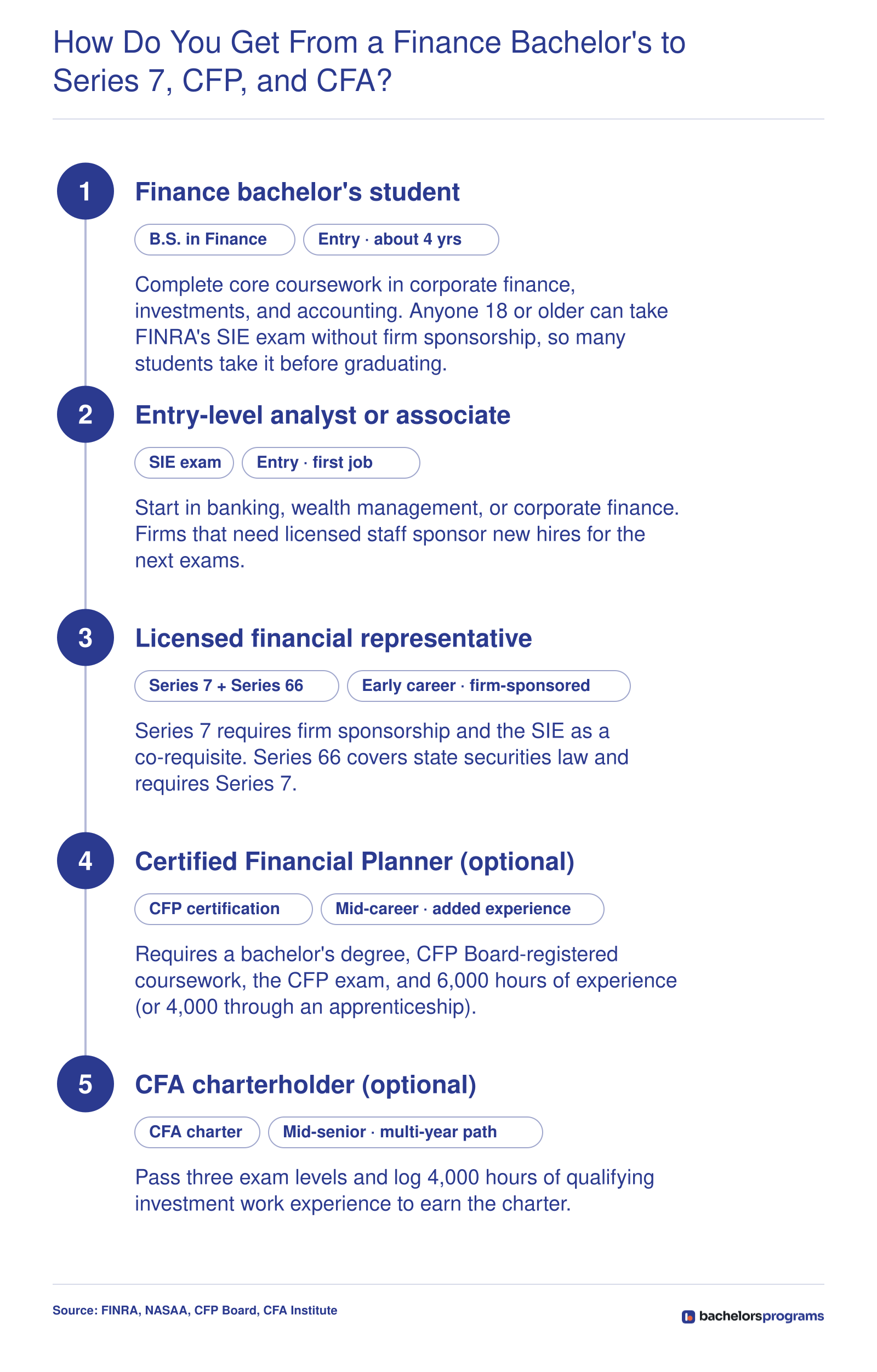
How Do You Get From a Finance Bachelor's to Series 7, CFP, and CFA?
Most finance careers build in layers. You earn the bachelor's degree first, then add licenses and certifications as your role requires them. The securities licenses usually come through an employer, while the CFP and CFA marks are optional credentials you choose to pursue.
Utah Licensing for Finance Careers
Frequently Asked Questions About Finance Schools in Utah
These answers draw on the school data and program requirements covered earlier on this page. Policies and credit rules vary by school, so confirm details with each admissions office before you apply.
What is the best finance school in Utah?
Are there online finance bachelor's degrees in Utah?
Is a finance degree the same as a financial planning degree?
Can I transfer community college credits into a Utah finance bachelor's program?
Do I need a license to work in finance after my bachelor's?
Compare Finance programs on the data that matters
Explore more Business & Management majors or browse every field of study.
All Business & Management programs Browse every field of study