Best Cybersecurity Schools in Utah
Compare 5 accredited Cybersecurity programs in Utah, with net price after aid, graduation rates, earnings and debt from IPEDS and the U.S. College Scorecard.

Whether the classes meet on campus in Orem or online through a Utah-based school, the credential is the same: a bachelor's degree in cybersecurity, usually a Bachelor of Science (B.S.). What changes is price and access. Utah's public universities charge residents a fraction of out-of-state rates, and several deliver the same coursework in hybrid or fully online sections.
Employers hiring security analysts still screen for the degree plus lab or certification evidence, not the delivery format. Admissions thresholds, net price after aid, and NSA CAE designation decide the rest.
Key Points
- Utah Valley University ranks first, with a dedicated campus cybersecurity center.
- Utah State charges residents $9,228 a year versus $24,802 for nonresidents.
- Weber State's hybrid program offers the most flexible path to a degree.
Best Bachelor's in Cybersecurity Programs in Utah, Ranked
Utah Valley University is the strongest overall choice for a bachelor's degree in cybersecurity in Utah, pairing a hands-on defense and offense curriculum with a dedicated campus cybersecurity center. Below are the five Utah schools that made the list, from a large public university in Orem to a hybrid program in Ogden, a tightly structured campus degree in Cedar City, an engineering-focused option in Logan, and a certificate and associate pathway at Snow College. Each card covers delivery format, tuition, net price after aid, and graduation rate, plus program-level outcomes wherever the federal data reports them.
Utah Valley University
#1Orem, UT · $5,000 – $10,000/yr (est.)
Best for: Hands-on learners targeting threat hunting roles
Utah Valley University houses its Bachelor of Science in Cybersecurity in the information systems department, and the program leans hard into both defensive and offensive technique rather than policy alone. The campus Center for Cybersecurity connects students with faculty, industry partners, and secure computing research, and the university's Lehi site in Silicon Slopes keeps the program close to the state's technology corridor. Coursework reaches into malware analysis, reverse engineering, threat hunting, IoT security, and industrial control systems, so students graduate with lab experience that maps directly to analyst and incident response jobs. It is the largest institution on this list and the most natural fit for someone who wants a broad public university with a security specialization.
- 120 credit hours to graduate
- Coursework in malware analysis and reverse engineering
- Covers threat hunting, IoT security, and application security
- Includes securing industrial control systems
- Prepares students for security analyst, ethical hacker, and threat hunter roles
- 25 bachelor's degrees awarded in the most recent federal reporting year
Weber State University
#2Ogden, UT · ~$10,000/yr (est.)
Best for: Working adults near Davis County
Weber State University awards an ABET-accredited Bachelor of Science in Cybersecurity and Network Management, a credential that carries real weight for an undergraduate security program and signals a technical, engineering-adjacent curriculum. Delivery is hybrid, mixing online classes with in-person sessions at the Davis campus in Layton, which works well for students along the Wasatch Front who cannot be on the Ogden campus every day. The same department stacks an Associate of Applied Science and institutional certificates underneath the bachelor's, so a student can pick up a marketable credential early and keep going. Courses run from routing and switching to cloud architecture, advanced LAN security management, and wireless security, and the program maintains a concurrent enrollment option and a partnership with Salt Lake Community College.
- ABET-accredited Bachelor of Science
- Hybrid delivery: online classes plus in-person sessions at the Davis campus in Layton
- Coursework in cyber defense, Linux administration, and routing and switching
- Cloud architecture and security, plus advanced LAN security management
- Wireless networking and security also covered
- Associate of Applied Science and institutional certificates available
- Concurrent enrollment option and partnership with Salt Lake Community College
Southern Utah University
#3Cedar City, UT · $7,000 – $21,000/yr (est.)
Best for: Future analysts wanting a structured core
Southern Utah University runs the most prescriptive of the Utah cybersecurity degrees, with a defined common core, a 48-credit cybersecurity core, and fixed elective slots instead of a loose menu of courses. Every major course must be passed with a C- or better, and credits older than ten years require department chair approval, so transfer students should plan their timeline carefully. Completing the B.S. also completes the requirements for the Information Technology A.A.S., and students can add a Computer Science minor without much extra load. Electives such as security scripting, compliance and risk assessment, cyber law, and cyber warfare point toward government and defense work, and a foreign language is strongly recommended for students who want federal jobs.
- 15-credit CSCY common core plus a 48-credit cybersecurity core
- 9 credits of major electives and 3 credits of cybersecurity electives
- C- or better required in every major course
- Credits older than 10 years need department chair approval
- Also completes Information Technology (A.A.S.) requirements
- Option to earn a Computer Science minor
- Electives include cyber law, compliance and risk assessment, and cyber warfare
- Foreign language strongly recommended for federal government work
Utah State University
#4Logan, UT · $9,000 – $25,000/yr (est.)
Utah State University launched the first cyber security engineering bachelor's program in Utah and keeps it ABET-accredited inside the Electrical and Computer Engineering department, which makes it a genuinely different degree from the state's computing-based security programs. The focus is on designing secure hardware and software for engineered systems in energy, finance, and defense, rather than on administering general IT security. New faculty with cyber security expertise have been recruited with support from the Utah Legislature, a sign of a program still building out its depth and research capacity. Students who want an engineering credential with a security specialization, and who are comfortable with a math- and systems-heavy track, will find the strongest match here.
- First cyber security engineering bachelor's program in Utah
- ABET-accredited and housed in Electrical and Computer Engineering
- Focus on designing secure hardware and software for critical systems
- Targets threats to energy, finance, and defense infrastructure
- New faculty hires with cyber security expertise
- State funding supports faculty recruitment and program growth
Snow College
#5Ephraim, UT · ~$6,000/yr (est.)
Snow College teaches networking and cybersecurity at the certificate and Associate of Applied Science level rather than at the bachelor's level, so it functions as a low-cost on-ramp toward a four-year degree rather than a destination for one. Instruction is hands-on and taught by industry professionals, covering network operation, threat detection, defense measures, penetration testing, network assessment, and monitoring. The program runs at the Ephraim and Richfield campuses with fall and spring start dates, and the college's technical division draws on a large roster of regional employer partners who sit on advisory panels. Students who want a Utah bachelor's degree in cybersecurity will need to plan a transfer after finishing here, but the foundation is practical and inexpensive.
- Certificate and Associate of Applied Science options
- Hands-on training in network operation, security, and threat detection
- Covers penetration testing, network assessment, and monitoring
- Taught by industry professionals
- Offered at the Ephraim and Richfield campuses with fall and spring start dates
- One-semester certificate options alongside the two-year degree
Cost & outcomes by school
Federal data for the highest-earning Cybersecurity programs, independent of the ranking above. Earnings are this field's bachelor's graduates four years after completing where the Scorecard reports them, else the school's undergraduate median.
| School | Net price / yr | Grad rate | Earnings | Debt | Grads/yr | Format |
|---|---|---|---|---|---|---|
| Weber State University UT | $10,258 | 46% | $56,287 | $15,113 | — | Hybrid |
| Utah Valley University UT | $6,376 | 45% | $55,486 | $14,750 | 31 | Campus |
| Utah State University UT | $14,936 | 59% | $54,022 | $14,340 | — | Campus |
| Southern Utah University UT | $10,462 | 61% | $50,296 | $12,500 | — | Campus |
| Snow College UT | $5,552 | 46% | $41,022 | $7,000 | — | Campus |
Sources: U.S. Department of Education. Net price, graduation rate, earnings and debt: College Scorecard (earnings and debt for this field's bachelor's graduates where reported, else school-wide); graduates: IPEDS. A dash means no figure is reported.
Cost, debt & payoff
Median earnings of this field's bachelor's graduates (4 yrs after completing, else the school's undergraduate median) vs. their median federal loan debt · U.S. College Scorecard
Across these programs the median graduate earns about $54,022 and finishes with roughly $14,340 in debt — a ratio that clears a common rule of thumb (keep debt below first-year salary). Net price and debt vary widely school to school, so check the per-school figures in the table above before you shortlist.
What Sets the Top Utah Programs Apart
A strong cybersecurity bachelor's program is one that pairs a fair price with evidence that students finish and get hired. The schools below were compared on four signals: net price after aid, institution-wide graduation rate, program-level earnings and completions from College Scorecard, and delivery format (campus, online, or hybrid).
Two of those figures need a caveat. Graduation rate and net price describe the whole school, not the cybersecurity program; treat them as background, not as a promise about the program.
- Cost: What students actually pay after aid often lands far below the sticker price.
- Completion: A higher school-wide graduation rate suggests students tend to finish.
- Outcomes: Program-level earnings and completions show what the specific degree produces.
- Format: Delivery options decide whether a program fits your schedule.
Online and Hybrid Cybersecurity Bachelor's Options at Utah Schools
Weber State University offers the most flexible route of the schools here: its cybersecurity bachelor's program is hybrid rather than fully on campus.
How Delivery Breaks Down
- Hybrid: Weber State's Cybersecurity and Network Management program is a B.S. that is ABET-accredited. It mixes online classes with in-person classes at the Davis campus.
- On campus: Utah Valley University (B.S. in Cybersecurity), Southern Utah University (Cybersecurity), and Utah State University (Cyber Security Engineering) list campus-based delivery on their program pages.
- On campus, below the bachelor's level: Snow College teaches networking and cybersecurity in person at Ephraim and Richfield. Its credentials are certificates and associate degrees, so it works as a starting point rather than a finish line.
Fully Remote Study and In-Person Requirements
The program pages for these schools do not describe a fully online cybersecurity bachelor's pathway. If you need study that is entirely remote, ask each admissions office about online formats, Southern Utah University's included. Also ask whether in-person labs, proctored exams, or campus visits are required, since the program pages do not spell those out.
Who Hybrid Study Suits
Hybrid delivery fits working adults who can reach the Davis campus for scheduled sessions but need the rest of their coursework online. Students in rural Utah can also cut commuting this way, though regular in-person attendance still applies.
Getting in: GPA, Test Policies, and Transfer Credit at Utah Schools
Admission to a bachelor's degree in cybersecurity in Utah runs through each university's general undergraduate process, not a separate program application. Southern Utah University admits about 82% of applicants and Utah State University about 92%, so both are broadly accessible to students with solid high school records.
GPA and Test Policies
The program pages for Utah Valley University, Weber State University, Southern Utah University and Utah State University do not publish a cybersecurity-specific minimum GPA or an ACT/SAT policy. Weber State's page lists no admissions requirements at all. Check each school's undergraduate admissions page for the current rule before you apply, and do not assume a school is test-optional or test-required.
Transfer Credit and Pathways
Transfer credit is where Utah's structure works in your favor. Weber State lists a concurrent enrollment option and a partnership with a community college. Snow College offers a certificate and associate path in networking and cybersecurity that can serve as a first stage before a bachelor's degree. Utah's public institutions generally accept general education credit from one another through statewide agreements, but confirm which courses count toward the major.
Southern Utah is the one school here that spells out a rule in its catalog: a C- or better is required in major courses, and credits older than 10 years need chair approval. Utah Valley's degree totals 120 credit hours, a useful benchmark when counting what you can bring in.
A Tip for Beginners
Finish college algebra and an introductory programming course, such as Python, before you start the core cybersecurity sequence. Both are common gatekeepers, and you can often take them at a lower cost at a community college.
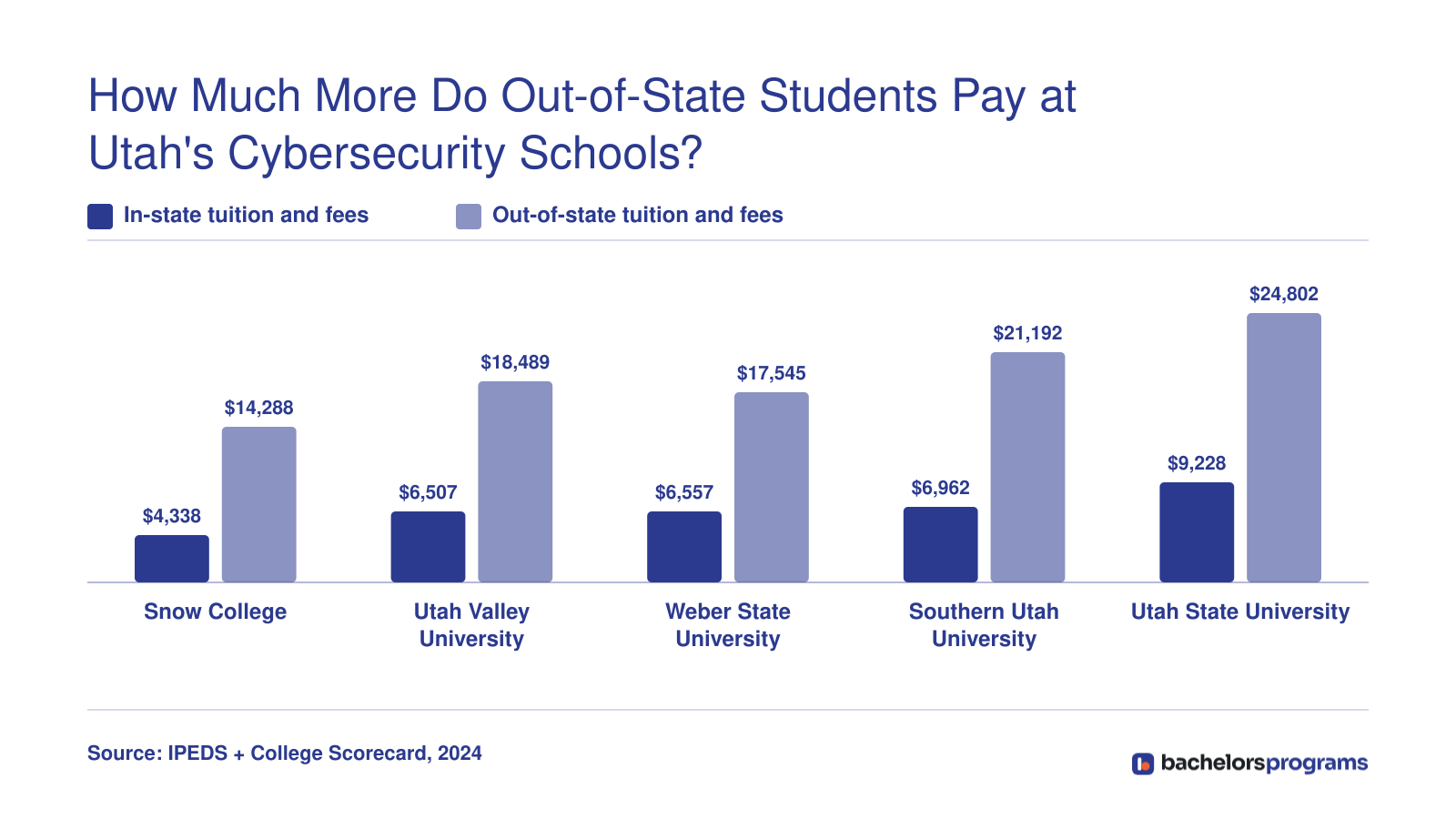
How Much More Do Out-of-State Students Pay at Utah's Cybersecurity Schools?
Residency status is the single biggest driver of sticker price at Utah's public cybersecurity schools. Utah State University shows the widest gap: out-of-state students pay $24,802 a year compared with $9,228 for residents, a difference of $15,574. Snow College posts the lowest in-state price at $4,338, though its cybersecurity offering is a technical certificate. Among the bachelor's programs, Utah Valley University's B.S. in Cybersecurity is the lowest-cost option for residents at $6,507 a year.
Cost of a Bachelor's Degree in Cybersecurity in Utah
Utah is one of the cheaper states in which to earn a bachelor's degree in cybersecurity, and the spread between the lowest and highest priced schools here is narrow enough that aid often matters more than the sticker.
The lowest-cost entry point
Snow College carries the smallest numbers of the schools here: roughly $4,338 a year for in-state tuition and fees, an average net price near $5,552, and median debt at graduation around $7,000. Its networking and cybersecurity offering is certificate and associate level, so many students use it as the first half of a four-year path. Among the bachelor's options, Utah Valley University is the value leader, pairing about $6,507 in resident tuition with a net price near $6,376 and median debt around $14,750. Weber State ($6,557) and Southern Utah ($6,962) sit close on tuition; Utah State is the highest at roughly $9,228.
Why net price and tuition don't line up
Net price is a school-wide average across all majors, not a cybersecurity figure, and it folds in housing, books, and other living costs before subtracting average grant aid. That is why Weber State (about $10,258) and Utah State (about $14,936) post net prices well above their tuition. Treat these as directional, then run each school's own net price calculator.
Utah aid to apply for
- Utah Promise Grant: Need-based for Utah residents with a diploma and no prior degree. File the FAFSA and apply through the campus financial aid office; awards vary with funding and run until your first bachelor's or 120 attempted credits.1
- New Century Scholarship: For students who finish a Utah associate degree in high school.2 Statute caps it at $5,000, paid across four full-time semesters or 60 credits.3 Applications open in November, due February 1, with documents by September 1.2
- Opportunity Scholarship: The achievement-based award that replaced the Regents' Scholarship starting with the 2022 graduating class.4 Apply during your senior year.5
A practical cost cut: finish general education at Snow College, then transfer into a four-year cybersecurity program after confirming credit equivalencies in advance.
Related Articles
Cybersecurity Careers and Pay in Utah: What the Degree Leads To
Northrop Grumman's 2026 Cybersecurity Analyst Intern role in Roy paid bachelor's-level students $22.25 to $27.25 an hour, 40 hours a week for a summer term of at least 10 weeks. That posting is closed, but it is a useful marker of what a Utah defense employer pays an undergraduate who has not yet finished the degree.
What the wage data shows
Entry-level security analyst openings advertised in Salt Lake City, including tier-one analyst roles at a major academic health system, have listed $28 to $32 an hour.1 Campus-based work pays less: Southern Utah University posted a Cybersecurity and Secure Data Integration Intern in Cedar City at $15 an hour, supporting its In-Conduit Hydropower Project.
For statewide context, covered employment in Utah averaged $1,415 a week in the first quarter of 2026 across roughly 1.74 million jobs, while the Salt Lake City-Murray metro averaged $1,650 a week across about 827,000 jobs. Those are all-industry figures, not security-specific ones, so read them as a picture of the local labor market rather than a cybersecurity wage. Federal earnings figures at one, two, and four years after completion are not published here for these Utah cybersecurity programs, which makes live job postings the better wage signal right now.
Who hires, and what they ask for
Three kinds of employer draw from Utah's cybersecurity pipeline: defense contractors in the Roy and Ogden corridor, hospital and health-system security teams in Salt Lake City, and financial firms such as Goldman Sachs, which runs a nine to ten week Summer Analyst Program in Salt Lake City. Utah Valley University points students toward security vendors including Arctic Wolf and cautions that internships are often summer-only and are not always posted publicly, so start asking faculty early.
Utah does not license cybersecurity practitioners. Hiring managers substitute certifications, and Security+ is the one most commonly named for entry-level work.
Which Utah Schools Hold the NSA CAE Designation
A National Centers of Academic Excellence in Cybersecurity designation from the NSA signals that a school's curriculum meets federal standards. CAE-CD covers cyber defense degrees and certificates, CAE-CO marks deeply technical, lab-heavy cyber operations programs, and CAE-R recognizes research-focused doctoral universities. Federal agencies and defense contractors treat the designation as a sign of program quality, and federal scholarships such as the CyberCorps Scholarship for Service are generally tied to designated schools. The NSA's official community list counts two Utah institutions, but the excerpt reviewed for this page does not name them, so check each school below on the NSA CAE site or with the school's cybersecurity department before you apply.
| School | CAE Designation | City |
|---|---|---|
| Utah Valley University | Not confirmed in reviewed NSA excerpt | Orem |
| Weber State University | Not confirmed in reviewed NSA excerpt | Ogden |
| Southern Utah University | Not confirmed in reviewed NSA excerpt | Cedar City |
| Utah State University | Not confirmed in reviewed NSA excerpt | Logan |
| Snow College | Not confirmed in reviewed NSA excerpt | Ephraim |
Choosing the Right Utah Cybersecurity School for You
The best fit among Utah's cybersecurity schools depends on how you learn, what you already know, and what you can afford, not on which name sits at the top of a page.
If You Are Starting From Scratch
Snow College's Technical Education Certificate in Networking and Cybersecurity gives beginners a shorter, lower-cost entry into help desk and technician roles before committing to four years. Students who want the full bachelor's degree in cybersecurity from the start should look at Utah Valley University, which offers a B.S. in Cybersecurity on its Orem campus.
If You Are Transferring or Working Full Time
Weber State University in Ogden and Southern Utah University in Cedar City both serve students arriving with prior coursework, and the deciding factor is usually how those credits map onto the major rather than the sticker price. Ask for a transfer evaluation in writing before you apply, and check whether the school's online or hybrid format fits around a full-time job.
If You Want Technical Depth
Utah State University's Cyber Security Engineering program leans toward engineering rather than IT administration, which suits students who want to design and harden systems, not just run them.
Weigh the schools on format, net price after aid, and whether the NSA CAE designation matters for the jobs you are targeting. The program-matching tool on bachelorsprograms.com lets you set Utah cybersecurity programs side by side on those factors and see which one fits.
Compare Cybersecurity programs on the data that matters
Explore more Computers & IT majors or browse every field of study.
All Computers & IT programs Browse every field of study