Best Finance Schools in Virginia
Compare 37 accredited Finance programs in Virginia at 26 colleges, with net price after aid, graduation rates, earnings and debt from IPEDS and the U.S. College Scorecard.

Prestige and price pull against each other in Virginia finance. William & Mary lists $51,038 for out-of-state students, yet its average net price after grants is $19,096, so the sticker figure alone can mislead.
The ranking covers bachelor's degree programs in finance at Virginia schools, both on campus and online. The common credential is the Bachelor of Science (B.S.) in Finance, though some schools house finance inside a business or commerce degree.
Residency, accreditation and business-school admission gates shape the real cost and path as much as a school's name.
Key Points
- Old Dominion charges Virginia residents $443 per online credit in Fall 2026.
- At William & Mary, average net price ($19,096) trails out-of-state price ($51,038).
- Residency matters: in-state discounts top $20,000 yearly at several Virginia publics.
Best Bachelor's in Finance Programs in Virginia: Our Top 10 Ranked
Virginia's finance programs range from large research universities with four separate specializations to small business schools where undergraduates run real portfolios. The ten programs below cover public and private schools, campus and online formats, and several paths into investments, banking and financial planning. Each entry notes what the program is built around so you can match it to how you want to study and where you want to work.
Virginia Polytechnic Institute and State University
#1Blacksburg, VA · $25,000/yr (est. net price)
Best for: Students wanting four finance specialization options
Virginia Tech runs its finance major through the Pamplin College of Business, and the breadth of the major is the draw: students choose from four specializations that range from corporate financial management to investment management and private credit. First-year students can enter the major directly, and fall, spring and summer transfer applicants are considered as well. The Blacksburg campus pairs a large research university setting with a finance curriculum built around financial models and decision making.
- Four specializations, from corporate finance to private credit
- Open to first-year applicants and transfer students
- Hosted by the Pamplin College of Business
- Curriculum built on financial models and decision making
- 124 total credit hours
- Capstone required
- Two experiential learning requirements
- Adds AI literacy, ethics and law, and global marketplace skills
William & Mary
#2Williamsburg, VA · $15,000 – $20,000/yr (est.)
Best for: Ambitious students targeting investment management careers
William & Mary awards a Bachelor of Business Administration in Finance through the Raymond A. Mason School of Business, and the major sits on top of a cohort-based business core. Students add 13 credit hours of finance coursework, including investments and corporate valuation, plus an experiential elective such as the Student Managed Investment Fund. Entry to the major is structured and selective: 39 completed credit hours, five prerequisite courses, a 2.5 GPA and fixed February and September deadlines.
- 120 credit hours; the finance major adds 13 credit hours
- Entry needs 39 credits, five prerequisites and a 2.5 GPA
- Deadlines: February 1 for fall, September 15 for spring
- Experiential elective such as the Student Managed Investment Fund
- $250 per credit supplemental fee on BUAD courses
George Mason University
#3Fairfax, VA · $15,000 – $20,000/yr (est.)
Best for: Northern Virginia students wanting hands-on portfolio work
George Mason's finance path is a concentration inside the Bachelor of Science in Business, taught at the Fairfax campus minutes from Washington, D.C. The program is CFA Institute affiliated, and students take on real portfolio responsibility by managing a roughly quarter-million-dollar equity fund. Coursework runs through valuation, risk management, capital budgeting and financial statement analysis, with an honors track for high achievers.
- Finance concentration inside the Bachelor of Science in Business
- Students manage a $250,000 equity portfolio
- CFA Institute affiliated program, with CFA exam scholarships
- Coursework in valuation, risk management and capital budgeting
- Honors Program available for high achievers
Christopher Newport University
#4Newport News, VA · $17,000 – $31,000/yr (est.)
Christopher Newport teaches finance as a major inside the Bachelor of Science in Business Administration at the Luter School of Business. The curriculum mixes the business core with investments, financial institutions, risk management and financial policy, and students work through case studies and competitions rather than lectures alone. A partnership with Smithfield Foods adds scholarships, internships and career exploration for business students on the Newport News campus.
- Finance major within the Luter School of Business
- Case studies and competitions build financial decision skills
- Coursework in investments, risk management and financial policy
- Smithfield Foods partnership adds scholarships and internships
Virginia Commonwealth University
#5Richmond, VA · ~$23,000/yr (est.)
Virginia Commonwealth University awards a Bachelor of Science in Finance with an optional financial planning concentration, and the planning track is built to satisfy the CFP Board's education requirement. The core program covers commercial banking, risk management and corporate finance, and students must earn at least a C in core finance courses. Study takes place in Richmond, where the business school sits inside a large urban public university.
- 120 total credit hours, four-year course of study
- 2.0 GPA minimum to stay in the program
- Minimum grade of C in core finance courses
- Prepares students for commercial banking and risk management
- Builds analytical and ethical communication skills
- Meets the CFP Board's educational requirements
- Financial planning capstone required
- Covers investment, tax, risk, estate and retirement planning
- Prepares graduates to sit for the CFP exam
Liberty University
#6Lynchburg, VA · ~$29,000/yr (est.)
Liberty University offers its finance degree in three forms: a residential Bachelor of Science in Business Administration with a finance specialization, the same degree online, and a data analysis version that pairs finance with analytics. Residential students work in a simulated stock trading room and can take Washington, D.C. internships, while online students take 8-week courses with eight start dates a year. Admission does not require SAT or ACT scores, and up to 75 percent of a degree can transfer.
- 120 credit hours with a simulated stock trading room
- Internships in Washington, D.C.
- No SAT or ACT scores required for admission
- Faith-integrated business curriculum
- 100% online, 8-week courses with eight start dates a year
- $410 per credit; $250 per credit for military students
- Transfer up to 75 percent of the degree
- Electronic textbooks included at no cost
- 2.0 GPA minimum for admission
- Combines data analysis coursework with a finance concentration
- Stock trading room and technology labs on campus
- Skills in business, accounting, economics and marketing
Regent University
#7Virginia Beach, VA · ~$20,000/yr (est.)
Regent University teaches finance as a Bachelor of Science in Financial Management, offered on its Virginia Beach campus and online. The curriculum centers on corporate finance, banking, risk management and portfolio strategy, taught from a Christian perspective by faculty with business experience. A second route, the Bachelor of Science in Business with a financial management concentration, gives students a broader business degree with finance depth.
- 120 credit hours, on campus in Virginia Beach or online
- Coursework in corporate finance, banking and risk management
- Military benefits accepted
- Taught from a Christian perspective
- One of nine concentrations in the Bachelor of Science in Business
- $415 per credit
- Full-time and part-time study options
- Career paths include financial planner and analyst
Old Dominion University
#8Norfolk, VA · $13,000 – $34,000/yr (est.)
Old Dominion University delivers its finance degree as financial management with a major in finance through the Strome College of Business in Norfolk. Students cover investments, portfolio management, banking and international financial management, and can earn credit through internships with regional employers. The program is available on campus and in an asynchronous online format built on 8-week courses.
- Business core from the Strome College of Business
- Coursework in investments, portfolio management and banking
- Internships through the Career Advantage Program
- $281 per credit
- Course materials included via Day One Access
- AACSB-accredited program delivered asynchronously online
- 120 credit hours in accelerated 8-week courses
- Transfer up to 90 credits
- Free tutoring services for online students
Hampton University
#9Hampton, VA · $25,000 – $30,000/yr (est.)
Hampton University's Bachelor of Science in Finance sits in the Department of Finance and Economics and gives students hands-on time on Bloomberg terminals. Students can also help run a Student Managed Investment Fund, applying valuation and portfolio concepts to real holdings. The curriculum spans corporate finance, investment management, public finance and insurance, with an emphasis on ethical decision making.
- Bloomberg terminal platform access
- Student Managed Investment Fund participation
- Coursework in corporate finance, public finance and insurance
- Emphasis on ethical decision making and social responsibility
Radford University
#10Radford, VA · $15,000/yr (est. net price)
Radford University awards a Bachelor of Business Administration in Finance through the AACSB-accredited Davis College of Business and Economics. Students choose a general finance track or an insurance and real estate track, and the program reports an 88 percent placement rate for graduates. Beyond class, the Student Managed Investment Portfolio Organization travels to financial centers and the annual Firm Night brings regional recruiters to campus.
- Tracks: General Finance, Insurance and Real Estate
- 88% job placement rate reported for graduates
- AACSB-accredited Davis College of Business and Economics
- Student Managed Investment Portfolio Organization trips to Chicago and New York
- Firm Night each fall connects students with regional recruiters
Cost & outcomes by school
Federal data for the highest-earning Finance programs, independent of the ranking above. Earnings are this field's bachelor's graduates four years after completing where the Scorecard reports them, else the school's undergraduate median.
| School | Net price / yr | Grad rate | Earnings | Debt | Grads/yr | Format |
|---|---|---|---|---|---|---|
| Virginia Polytechnic Institute and State University VA | $24,953 | 86% | $102,902 | $21,500 | 356 | Campus |
| George Mason University VA | $17,915 | 68% | $88,080 | $20,000 | 3 | Campus |
| University of Virginia VA | $21,565 | 96% | $86,863 | $17,500 | — | Campus |
| University of Richmond VA | $31,309 | 85% | $76,178 | $21,000 | — | Campus |
| William & Mary VA | $19,096 | 89% | $73,490 | $18,500 | — | Campus |
| Radford University VA | $14,578 | 49% | $72,364 | $24,900 | 36 | Campus |
| Marymount University VA | $29,137 | 54% | $67,516 | $25,000 | — | Campus |
| Old Dominion University VA | $14,638 | 46% | $67,320 | $23,849 | 86 | Campus |
| University of Mary Washington VA | $20,667 | 66% | $60,613 | $20,500 | — | Campus |
| Christopher Newport University VA | $23,015 | 72% | $60,509 | $25,000 | — | Campus |
| Hampton University VA | $25,319 | 57% | $59,159 | $25,442 | 19 | Campus |
| Randolph-Macon College VA | $27,866 | 71% | $58,448 | $27,000 | — | Campus |
Sources: U.S. Department of Education. Net price, graduation rate, earnings and debt: College Scorecard (earnings and debt for this field's bachelor's graduates where reported, else school-wide); graduates: IPEDS. A dash means no figure is reported.
Cost, debt & payoff
Median earnings of this field's bachelor's graduates (4 yrs after completing, else the school's undergraduate median) vs. their median federal loan debt · U.S. College Scorecard
Across these programs the median graduate earns about $58,288 and finishes with roughly $24,534 in debt — a ratio that clears a common rule of thumb (keep debt below first-year salary). Net price and debt vary widely school to school, so check the per-school figures in the table above before you shortlist.
Cheapest Bachelor's in Finance Programs in Virginia
If you are asking how much a finance degree costs in Virginia, average annual net price, meaning what students pay after grants and scholarships, is the most useful starting point. The schools below have the lowest average net price among the Virginia finance programs we track, based on 2024 U.S. Department of Education data from IPEDS and the College Scorecard. Radford University and Old Dominion University also earn spots in our ranking. Net price is an institution-wide average across undergraduates, not an exact quote, so your own cost will depend on family income, residency and the aid you receive.
| School | City | Sector | Finance Program | Average Annual Net Price | In-State Tuition and Fees | Out-of-State Tuition and Fees |
|---|---|---|---|---|---|---|
| University of Virginia's College at Wise | Wise | Public | Finance | $9,210 | $11,780 | $28,010 |
| Virginia Union University | Richmond | Private nonprofit | Finance and Banking, Bachelor of Science | $13,235 | $17,450 | $17,450 |
| Radford University | Radford | Public | Finance | $14,578 | $12,548 | $25,633 |
| Old Dominion University | Norfolk | Public | Financial Management with a Major in Finance | $14,638 | $12,750 | $33,780 |
| Norfolk State University | Norfolk | Public | Bachelor of Science in Business (Finance concentration) | $15,282 | $10,180 | $21,682 |
Online and Hybrid Bachelor's in Finance Options at Virginia Schools
Virginia residents pay $443 per credit for Old Dominion University's online B.S.B.A. in Financial Management, with a finance major, in Fall 2026. That figure is $281 in standard tuition plus a $162 mandatory auxiliary charge. Out-of-state online students pay $453 per credit.
Campus, Hybrid and Online Formats
Virginia Tech, William & Mary, George Mason, Christopher Newport, VCU, Hampton and Radford deliver their finance programs on campus. None of them offers a hybrid finance bachelor's. Three Virginia-based schools add online delivery:
- Old Dominion University: The B.S.B.A. is fully online and requires 120 credits, at least 30 of them completed at ODU. Online courses generally have no scheduled meetings, though instructors may set deadlines or exam times.
- Liberty University: The B.S. in Business Administration and Data Analysis, Finance, is 100% online, taught in 8-week courses.1 Residential base tuition for 2026-2027 is $25,390 before mandatory fees.2
- Regent University: The B.S. in Business, Financial Management, runs fully online or on campus in Virginia Beach and requires 120 or more credits.3 On-campus tuition for 2026-2027 is $10,995 per semester block (12 to 18 credits), or $21,990 a year.3
Do Online Students Pay Different Rates?
Often, yes. ODU's online rate depends on residency, so Virginians and non-Virginians pay different per-credit prices. Liberty's residential tuition does not tell you what its online rate is, and Regent's 2026-2027 online rate is not listed on its program page, so confirm both with the schools before comparing costs. None of the three online programs requires a campus visit, according to the sources reviewed.
Can You Earn a Bachelor's Degree in Finance Online From a Virginia School?
Yes. ODU, Liberty and Regent each offer a fully online finance-focused bachelor's, and Regent also offers the same degree on campus.
Admissions for a Bachelor's Degree in Finance in Virginia: GPA, Test Policy and Transfer Credit
Finance admissions in Virginia now runs on two tracks: a published set of business-school gates at some universities, and a general first-year review at others. William & Mary's Mason School of Business is the most explicit example, listing a 2.5 GPA minimum, prerequisite courses and a cohort-based foundation semester, plus a 39-credit requirement for Fall 2026 and beyond. Virginia Tech lists finance as open to first-year applicants, while requiring pre-approval before a student takes courses elsewhere for transfer credit. Those pages describe different moments of entry, so applicants should read the business school's own page rather than assume a common first-year standard. Neither page uses the phrase "direct admission," so ask an advisor whether finance is declared at entry or after the foundation sequence.
GPA, tests and selectivity
Only some schools publish a GPA threshold. William & Mary posts 2.5; Virginia Tech does not publish a finance-specific freshman GPA or SAT/ACT threshold on its program page. Liberty University states that it is test optional and requires no entrance exam. Overall admit rates range from 34.1% at William & Mary to 99.0% at Liberty, with George Mason at 87.5% and Hampton at 62.3%, so a finance-specific gate matters most where general admission is already tight. George Mason's finance page does not set out a separate freshman GPA or test rule. Old Dominion, Hampton and Radford do not publish finance-specific freshman GPA, SAT/ACT or transfer-credit policies on their admissions pages. Where a school is silent, the general university standard is the only published baseline, not a guarantee of admission to the major.
Transfer credit and community college pathways
Transfer rules are more specific where they exist. Liberty caps transfer credit at 75% of a degree. Virginia Tech requires prior approval for outside coursework, a rule that applies before the student enrolls in the course. William & Mary's business page lists prerequisite courses and a foundation semester, so community college students should map those courses before transfer rather than rely on a general credit cap. For Old Dominion, Hampton and Radford, no finance-specific transfer-credit limit or residency rule is published. Prospective transfers should request a written credit evaluation before depositing, because the published rules tend to be course-specific.
What a Bachelor's Degree in Finance Costs in Virginia
Residency is the biggest factor in what a bachelor's degree in finance costs in Virginia. At several public universities, the in-state discount tops $20,000 a year.
In-State vs. Out-of-State Tuition
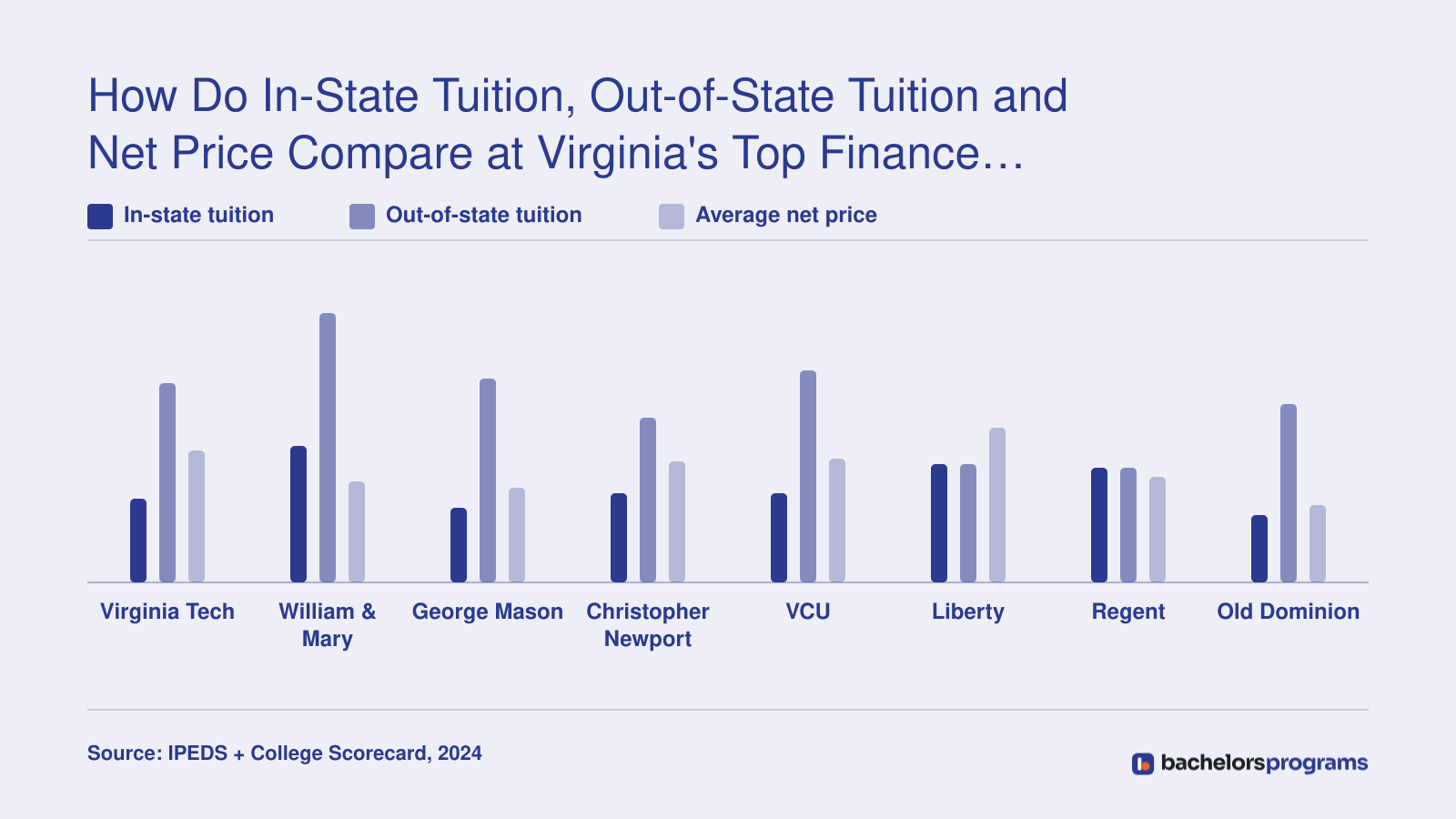
At the public schools ranked here, published in-state tuition and fees run from $12,548 at Radford University to $25,914 at William & Mary. Nonresidents pay $25,633 at Radford and $51,038 at William & Mary. Virginia Tech ($15,948 vs. $37,764) and George Mason ($14,220 vs. $38,688) show the typical gap. Private schools charge one rate regardless of residency: $21,650 at Regent University, $22,465 at Liberty University and $30,592 at Hampton University.
Net Price After Aid
Net price is the average annual cost after grants and scholarships. It includes housing, books and other expenses, not just tuition. That is why it can fall below the sticker price (William & Mary averages $19,096) or rise above it (Liberty averages $29,357). Radford ($14,578) and Old Dominion ($14,638) post the lowest averages. Your own cost depends on family income and the aid you qualify for.
Virginia Aid Programs
- Tuition Assistance Grant (TAG): Up to $5,250 for 2026-27 for full-time Virginia residents (generally one year of domicile) at participating private nonprofit colleges.1 New fully online students receive $2,625 a year for their first two years.1 The deadline is September 15, 2026.1 October 1 and December 1 (spring) applications are funded only if money remains.1
- Commonwealth Award: Need-based aid for Virginia residents enrolled at least half-time, limited to tuition and required fees.4 Amounts vary with remaining need (some schools cite up to $9,000), and each school sets its own priority deadline.2
- Virginia Guaranteed Assistance Program (VGAP): For dependent Virginia high school graduates with at least a 2.5 GPA and financial need. It covers up to in-state tuition plus books and renews for up to three more years with a 2.0 GPA and continuous full-time enrollment.2
- Community College Transfer Grant: $1,000 a year ($500 per term) for eligible transfers.3
Combining Aid
File the FAFSA before your school's priority deadline. VGAP students are funded before Commonwealth Award recipients, and late filers risk missing both. State grants also interact: the transfer grant reduces need-based eligibility. Ask the aid office to show how state, institutional and federal awards stack before you commit.
How Do In-State Tuition, Out-of-State Tuition and Net Price Compare at Virginia's Top Finance Schools?
The gap between sticker price and net price matters more than either number alone. William & Mary lists $51,038 for out-of-state students, yet its average net price after grants is $19,096, and Old Dominion's $14,638 is the lowest net price shown. Net price is an institution-wide average for aided students (in-state students at public schools), not a finance-only figure, and it includes housing and books, which is why Liberty's $29,357 exceeds its listed tuition.
AACSB Accreditation and Finance Program Quality in Virginia
Yes, Virginia has AACSB accredited finance programs. Several business schools in Virginia hold accreditation from AACSB International, the main specialized accreditor for business education, and award a bachelor's degree in finance or a finance concentration.
What AACSB Accreditation Actually Covers
AACSB reviews the business school as a whole: faculty qualifications, curriculum design, resources, and how the school measures student learning. That review extends to the business degrees it awards, but there is no separate AACSB seal for a finance major. So the practical question is not "is the finance program accredited" but "is the business school that awards my B.S. in Finance accredited." Employers and graduate admissions offices use that distinction the same way, as a quick screen for whether the school has been examined from the outside.
Which Virginia Schools Hold It
- William & Mary1
- Virginia Tech2
- Virginia Commonwealth University3
- Radford University4
- University of Richmond5
Each of these appears with current AACSB business accreditation and offers undergraduate finance coursework.
Accreditation Is Not Exam Preparation
The seal says a program survived external review. It says nothing about which professional credentials the coursework is built around, and that varies. Virginia Commonwealth University's financial planning concentration is designed around CFP Board educational requirements. George Mason University describes its finance concentration as a CFA-affiliated program. For the CPA route, plan on adding accounting hours, since that exam tests auditing and tax rather than corporate finance. Read the concentration list, not just the accreditation line, before you apply.
Finance Careers and Salaries in Virginia
A finance degree in Virginia typically leads to one of three job families: financial analysts who evaluate investments and company performance, personal financial advisors who manage money for individuals and families, and loan officers who underwrite consumer and commercial credit. Nationally, financial analysts earned a median of $102,740 a year as of May 2025 across about 443,100 jobs1, personal financial advisors $105,070 across roughly 266,800 jobs2, and loan officers $76,690 across about 283,000 jobs.3 For context, the median wage across all occupations in Virginia was $55,690, spread over roughly 4.1 million jobs.4
Pull the Virginia and Metro Numbers Yourself
National medians only get you so far. Go to BLS.gov and open the Occupational Employment and Wage Statistics pages for each occupation, then switch the geography selector from national to Virginia and to the individual metro areas: Northern Virginia, Richmond, and Virginia Beach-Norfolk. Note the release date on each table so you are comparing the same survey year across regions.
Cross-Check With State and Local Sources
Virginia Works, the state's workforce development agency, publishes occupational employment and wage data that you can hold up against the federal figures.4 Regional workforce boards and metro economic development offices add detail on which employers are hiring.
Use School and Association Resources
Career services pages at Virginia Tech, William & Mary, the University of Virginia, Virginia Commonwealth University, George Mason, and Old Dominion often name the firms recruiting their finance graduates. Then check live job postings for current salary ranges. For credential and compensation research, the CFP Board, the American Bankers Association, and the Mortgage Bankers Association publish career resources and run local chapters worth joining before you graduate.
Related Articles
Common Questions About Finance Degrees in Virginia
These answers draw on the rankings, cost and earnings figures covered earlier on this page. Where sources disagree or a figure is limited, the answer says so.
What is the best college for finance in Virginia?
How much does a finance degree cost in Virginia?
What is the average salary with a finance bachelor's degree in Virginia?
What is the difference between a finance major and a financial management major?
Compare Finance programs on the data that matters
Explore more Business & Management majors or browse every field of study.
All Business & Management programs Browse every field of study