Best Finance Schools in Washington
Compare 15 accredited Finance programs in Washington at 14 colleges, with net price after aid, graduation rates, earnings and debt from IPEDS and the U.S. College Scorecard.

Annual in-state tuition and fees at Washington's public universities run from $8,586 at Eastern Washington University to $13,391 at Washington State, while private options charge roughly $34,000 to $57,000. Most finance-degree decisions here come down to that spread, measured against a Seattle employer base of banks, asset managers and corporate finance teams.
Most of these schools award a Bachelor of Business Administration or a Bachelor of Arts in Business Administration with a finance concentration, and Central Washington offers a B.S. in Business Administration with a finance specialization.
Cost is only half the calculation. Median earnings four years after graduation differ by more than $50,000 between the highest and lowest of these programs.
Key Points
- Nonresidents pay $16,559 to $30,236 more yearly than Washington residents.
- AACSB accreditation covers the whole business school, not just finance.
- Fully online bachelor's in finance options at Washington schools remain thin.
Best Schools for a Bachelor's Degree in Finance in Washington: Ranked
Ten Washington schools enroll undergraduates in a finance-focused bachelor's degree, and the strongest of them pair a rigorous quantitative core with hands-on portfolio or investment-team experience. The list below runs from the Seattle flagship to private colleges in Spokane, Tacoma, Bellingham and College Place. Each entry notes what sets the school apart and which specific finance tracks it admits students into.
University of Washington-Seattle Campus
#1Seattle, WA · ~$14,000/yr (est.)
Best for: Students wanting a research-driven finance core
The University of Washington's Seattle campus is the state's flagship public university and home to the Foster School of Business, where finance sits inside the Department of Finance and Business Economics. Undergraduates study asset pricing, corporate finance, governance, fintech and behavioral finance with faculty whose research spans mergers, household finance and machine learning. The department publishes the Journal of Financial and Quantitative Analysis, an unusual level of research access for an undergraduate program. Seattle's banking, asset management and technology employers surround the campus.
- Finance major housed in the Foster School's Department of Finance and Business Economics
- Coursework spans asset pricing, corporate finance, governance, fintech and behavioral finance
- Faculty research covers mergers, household finance and machine learning in finance
- Department publishes the Journal of Financial and Quantitative Analysis
- Blends quantitative methods with applied, real-world finance problems
- 295 bachelor's degrees in finance completed in the latest reporting year
- Seattle location near a deep finance, banking and technology employer base
University of Washington-Bothell Campus
#2Bothell, WA · ~$12,000/yr (est.)
Best for: Transfer students entering a flexible business core
UW Bothell is a smaller campus northeast of Seattle that houses finance inside its Bachelor of Business Administration. Students build a broad business base in organizational behavior, marketing and operations, then specialize through either a Finance Concentration or a Finance Option, both ending in a capstone on a strategic business challenge. The campus is small relative to the Seattle flagship, and its location puts students near Eastside technology and banking employers.
- 90-credit concentration inside the Bachelor of Business Administration
- Strong business foundation in organizational behavior, marketing and operations
- Electives range from entrepreneurial finance to risk management
- Required capstone asks students to tackle a strategic business challenge
- Prepares students for commercial banking, investment banking and corporate finance
University of Washington-Tacoma Campus
#3Tacoma, WA · $13,000 – $43,000/yr (est.)
Best for: Career switchers eyeing Puget Sound employers
UW Tacoma's Milgard School of Business offers a Bachelor of Arts in Business Administration with a finance option, one of five transcripted study options in the degree. The program totals 180 credits, including 30 credits of core business coursework and 30 credits of upper-level finance and business economics. The finance option is printed on both the transcript and the diploma, and students may hold only one transcripted option. Graduates have gone on to employers including Boeing, BNY Mellon and the State of Washington.
- Finance is one of five study options in the business administration degree
- 30 credits of core business courses plus 30 credits of upper-level finance and economics
- 5-credit business policy and strategic management course required
- Finance option is noted on both the transcript and the diploma
- Students may hold only one transcripted option
- Coursework covers bond and stock valuation, derivatives and portfolio management
- Recent employers include Boeing, BNY Mellon and the State of Washington
- Degree totals 180 credits
Whitworth University
#4Spokane, WA · ~$27,000/yr (est.)
Whitworth University is a private Christian university in Spokane whose business school blends quantitative training with a faith-informed view of business ethics. Finance students gain real investing experience through the Student Investment Group, compete in the CFA Institute Research Challenge and present their work to the university's trustees. Mock interviews with local business leaders sharpen job-search skills, and graduates have landed at firms such as Fisher Investments and Washington Trust Bank.
- Finance concentration inside the BBA in Business Administration
- Student Investment Group gives students real-world investing experience
- Team competes in the CFA Institute Research Challenge
- Students present their analysis to Whitworth's trustees
- Uses computer models such as FORAD for multinational operations
- Mock interviews with local business leaders build job-search skills
- Faith-informed lens applied to ethical dilemmas in finance
- Women in Finance club active on campus
Central Washington University
#5Ellensburg, WA · ~$18,000/yr (est.)
Central Washington University in Ellensburg offers finance as a specialization within its Bachelor of Science in Business Administration, built on a curriculum recognized by the CFA Institute. Students cover corporate finance, investments, financial modeling, portfolio analysis, international finance and financial planning, with internships and real portfolio projects alongside coursework. A capstone assesses student work against business-school accreditation standards. Classes are small, and the department advertises 22 award and scholarship opportunities.
- Curriculum recognized by the CFA Institute
- Embeds at least 70% of the CFA Program Candidate Body of Knowledge
- Capstone assesses student skills against accreditation standards
- Covers corporate finance, investments, financial modeling and portfolio analysis
- Real-world portfolio projects and internships built into the program
- Small classes with personalized faculty attention
- 22 departmental award opportunities
Western Washington University
#6Bellingham, WA · $10,000 – $29,000/yr (est.)
Western Washington University in Bellingham offers finance as a concentration in the Bachelor of Arts in Business Administration, with a related Financial Economics major for students aiming at analyst roles. Coursework covers investments, corporate finance, real estate, derivative contracts, multinational finance, insurance and risk management, with an emphasis on contextual decision making. The department publishes a multi-year course schedule so students can plan around quarterly offerings.
- Finance concentration in the BA in Business Administration
- Coursework spans investments, corporate finance, real estate and derivatives
- Also covers multinational finance, insurance and risk management
- Related Financial Economics major offered for analyst-track students
- Emphasis on contextual decision making with real financial information
- Multi-year course schedule published to help students plan quarters
- Prepares students for financial analyst, loan officer and portfolio manager roles
Seattle University
#7Seattle, WA · ~$35,000/yr (est.)
Seattle University is a private Jesuit university on Capitol Hill, just east of downtown Seattle, and its Albers School of Business and Economics offers finance as a Bachelor of Arts in Business Administration. Students follow a 120-credit, four-year path that pairs financial theory with data analytics and risk management, and many manage real money through the Redhawk Investment Fund. The campus sits close to Seattle's Fortune 500 headquarters, and the school publishes a two-year plan for transfer students.
- 120-credit, four-year finance degree in the Bachelor of Arts in Business Administration
- Students manage a real portfolio through the Redhawk Investment Fund
- Team competes in the CFA Institute Research Challenge
- Small, experiential classes with professors who know students by name
- Curriculum covers corporate finance, investments, data analytics and risk management
- Grounded in a Jesuit mission focused on equity and shared prosperity
- Campus near Seattle's Fortune 500 headquarters
- Two-year transfer plan published for incoming transfer students
Walla Walla University
#8College Place, WA · $20,000 – $25,000/yr (est.)
Walla Walla University is a private Seventh-day Adventist university in College Place, in southeastern Washington, offering finance as a concentration in its four-year Bachelor of Business Administration. The program covers financial markets, corporate finance, banking, investments, real estate, insurance, retirement planning and international finance, plus the analytical groundwork for professional certifications. The business school reports that 97% of its graduates are employed or enrolled in graduate school within a year.
- Finance concentration inside the four-year Bachelor of Business Administration
- Covers corporate finance, banking, investments, real estate and insurance
- Includes retirement planning and international finance coursework
- Builds analytical skills needed for professional certification exams
- School reports 97% of business graduates placed in jobs or graduate school within a year
- Business program holds ACBSP accreditation
Eastern Washington University
#9Cheney, WA · ~$14,000/yr (est.)
Eastern Washington University in Cheney, just outside Spokane, offers finance as a Bachelor of Science in Business Administration. The 180-quarter-credit degree covers financial analysis, investments, derivatives, capital budgeting, short-term financial management and international finance, and closes with a senior capstone. Students declare the business major before entering upper-division business courses, earn at least a C in each major course and hold a 2.5 GPA in the business core.
- 180 quarter credits, including a senior capstone
- Coursework covers financial analysis, investments, derivatives and capital budgeting
- Includes short-term financial management and international finance
- Minimum C grade required in each major course
- 2.5 GPA required in the upper-division business core
- Students must declare the business major before taking upper-division business classes
- Electives chosen with a faculty advisor
- Prepares graduates for banking, insurance and securities careers
Washington State University
#10Pullman, WA · ~$15,000/yr (est.)
Washington State University is the state's land-grant research university, and its Carson College of Business teaches finance at both the Pullman and Vancouver campuses. Undergraduates choose one of five specialty areas, from financial management to risk management and insurance, and can join the FIRE Club or the D.A. Davidson student investment team. The college awards more than $1,000,000 in scholarships each year, and a faculty-led Cougs on Wall Street trip takes selected students to New York. Finance Industry Night runs every fall.
- Five specialty areas, including investment analysis and risk management and insurance
- Taught at both the Pullman and Vancouver campuses
- Carson College awards more than $1,000,000 in scholarships each year
- D.A. Davidson student investment team and FIRE Club on campus
- Faculty-led Cougs on Wall Street trip requires a 3.25 GPA
- Coursework draws on economics, accounting, statistics and decision sciences
- Program centers on cash flows, timing and risk
- Finance Industry Night held every fall
Cost & outcomes by school
Federal data for the highest-earning Finance programs, independent of the ranking above. Earnings are this field's bachelor's graduates four years after completing where the Scorecard reports them, else the school's undergraduate median.
| School | Net price / yr | Grad rate | Earnings | Debt | Grads/yr | Format |
|---|---|---|---|---|---|---|
| Seattle University WA | $34,662 | 76% | $99,791 | $23,000 | 57 | Campus |
| University of Washington-Seattle Campus WA | $14,091 | 85% | $97,452 | $13,856 | 303 | Campus |
| University of Washington-Tacoma Campus WA | $10,163 | 63% | $97,452 | $13,856 | 75 | Campus |
| Washington State University WA | $14,971 | 61% | $86,012 | $19,500 | 160 | Campus |
| Gonzaga University WA | $35,119 | 86% | $78,892 | $24,454 | — | Campus |
| University of Washington-Bothell Campus WA | $12,319 | 65% | $78,466 | $14,615 | 4 | Campus |
| Western Washington University WA | $21,193 | 65% | $75,730 | $19,084 | 36 | Campus |
| Pacific Lutheran University WA | $19,589 | 69% | $66,990 | $22,578 | — | Campus |
| Eastern Washington University WA | $13,886 | 44% | $66,710 | $15,298 | 54 | Campus |
| Seattle Pacific University WA | $24,488 | 62% | $64,506 | $24,000 | — | Campus |
| Walla Walla University WA | $23,329 | 60% | $61,885 | $26,842 | 5 | Campus |
| Central Washington University WA | $18,476 | 54% | $61,580 | $19,500 | 2 | Online |
Sources: U.S. Department of Education. Net price, graduation rate, earnings and debt: College Scorecard (earnings and debt for this field's bachelor's graduates where reported, else school-wide); graduates: IPEDS. A dash means no figure is reported.
Cost, debt & payoff
Median earnings of this field's bachelor's graduates (4 yrs after completing, else the school's undergraduate median) vs. their median federal loan debt · U.S. College Scorecard
Across these programs the median graduate earns about $75,730 and finishes with roughly $19,500 in debt — a ratio that clears a common rule of thumb (keep debt below first-year salary). Net price and debt vary widely school to school, so check the per-school figures in the table above before you shortlist.
Most Affordable Washington Schools for a Bachelor's in Finance
Every school in this table is a public university, so the in-state tuition and fees apply to Washington residents, and the private schools ranked here do not post net prices low enough to appear. Net price is an institution-wide average after grants and scholarships, drawn from 2024 U.S. Department of Education data, so treat it as a benchmark, not an exact quote for every student. UW Tacoma's $10,163 average net price sits $4,808 below Washington State University's $14,971, the highest figure in this table.
| School | City | Finance Program | In-State Tuition and Fees | Nonresident Tuition and Fees | Average Net Price After Aid (Institution-Wide) |
|---|---|---|---|---|---|
| University of Washington-Tacoma Campus | Tacoma | Finance | $13,168 | $43,404 | $10,163 |
| University of Washington-Bothell Campus | Bothell | Bachelor of Business Administration (Finance Concentration) | $12,919 | $43,155 | $12,319 |
| Eastern Washington University | Cheney | Finance | $8,586 | $25,959 | $13,886 |
| University of Washington-Seattle Campus | Seattle | Finance and Business Economics | $12,973 | $43,209 | $14,091 |
| Washington State University | Pullman | Finance | $13,391 | $29,950 | $14,971 |
Online and Hybrid Bachelor's in Finance Options at Washington Schools
Flexibility is the draw of an online bachelor's in finance, but in Washington the fully online route is thin, and listings can promise more than a school's own page confirms. Sort the options by format before you compare anything else.
Delivery Format by School
- Online: Central Washington University's finance specialization is tagged as online in our data. Its own page did not clearly confirm a fully online path, so verify that with the school before you plan around it.
- Campus only: University of Washington-Seattle, Bothell, and Tacoma, Washington State University, Whitworth, Western Washington, Seattle University, Walla Walla, and Eastern Washington are listed as campus programs. We found no verified hybrid finance options at any of them.
- Online but not finance: WSU Global Campus is 100% online, yet its online bachelor's programs are Accounting and Economic Sciences.1 The Economic Sciences degree (B.S. or B.A.) includes business finance coursework and is pitched at finance and analytics roles, but it is not a finance degree.2
Major vs. Concentration
A finance major is its own degree plan. A concentration is a track inside a general business degree. Washington State, UW-Tacoma, Seattle University, and Eastern Washington list Finance directly. Western Washington, Whitworth, UW-Bothell, and Walla Walla place it inside a business administration degree, and Central Washington calls it a specialization. Online listings often blur the two, so check the degree title you will actually earn.
Which Format Fits
- Working adults: Online is the best match, but only once the school confirms the program is available.
- Transfer students: Campus programs with a stated business-major admission step are easier to plan around. Ask an advisor how your credits will apply.
- First-time freshmen: Campus programs offer the internships, student investment teams, and career events that several of these schools highlight.
AACSB Accreditation and CFA Affiliation at Washington Finance Programs
AACSB accreditation applies to a whole business school, not to the finance major by itself. A finance degree from an accredited school sits inside a business college that passed a peer review of its faculty, curriculum and student outcomes. Directory labels vary, and some schools offer finance as a specialization inside a business administration degree.
Verified AACSB Schools
Central Washington University, Eastern Washington University, and the University of Washington's Tacoma, Bothell and Seattle campuses all appear in the AACSB directory as accredited. Central Washington's accreditation was extended in February 2026.1 UW Bothell lets business students specialize in finance, and the UW Seattle directory entry lists general business, so confirm the finance offering on each school's program page.
Not Verified
We could not confirm AACSB status for Washington State University, Whitworth University, Western Washington University, Seattle University or Walla Walla University. Seattle University's program page states AACSB accreditation. Walla Walla's page lists ACBSP, a different business accreditor.
What CFA Affiliation Signals
Our sources do not establish CFA affiliation for any of the schools listed here. Central Washington's page describes a CFA-recognized curriculum, which is a different claim.
Quick Directory Check
- AACSB: Search the school's name in the AACSB accredited-schools directory and confirm finance appears under the business school.
- CFA: Look for the school on the CFA affiliation list on the CFA website, or ask admissions directly.
Related Articles
Transferring Into a Washington Finance Program: DTA and Credit Checklist
Many Washington students start a bachelor's degree in finance at a community college. Use this checklist to protect your credits and your timeline.
- Finish the DTA associate degreeThe Direct Transfer Agreement requires 90 quarter credits (about 60 semester credits). It generally awards junior standing at every Washington public four-year school. The updated DTA takes effect September 2026. If you started under the prior version, confirm your completion timing with the school.
- Know what the DTA does not doIt does not guarantee admission to the university or the business major. Professional-technical courses count only in limited amounts: up to 15 credits in a DTA and 5 in an Associate of Science-Transfer.
- Follow business prerequisitesAsk about a DTA/Major Related Program in business, which pairs the DTA with a set major curriculum. UW Seattle's Foster School of Business accepts business coursework only as direct UW course equivalents. Its transfer deadlines are February 15 for autumn and September 1 for winter.
- Check credit capsWestern Washington University accepts up to 135 transfer credits, with no more than 105 lower-division credits, and requires grades of C or better. Central Washington University also caps transfer credit at 135, with up to 105 from community colleges.
- Meet GPA thresholdsUW Tacoma guarantees general admission to eligible Washington residents with an approved transfer degree and a 2.75 GPA. That guarantee does not cover the Finance BA, and Running Start students do not qualify.
- Contact transfer advising earlyAt UW Bothell, Washington State, Eastern Washington, Seattle University, Whitworth and Walla Walla, ask the transfer office directly how your courses apply to the finance major.
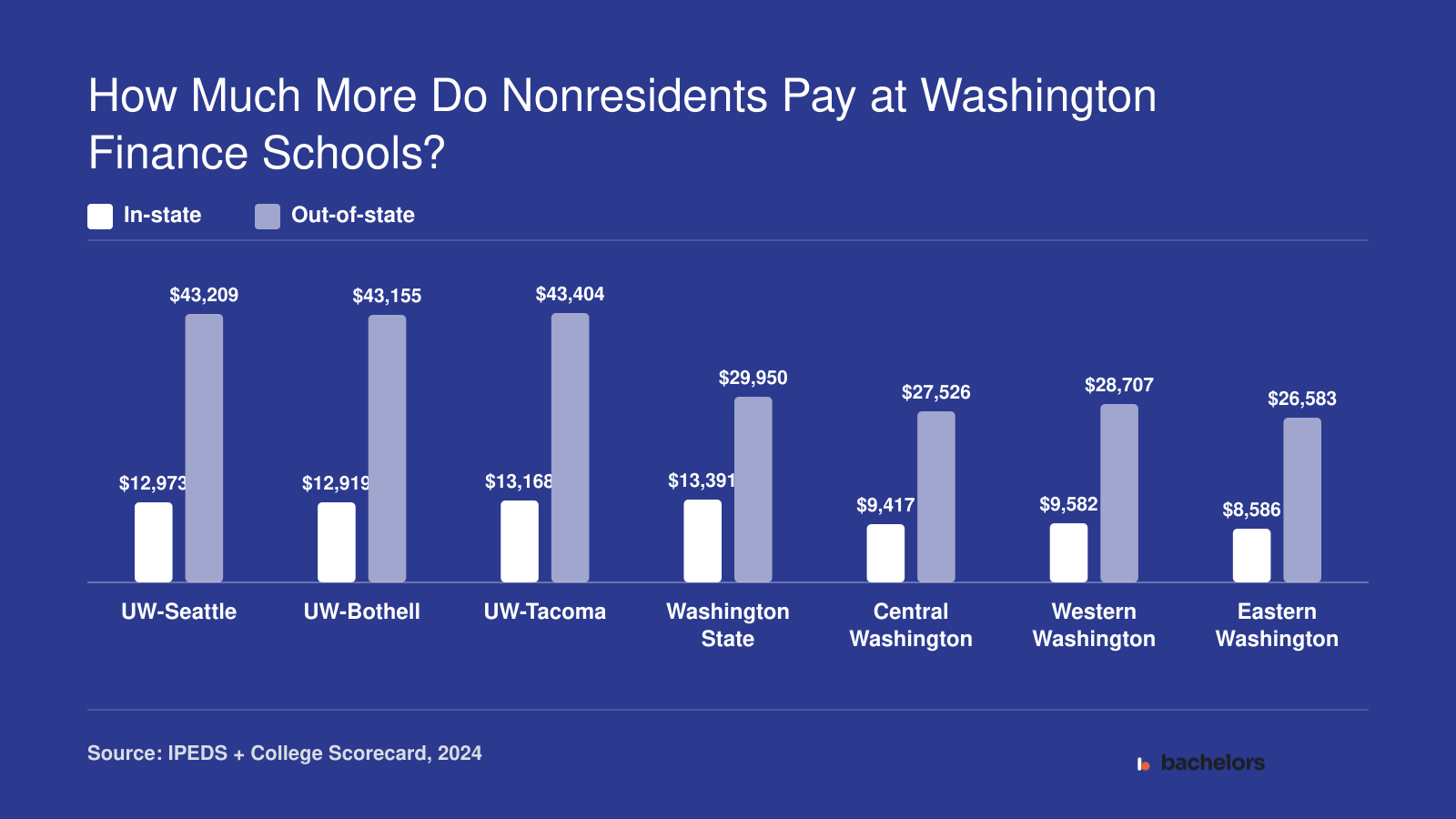
How Much More Do Nonresidents Pay at Washington Finance Schools?
At Washington's public universities, nonresidents pay more than residents in annual tuition and fees, a gap that runs from $16,559 at Washington State University to $30,236 at each University of Washington campus. The private schools charge one rate regardless of residency: $56,721 at Seattle University, $52,880 at Whitworth University and $34,227 at Walla Walla University. These are published sticker prices before grants, scholarships or other aid.
Finance Careers and Salaries in Washington
What does a finance graduate actually earn in Washington? The answer depends on the role, and these figures describe everyone in each occupation, not new graduates.
Wages for Common Finance Roles
May 2025 occupational data from the Washington State Employment Security Department and the U.S. Bureau of Labor Statistics gives these statewide medians:
- Financial and investment analysts: $94,256 per year1.
- Personal financial advisors: $114,050 per year, with about 5,790 jobs statewide2.
- Financial managers: $172,470 per year, with about 13,890 jobs statewide1.
In the Seattle-Tacoma-Bellevue metro area, personal financial advisors earn a median of $114,5402, close to the statewide figure. Financial manager roles usually go to people with several years of experience, so treat that median as a mid-career target rather than a first-job salary.
Seattle-Area Access
The Puget Sound region concentrates banking, investment, corporate finance and advisory work in one commuting area. Students at the University of Washington campuses in Seattle, Bothell and Tacoma, and at Seattle University, can pursue internships and part-time finance work within reach of campus. Students at Western Washington University, Central Washington University, Washington State University, Eastern Washington University, Whitworth University and Walla Walla University can look to the Seattle area as well as regional markets closer to home. Local internships and alumni contacts often shape a first offer more than the degree title does.
Occupational Wages vs. Graduate Earnings
Graduate earnings figures come from federal Scorecard data and track recent alumni of each school. Occupational wages are different. They cover every worker in a job, including veterans with decades of experience, so medians run higher than what most new graduates are paid.
For a realistic starting-pay anchor, look at the 10th percentile wage for the role you want. That figure reflects entry-level pay far better than the median does. Pull the 10th percentile for financial analysts and personal financial advisors from the state's wage tables, then compare it with the graduate earnings at the schools on your list.
Compare Finance programs on the data that matters
Explore more Business & Management majors or browse every field of study.
All Business & Management programs Browse every field of study