Best Finance Schools in West Virginia
Compare 11 accredited Finance programs in West Virginia at 9 colleges, with net price after aid, graduation rates, earnings and debt from IPEDS and the U.S. College Scorecard.

Studying finance in West Virginia usually means pursuing a Bachelor of Science (B.S.) in Finance, or a business administration degree with a finance concentration, and the price spread between programs is wide. Average net prices at the schools ranked here run from $1,807 at West Virginia University at Parkersburg to $18,273 at Davis & Elkins College. West Virginia University sits at $15,634 and Marshall University at $7,502.
Earnings differ too. West Virginia University finance graduates earn a median $48,645 one year out, against $36,046 at Marshall. The real tradeoff is whether that early pay gap justifies the higher net price.
Key Points
- West Virginia University finance graduates earn a median $80,532 after five years.
- Marshall suits price-focused students; its finance graduates earn $36,046 one year out.
- West Virginia personal financial advisors earned a $152,330 median in May 2023.
Best Bachelor's Degree in Finance Schools in West Virginia, Ranked
Nine West Virginia schools offer an undergraduate finance or finance-focused business degree, from the flagship research campus in Morgantown to a small private college in Elkins and online programs based in Charles Town. Some are built around real-money portfolio management and Bloomberg terminals, while others keep costs low or schedule classes around full-time work. Each entry below covers what the program asks of students and who it fits best.
West Virginia University
#1Morgantown, WV · ~$16,000/yr (est.)
Best for: Students wanting real-money portfolio experience
West Virginia University is the state's flagship campus in Morgantown and runs its finance degree inside the AACSB-accredited John Chambers College of Business and Economics. Students pick from six emphasis areas and can manage a real-money portfolio in the Bloomberg lab. A 2026 partnership with Huntington Bank added financial-literacy programming, financial-services internships and $250,000 in student scholarships.
- AACSB accredited through the John Chambers College of Business and Economics
- Tracks: Investments, Wealth Management
- Six emphases including Banking, Energy Finance and Risk Management and Insurance
- Student team manages a $100,000 real-money portfolio
- Free 8-hour Bloomberg certification available in the Bloomberg lab
- CFP Board-approved; graduates eligible for CFP, CVA and CFA exams
- More than 100 merit and need-based scholarships awarded annually
- 3.0 GPA plus ACT or SAT required; internships encouraged early
Davis & Elkins College
#2Elkins, WV · ~$18,000/yr (est.)
Best for: Learners who want small classes and mentoring
Davis & Elkins is a small private college in Elkins where finance sits inside an IACBE-accredited business program and classes stay small enough for individual attention. The Bachelor of Science in Finance lays out 66 credit hours with room for electives in finance, management or accounting. Internships can be scheduled in any semester, and independent study is available with a faculty member.
- IACBE-accredited business program
- 66 credit hours: 21 in economics and finance, 45 core, 9 electives
- Coursework spans personal finance, insurance, investments and corporate finance
- Senior thesis required for the degree
- Internships available any semester; summer placements run about 10 weeks
- Independent study available with a faculty member
- Small class sizes with individualized attention
- Covers real estate investment, portfolio management and risk management
American Public University System
#3Charles Town, WV · $5,000 – $10,000/yr (est.)
Best for: Working adults needing monthly online starts
American Public University System is based in Charles Town and delivers its finance degree entirely online, which makes it the most flexible option on this list for working adults. Classes run eight weeks and start every month, and students have up to 10 years to finish. Tuition is set per credit rather than by residency, and work or military experience can be evaluated for credit.
- Fully online, 8-week classes with 12 start dates a year
- $360 per credit; $250 per credit for eligible military members and families
- No SAT, ACT or entrance exam; $0 application fee
- Free ebooks and free transfer credit evaluation
- Credit awarded for work and military experience
- Coursework covers blockchain, machine learning and data analytics
- Students have up to 10 years to finish the degree
- Accredited by the Higher Learning Commission
Fairmont State University
#4Fairmont, WV · ~$9,000/yr (est.)
Fairmont State pairs a broad business core with a 21-credit finance concentration, so graduates leave with both management fundamentals and financial analysis skills. An accelerated BS to MBA path lets eligible students double-count up to 12 credits toward a graduate degree. The university sits in Fairmont, in north-central West Virginia.
- 30-33 credit core curriculum plus 48 credits of business core
- 21 credits in the finance concentration
- Business core includes marketing, management and accounting fundamentals
- Accelerated BS to MBA option with up to 12 credits double-counted
- Calculus I recommended for students planning graduate study
- Prepares students for credit director, equity trader and risk manager roles
Marshall University
#5Huntington, WV · $5,000 – $10,000/yr (est.)
Marshall University in Huntington builds its finance major around risk management, international finance, corporate finance and investments. More than ten finance-related organizations and a Professionalism Certificate give students ways to build a resume outside class. Accounting and economics minors are straightforward add-ons, and the program emphasizes practical data gathering and financial analysis.
- Covers risk management, international finance, corporate finance and investments
- More than ten finance-related student organizations
- Professionalism Certificate available to finance majors
- Accounting and economics minors can be added
- Coursework includes money and banking, investment principles and portfolio management
- Prepares for corporate management, investment services and banking careers
Concord University
#6Athens, WV · $10,000/yr (est. net price)
Concord University is a small public campus in Athens with an ACBSP-accredited business program and a finance emphasis inside the Business Administration major. The coursework balances financial theory with applied exercises that mirror corporate financial management decisions. A 3 + 1 option and a 2025-2026 College of Distinction for Business recognition round out the appeal.
- ACBSP-accredited business program
- Four-year program with a 3 + 1 option
- Named a 2025-2026 College of Distinction for Business
- Coursework simulates corporate financial management decisions
- Balances financial theory with practical application
- Prepares students for financial analyst and personal financial advisor roles
West Virginia State University
#7Institute, WV · $11,000/yr (est. net price)
West Virginia State University is a historically Black university in Institute, just outside Charleston, offering a Bachelor of Science in Business Administration with a finance concentration. Finance is one of nine concentration options in the College of Business, Sciences, and Technology, so students can pair it with accounting, economics or international business coursework.
- Nine concentration options across the business programs
- Finance sits alongside Accounting, Economics and International Business
- Housed in the College of Business, Sciences, and Technology
West Virginia University at Parkersburg
#8Parkersburg, WV · $1,800/yr (est. net price)
WVU Parkersburg offers a Bachelor of Applied Science in Business Administration with a concentration in Accounting and Financial Management, an applied degree that leans toward accounting and auditing practice. Coursework prepares students for roles ranging from staff accountant to chief financial officer, and the regional campus keeps published costs low. It suits students in the Mid-Ohio Valley who want a four-year business degree without leaving home.
- Four-year program with one of the state's lowest published net prices
- Coursework covers accounting and auditing practice
- Estimated 2025-2026 tuition: $192 to $267 per credit for WV and Ohio residents
- Careers listed include chief financial officer, controller and fund manager
- Financial managers direct investment activity and build long-term strategy
Strayer University-West Virginia
#9Scott Depot, WV · ~$14,000/yr (est.)
Strayer University's West Virginia location in Scott Depot serves students who want a business degree with a finance concentration, either online or in person at select campuses. The 40-course BBA runs in 11-week blocks with fixed per-course pricing rather than residency-based tuition. Generous transfer credit and employer tuition assistance make it a practical choice for adults who already hold some college credit.
- 40 courses, each 11 weeks long, at $1,555 per course
- Fully online or in person at select campuses
- ACBSP-accredited business program
- Transfer up to 28 classes
- Core finance courses include Money and Banking and Financial Risk Analysis
- One free course for every three passed through the Learn and Earn Scholarship
- Employer Tuition Assistance through more than 500 partner organizations
- Admission requires a high school diploma or equivalent and official transcripts
Cost & outcomes by school
Federal data for the highest-earning Finance programs, independent of the ranking above. Earnings are this field's bachelor's graduates four years after completing where the Scorecard reports them, else the school's undergraduate median.
| School | Net price / yr | Grad rate | Earnings | Debt | Grads/yr | Format |
|---|---|---|---|---|---|---|
| West Virginia University WV | $15,634 | 65% | $76,959 | $24,242 | 125 | Campus |
| Marshall University WV | $7,502 | 51% | $63,906 | $24,250 | — | Campus |
| Fairmont State University WV | $9,032 | 44% | $46,857 | $21,000 | — | Campus |
| American Public University System WV | $9,597 | 57% | $44,409 | $21,743 | — | Online |
| Davis & Elkins College WV | $18,273 | 39% | $43,411 | $27,000 | 6 | Campus |
| Concord University WV | $9,966 | 39% | $42,703 | $18,900 | — | Campus |
| West Virginia State University WV | $11,139 | 39% | $40,492 | $23,338 | — | Campus |
| Strayer University-West Virginia WV | — | — | $40,092 | $40,621 | — | Online or campus |
| West Virginia University at Parkersburg WV | $1,807 | 9% | $35,171 | $12,570 | — | Campus |
Sources: U.S. Department of Education. Net price, graduation rate, earnings and debt: College Scorecard (earnings and debt for this field's bachelor's graduates where reported, else school-wide); graduates: IPEDS. A dash means no figure is reported.
Cost, debt & payoff
Median earnings of this field's bachelor's graduates (4 yrs after completing, else the school's undergraduate median) vs. their median federal loan debt · U.S. College Scorecard
Across these programs the median graduate earns about $44,409 and finishes with roughly $24,242 in debt — a ratio that clears a common rule of thumb (keep debt below first-year salary). Net price and debt vary widely school to school, so check the per-school figures in the table above before you shortlist.
How We Ranked West Virginia Finance Schools
Every school on this list earns its place on evidence, not reputation. We weighed four factors, applying the same standard to every program.
What We Looked At
- Cost: In-state tuition and the average net price students actually pay once grants and scholarships are counted, since sticker price rarely matches the bill.
- Earnings: What graduates of the finance program itself tend to earn after leaving, where that figure is published.
- Student outcomes: Graduation and retention rates, which tell you how many students finish what they start.
- Accreditation: Institutional accreditation, plus business-school accreditation where a school holds it.
What the Numbers Can and Cannot Tell You
Two of those measures deserve a caveat. Both the graduation rate and the net price are campus-wide averages covering every major, from nursing to education, not finance majors specifically. A school with a strong overall completion rate may still have a demanding finance sequence, and a low average net price reflects the aid picture across the whole student body. Read them as context, not as a verdict on the finance department.
Who Made the Cut
Only bachelor's degrees in finance, or business administration degrees with a finance concentration, at schools based in West Virginia. Both campus and online programs were eligible, since several West Virginia institutions deliver the degree fully online to students anywhere.
Cheapest Bachelor's Degree in Finance Options in West Virginia
These finance programs at West Virginia schools are sorted by average net price, which is what students actually paid after grants and scholarships according to IPEDS and College Scorecard (2024) data from the U.S. Department of Education. West Virginia University at Parkersburg posts the lowest net price at $1,807, while Marshall University offers the lowest-cost dedicated finance major in the group at $7,502. American Public University System, the only fully online option here, charges the same tuition to in-state and out-of-state students.
| School | City | Program | Format | In-State Tuition & Fees | Out-of-State Tuition & Fees | Average Net Price | Graduation Rate |
|---|---|---|---|---|---|---|---|
| West Virginia University at Parkersburg | Parkersburg | Accounting and Financial Management | Campus | $4,612 | $9,124 | $1,807 | 9% |
| Marshall University | Huntington | Finance | Campus | $9,162 | $20,342 | $7,502 | 51% |
| Fairmont State University | Fairmont | Business Administration, Finance Concentration, B.S. | Campus | $8,708 | $18,924 | $9,032 | 44% |
| American Public University System | Charles Town | Finance | Online | $8,400 | $8,400 | $9,597 | 57% |
| Concord University | Athens | Business Administration, Finance Emphasis | Campus | $10,664 | $22,000 | $9,966 | 39% |
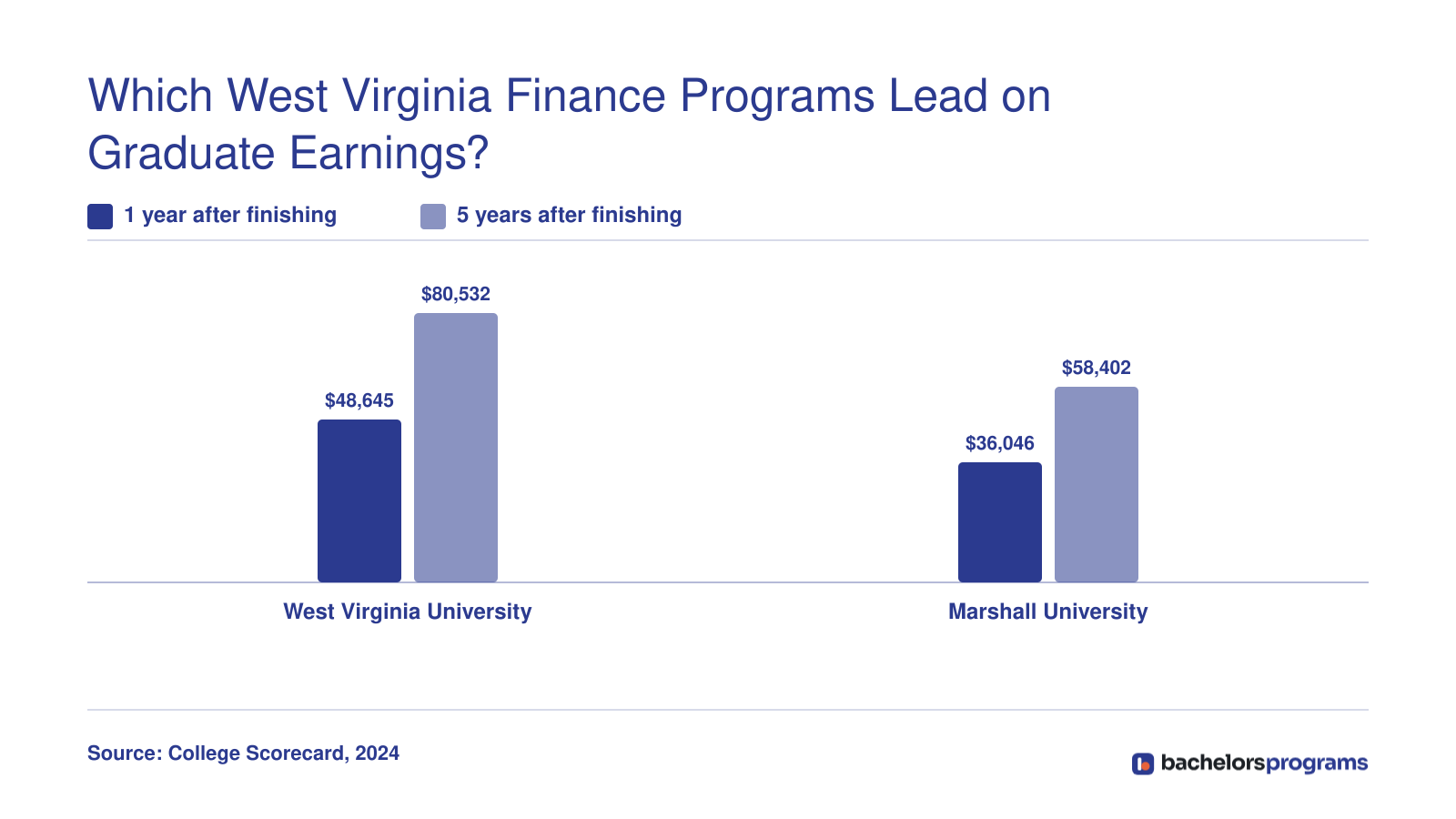
Which West Virginia Finance Programs Lead on Graduate Earnings?
Federal data on finance bachelor's graduates show West Virginia University graduates earning a median $48,645 one year after finishing and $80,532 five years after. Marshall University finance graduates earn a median $36,046 one year after finishing and $58,402 five years after. Program-level earnings are not reported for Fairmont State University, American Public University System or Davis & Elkins College, so those schools do not appear in the chart. At both WVU ($24,242) and Marshall ($24,250), median finance graduate debt is about $24,000, well below what graduates earn in their first year.
WVU vs. Marshall: Comparing the Two Top Finance Programs
West Virginia University suits the student who wants a large research university, a CFP-aligned wealth management track, and a shot at a live student-managed portfolio. Marshall University suits the student who puts net price first and wants a broad corporate finance foundation from a smaller business school.
Cost and outcomes, side by side
- In-state tuition: $10,104 a year at WVU, $9,162 at Marshall. Out-of-state runs $28,608 and $20,342.
- Net price after aid: $15,634 at WVU, $7,502 at Marshall.
- Graduation rate: 64.7% at WVU, 51.2% at Marshall.
- Median earnings: about $55,900 for WVU former students who received federal aid, versus $46,354 at Marshall.
- Student-to-faculty ratio: 19 to 1 at WVU, 16 to 1 at Marshall.
Curriculum and hands-on work
WVU's bachelor's in finance lists six concentration options and is AACSB accredited, and its Wealth Management Area of Emphasis is approved by the Certified Financial Planner Board of Standards, with coursework that satisfies the education requirement to sit for the CFP exam. The Student Managed Investment Fund, launched in 2017, now runs a live equity portfolio above $750,000. Roughly 16 undergraduates from finance, accounting, economics, and math make the buy and sell calls, earning $20 an hour for about 10 hours a week through FIN 465: Applied Investment Management, worth three credits per semester for up to two. Seniors and second-semester juniors who have completed FIN 310: Investments are eligible, and the fund takes biannual New York treks with visits to the NYSE and Nasdaq. A separate one-credit investing sequence that began in Spring 2024, FIN 293A, FIN 293B, and Experiential Investing, lets students manage a $100,000 real-money portfolio.
Marshall's finance major covers banking, investments, corporate finance, risk management, and international finance, with more than ten student organizations for majors, a Professionalism Certificate, and minors in accounting and economics. Its published program page does not list a student-managed fund or a CFP-registered track.
Choose WVU if, choose Marshall if
- Choose WVU if: you want the CFP-aligned wealth management path or a competitive, paid seat in a student-run fund.
- Choose Marshall if: net price and smaller classes matter most, and you want a straightforward corporate finance route.
- Choose either if: you plan to build a career in West Virginia; both are public options with regional employer ties.
Online and Hybrid Bachelor's Degree in Finance Options at West Virginia Schools
Online delivery is now a standing format at a few West Virginia business schools, though a finance-specific online degree remains scarcer than an online business degree.
Which Schools Offer a Finance Bachelor's Online
Strayer University-West Virginia, based in Scott Depot, lists its Bachelor of Business Administration in Finance as available both on campus and fully online, with 11-week courses and up to 28 classes accepted in transfer. American Public University System in Charles Town lists its finance bachelor's as an online program, with 8-week classes and multiple start dates through the year. Both are accredited business programs, and Strayer's is accredited by the Accreditation Council for Business Schools and Programs.
West Virginia University's Finance, BSBA is a Morgantown campus major, not an online one. WVU does run a fully online General Business, B.S.B.A. at 120 credits and $534 per credit hour, but that is a general business degree rather than a finance concentration, so a student set on the finance major should plan for the Morgantown campus. The finance programs at Davis & Elkins, Fairmont State, Marshall, Concord, West Virginia State, and WVU Parkersburg are listed as campus programs.
What to Check Before You Enroll
- Tuition basis: an online per-credit rate is often separate from the in-state campus rate, so compare the number you will actually be billed rather than the sticker price on the main tuition page.
- Proctoring and residencies: ask whether exams need a remote proctor, whether proctoring carries a fee, and whether any course requires a campus visit.
- Transfer credit: request a written evaluation before registering, since prior college work and military training can shorten the degree.
Related Articles
Questions to Ask Yourself
Do you want a financial planning track or a broader banking and investments focus?
Will you live on campus in West Virginia, or do you need an online option from a school based in the state?
After in-state tuition and PROMISE or other state aid, which school gives you the lowest net price?
Cost of a Bachelor's Degree in Finance in West Virginia
Cost is the part of this decision families control most, and in West Virginia the gap between sticker price and what students actually pay is wide enough to change which program makes sense.
Sticker Price vs. Net Price
In-state tuition at the public schools ranked here runs from about $4,612 a year at West Virginia University at Parkersburg to $10,664 at Concord University, with West Virginia University at $10,104, West Virginia State University at $9,570, Marshall University at $9,162 and Fairmont State University at $8,708. Out-of-state rates climb sharply: $28,608 at WVU and $20,342 at Marshall. Davis & Elkins College, the private option, lists $31,820 for every student.
Net price, the average a student pays once grants and scholarships are counted, is the fairer comparison. Treat these as approximate averages for each sector, not a quote for any one student: about $15,634 at West Virginia University, $7,502 at Marshall, $9,032 at Fairmont State, $9,966 at Concord, $11,139 at West Virginia State, $1,807 at Parkersburg, $9,597 at American Public University System and $18,273 at Davis & Elkins.
What Borrowing Looks Like
Median federal debt among graduates who borrowed is $24,242 at WVU, $23,250 at Marshall, $21,000 at Fairmont State, $18,900 at Concord, $12,570 at WVU Parkersburg and $27,000 at Davis & Elkins. Where a standard 10-year monthly payment is reported, it sits around $257.
Two State Awards Worth Knowing
- PROMISE Scholarship: a merit award for West Virginia high school graduates who meet the state's GPA and test-score targets and enroll at a participating West Virginia college. It is built to cover tuition and fees, and it renews with full-time enrollment and a college GPA the state sets.
- West Virginia Higher Education Grant: need-based aid for residents attending a participating institution, awarded according to the financial need the FAFSA confirms.
- Institutional scholarships: WVU, Marshall, Fairmont State, Concord and West Virginia State each run their own merit and need awards on top of state aid.
File the FAFSA Early
West Virginia's need-based money is limited and awarded until it runs out. Submit the FAFSA as soon as the fall window opens for the year you plan to enroll, and list every school you are considering so each one can build an aid package.
What Finance Professionals Earn in West Virginia
Finance pay in West Virginia depends heavily on the role. The Bureau of Labor Statistics state estimates for May 2023 show median annual wages of $74,500 for financial and investment analysts, $152,330 for personal financial advisors, and $63,200 for loan officers.1 The three roles serve different clients and follow different business models, which helps explain the spread.
Median Pay by Role
- Financial and investment analysts: A $74,500 median across roughly 320 positions.1 The work typically involves modeling, forecasting, and investment or credit research.
- Personal financial advisors: A $152,330 median across about 550 positions, the highest of the three.1 The occupation is smaller and includes advisors who build client practices over time.
- Loan officers: A $63,200 median across roughly 1,060 positions, the largest employment base of the three.1 Banks, credit unions, and mortgage companies hire most of these workers.
Reading the Numbers Carefully
These are medians for experienced workers across all employers, not offers for a first job. A statewide figure also blends small advisory practices, community banks, and corporate finance departments, so treat it as a benchmark rather than a predicted salary. Median pay is not a ceiling or a floor: half of workers in each occupation earn more, and half earn less.
School-reported earnings for recent finance graduates are a different measure. They usually reflect graduates in their first years after a bachelor's degree, while the occupational figures above cover workers at every career stage. A graduate's early-career earnings should not be compared directly with the advisor median, or with any single occupational median, as if the two described the same population.
Common Questions About Finance Schools in West Virginia
Which West Virginia school is the best overall for finance?
What are typical starting salaries for finance graduates in West Virginia?
Do I need a CFP certification to work as a financial planner in West Virginia?
Is a finance degree worth it if I plan to stay in West Virginia?
Compare Finance programs on the data that matters
Explore more Business & Management majors or browse every field of study.
All Business & Management programs Browse every field of study