Best Cybersecurity Schools in West Virginia
Compare 16 accredited Cybersecurity programs in West Virginia at 10 colleges, with net price after aid, graduation rates, earnings and debt from IPEDS and the U.S. College Scorecard.

Most cybersecurity jobs in West Virginia are defensive IT roles: watching networks, patching systems, investigating alerts. A bachelor's degree in cybersecurity is the usual entry credential, most often awarded as a Bachelor of Science (B.S.) in Cybersecurity, though some schools here fold security into a computer science or business degree instead.
That difference matters more than the title. Campus and online bachelor's programs appear side by side here, because the gap in net price after aid between the public universities and the small private colleges is wide.
Employers hiring analysts tend to screen on evidence of hands-on work, not the wording on the diploma.
Key Points
- Marshall University posts the lowest average net price among these programs.
- University of Charleston's online degree-completion B.S. takes about 24 months.
- First-year applicants to WVU need at least a 2.5 high school GPA.
Top West Virginia Schools for a Bachelor's Degree in Cybersecurity
Ten West Virginia schools award a bachelor's degree in cybersecurity or a related computing degree with a security concentration, from a flagship research university in Morgantown to small private colleges and a national online university headquartered in Charles Town. Both campus and online formats appear here, so readers can compare a residential engineering program against a flexible degree built for working adults.
West Virginia University
#1Morgantown, WV · ~$16,000/yr (est.)
Best for: Students wanting a research-university security program
West Virginia's flagship research university runs its cybersecurity bachelor's degree through the Statler College of Engineering and Mineral Resources, and the program holds ABET accreditation. Students work through 122 credit hours spanning six security domains, from data and software security to human and organizational security, finishing with a capstone. Federal data put median earnings for graduates ten years after entry near $55,900, the highest among the schools ranked here. Morgantown also gives students access to a broad campus cyber initiative that collaborates with the Department of Defense, the FBI, and U.S. Cyber Command.
- ABET-accredited Bachelor of Science in Cybersecurity
- 122 credit hours with a capstone project
- 2.0 overall GPA minimum
- Ethical hacking, secure software development, and incident response courses
- Covers data, software, system, human, organizational, and societal security
- Cryptography plus probability and statistics required
- Four-year suggested plan with technical electives
- Dual degree options available
American Public University System
#2Charles Town, WV · $5,000 – $10,000/yr (est.)
Best for: Working adults needing fully online coursework
American Public University System is based in Charles Town and delivers its cybersecurity bachelor's degree entirely online, making it the most flexible option on this list for students who cannot relocate. The 120-credit program spans cyber defense, cybercrime, cyberoperations, cyberlaw, and cyberintelligence, with five concentration options and a senior capstone. Net price after aid sits near $9,600, well below most private alternatives, and median earnings ten years after entry run about $44,400.
- 120-credit online Bachelor of Science in Cybersecurity
- Five concentrations, including Critical Infrastructure and Digital Forensics
- Critical Infrastructure track covers ICS/SCADA and PLC security
- Digital Forensics track emphasizes evidence collection and incident response
- Senior capstone seminar required
- Courses in hardening operating systems, networking, cryptography, and network security
Fairmont State University
#3Fairmont, WV · ~$9,000/yr (est.)
Best for: Cost-conscious students wanting a nearby campus
Fairmont State University offers cybersecurity as a concentration inside its computer science bachelor's degree, so students graduate with a B.S. in Computer Science and a named concentration in cybersecurity. The concentration adds 23 credit hours of security coursework on top of a 46-credit major within a 120-credit degree. It is one of the more affordable residential options in the state, with net price after aid around $9,000, and it asks students to clear Programming I and II plus Calculus I by the end of freshman year.
- B.S. in Computer Science with a 23-credit Cybersecurity concentration
- 46 credit hours of major coursework inside a 120-credit degree
- Cryptography, network security, vulnerability assessment, and cybercrime courses
- Senior cybersecurity project capstone
- Programming I and II plus Calculus I recommended by end of freshman year
- Prepares students for cybersecurity analyst and systems analyst roles
Marshall University
#4Huntington, WV · $5,000 – $10,000/yr (est.)
Marshall University runs a Bachelor of Science in Cyber Forensics and Security through its Institute for Cyber Security, which carries a National Center of Academic Excellence designation from the NSA and CISA. The Huntington program leans on hands-on work: cyber range simulations, tabletop exercises, internships, and a student-led security operations center. The institute's partnerships with the West Virginia National Guard, the Secretary of State's Office, and the state Fusion Center give students direct exposure to public-sector cybersecurity work.
- B.S. in Cyber Forensics and Security, housed in the Institute for Cyber Security
- National Center of Academic Excellence designation from NSA and CISA
- Cyber range simulations and cyber tabletop exercises
- Student internship programs and a student-led security operations center
- Network security, incident response, and forensic analysis coursework
- VICEROY Scholars Program adds scholarships, mentoring, and internships
- Partnerships with the West Virginia National Guard and state agencies
University of Charleston
#5Charleston, WV · $20,000 – $25,000/yr (est.)
The University of Charleston offers two routes to a cybersecurity bachelor's degree: an online completion program for students who already hold an associate degree, and a four-year in-seat program that awards an Applied Computer Science degree with specialized cybersecurity coursework. The completion track can be finished in two years and is built around asynchronous online courses for working professionals. Median earnings ten years after entry run about $55,800, though the net price after aid, near $22,100, is the highest on this list.
- Online degree completion program, two years after an associate degree
- Admission requires a 2.0 college GPA or higher
- Network security, ethical hacking, cryptography, digital forensics, risk management
- Prepares students for CCNA, A+, and Network+ certifications
- Accredited by EC-Council
- Asynchronous courses designed for working professionals
- Four-year in-seat program awarding an Applied Computer Science degree
- 2.5 GPA minimum plus ACT entrance exam
- Capstone project with labs that simulate real-world scenarios
- Some courses delivered online or in a hybrid format
- Double major options in IT, game design, and data science
- Minimum grade of C required in program courses
Salem University
#6Salem, WV · ~$12,000/yr (est.)
Salem University delivers its cybersecurity coursework online as a specialization inside a Bachelor of Science in Information Technology, pairing IT fundamentals with security courses in network defense, digital forensics, and risk management. The program runs on rolling admissions with twelve start dates a year, which suits students who want to begin quickly rather than wait for a fall term. The university's completion rate is lower than at the state's public four-year campuses, so applicants should plan for a more self-directed experience.
- Online B.S. in Information Technology with a Cybersecurity specialization
- 12 start dates per year under rolling admissions
- Network security, digital forensics, and information security coursework
- Capstone project required
- Faculty are industry professionals
- Prepares students for network security analyst and forensics analyst roles
Shepherd University
#7Shepherdstown, WV · $9,000 – $19,000/yr (est.)
Shepherd University awards a Bachelor of Science in Computer and Information Sciences with a cybersecurity and networking concentration, taught on its Shepherdstown campus. The 35-hour concentration stacks onto a traditional computer science core, with courses in information security, network security, cryptography, and biometrics plus a directed research project. It is one of the smaller, less expensive public options in the Eastern Panhandle, with net price after aid near $11,400.
- B.S. in Computer and Information Sciences, Cybersecurity and Networking track
- 120 credits total, including 35 in the concentration
- Information security, network security, cryptography, and biometrics courses
- Directed research project required
- C average required in core computer science courses
- Includes data communication, server operating systems, and web programming
West Liberty University
#8West Liberty, WV · $15,000/yr (est. net price)
West Liberty University houses cybersecurity inside its business college, awarding a Bachelor of Science in Business Administration with a major in cybersecurity. That structure puts security coursework alongside a 45-credit business core, which appeals to students aiming at analyst, consulting, or risk roles rather than pure engineering work. A dedicated cybersecurity lab supports hands-on work in digital forensics, network defense, and penetration testing, and the program builds in CompTIA certification preparation.
- B.S. in Business Administration with a Cybersecurity major
- 120 credits: 37 general studies and a 45-credit business core
- Dedicated cybersecurity lab for hands-on industry experience
- Digital forensics, network security, and penetration testing coursework
- CompTIA certification preparation built into the curriculum
- Coursework in Java, HTML/CSS, and operating systems
- Cybersecurity minor available
Bluefield State University
#9Bluefield, WV · $11,000 – $18,000/yr (est.)
Bluefield State University offers two cybersecurity paths: a computer science degree with a cybersecurity concentration, built with Department of Defense practitioner input, and a criminal justice degree with a cyber security concentration for students aiming at law enforcement and intelligence work. The computer science route requires 68 credits in computing courses and a 2.0 GPA, and it maps to information security analyst roles. As a historically Black university in southern West Virginia, Bluefield State serves a distinctive regional student population.
- Built with Department of Defense practitioner expertise
- Aligned with leading industry certifications
- 2.0 GPA minimum and 68 credits in computer science courses
- Risk identification, secure system design, and incident response
- Prepares graduates for information security analyst roles
- Criminal justice degree with a cyber security concentration
- 54 credits in criminal justice courses
- 2.0 GPA minimum
- Prepares students for law enforcement, private security, and intelligence roles
Bethany College
#10Bethany, WV · $19,000/yr (est. net price)
Bethany College is a small private liberal arts college in the northern panhandle that awards a Bachelor of Science in Cybersecurity with a foundation in computer science and security. Students cover network security, cryptography, computer forensics, and operating system security, with internships, research, and industry certification preparation layered on. The college also offers a Bachelor of Arts in Cybersecurity with an information assurance focus for students who prefer a broader liberal arts frame.
- Network security, cryptography, computer forensics, and operating system security
- Internships, research, and industry certification preparation
- Prepares students for security analyst, network administrator, and forensic roles
- Hands-on projects throughout the major
- Bachelor of Arts route with an Information Assurance focus
- Two concentration options within the program
Cost & outcomes by school
Federal data for the highest-earning Cybersecurity programs, independent of the ranking above. Earnings are this field's bachelor's graduates four years after completing where the Scorecard reports them, else the school's undergraduate median.
| School | Net price / yr | Grad rate | Earnings | Debt | Grads/yr | Format |
|---|---|---|---|---|---|---|
| West Virginia University WV | $15,634 | 65% | $62,455 | $24,121 | 103 | Campus |
| American Public University System WV | $9,597 | 57% | $57,237 | $32,062 | 46 | Online |
| University of Charleston WV | $22,107 | 46% | $55,774 | $19,500 | 42 | Online |
| Shepherd University WV | $11,363 | 51% | $49,358 | $21,600 | — | Campus |
| Fairmont State University WV | $9,032 | 44% | $46,857 | $21,000 | 9 | Campus |
| Marshall University WV | $7,502 | 51% | $46,354 | $23,250 | — | Campus |
| Bethany College WV | $18,605 | 47% | $44,512 | $27,000 | — | Campus |
| Davis & Elkins College WV | $18,273 | 39% | $43,411 | $27,000 | — | Campus |
| West Liberty University WV | $15,366 | 60% | $43,296 | $23,250 | — | Campus |
| Bluefield State University WV | $13,684 | 37% | $38,217 | $18,250 | — | Campus |
Sources: U.S. Department of Education. Net price, graduation rate, earnings and debt: College Scorecard (earnings and debt for this field's bachelor's graduates where reported, else school-wide); graduates: IPEDS. A dash means no figure is reported.
Cost, debt & payoff
Median earnings of this field's bachelor's graduates (4 yrs after completing, else the school's undergraduate median) vs. their median federal loan debt · U.S. College Scorecard
Across these programs the median graduate earns about $48,108 and finishes with roughly $23,250 in debt — a ratio that clears a common rule of thumb (keep debt below first-year salary). Net price and debt vary widely school to school, so check the per-school figures in the table above before you shortlist.
Our Ranking Criteria and the Accreditation Signals Behind Them
ABET accreditation and a National Centers of Academic Excellence in Cybersecurity designation are two different signals, and treating them as interchangeable is the fastest way to misjudge a program. ABET itself describes the two as separate but complementary forms of recognition.3 Verify each one on its own.
Confirm ABET Status in ABET's Own Search
ABET accredits programs, not whole institutions, so a campus-level claim tells you nothing about the degree you would actually enroll in.2 Its Computing Accreditation Commission covers computing programs at the associate, bachelor's and master's levels, and cybersecurity is among the program areas it recognizes. Open the ABET Accredited Program Search, filter to U.S. bachelor-level computing, and look for the exact degree title. West Virginia University appears in that search as a listed institution, but you still need to read the specific program entry, the commission and the accreditation dates before concluding anything.1
Check CAE Designations on the NSA List
CAE-CD (cyber defense), CAE-R (research) and CAE-CO (cyber operations) are distinct designations tied to a named program, not a brochure claim. Confirm any of them on the official NSA CAE list rather than on a department page that may be years old.
Questions to Put in Writing
Visit the cybersecurity or computer science program page at WVU, Marshall, Fairmont State, Shepherd, Bluefield State, West Liberty, Bethany, Salem, the University of Charleston, Davis & Elkins or American Public University System, then email admissions or the program director and ask:
- Accreditation: Is this specific bachelor's program ABET accredited, and through what date?
- Designation: Does the school hold a current CAE designation, and which degree does it cover?
- Scope: Does a concentration or online section fall under the same recognition as the main major?
Sources Worth Bookmarking
For career context, use the BLS Occupational Outlook Handbook entries for information security analysts and related computer occupations. For certification pathways, ISC2, ISACA and CompTIA publish the requirements directly. Accreditation and CAE status both change, so check the original source before you apply.
The Cheapest Cybersecurity Bachelor's Programs in West Virginia
These are the most affordable cybersecurity bachelor's programs at West Virginia schools, ordered by average net price after grants and scholarships, based on 2024 IPEDS and College Scorecard data from the U.S. Department of Education. Marshall University has the lowest net price at $7,502 a year. American Public University System posts the lowest sticker price, $8,400, and charges that rate to in-state and out-of-state students alike. Earnings and graduation rates are school-wide figures, not program-specific ones, so treat them as a general measure of outcomes.
| School | City | Program | Format | In-State Tuition and Fees | Average Net Price | Graduation Rate | Median Earnings 10 Years After Entry (School-Wide) |
|---|---|---|---|---|---|---|---|
| Marshall University | Huntington | Cyber Forensics and Security, B.S. | Campus | $9,162 | $7,502 | 51% | $46,354 |
| Fairmont State University | Fairmont | Computer Science, Cybersecurity Concentration, B.S. | Campus | $8,708 | $9,032 | 44% | $46,857 |
| American Public University System | Charles Town | Bachelor of Science in Cybersecurity | Online | $8,400 | $9,597 | 57% | $44,409 |
| Shepherd University | Shepherdstown | Computer and Information Sciences Comprehensive, B.S. (Cybersecurity and Networking) | Campus | $9,056 | $11,363 | 51% | $49,358 |
| Salem University | Salem | Bachelor of Science in Information Technology, Cybersecurity | Online | $11,900 | $12,303 | 20% | $34,642 |
Online and Hybrid Cybersecurity Bachelor's Options at West Virginia Schools
The University of Charleston's online Bachelor of Science in Cybersecurity is a degree-completion program that takes about 24 months and requires an associate degree for entry. It is one of the clearest online routes among the schools here.
Fully Online, On Campus, and Everything Between
- Online: University of Charleston and American Public University System (online B.S. in Cybersecurity, listed at 120 credits). Salem University offers an online B.S. in Information Technology with a cybersecurity emphasis, so confirm the current title and delivery terms with the school.
- On campus: West Virginia University (Morgantown), Bethany College (Cybersecurity B.S. and Cybersecurity-Information Assurance B.A.), and Fairmont State University (computer science with a cybersecurity concentration).
- Other schools: Marshall, Shepherd, West Liberty, Bluefield State, and Davis & Elkins publish their own formats. Check each program page for hybrid scheduling before you apply.
Who Each Format Suits
Working adults and rural students far from a campus get the most from the online options. Military students and veterans often choose online study because it moves with them through relocations. APUS is built around that kind of schedule. Traditional students who want labs, clubs, and in-person faculty contact fit the Morgantown, Bethany, and Fairmont State campuses.
2+2 and Transfer Routes
The University of Charleston's degree-completion design works as a built-in 2+2 for associate holders. We could not confirm any published articulation agreement specific to cybersecurity between these schools and West Virginia community colleges. WVU reportedly had no widely publicized program-specific cybersecurity agreement as of 2026, though ordinary transfer credit may still apply. Ask each admissions office for a written credit evaluation before enrolling, and confirm which associate courses count toward the major.
Caveats to Check
- Online programs may still require proctored exams or occasional on-site components.
- Campus labs for hands-on courses are a reason to favor in-person programs.
- Online and in-state tuition rates can differ, so compare the per-credit price for your format.
Admissions: GPA, Test Policy, and Transfer Credit
Entry standards vary widely across West Virginia's cybersecurity programs, and the most detailed published requirements belong to West Virginia University.
Freshman GPA and Test Scores at WVU
WVU sets a 2.5 high school GPA floor for first-year applicants. West Virginia residents pair that GPA with an SAT of 990 or an ACT of 19; nonresidents need an SAT of 1060 or an ACT of 21. The university is test-optional, and students who apply without scores are reviewed against a 3.0 GPA instead, or qualify through additional academic-success criteria at the 2.5 level. Cybersecurity applicants face one extra layer: the program expects an ACT Math subscore of 22 or an SAT Math score of 540, which signals readiness for the calculus sequence.
Admissions pages at the other schools ranked here, including Fairmont State, Marshall, Shepherd, West Liberty, Bluefield State, Bethany, Davis & Elkins, the University of Charleston, Salem University, and American Public University System, do not publish a cybersecurity-specific GPA or test threshold in the sources reviewed for this page. Contact each admissions office directly rather than assuming WVU's numbers apply.
Transferring In
WVU asks transfer applicants for a 2.0 GPA across all prior college work, but the Computer Science and Cybersecurity program raises that to 2.25 and requires eligibility for MATH 126 or higher. Anyone arriving with fewer than 24 transferable hours is also judged against freshman standards and may still apply test-optional. Transcripts are evaluated after admission, with established course equivalencies posted in DegreeWorks; anything without a match requires a Transfer Equivalency Review Request, and work from institutions without regional accreditation must be approved as prior learning credit.
Three Practical Moves
- Clear the math early. Precalculus or calculus readiness is the most common gate into a cybersecurity major, so take the placement exam seriously.
- Check equivalencies before you enroll. Run your community college coursework against DegreeWorks so you know which credits actually count toward the degree.
- Keep your GPA above the program floor, not the university floor. Graduating from WVU's program requires a 2.00 overall, institutional, and college GPA.
What a Bachelor's in Cybersecurity Costs in West Virginia
Sticker price is only part of the picture in West Virginia, where the in-state and out-of-state gap is wide and generous state aid reshapes what students actually pay.
Tuition Versus Net Price
Among the public schools here, in-state tuition and fees run from $8,708 at Fairmont State University to $10,648 at Bluefield State University. Marshall University sits at $9,162 in-state against $20,342 out-of-state. West Virginia University charges $11,064 in-state and $32,256 out-of-state. American Public University System, which is online, charges a flat $8,400 regardless of residency. Private Bethany College lists $36,765.
Net price, the average cost after grants and scholarships, is the figure to compare. These figures are sector-level averages, not quotes for a specific student. Marshall averages $7,502, Fairmont State $9,032, Shepherd University $11,363, and West Virginia University $15,634. Bethany drops to $18,605 despite its high sticker price.
State Aid Worth Knowing
The WV PROMISE Scholarship pays $5,500 a year, or tuition and mandatory fees if that is less, for up to eight semesters.1 It goes to full-time first-year students who have lived in West Virginia for at least a year before the March 1 deadline.2 Students already enrolled generally cannot apply.2
The West Virginia Higher Education Grant is need-based. For 2026-2027 it offers up to $3,400 at eligible West Virginia institutions.3 You must be a high school graduate, have 12 months of state residency, and have a Student Aid Index of 13,000 or less.3 The award is the lesser of the annual amount or your remaining financial need, and amounts can shift with legislative funding.
Federal and Cybersecurity-Specific Aid
CyberCorps Scholarship for Service, run by the U.S. Office of Personnel Management, funds cybersecurity degrees at the undergraduate and graduate levels.4 Participation depends on the school, so ask each financial aid office whether it takes part. No separate cybersecurity scholarship for West Virginia undergraduates is established for 2026.
One Way to Stack Aid
File the FAFSA before March 1. That single filing drives your Pell eligibility, the Higher Education Grant, and your PROMISE application. Because the grant is based on need left after other aid, ask the aid office to layer institutional awards on top. Total aid cannot exceed the cost of education, so confirm the order before you commit.
Related Articles
Cybersecurity Careers, Employers, and Pay in West Virginia
Cybersecurity in West Virginia is largely defensive IT work: watching networks for intrusions, patching systems, investigating alerts, and writing the policies that keep an organization out of the headlines. The state's employer mix shapes that work day to day.
Who Hires Across the State
- Federal: the FBI's Criminal Justice Information Services division in Clarksburg anchors a federal presence, with contractor and support roles clustered around it.
- Energy and critical infrastructure: utilities and pipeline operators carry the reliability obligations that drive security spending.
- Healthcare and higher education: Mon Health and West Virginia University both run enterprise networks with patient or student data to protect.
- State government: agencies need analysts for incident response, procurement review, and compliance.
WVU Research Corporation also runs the state's Cyber-Resilience Resource Center, launched with $1 million from the Appalachian Regional Commission. It advises small businesses and critical-infrastructure operators, and it trains students from West Virginia colleges through a project period ending in 2027.
Pay: Read the Federal Data Carefully
The most recent federal wage release (May 2025, published in 2026) does not provide a West Virginia median for information security analysts, so treat any single statewide salary figure with skepticism. What the data does offer is coverage of the state's labor markets: Charleston, Beckley, Huntington-Ashland, Parkersburg-Vienna, Weirton-Steubenville, and the northern and southern nonmetro counties all fall within the wage program's reach. Pay for this title in West Virginia tends to run below the national average, a pattern common across the state's IT occupations, and metro-level figures are the more useful comparison for a job offer.
Keep two numbers separate. Earnings reported for a program's graduates describe former students a few years after finishing. Occupational wages describe everyone working in the job. They answer different questions.
Credentials Employers Ask For
No state license is required to work in cybersecurity in West Virginia. Employers screen on certifications instead: CompTIA Security+ for entry-level analyst and security-operations roles, CySA+ for detection and threat work, and CISSP later, once you have several years of experience and are moving toward architecture or management. Some federal positions require a security clearance, which usually means U.S. citizenship and a clean background check.
What West Virginia Information Security Analysts Earn
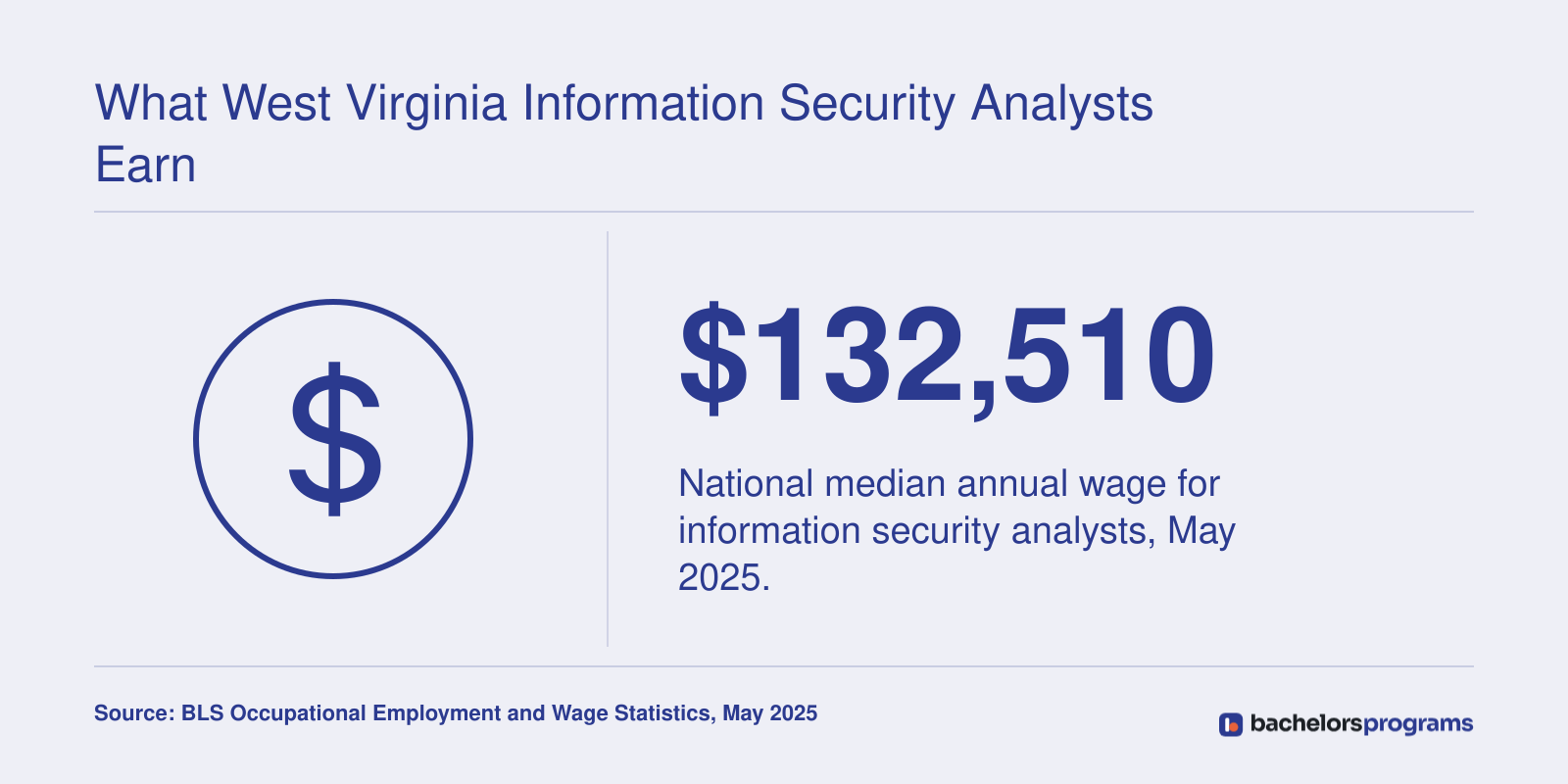
Nationally, information security analysts earned a median annual wage of $132,510 in May 2025, with the 10th percentile at $78,190, the 90th percentile at $211,450, and total employment of 190,650. For pay closer to home, use the BLS Occupational Employment and Wage Statistics query tool for Information Security Analysts (SOC 15-1212) in West Virginia statewide and in metro areas such as Charleston, Huntington, and Morgantown, then compare the results with WorkForce WV labor market data. Confirm realistic ranges with career services at schools such as West Virginia University and Marshall University, salary surveys from ISC2, ISACA, and CompTIA, and conversations with West Virginia security professionals.
Choosing the Right West Virginia Cybersecurity School for You
Prestige is the easiest thing to shop for and the least useful. The better question is which trade-off you can live with: a bigger name and higher net price, or a lower bill and a thinner alumni network; a fully online format that fits your shift schedule, or a campus lab where you actually touch the equipment.
Match the School to Your Situation
- Traditional full-time student: West Virginia University in Morgantown and Marshall University in Huntington carry the strongest name recognition and the deepest employer pipelines in the state, and that is exactly what you pay more for. Marshall's program runs through cyber forensics and security, so read the course sequence before assuming it matches a pure network-defense track.
- Working adult: American Public University System, based in Charles Town, delivers its cybersecurity bachelor's fully online, and University of Charleston runs a bachelor's degree completion program for students who already hold technical credits. You trade campus career fairs and hands-on lab time for schedule control.
- Community college transfer: Fairmont State University, Bluefield State University, and Shepherd University are the practical landing spots, but transfer credit is where money disappears. Ask for a written evaluation before you enroll, not after.
- Budget-focused student: West Liberty University, Bluefield State, and Davis & Elkins College sit at the value end of the list. Compare net price after aid, not sticker tuition, because the gap between those two numbers is often wider than the gap between schools.
Verify Three Things Before You Apply
Confirm the institutional accreditation and whether any programmatic or federal designation the school advertises is current. Check the total credits required to graduate and the cap on how many transfer credits count. Then look for named employer partners or a required internship, since that is the clearest signal of how the program connects to actual hiring.
Email the admissions office for a transfer credit evaluation the same week you file the FAFSA. Both take weeks, and neither costs you anything to start.
West Virginia Cybersecurity Degree Questions, Answered
These answers pull together the main points from the rest of this page. Costs and wages are estimates, so confirm current figures with each school before you apply.
Which school is the best choice for a cybersecurity degree in West Virginia?
Does West Virginia University offer a cybersecurity bachelor's degree?
Can I earn a cybersecurity bachelor's from a West Virginia school without moving to campus?
What does a four-year cybersecurity degree cost at a West Virginia public university?
How much do information security analysts make in West Virginia?
Do you need a license to work in cybersecurity in West Virginia?
Compare Cybersecurity programs on the data that matters
Explore more Computers & IT majors or browse every field of study.
All Computers & IT programs Browse every field of study