Best Food Industry Management Degree Programs
Compare 40+ accredited Food Industry Management programs, with net price after aid, graduation rates, earnings and debt from IPEDS and the U.S. College Scorecard.

Food companies want managers who can read a profit-and-loss statement and a cold-chain schedule in the same meeting. Grocery chains, distributors, consumer packaged goods sales teams and manufacturers all recruit graduates who pair business training with working knowledge of how food moves from processor to shelf.
Cost varies widely. Among the schools ranked here, average annual net price after grants runs from $4,831 at the University of Texas Rio Grande Valley to $28,690 at Cornell University.
The major also sits in different departments, from applied economics to nutrition, and where it sits shapes both the coursework and which employers recruit from it.
Key Points
- Cornell graduates earn a median $98,785 five years after finishing.
- BYU-Idaho lists published tuition of just $4,800, the lowest sticker price highlighted.
- Plan to study in person: every ranked program is campus-based.
Top 10 Food Industry Management Bachelor's Programs for 2027
The programs below have three things in common: coursework that treats food as a business rather than a science project, a required internship or field experience, and enough business foundation to move into retail, manufacturing or foodservice management. What separates them is where the degree sits on campus, whether a business school, an agriculture college or a nutrition department, because that placement shapes which electives and industry networks students can reach. Several are campus-only, so readers who need online delivery should check the format label on each card.
University of Georgia
#1Athens, GA · ~$14,000/yr (est.)
Best for: Hands-on learners drawn to hotel operations
The University of Georgia runs an applied, industry-heavy hospitality and food management major inside a large public research university in Athens. Its advantage is infrastructure: a university-owned hotel and conference center used as a working laboratory, plus placements with campus dining, the golf course and the botanical garden. The school graduates 90% of students, and 400 to 600 hours of industry experience fit inside a four-year plan.
- 400 to 600 hours of industry experience built into the degree
- University-owned hotel and conference center serves as a learning lab
- Placements with campus dining, the golf course and botanical garden
- Certificates in entrepreneurship and sustainability available
- More than 100 minors and an approved pre-law major
- Double Dawgs pathway to a Master of Agribusiness
- Study abroad options include the Mediterranean and Cuba
Cornell University
#2Ithaca, NY · $29,000/yr (est. net price)
Best for: Business-minded students seeking Ivy prestige
Cornell pairs a Bachelor of Science in applied economics and management with a food industry management concentration, so students learn the business of food inside a full agriculture-and-business university. The Dyson School setting opens finance, marketing and supply chain coursework that a stand-alone food major rarely reaches. The school graduates 95% of students, and admission is campus-based in Ithaca with no spring transfers.
- Food industry management is 1 of 11 AEM concentrations
- 120 credit hours for the Bachelor of Science
- Dyson School is AACSB accredited
- Combine with a minor or double major
- CALS Honors Research Program available
- Semester or year abroad available
- No spring transfer admission
Ohio State University
#3Columbus, OH · $17,000/yr (est. net price)
Best for: Aspiring food manufacturing operations managers
Ohio State's food business management degree sits in the College of Food, Agricultural and Environmental Sciences and can be finished on a general track or with a culinary science specialization. A required industry internship, placed with help from a dedicated industry coordinator, is built into the curriculum rather than left to chance. The school graduates 88% of students.
- Choose a general track or a culinary science specialization
- Required food industry internship, with an industry coordinator placing students
- Internship can earn academic credit
- Over $274,000 in scholarships awarded annually
- 2026 average starting salary reported at $60,000
- Food Science and Technology Club for industry networking
San Jose State University
#4San Jose, CA · ~$14,000/yr (est.)
San Jose State offers a food management concentration inside its nutritional science major, which means science prerequisites in chemistry and physiology alongside accounting, human resources and labor relations. The sequence is unusually structured, with a 200-hour foodservice internship, a 90-hour senior field experience and a four-year plan students map out with an advisor early. The school graduates 69% of students.
- 200-hour foodservice internship required
- Senior field experience totals 90 hours
- 120 credit hours with a 2.5 GPA minimum
- Business courses in HR, accounting and labor relations
- Coursework covers culinary skills, catering and food science
- Structured four-year plan; meet an advisor early on sequencing
California State Polytechnic University-Pomona
#5Pomona, CA · $10,000 – $15,000/yr (est.)
Cal Poly Pomona's agribusiness and food industry management degree covers the whole chain from field to plate, with agribusiness accounting, food law and regulations, and retailing coursework. The Huntley College approach is practical rather than theoretical, and an active Agribusiness Management Club plus intercollegiate case competitions give students concrete work to point to. The school graduates 68% of students.
- Covers agribusiness accounting, marketing and retailing
- Food laws and regulations coursework included
- Active Agribusiness Management Club on campus
- Intercollegiate case study competitions
- Alumna works as a global produce planner at John Deere
- Scholarships available through the Huntley College
Virginia Polytechnic Institute and State University
#6Blacksburg, VA · $25,000/yr (est. net price)
Virginia Tech houses its food business option inside food science and technology, so students take chemistry, microbiology and processing courses alongside accounting, finance and supply chain management. A required Bridge Experience adds experiential learning, and electives in fermentation, brewing and wine draw students aiming at product-side careers. The school graduates 86% of students.
- 120 credit hours with a 2.0 GPA minimum
- Bridge Experience adds a required experiential learning component
- Electives in fermentation, brewing and wine
- Two foreign language courses required
- Undergraduate research and independent study available
- Study abroad opportunities
Michigan State University
#7East Lansing, MI · $16,000 – $44,000/yr (est.)
Michigan State treats food industry management as a stand-alone Bachelor of Science rather than a concentration buried inside another major. The 120-credit curriculum pairs core business disciplines with food-industry coursework, and faculty ties to food companies and trade associations bring current practice into the classroom. The school graduates 81% of students.
- 120 credit hours for the Bachelor of Science
- Faculty maintain ties with food companies and trade associations
- Prepares for wholesale, distribution and retail management
- Study abroad may satisfy a program requirement
- Scholarships available through the college
- Independent study option
The University of Tennessee-Knoxville
#8Knoxville, TN · ~$19,000/yr (est.)
At Tennessee, food industry management is a concentration within the food and agricultural business major in the Herbert College of Agriculture. Students take dedicated food marketing and food policy courses plus a required food laws and regulations class, and the uTrack system keeps full-time students on pace toward completion. The school graduates 74% of students.
- Dedicated courses in food industry management and food marketing
- Required food laws and regulations course
- Food policy coursework part of the concentration
- Experiential learning and a senior seminar required
- uTrack keeps full-time students on pace for graduation
Appalachian State University
#9Boone, NC · $8,000 – $25,000/yr (est.)
Appalachian State approaches the field from the nutrition side, offering a foodsystems management concentration inside nutrition and foods. Students mix culinary design, food safety and service standards with the managerial side of the business, then add a required minor in an area such as public health or sustainable development. The school graduates 75% of students.
- 200-hour internship in a foodservice setting
- Required minor, such as public health or sustainable development
- Coursework in culinary design, food safety and service standards
- Student Dietetic Association on campus
- Prepares for foodservice manager and product development roles
The University of Texas Rio Grande Valley
#10Edinburg, TX · under $5,000/yr (est.)
UTRGV's nutritional sciences degree includes a food technology and management concentration that leans toward production, quality control and distribution rather than hospitality. The university's Tuition Advantage program covers tuition for eligible students from households earning under $125,000, which makes the degree reachable for students who work. The school graduates 51% of students.
- Food technology and management is 1 of 3 concentrations
- Tuition Advantage covers tuition for household incomes under $125,000
- Prepares students for food buyer and quality control roles
- Foundation for graduate study in food or nutrition
- Hands-on, evidence-based nutrition research
Cost & outcomes by school
Federal data for the highest-earning Food Industry Management programs, independent of the ranking above. Earnings are this field's bachelor's graduates four years after completing where the Scorecard reports them, else the school's undergraduate median.
| School | Net price / yr | Grad rate | Earnings | Debt | Grads/yr | Format |
|---|---|---|---|---|---|---|
| Cornell University NY | $28,690 | 95% | $112,289 | $13,086 | 221 | Campus |
| Drexel University PA | $38,509 | 78% | $84,648 | $25,325 | 4 | Campus |
| San Jose State University CA | $13,760 | 69% | $78,988 | $15,000 | 3 | Campus |
| Virginia Polytechnic Institute and State University VA | $24,953 | 86% | $72,817 | $24,500 | 46 | Campus |
| Clemson University SC | $22,253 | 87% | $71,513 | $21,500 | — | Campus |
| Michigan State University MI | $19,680 | 81% | $69,651 | $21,815 | 104 | Campus |
| University of Georgia GA | $13,936 | 90% | $68,726 | $18,500 | 30 | Campus |
| Texas Christian University TX | $36,660 | 86% | $68,424 | $21,500 | — | Campus |
| Arizona State University AZ | $14,967 | 68% | $64,315 | $15,000 | 38 | Hybrid |
| Benedictine University IL | $22,313 | 50% | $63,446 | $22,500 | — | Campus |
| Arizona State University AZ | — | — | $62,668 | $19,500 | — | Hybrid |
| Colorado State University-Fort Collins CO | $21,279 | 67% | $62,556 | $18,500 | 37 | Campus |
Sources: U.S. Department of Education. Net price, graduation rate, earnings and debt: College Scorecard (earnings and debt for this field's bachelor's graduates where reported, else school-wide); graduates: IPEDS. A dash means no figure is reported.
Cost, debt & payoff
Median earnings of this field's bachelor's graduates (4 yrs after completing, else the school's undergraduate median) vs. their median federal loan debt · U.S. College Scorecard
Across these programs the median graduate earns about $55,790 and finishes with roughly $21,880 in debt — a ratio that clears a common rule of thumb (keep debt below first-year salary). Net price and debt vary widely school to school, so check the per-school figures in the table above before you shortlist.
How We Ranked These Food Industry Management Programs
A ranking built on reputation tells you what a school is known for. A ranking built on outcomes tells you what students actually get from it. We leaned toward the second, because cost and results matter most when you are the one paying.
What We Looked At
- Net price: The average cost after grants and scholarships, not the published sticker price.
- Graduation rate: The share of students who finish at the institution.
- Earnings and debt: Program-level figures for graduates, where available.
- Delivery format: Whether the degree is offered on campus, online, or in a hybrid format.
- Completion data: How many students finish the program itself, which shows whether it is an established pathway.
Outcomes and cost mattered most. We did not assign numeric weights to any factor.
Where the Data Comes From
The figures come from the U.S. Department of Education's College Scorecard and the Integrated Postsecondary Education Data System (IPEDS). We used the most recent snapshot available, which means some numbers trail current-year tuition and pay.
Limits Worth Knowing
The data has gaps that should change how you read the results.
- Graduation rates describe the whole school, not the food industry management major alone.
- Net price is an institution-wide average, not a fixed price. What you pay depends heavily on family income and aid eligibility.
- Some small programs have no published earnings or debt figures, so they are judged on the information that does exist.
Use the rankings to build a shortlist, then confirm current costs and outcomes directly with each school.
Food Industry Management Degree Cost and Tuition: The Most Affordable Options
Published tuition is the sticker price, while net price is what the average student actually pays for a year of attendance (tuition, housing, books and other costs) after grants and scholarships. That is why BYU-Idaho's $4,800 tuition sits beside an $8,221 net price, and why UTRGV's $4,831 net price falls well below its $9,987 in-state tuition, helped by a program the school says covers tuition for families earning under $125,000. At the two public universities, in-state students pay roughly half the out-of-state rate, so residency can matter as much as school choice. Debt stays modest across these schools: at City Tech, the median program debt of $10,828 works out to about $115 a month on a standard 10-year repayment plan, according to IPEDS and College Scorecard data.
| School | Location | In-State Tuition and Fees | Out-of-State Tuition and Fees | Average Net Price | Median Program Debt | Median Monthly Payment (10-Year) | Median Debt, All Graduates |
|---|---|---|---|---|---|---|---|
| The University of Texas Rio Grande Valley | Edinburg, TX | $9,987 | $19,827 | $4,831 | N/A | N/A | $12,950 |
| CUNY New York City College of Technology | Brooklyn, NY | $7,332 | $15,282 | $5,127 | $10,828 | $115 | $10,533 |
| Brigham Young University-Idaho | Rexburg, ID | $4,800 | $4,800 | $8,221 | N/A | N/A | $13,969 |
Related Articles
Online vs. Campus Food Industry Management Degrees
Can you earn a food industry management bachelor's degree online, or do the strongest programs require you to be on campus? For the schools ranked here, the answer is campus. Every program on this list is delivered in person, at schools in 21 states, from Georgia, New York and Ohio to California, Michigan and Texas. Online options exist elsewhere, and they suit a different kind of student.
Credits and Transfer Paths
Most food industry management bachelor's degrees run about 120 credit hours. Cornell, Michigan State, Virginia Tech, and San Jose State list that total, as does Arizona State's online BA in Business with a Food Industry Management focus. Structures vary, though. Johnson & Wales University's online BS in Baking & Pastry Arts and Food Service Management is a 90 to 91 credit program built for about three years, and holders of a Baking & Pastry Arts associate degree may finish in as few as two.2 Colorado Technical University's online management degree with a Food Service Management concentration totals 180 credits.3
Transfer rules shape how fast working adults finish. Western Michigan University sets no transfer-credit cap for its Food Marketing BBA, but students from two-year schools must complete at least 60 hours at a four-year institution, and 30 hours must come through WMU, including 10 of the final 30.1 Arizona State asks transfer students for a 3.00 cumulative GPA. JWU reviews transfer credit case by case, usually within 48 hours.2
Who Each Format Fits
Online study makes sense if you already work in grocery, foodservice, or distribution and want the credential for a promotion without leaving your job. Campus programs reward students who want structured industry exposure. Ohio State requires a food industry internship, with a coordinator who helps place students. Georgia builds in 400 to 600 hours of industry experience, and San Jose State includes a 200-hour foodservice internship. Plant tours and recruiter access also come more easily in person.
Questions to Ask Before Enrolling Online
- Proctoring: Find out whether exams require a testing center or remote monitoring.
- Internships: Ask whether a field placement is required and how it gets arranged where you live.
- Diploma: Confirm the degree name and diploma match what campus graduates receive.
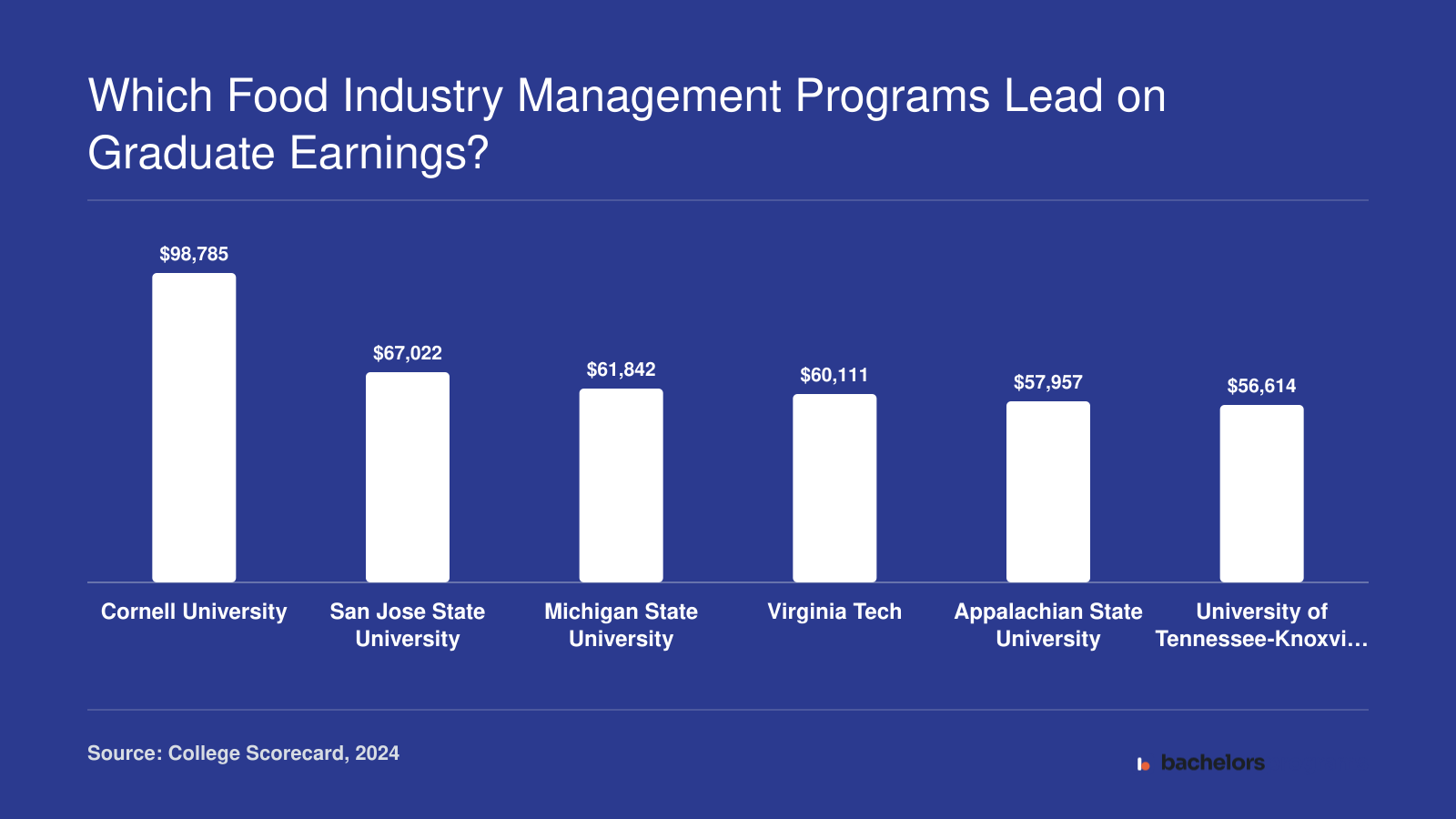
Which Food Industry Management Programs Lead on Graduate Earnings?
Cornell University leads on graduate pay: its food industry management completers earn a median of $98,785 five years after finishing, followed by San Jose State University at $67,022. Each figure in the chart is the program's own median at the five-year mark, not a campus-wide average. On return on investment, typical debt is modest next to pay. Cornell graduates borrow a median of $13,086, and median debt at Michigan State, Virginia Tech, Appalachian State and Tennessee falls between $21,500 and $24,500, well under one year of earnings.
Accreditation and What to Look for in a Food Industry Management Program
Two kinds of accreditation matter here, and they answer different questions: institutional accreditation asks whether the university itself is legitimate enough for federal aid and credit transfer, while business-school accreditation asks whether the business unit running your major has met an outside standard. Neither is a ranking, but together they do most of the vetting work in a field with no specialized accreditor of its own.
Institutional Accreditation Is the Baseline
Any program worth your application fee sits inside an institutionally accredited university. That status is what makes federal student aid possible and what lets credits move if you transfer or later pursue a master's. Arizona State University, for instance, is accredited by the Higher Learning Commission. Verify it yourself instead of trusting a marketing page: the U.S. Department of Education's DAPIP database and the CHEA directory both let you search an institution by name and confirm who accredits it.
Business Accreditation and Industry Signals
AACSB and ACBSP are the two business accreditors you will see cited, and they accredit the business school or unit, not an individual bachelor's major. ASU's W. P. Carey School of Business holds AACSB accreditation, and Niagara University's Holzschuh College of Business Administration, which houses the BS in Food Industry Management that launched in fall 2025, is likewise AACSB-accredited. AACSB's directory returns well over a thousand accredited business results, but that count spans the whole directory rather than one country or degree level, so search the specific school and campus rather than assuming.
Because no dedicated programmatic accreditor exists for food industry management, judge the program itself next.
A Short Checklist
- Accreditation: institutional status in DAPIP plus the business unit's listing in the AACSB or ACBSP directory.
- Internship requirement: a for-credit placement built into the degree signals real industry ties.
- Advisory board and partnerships: named employers or a working industry council that reviews the curriculum.
- Outcomes: recent graduate earnings and placement information, wherever the program publishes it.
Finally, confirm in the 2026 catalog that the major still exists under that exact title, since business schools sometimes rename or retire concentrations.
Internships, Co-Ops, and Industry Partnerships
A food industry management degree pays off most when classroom work is paired with paid experience at grocers, manufacturers, and distributors. The strongest programs build that experience into the curriculum rather than leaving it to chance.
What Leading Programs Offer
Saint Joseph's University runs a competitive co-op for Food Marketing majors. It includes two full-time paid placements that add up to roughly a year of work experience. Approved internships can also earn up to 3 general-elective credits, though students need good standing and a 3.0 GPA.1 Employers tied to its experiential learning include Wegmans, Weis Markets, Giant Foods, BJ's Wholesale Club, The Hershey Company, Colgate-Palmolive, and KIND Snacks.1
Western Michigan University states that every Food Marketing graduate completes at least one internship, and approved internships can earn credit.2 Its industry connections include Meijer, PepsiCo, Kraft Heinz, Kellanova, Hormel Foods, and SpartanNash.2 Those names show where the program has relationships, not necessarily formal internship providers or scholarship sponsors.
Industry-Funded Scholarships
Saint Joseph's Food Marketing Foundation awards three two-year scholarships to rising juniors.3 Applicants need a 2.5 GPA, an essay, employer and advisor recommendations, and a transcript. The 2026 deadline was April 6.3 Western Michigan says Food Marketing students can tap a scholarship pool of more than $100,000 a year4, and in 2026 three students received awards from a Grand Rapids food-industry sales professionals group.5
Questions to Ask Admissions
- What share of students complete a paid internship or co-op before graduating?
- Which employers recruited on campus this year?
- Are placements required, or competitive and optional?
- Which scholarships come from industry sponsors, and who is eligible?
Median Pay for Food Service Managers
A food industry management degree prepares graduates for supervisory roles across restaurants, institutional dining and food operations, and food service management is one of the clearest benchmarks for entry into that field.
Food Industry Management vs. Agribusiness, Hospitality, and Supply Chain Degrees
Food industry management centers on the retail-to-consumer end of the food chain: manufacturing, marketing, and distribution beyond the farm. Agribusiness centers on farm and commodity economics, hospitality on restaurants and lodging, and supply chain on logistics that cut across industries. Food science is a different animal: a STEM degree built around product development and food safety rather than business, though some programs pair it with a business concentration.
| Factor | Food Industry Management | Agribusiness | Hospitality Management | Supply Chain Management |
|---|---|---|---|---|
| Core coursework focus | Full business core plus about 21 credit hours of food-industry courses, including food retailing, advertising, finance, and organizational leadership | Accounting, marketing, retailing, wholesaling, personnel management, and food laws and regulations | Operations, strategic management, food-service and beverage operations, finance, and human resources | Supply-chain operations, retail strategy, consumer insights, and category management |
| Typical industries hired into | Food manufacturing, marketing, and distribution, including retail stores, restaurants, schools, and hospitals | Agricultural and food-product businesses in fruits, vegetables, meat, dairy, and processed foods | Food-service operations and food-related businesses, from front-of-house to leadership | Food-industry supply chains, retail, sales, and consumer-goods operations |
| Math and science intensity | Moderate: business math, finance, and accounting, with little lab science | Moderate: economics, accounting, and market analysis tied to agricultural products | Moderate to light: accounting and finance alongside service-focused coursework | Moderate: operations and analytical coursework within a business framework |
| Common job titles | Brand manager, marketing specialist, account executive, retail store manager, wholesale and retail buyer, data analyst | Roles supporting farmers and ranchers, analyzing crop markets, and managing or marketing food products | Restaurant manager | Distribution and logistics manager |
| Best fit for | Students who want a business career in food retail, branding, buying, or distribution | Students drawn to farm economics, crop markets, and agricultural trade relationships | Students who want to run restaurants or other service operations | Students who want logistics skills that transfer beyond food |
| How food science differs | Business-driven, focused on selling and distributing food products | Business-driven, focused on agricultural economics | Business-driven, focused on service operations | Business-driven, focused on moving goods |
Food Industry Management programs by state
Compare Food Industry Management programs on the data that matters
Explore more Business & Management majors or browse every field of study.
All Business & Management programs Browse every field of study